HONOR

Search documents
Omdia: Apple and HONOR Claim Record Market Shares as Europe's Smartphone Shipment Dips 1% in 2025
Businesswire· 2026-02-23 11:48
Core Insights - The European smartphone market experienced a 1% decline in 2025, totaling 134.2 million units, attributed to subdued demand and new eco-design regulations [1] - Samsung maintained its position as the largest smartphone vendor in Europe, with shipments slightly increasing to 46.6 million units [1] - A slow first half of 2025 was noted due to the absence of the Galaxy A0x series, but Samsung rebounded in the second half of the year [1]



Omdia数据快闪:2025年第四季度,全球智能手机重点市场厂商排名
Canalys· 2026-02-12 01:03
Core Insights - The global smartphone market experienced a year-on-year growth of 4% in Q4 2025, driven by seasonal demand recovery and improved inventory management, despite some manufacturers facing rising component costs [2] - Apple led the global smartphone market with a 25% market share, attributed to strong demand for the iPhone 17 series, achieving record quarterly shipments and maintaining its position as the largest smartphone manufacturer for three consecutive years, slightly ahead of Samsung [2] - Samsung ranked second with an 18% market share, boosted by strong sales of models priced below $300, particularly the Galaxy A17 4G and 5G series [2] - Xiaomi maintained its position as the third-largest manufacturer, although its market share declined to 11% due to shipment challenges in key markets [2] - Vivo achieved an 8% market share, benefiting from its leading position in the Indian market, while OPPO returned to growth, re-entering the global top five [2] Regional Summaries Global Key Regions - In Q4 2025, Apple held a 25% market share globally with a 9% annual growth, while Samsung had an 18% share with a 16% growth. Xiaomi's share fell to 11% with an 11% decline, Vivo and OPPO both held 8% shares with growth rates of 4% and 9% respectively [2] Europe - In Europe, Apple captured a 30% market share with a 6% growth, while Samsung followed closely with 28% and a 10% growth. Xiaomi's share was 17%, down by 3%, and Lenovo achieved a 6% share with a 13% growth [3] APAC (Excluding Greater China) - In the APAC region, Samsung led with a 19% market share and an 18% growth, followed by Apple at 18% with a 4% growth. Vivo and OPPO held 15% and 11% shares with growth rates of 11% and 6% respectively, while Xiaomi's share dropped to 10% with a 23% decline [3] Mainland China - In Mainland China, Apple ranked first with a 22% market share and a significant 26% growth. Vivo and OPPO followed with 16% and 15% shares, experiencing declines of 8% and growth of 9% respectively [7] India - In India, Vivo led with a 25% market share and a 16% growth, followed by OPPO at 16% with a 4% growth. Samsung's share was 14%, down by 11%, while Xiaomi's share fell to 12% with a 26% decline [7] United States - In the United States, Apple dominated with a 69% market share and an 8% growth, while Samsung held 14% with a 3% decline. Lenovo captured 9% with a 13% growth [9] Brazil - In Brazil, Samsung led with a 39% market share, experiencing a slight decline of 1%. Lenovo and Xiaomi both held 23% and 15% shares with 12% growth, while Apple had an 11% share with a 10% growth [10]


Counterpoint:成本上升影响终端需求 预计2026年全球智能手机出货量下跌2.1%
Zhi Tong Cai Jing· 2025-12-19 01:32
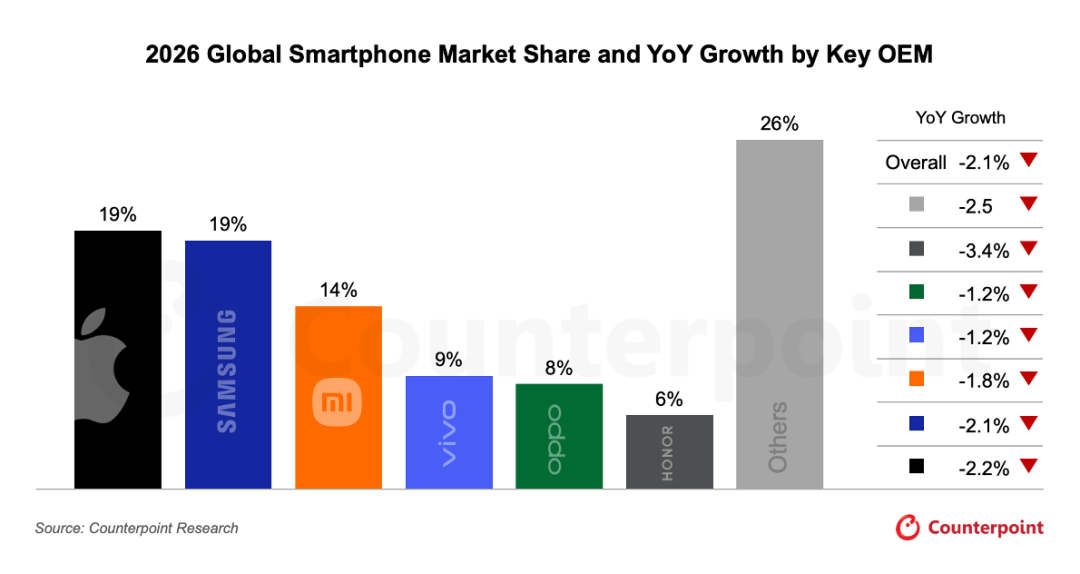
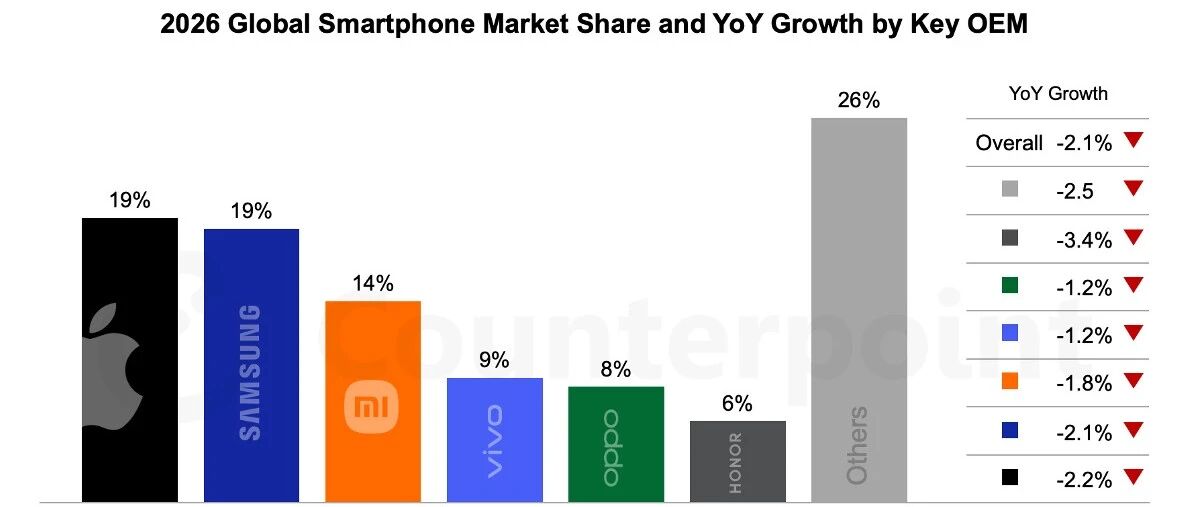
Core Insights - Counterpoint Research predicts a potential 2.1% decline in global smartphone shipments in 2026 due to rising component costs impacting end demand [1][4] - The forecast for 2026 has been revised down by 2.6 percentage points, with significant adjustments for Chinese OEMs like HONOR, OPPO, and vivo [4] Group 1: Market Trends - The low-end market (below $200) is expected to be significantly affected, with Bill of Materials (BoM) costs rising by 20%-30% since the beginning of the year [7] - Mid to high-end market segments are experiencing a cost increase of approximately 10%-15% [7] - Average smartphone selling prices are projected to increase by 6.9% in 2026, up from a previous forecast of 3.9% [7] Group 2: Competitive Landscape - Brands with scale advantages, comprehensive product lines (especially in high-end models), and vertical integration capabilities are expected to be more resilient to supply chain changes [8] - Market competition is anticipated to become more differentiated, with some brands facing challenges in balancing market share and profitability [8] - OEMs are adopting diverse strategies, including adjusting specifications of certain models and guiding consumers towards higher-spec versions to cope with cost and market changes [8]
存储成本走高,2026 年智能手机出货预期下滑
Counterpoint Research· 2025-12-19 01:10
Core Insights - The global smartphone shipment volume is expected to decline by 2.1% in 2026 due to rising storage costs, marking a downward revision of 2.6 percentage points from previous forecasts [4][5][7]. Group 1: Market Trends - The increase in component costs is anticipated to impact end-user demand, particularly affecting Chinese OEMs like HONOR, OPPO, and vivo, which have seen significant adjustments in their forecasts [5][7]. - The average selling price of smartphones is projected to increase by 6.9% in 2026, up from a previous estimate of 3.6%, driven by rising Bill of Materials (BoM) costs [7][10]. Group 2: Cost Implications - DRAM prices have risen, leading to an increase in BoM costs by approximately 25% for low-end models, 15% for mid-range, and 10% for high-end models, with further increases expected in the second quarter of 2026 [7][9]. - The cost of storage is projected to rise by about 40% before the second quarter of 2026, further exacerbating BoM costs [9]. Group 3: Strategic Responses - OEMs are likely to adjust their product strategies in response to cost pressures, with some low-SKU models already experiencing reduced shipments [10]. - Companies are adopting various strategies, including adjusting specifications of camera modules, displays, and storage configurations, as well as streamlining product lines to cope with market changes [10].
Omdia: Latin America Smartphone Shipments Grow 1% in 3Q25, Reaching Highest Quarterly Levels Since 2015
Businesswire· 2025-12-02 12:02
Core Insights - Latin America's smartphone market experienced a 1% year-over-year growth in 3Q25, with shipments reaching 35.2 million units, the highest since 4Q15 [1][3][9] Market Performance - Samsung led the market with 11.6 million units shipped, capturing a 33% market share, primarily due to its low-end A-series models, which constituted 68% of its shipments [1][3] - Xiaomi followed with 6.3 million units (18% share), while Motorola saw an 11% decline in shipments, marking its sixth consecutive quarter of decline [1][3] - HONOR achieved record shipments for the third consecutive quarter with 2.9 million units, driven by growth in the Caribbean, Colombia, and Ecuador [1][3] - TRANSSION rounded out the top five despite a 19% year-over-year decline [1][3] Regional Insights - Brazil, the largest market, accounted for 29% of shipments with 10.3 million units, reflecting a 5% year-over-year increase [3][4] - Mexico, the second-largest market, saw a decline of 11% with 7.4 million units shipped, marking its fourth consecutive quarter of contraction [3][4] Segment Analysis - The sub-$300 segment, which represents 71% of total shipments, experienced a 2% decline year-to-date through 3Q25 due to inventory pressures and reduced consumer demand [5][6] - Conversely, shipments of high-end and premium devices priced above $500 increased by 20% year-to-date, contributing to an 8% rise in average selling prices (ASP) in 3Q25 [6][7] Future Outlook - Omdia projects the Latin American smartphone market to remain flat by the end of 2025, with total shipments expected to reach 137.0 million units [9] - Challenges for 2026 include rising memory and storage costs, which may increase device prices, particularly in entry-level segments [9]


China Hi-Tech Fair 2025 Opens in Shenzhen: Empowering Global Innovation Through Technology and Collaboration
Globenewswire· 2025-11-17 19:00
Core Insights - The 27th China Hi-Tech Fair (CHTF) opened on November 14, 2025, focusing on empowering industries through technology and fostering future collaboration [1] - The event features over 5,000 enterprises and international organizations, showcasing cutting-edge products and innovations from more than 100 countries [3] Industry Overview - CHTF serves as a significant platform for global innovation exchange and technology commercialization, highlighting China's commitment to high-level opening-up in high-tech sectors [4] - The exhibition spans 400,000 square meters and includes 22 specialized zones covering areas such as artificial intelligence, semiconductors, and commercial aerospace [6][7] Regional and International Collaboration - The Fair promotes regional cooperation and resource integration, with participation from over 30 regional delegations across the Greater Bay Area [10] - A "Belt and Road International Cooperation Zone" and an "International Friendship City Technology Zone" are featured, attracting innovators from various global regions [18] Innovation Highlights - The Ascend AI Ecosystem Pavilion showcases significant advancements in AI computing, including Huawei's 384 Super Node and China's open-source CANN architecture [9] - Notable exhibitors include Zhejiang Strong Brain Technology, presenting non-invasive brain-computer interface technology, and Hangzhou Gaoxi Technology, showcasing innovations in graphene oxide [12] Economic Impact - Over 40 state-owned enterprises and more than 30 top universities and research institutes are participating, demonstrating breakthroughs in national projects and cutting-edge research [14][15] - The event is expected to attract over 30,000 professional buyers and 1,000 procurement delegations, facilitating direct cooperation between global buyers and Chinese suppliers [19][20] Legacy and Future Outlook - CHTF has evolved into a key stage for innovation, contributing to the journey of Chinese technology from follower to global leader [24][25] - The Fair will host over 200 events, including product launches and investment forums, with a significant number of new products making their debut [22][23]


2025年Q3国内智能机销量同比下滑3%,vivo跃居第一,竞争格局激烈
CINNO Research· 2025-11-13 23:32
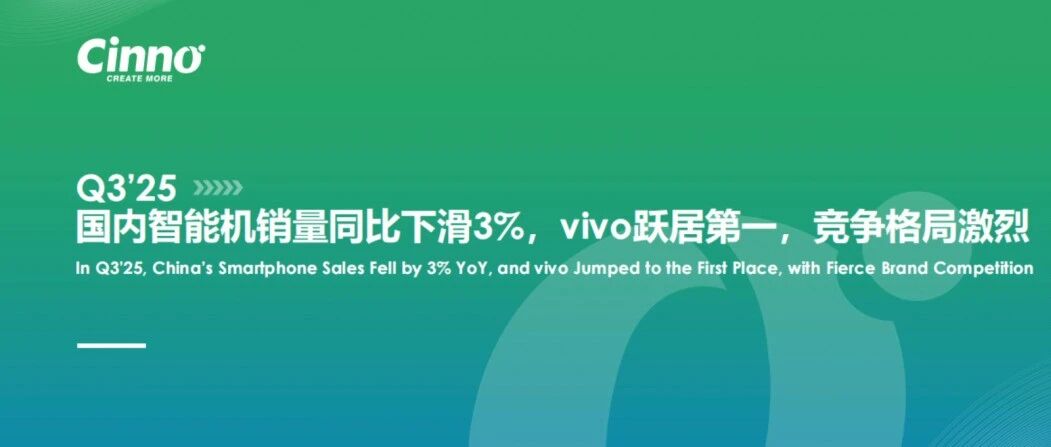
Core Insights - The domestic smartphone market in China experienced a 3% year-on-year decline in sales in Q3 2025, with vivo emerging as the leading brand amidst intense competition [3]. Group 1: Sales Trends - From Q1 2023 to Q3 2025, the overall sales volume of smartphones in the Chinese market showed a downward trend, indicating a challenging environment for manufacturers [3]. - The analysis includes detailed year-on-year comparisons of smartphone sales, highlighting the competitive dynamics among various brands [3]. Group 2: Brand Performance - vivo has taken the lead in the Chinese smartphone market, surpassing other brands in terms of sales volume during Q3 2025 [3]. - The report provides insights into the sales trends of other major brands, including OPPO, Xiaomi, Huawei, HONOR, and Apple, showcasing their performance relative to vivo [3]. Group 3: Price Segment Trends - The report analyzes the price segment trends of smartphones in the Chinese market from Q1 2023 to Q3 2025, indicating shifts in consumer preferences and pricing strategies among brands [3]. - Specific trends in the pricing of vivo smartphones are highlighted, reflecting the brand's strategy in a competitive landscape [3].
HONOR Teases A Robot Phone Concept That Has A Pop-Up Camera and Gimbal 📲🤖
CNET· 2025-10-15 16:05
Product Innovation - Honor 公司发布了一款名为 "Robot Phone" 的概念预告片,该概念集成了 "AI 智能、机器人功能和手持成像"[1] - 预计将在 2026 年 3 月的世界移动通信大会上公布更多关于这款 "Robot Phone" 的细节[1] Technology Trends - 行业关注点在于 "Robot Phone" 概念中 AI 智能和机器人功能的集成[1] - 该技术可能代表了智能手机领域的一种新趋势,将机器人技术与传统手持设备相结合[1]

Unboxing HONOR’s Special Edition Prof.JimmyChoo Magic V Flip2
CNET· 2025-08-21 13:38
Product Information - A new foldable smartphone from Honor is being unboxed [1] - The phone will only be available in China [1] Market Availability - The product's availability is limited to the Chinese market [1]

Canalys:第二季度全球智能手机出货量小幅下降至2.889亿部
Zhi Tong Cai Jing· 2025-08-11 08:21
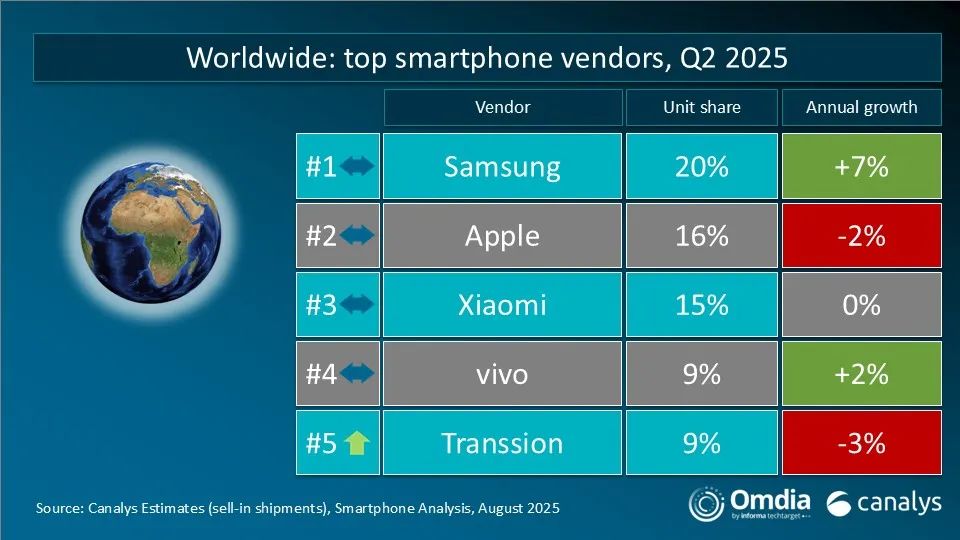
Core Insights - Global smartphone shipments are projected to slightly decline to 288.9 million units in Q2 2025 due to moderate consumer demand, leading to suppressed market growth [1] - Samsung retains the top position in global shipments with 57.5 million units, a 7% year-on-year increase, primarily driven by the Galaxy A series targeting the mass market [1] - Apple ranks second with 44.8 million iPhone units shipped, experiencing a 2% decline, facing challenges from intense competition in China and inventory adjustments in the U.S. market [1] - Xiaomi holds the third position with 42.4 million units shipped, showing strong performance in Latin America and Africa [1] - Vivo ranks fourth with 26.4 million units, a 2% increase, particularly strong in the Indian market [1] - Transsion is fifth with 24.6 million units shipped, reflecting a 3% decline [1] Global Market Overview - In the worldwide smartphone vendor rankings for Q2 2025, Samsung leads with a 20% market share and a 7% annual growth, followed by Apple at 16% with a 2% decline, and Xiaomi at 15% with no growth [1] - Vivo and Transsion hold 9% market shares each, with Vivo growing by 2% and Transsion declining by 3% [1] Regional Insights Latin America - Samsung leads with a 32% market share and an 8% growth, followed by Xiaomi at 20% with an 8% growth [3] - Lenovo holds 15% with a 10% decline, while Honor shows significant growth at 8% with a 70% increase [3] Europe - Samsung has a 31% market share but a 10% decline, while Xiaomi grows by 11% to 23% [3] - Apple holds 21% with a 4% decline, and Lenovo and realme have 5% and 4% shares respectively [3] Mainland China - Huawei leads with an 18% market share and a 15% growth, followed closely by Vivo at 17% with a 10% decline [5] - OPPO and Xiaomi both have 16% and 15% shares respectively, with Xiaomi growing by 3% [5] India - Vivo dominates with a 21% market share and a 31% growth, followed by Samsung at 16% with a 2% growth [6] - OPPO and Xiaomi both hold 13% shares, with OPPO growing by 24% and Xiaomi declining by 25% [6] United States - Apple leads with a 49% market share but a 10% decline, while Samsung follows with 31% and a significant 38% growth [7] - Lenovo and Google hold 12% and 3% shares respectively, with Google growing by 11% [7] Brazil - Samsung leads with a 40% market share but a 3% decline, followed by Lenovo at 24% with an 8% decline [8] - Xiaomi holds 17% with no growth, while Apple has 5% with a 9% decline [8] Mexico - Samsung leads with a 23% market share but a 2% decline, followed by Xiaomi at 18% with a 13% decline [9] - Lenovo and OPPO have 12% and 10% shares respectively, with OPPO declining by 14% [9]