
Solaris Energy Infrastructure

Search documents
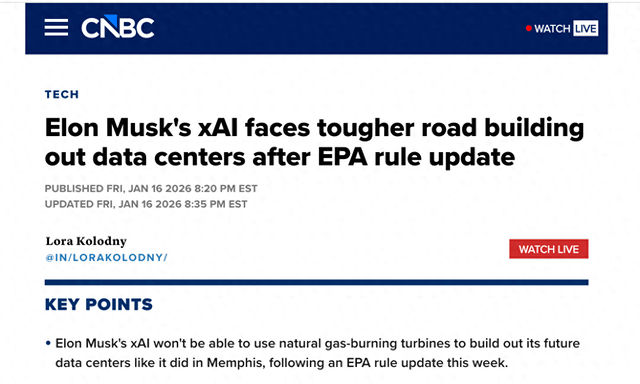
外媒:美国新规堵住漏洞 xAI数据中心扩张遇阻
Xin Lang Cai Jing· 2026-01-18 00:57
Core Viewpoint - The recent update by the U.S. Environmental Protection Agency (EPA) prohibits Elon Musk's xAI from using natural gas turbines in its Memphis data center, impacting its operational plans and expansion efforts [1][3]. Group 1: Regulatory Changes - The updated regulations require companies to obtain permits under the Clean Air Act to operate such turbines, closing a loophole that xAI previously exploited [3]. - The new rules specify that these turbines cannot be classified as non-road engines, which previously allowed xAI to bypass air pollution emission permits [3]. Group 2: Environmental Impact - Research from the University of Tennessee, Knoxville, indicated that xAI's use of natural gas turbines last year contributed to increased air pollution in the local area [3]. - Local authorities had previously allowed xAI to classify the turbines as non-road engines, avoiding public consultation and environmental impact assessments [3]. Group 3: Company Operations and Funding - xAI's Memphis data center is set to be operational in 2024, supporting its Grok model and applications, including a chatbot integrated with the social platform X [4]. - Despite commitments to use advanced pollution control technologies, reports indicate that the turbines installed do not have such controls [4]. - xAI has raised $20 billion from investors like NVIDIA and Cisco, but faces investigations due to content generated by its Grok and X applications that may promote violence and explicit material [4].

速递|xAI豪购第三座超大规模数据中心,马斯克的“自营算力”帝国,旨在自建、自营并自供能源
Z Potentials· 2026-01-04 04:18
Core Insights - xAI, led by Elon Musk, is expanding its operations by acquiring a building in Memphis, Tennessee, to establish a third large-scale data center aimed at deploying 1 million chips for AI models [1][2] - Unlike competitors such as OpenAI and Anthropic, which rely on external developers and cloud services, xAI is pursuing an independent development strategy for its data centers [1] - The company plans to convert a recently acquired 810,000 square foot warehouse in Mississippi into a data center by 2026, which will complement its existing Colossus 2 data center [2] Expansion Strategy - xAI's decision to build data centers in metropolitan areas with populations over one million allows for quicker conversion of existing buildings into operational facilities [4] - The company aims to achieve a competitive edge by rapidly bringing its data centers online, despite the high costs and risks associated with this strategy [1][4] Infrastructure and Power Supply - The new data center and Colossus 2 are strategically located near a natural gas power plant and other energy sources, which is crucial for their operations [2][7] - xAI has plans to provide over 1 gigawatt of power through a joint venture with Solaris Energy Infrastructure by early 2027, enhancing its energy supply for data center operations [7] Community and Political Challenges - The proximity of xAI's data centers to residential areas has led to political opposition, particularly regarding the use of gas turbines for power generation [5][7] - Complaints from local residents about noise from the power plant have prompted xAI to construct a wall to mitigate disturbances [8]

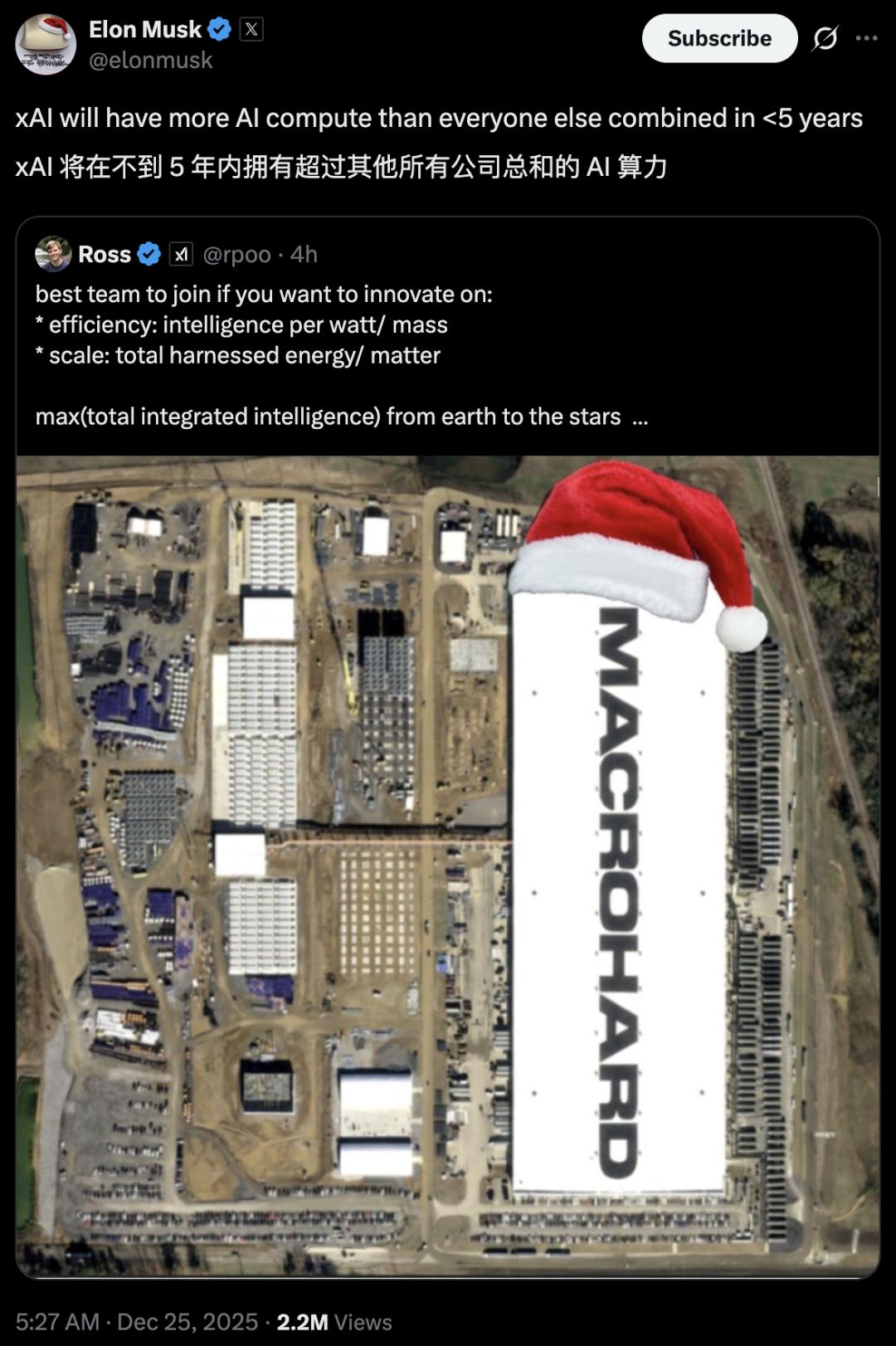
马斯克宣战,太空可见,把AI超算涂成这样,微软破防了
3 6 Ke· 2025-12-26 02:34
Core Viewpoint - Elon Musk has declared that xAI will possess more AI computing power than all other companies combined within five years, positioning xAI against major competitors like Google, OpenAI, and Microsoft [1][3]. Group 1: xAI's Infrastructure and Strategy - xAI's Colossus supercomputing center in Memphis is one of the largest commercial AI supercomputing centers globally, emphasizing a "hardcore" approach to AI development [5][9]. - The first phase, Colossus 1, was rapidly constructed to ensure xAI could compete, while Colossus 2 represents a more advanced engineering project aimed at long-term scalability [9][10]. - Colossus 2's construction is notably fast, with significant infrastructure completed in just six months, compared to competitors that typically require 15 months [10]. Group 2: Power Supply and Energy Strategy - xAI has strategically acquired a decommissioned power plant in Mississippi to circumvent regulatory hurdles in Tennessee, allowing for a temporary operation of gas turbines to supply power [13][15]. - Solaris Energy Infrastructure will provide over 1.1GW of power to meet the projected 1.7GW demand for Colossus 2, effectively creating an independent energy network for xAI [15][16]. Group 3: Financial Aspects and Funding - xAI is seeking $40 billion in new funding, with a valuation approaching $200 billion, despite its current revenue being minimal compared to its capital expenditures [19][16]. - The company is leveraging investments from Middle Eastern sovereign wealth funds, indicating strong financial backing for its ambitious plans [18][22]. Group 4: Company Culture and Workforce - xAI promotes a high-pressure work environment, with a culture that emphasizes extreme dedication, which has led to both attrition and the retention of passionate talent [23][24]. - The company is focusing on unique paths in AI development, such as emotional intelligence and interaction, rather than traditional programming skills [27][29]. Group 5: Future Outlook and Challenges - Musk has indicated that the next 2-3 years are critical for xAI to secure a leading position in the AI race, with significant investments required for expansion [30][31]. - The financial model of xAI raises concerns about sustainability, as training costs far exceed current revenue streams, potentially leading to market vulnerabilities [36].
主题会议十大要点-Thematics Conference 10 Key Takeaways
2025-12-16 03:30
Summary of Thematic Research Conference Key Takeaways Industry and Company Focus - **Industry**: Thematic Investing - **Key Companies Mentioned**: Bloom Energy (BE), Solaris Energy (SEI), John Deere Core Themes and Insights 1. **Rising Interest in Thematic Investing**: There is a significant increase in investor interest in thematic investing, with a focus on curated portfolios driven by enduring themes [3][8] 2. **AI and Capital Expenditure Cycle**: AI is driving a major capital expenditure and productivity cycle, with power supply becoming a critical bottleneck in the US and Europe [3][4] 3. **Distributed Power Supply Strategies**: The shift towards distributed energy solutions is gaining momentum, with companies like Bloom Energy positioned to benefit from this trend [4][13] 4. **Multipolar World Dynamics**: The geopolitical landscape is evolving, emphasizing technology leadership and the strategic importance of critical minerals [5][8][16] 5. **Long-Term Investment Trends**: Investors are transitioning from short-term trades to long-term trends, focusing on structural megatrends that drive alpha generation [8][14] 6. **AI Diffusion in Traditional Industries**: AI is expanding into traditional sectors such as agriculture and manufacturing, transforming companies like John Deere into "smart industrials" [9][21] 7. **Longevity as a Market Opportunity**: The aging population presents a significant market opportunity, with the 60+ demographic holding substantial buying power [9][17] 8. **Tokenized Finance**: The trend towards tokenized finance is expected to democratize private markets and enhance transaction efficiency [10][24] 9. **Brain-Computer Interfaces**: This emerging technology is positioned at the intersection of healthcare and AI, with significant market potential [10][20] 10. **Execution Challenges**: Across various themes, execution challenges such as power, labor, and regulatory issues are identified as key constraints that can generate alpha [11] Additional Important Insights - **Bloom Energy's Growth Prospects**: Bloom Energy is optimistic about its growth, particularly in the data center segment, with plans to increase manufacturing capacity by 1 GW by 2027 [13] - **Market Underestimation of Power Supply Challenges**: There is a belief that investors may not fully appreciate the complexities and challenges associated with providing high-quality power to data centers [13] - **AI's Role in Agriculture**: AI is enhancing agricultural productivity, with significant data processing capabilities being utilized to optimize farming practices [21] - **Investment Strategies Evolution**: Thematic investment strategies are evolving from human-driven stock selection to systematic thematic baskets, allowing for scalable alpha opportunities [14][18] This summary encapsulates the key takeaways from the Thematic Research Conference, highlighting the critical themes and insights that are shaping the investment landscape.
AI’s insatiable need for power is driving an unexpected boom in oil-fracking company stocks
Yahoo Finance· 2025-10-23 09:17
Oil prices are their lowest since the pandemic, revenues are falling, and profits are shrinking, but some frackers and oilfield players are suddenly thriving in the stock market as they invest in power generation for data centers and ride the AI wave. Liberty Energy—the fracking company cofounded by U.S. Energy Secretary Chris Wright—saw its stock jump 30% after announcing on Oct. 17 it would more than double its planned power generation capacity for data centers. Halliburton’s stock is up about 15% this ...
马斯克的“财技”:财力窘迫的xAI,如何为“世界最强算力集群+大型天然气发电厂”融资
Hua Er Jie Jian Wen· 2025-10-17 08:13
Core Insights - xAI, under Elon Musk, is attempting to build and control a powerful data center and a large natural gas power plant, but its financial constraints have led to unconventional financing arrangements that shift most funding pressure and risk to external partners [1] - Valor Equity Partners is raising $20 billion through a special purpose vehicle (SPV) to purchase and lease NVIDIA chips to xAI, indicating that xAI will not initially own the chips or control the power facilities for its second data center, Colossus 2 [1][2] - The financing structure highlights the difficulty investors face in providing substantial support for Musk's strategies, with xAI needing to generate sufficient cash flow to cover lease payments and repay raised debt [1] Financing Structure - The SPV consists of $7.5 billion in equity and $12.5 billion in debt, with Valor leading the equity portion and NVIDIA contributing up to $2 billion [2] - The SPV will lease chips to xAI for several years, allowing xAI the option to purchase them at the end of the lease term, thus transferring most of the financial risk to Valor Equity Partners [2] - This arrangement allows xAI to avoid upfront cash payments, but if xAI no longer needs the chips, the SPV can lease or sell them to other companies [2] Current Operations and Future Plans - xAI currently owns the land for Colossus 2 and has approximately 100,000 NVIDIA GB200 chips operational, with plans to deploy an additional 200,000 chips in the coming months [3] - Musk has expressed ambitions for Colossus 2 to eventually house between 550,000 to 1,000,000 chips [3] Risk Factors - The high equity stake in the SPV, close to 40%, is significantly above the typical 10% to 20% seen in recent data center transactions, providing lenders with a buffer against potential defaults by xAI [4][5] - If xAI fails to pay lease fees or opts to purchase the chips, Valor may face challenges, as the chips will be installed in xAI's data centers, complicating the resale process [5] Power Supply Collaboration - To power Colossus 2, xAI has partnered with Solaris Energy Infrastructure to form a joint venture, Stateline Power, which will lease natural gas turbines [6] - xAI has invested $86 million in the joint venture, while Solaris has contributed $86.4 million, with Stateline securing a floating-rate loan of up to $550 million [6] - Stateline is installing turbines in northern Mississippi, expected to provide over 1 gigawatt of power to xAI by early 2027 [6]
Nvidia砸千亿美元助力OpenAI,马斯克狂飙造全球最大AI集群 | Jinqiu Select
锦秋集· 2025-09-23 04:44
Core Insights - Nvidia announced a strategic investment of up to $100 billion in OpenAI to build at least 10 gigawatts of data center infrastructure for next-generation model training and deployment [1] - The AI competition has shifted from algorithm and product levels to a "infrastructure + computing power" battle [2] - Major players in the model layer are betting heavily on models, creating a strong moat with capital, computing power, and speed [3] Investment and Infrastructure Development - xAI has rapidly initiated the Colossus 2 project, completing approximately 200MW of cooling capacity and rack installation within six months, significantly faster than industry averages [5] - To address local power limitations in Memphis, xAI creatively acquired an old power plant in Southaven, Mississippi, to quickly provide hundreds of megawatts of power [5] - xAI has partnered with Solaris Energy Infrastructure to deploy over 460MW of turbine generators, with plans to expand total installed capacity to over 1GW in the next two years [5][17] - xAI has secured a large allocation of GPUs from Nvidia and plans to start training large-scale models in early next year, facing a funding requirement of several billion dollars [5][9] Competitive Landscape - xAI's Colossus 1 project, completed in 122 days, is the largest AI training cluster, but its 300MW capacity is dwarfed by competitors building gigawatt-scale clusters [7][9] - By Q3 2025, xAI's total data center capacity for a single training cluster is expected to exceed that of Meta and Anthropic [9] - xAI's unique approach to reinforcement learning, focusing on human emotions and interactions, may lead to significant advancements in AI capabilities [52][54] Financial Sustainability and Future Prospects - xAI's current capital expenditures are substantial, requiring ongoing investments of hundreds of billions, with a heavy reliance on external financing [5][29] - The company is exploring potential funding from the Middle East, with reports of a new round of financing approaching $40 billion [31] - xAI's integration with X.com may provide a cash buffer, but substantial revenue generation will be necessary to support its large language model training [54]


Solaris Energy Infrastructure, Inc.(SEI) - 2025 Q1 - Earnings Call Transcript
2025-04-29 14:00
Financial Data and Key Metrics Changes - Solaris generated total revenue of $126 million in Q1 2025, reflecting a 31% increase from the prior quarter [25] - Adjusted EBITDA for the quarter was $47 million, representing a 25% increase from the prior quarter [25] - The average contract tenor for Power Solutions increased to approximately 5.5 years, compared to about 4 years last quarter and approximately 6 months when the MER transaction was closed [21][25] Business Line Data and Key Metrics Changes - Power Solutions contributed 55% of total segment adjusted EBITDA and is expected to contribute more than 80% of consolidated adjusted EBITDA after the on-order fleet is deployed [25] - Solaris Power Solutions generated revenue from approximately 390 megawatts of capacity during the first quarter [25] - Logistics Solutions saw system activity up over 25% sequentially, benefiting from seasonal rebound and new customer wins [14] Market Data and Key Metrics Changes - The company expects average megawatts earning revenue to increase by 13% sequentially to 440 megawatts in Q2 2025 and by 18% to approximately 520 megawatts in Q3 2025 [25] - Approximately 70% of the new pro forma delivered total fleet of 1,700 megawatts is contracted, with around 500 megawatts of open capacity available for bidding [10] Company Strategy and Development Direction - Solaris is focused on generating strong free cash flow from its logistics business and reinvesting that cash into its growing Power Solutions business [6] - The company aims to maximize shareholder value through growth while maintaining a strong financial profile [18] - Solaris is working on diversifying its customer base while securing extended contract tenors [80] Management's Comments on Operating Environment and Future Outlook - Management expressed confidence in the demand for power solutions, citing ongoing discussions for additional oilfield applications and data center projects [33] - The company anticipates a slowdown in oil-directed activity if commodity prices remain low, which could impact the logistics segment [26][70] - Management highlighted the importance of regulatory challenges for data centers, which support the Power as a Service model [13] Other Important Information - Solaris has secured a senior secured term loan facility of up to $550 million to support approximately 80% of the forecasted CapEx requirements of the joint venture [21] - The company is planning to manufacture certain capital items in-house to reduce costs and enhance returns [29] Q&A Session Summary Question: What is the demand outlook for uncontracted assets? - Management indicated strong demand for uncontracted assets, with ongoing discussions for various applications [33] Question: What is the expected EBITDA per megawatt? - Management noted that the dollar per megawatt economics are in line with expectations, with some lumpiness due to ramping up costs [35][36] Question: Will clients be able to attain air permits in a reasonable time? - Management confirmed that the customer is following EPA guidelines and expects to obtain the necessary permits [43] Question: What is the ideal mix of contracted versus spot assets? - Management stated that most of the fleet will be used for medium to long-term contracts, with a small percentage available for emergency situations [56] Question: How are industrial opportunities evolving? - Management highlighted various industrial applications needing large power loads, including metals manufacturing and LNG export facilities [99]