住房公积金制度

Search documents
中经评论:发挥住房公积金制度作用
Jing Ji Ri Bao· 2026-02-25 00:06
住房公积金制度是我国城镇住房制度的重要组成部分,对于促进城镇住房建设、提高居民居住水平 发挥了积极作用。2024年,住房公积金实缴人数超1.76亿人。近年来,立足缴存人不同阶段住房消费特 点,住房公积金的缴存、使用、管理和运行机制不断健全。 使用政策持续优化,支持缴存人提取住房公积金用于支付购房首付款,支持异地贷款和异地购房提 取,还对多子女家庭租购住房提供政策支持。不仅能用于购房,住房公积金还精准对接新市民、青年人 安居需求,优化租房提取政策,减轻租房压力。2024年,我国2257.44万人提取住房公积金2720.57亿元 用于租赁住房,近两年来租房提取金额增幅均超30%。 各地也在积极探索更多住房公积金用途,如支持老旧小区加装电梯、自住住房老旧电梯更新改造和 老旧住房更新改造等。2024年,共有6.53万人提取住房公积金20.43亿元用于加装电梯等自住住房改造。 居民对居住品质的要求日益提升,期盼住上"好房子",一些地方出台政策,对购买"好房子"的缴存人提 高了贷款额度。 住房公积金制度惠及更广泛就业群体。近年来,我国灵活就业人员参加住房公积金制度试点持续深 化,住房公积金制度发展成果更多更公平惠及人民群 ...
发挥住房公积金制度作用
Jing Ji Ri Bao· 2026-02-24 22:12
住房公积金的缴存、使用、管理和运行机制不断健全。相信住房公积金制度将在扩内需、惠民生中发挥 更大作用,更好地满足缴存人多元化住房需求,助力实现住有宜居、住有优居。 住房公积金制度是我国城镇住房制度的重要组成部分,对于促进城镇住房建设、提高居民居住水平发挥 了积极作用。2024年,住房公积金实缴人数超1.76亿人。近年来,立足缴存人不同阶段住房消费特点, 住房公积金的缴存、使用、管理和运行机制不断健全。 使用政策持续优化,支持缴存人提取住房公积金用于支付购房首付款,支持异地贷款和异地购房提取, 还对多子女家庭租购住房提供政策支持。不仅能用于购房,住房公积金还精准对接新市民、青年人安居 需求,优化租房提取政策,减轻租房压力。2024年,我国2257.44万人提取住房公积金2720.57亿元用于 租赁住房,近两年来租房提取金额增幅均超30%。 各地也在积极探索更多住房公积金用途,如支持老旧小区加装电梯、自住住房老旧电梯更新改造和老旧 住房更新改造等。2024年,共有6.53万人提取住房公积金20.43亿元用于加装电梯等自住住房改造。居民 对居住品质的要求日益提升,期盼住上"好房子",一些地方出台政策,对购买"好房子 ...
以“真金白银”印证深圳的经济热度与民生温度 深圳公积金新开户增长6.01%
Shen Zhen Shang Bao· 2025-12-30 23:22
Core Insights - The housing provident fund in Shenzhen serves as a crucial indicator of the city's economic vitality and public welfare, with significant growth in new accounts and funds collected in 2025 [1][2] Group 1: Account Growth and Economic Impact - In 2025, Shenzhen saw the addition of 40,000 new account-holding units and 833,100 new individual accounts, marking a year-on-year growth of 6.01%, with total funds collected reaching 119.158 billion yuan [2] - Non-public enterprises account for 97% of the contributing units, highlighting their role as the main contributors to the provident fund [2] - The total number of units with housing provident fund accounts has exceeded 600,000, serving over 21 million individuals [2] Group 2: Flexible Employment Participation - Shenzhen has pioneered the inclusion of flexible employment workers in the housing provident fund system, allowing approximately 120,000 individuals to voluntarily contribute [3] - The system provides flexible contribution options for these workers, enhancing their ability to secure housing loans [3] Group 3: Rental Withdrawals and Policy Support - In 2025, rental withdrawals reached 61.244 billion yuan, benefiting 3.617 million citizens, addressing the housing needs of new residents and young people [4] - The new regulations facilitate various withdrawal options, including for down payments and tax payments, aimed at easing housing pressures for different demographics [4] Group 4: Loan Support and Benefits - The maximum loan amount available is 2.31 million yuan, the highest in the country, with additional support mechanisms for families with multiple children [5] - As of November 2025, Shenzhen has issued 543,800 personal housing loans totaling 387.851 billion yuan, supporting the purchase of 51.66 million square meters of housing [6] - The introduction of interest subsidies and innovative loan repayment options further enhances the financial benefits for employees utilizing the provident fund [6]
深圳发布公积金“账本”:15年归集万亿,最高可贷231万
Nan Fang Du Shi Bao· 2025-12-26 10:20
Core Viewpoint - The Shenzhen housing provident fund system is set to celebrate its 15th anniversary in December 2025, marking significant growth and development in supporting housing construction and improving living conditions for residents [1]. Group 1: Fund Accumulation and Growth - Over the past 15 years, the Shenzhen housing provident fund has grown from zero to over 1 trillion yuan, with an average annual growth rate exceeding double digits [2]. - By September 2025, the accumulated fund will surpass 1 trillion yuan, reflecting a robust increase from 218 billion yuan in 2011 to 9,000 billion yuan in 2024 [2]. - The number of new account holders reached 833,100, with a year-on-year growth of 6.01%, indicating strong market confidence in Shenzhen's business environment [2]. Group 2: Policy Innovations and Support - The fund has expanded its coverage to include foreign workers and flexible employment groups, with over 600,000 units and 21 million account holders [3]. - A new interest subsidy policy has been introduced, providing 500 million yuan in interest subsidies to employees who have not used their provident fund loans [3]. - The fund's policies have been optimized to support housing consumption, with the maximum loan amount reaching 2.31 million yuan, the highest in the country [5][7]. Group 3: Digital Transformation and Service Efficiency - The digital transformation of the fund has led to an online processing rate exceeding 98%, significantly enhancing service efficiency [8]. - The establishment of a comprehensive service platform allows for seamless online transactions, reducing the need for physical visits [8][12]. - The introduction of AI and blockchain technologies has improved risk control and automated approval processes, streamlining operations [9]. Group 4: Integration of Services - The fund center has integrated housing transaction management with provident fund services, creating a unique dual-function model [11]. - A "one-stop" platform for housing transactions and provident fund withdrawals has been developed, allowing for simultaneous processing of related services [12]. - The launch of the "cloud viewing" platform provides citizens with easy access to housing information and services, enhancing the overall efficiency of property transactions [12]. Group 5: Future Directions - The Shenzhen housing and construction bureau aims to continue optimizing policies and services while focusing on digital transformation to enhance the housing provident fund system [14]. - The commitment to improving living standards and supporting urban development aligns with national strategies for high-quality growth [14].

“十四五”时期济宁市住房公积金五年累计提取409.75亿元
Qi Lu Wan Bao· 2025-12-24 14:03
Core Insights - The article highlights the achievements of Jining's housing provident fund system during the "14th Five-Year Plan" period, emphasizing its role in supporting high-quality development and addressing housing needs. Group 1: Development Achievements - Over the past five years, Jining has seen a steady increase in its housing provident fund's comprehensive strength, with 8,298 new account-opening units and 277,800 new employees, averaging annual growth of 1,660 units and 55,600 employees [1] - The number of contributing units reached 12,900, with 689,800 contributing employees, reflecting growth of 31.04% and 10.74% respectively. The annual contribution amount has increased by 10% on average [1] - By November 2025, Jining's housing provident fund loan issuance growth ranked first in the province, with cumulative contributions and balances ranking fourth, and cumulative withdrawals and loans ranking fifth [1] Group 2: Policy and Accessibility Improvements - By the end of 2024, 81% of housing provident fund loans were issued to employees under 40, a 20.5 percentage point increase from the end of 2020. The proportion of first-time home loans reached 78.96% [2] - A pilot program for flexible employment individuals was launched, resulting in 14,400 new accounts and contributions of 327 million yuan, with the proportion of non-public contributors increasing by 8.36 percentage points compared to the end of the "13th Five-Year Plan" [2] - Over the past five years, 8,300 cross-regional loans totaling 2.936 billion yuan were issued to support employees' housing needs [2] Group 3: Policy Optimization and Support for Housing Consumption - The housing provident fund policies were scientifically adjusted, removing restrictions on withdrawals for purchasing homes within the province, and optimizing standards for housing unit recognition [3] - The average loan amount reached 464,400 yuan, an increase of 124,000 yuan compared to the end of the "13th Five-Year Plan" [3] - The annual growth rate of rental withdrawal amounts was 19.57%, supporting housing consumption significantly [3] Group 4: Service Efficiency and Innovation - The implementation of a "one-stop" service for various business processes has made it easier for enterprises and individuals to access services [4] - Digital development has accelerated, with eight high-frequency services achieving "instant approval" [4] - The overdue loan rate is maintained at a leading level in the province, demonstrating effective post-loan management [4] Group 5: Community Engagement and Governance - The establishment of a "clean and efficient" service ethos has been integrated into all aspects of development, leading to the recognition of the center as a "national civilized unit" [5] - The center has actively engaged in community support initiatives, fostering collaboration in the housing provident fund sector [5] - Regulatory compliance has been strengthened, with measures in place to prevent fraud and enhance legal awareness in the housing provident fund domain [5] Group 6: Future Outlook - Looking ahead to the "15th Five-Year Plan," the housing provident fund system aims to align with the city's strategic goals, focusing on expanding coverage and enhancing support for housing consumption [6] - The core philosophy emphasizes the importance of fulfilling its functions and contributing to the vision of providing quality housing for all [6]
我省“商转公贷款”新增“带押直转”方式
Hai Nan Ri Bao· 2025-11-28 01:31
Core Viewpoint - The new "Commercial to Public Loan" policy in Hainan introduces a "Direct Transfer with Mortgage" option, aimed at reducing borrowers' interest burdens and enhancing the accessibility and benefits of the housing provident fund system [1][2]. Group 1: Policy Changes - The "Commercial to Public Loan" will now have two processing methods: "Direct Transfer with Mortgage" and "Self-Funded Settlement" [1]. - The "Direct Transfer with Mortgage" allows loan funds to be directly transferred to the original commercial loan bank after approval, while the "Self-Funded Settlement" requires borrowers to first pay off their original loans before applying for the public loan [1]. Group 2: Loan Limits and Eligibility - The loan amount for "Commercial to Public Loan" is determined by the lowest value among four criteria: the maximum public loan limit, the remaining principal of the original commercial loan, the calculated loan amount based on repayment ability, and 60% of the housing price indicated on the VAT invoice [2]. - The policy now covers a wider range of housing purchases, including new self-occupied homes, second-hand homes, affordable housing, and relocation housing [2]. Group 3: Application Process and Funding Mechanism - Applications for "Commercial to Public Loan" can be submitted through the "Haiyi Ban" app, the Hainan government service website, or at local housing provident fund service centers [2]. - The "Commercial to Public Loan" is linked to the individual loan rate; when it reaches 95%, a monthly limit of 500 million yuan will be implemented, and when it exceeds 110%, new applications will be suspended [2].
深圳住房公积金归集资金破万亿
Shen Zhen Shang Bao· 2025-10-21 23:11
Core Insights - Shenzhen's housing provident fund system has significantly expanded, accumulating over 1 trillion yuan in funds and benefiting over 20 million citizens since its implementation in December 2010 [2] Group 1: Loan and Housing Support - The total amount of housing provident fund loans issued has exceeded 380 billion yuan, supporting the purchase of approximately 51 million square meters of housing [1][3] - The maximum loan amount available is 2.31 million yuan, the highest in the country, with policies in place to support first-time homebuyers and families with multiple children [3] Group 2: Coverage and Participation - The system has broadened its coverage to include both local and non-local workers, as well as foreign nationals and residents from Hong Kong, Macau, and Taiwan [2] - Approximately 120,000 flexible employment workers, such as delivery personnel and ride-hailing drivers, have voluntarily joined the provident fund system since its pilot launch in 2021 [2] Group 3: Withdrawal and Usage Policies - The withdrawal policy allows employees to access funds for various purposes, including home purchases, loan repayments, and rent, with a total rental withdrawal amount exceeding 260 billion yuan [3] - The system has implemented a "monthly automatic withdrawal" service, enhancing convenience for users [3] Group 4: Digital Services and Accessibility - Over 98% of provident fund transactions can be completed online, with a comprehensive digital service platform established for easy access to services [4] - The launch of the "iShenfang" platform provides citizens with integrated online services, including real estate project displays and housing policy information [5]
全面推进灵活就业人员缴存公积金,山东有了指导意见
Qi Lu Wan Bao· 2025-09-04 14:41
Core Viewpoint - Shandong province is implementing a comprehensive plan to allow flexible employment individuals to participate in the housing provident fund system, aiming to enhance housing security for this group by the end of 2025 and establish a broad, flexible, and convenient management system by 2030 [1] Group 1: Participation and Management - The plan specifies that flexible employment individuals, including those working part-time, self-employed, and in new industries, can apply to join the housing provident fund system [2] - Participants can determine their contribution amounts within the local limits based on their income, and there are provisions for transitioning contributions between flexible and full-time employment [2] Group 2: Rights and Benefits - The plan includes measures to support flexible employment individuals in accessing housing loans, including the ability to apply for loans in different locations and to withdraw their contributions under certain conditions [3] - Flexible employment contributors will enjoy similar withdrawal policies as full-time employees, allowing for full withdrawal of contributions if they have not taken out a housing loan or have fully repaid one [3] Group 3: Housing Security and Support - Local governments are encouraged to integrate eligible flexible employment contributors into the housing security system, providing access to public rental housing and other related policies [5] - Collaboration with housing rental agencies is promoted to offer online services and financial incentives for flexible employment contributors [5] Group 4: Incentives and Services - The plan suggests various incentives for flexible employment individuals, such as contribution subsidies and tax benefits, as well as personalized financial services from commercial banks [6] - It also proposes establishing a platform for entrepreneurship and employment guidance, including skills training and job fairs to enhance employment opportunities for flexible workers [6]
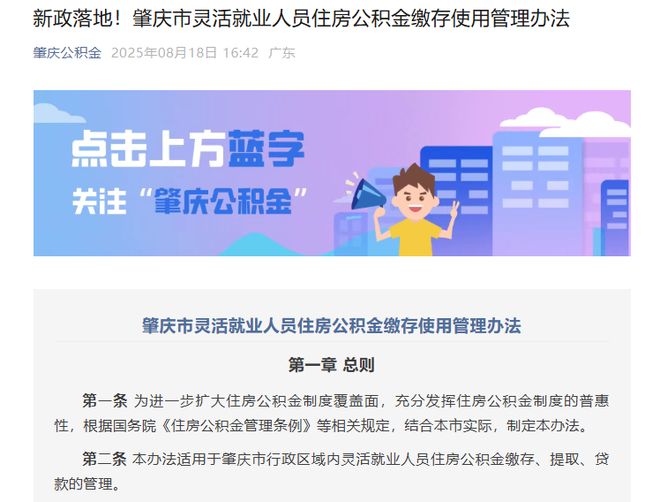
个人也可以缴存!肇庆出台住房公积金新政
Nan Fang Du Shi Bao· 2025-08-20 03:48
Core Points - The article discusses the implementation of a new policy in Zhaoqing City that allows flexible employment individuals to voluntarily contribute to and utilize housing provident funds, effective immediately [1] Group 1: Policy Overview - The new management measures aim to expand the coverage of the housing provident fund system and enhance its inclusivity [6] - The policy applies to flexible employment individuals aged 16 and above who earn their primary income through self-employment, part-time work, or new business models, and who have full civil capacity [5][7] Group 2: Contribution Details - Contributions to the housing provident fund are voluntary, with individuals required to report their contribution base and rate [8] - The contribution base cannot exceed three times the average monthly salary of employees in the previous year, nor fall below the minimum wage standard set by the city [8] - The contribution rate must be between 10% and 24%, chosen by the individual [8] Group 3: Account Management - Each individual can only have one housing provident fund account, and existing accounts can be used [8] - Contributions can be made monthly, quarterly, or as a lump sum, and the funds are owned by the contributor [8] - If an individual wishes to stop contributing, they must first freeze their account for six months before withdrawing the total balance [10] Group 4: Withdrawal and Loan Conditions - Flexible employment individuals can apply to withdraw their provident fund balance if they meet the city's withdrawal policy [10] - To qualify for a housing loan, individuals must have contributed to the fund for at least six months prior to the loan application [11] Group 5: Implementation Timeline - The policy will be effective for five years starting from August 18, 2025 [11]
国泰海通|地产:优化用途稳刚需,增加效用惠民
国泰海通证券研究· 2025-08-15 10:15
Core Viewpoint - The article emphasizes that the housing provident fund policy will have a significant supplementary effect on stabilizing housing prices, with potential for further optimization to encourage more individuals to consider purchasing homes [1][3]. Summary by Sections Housing Provident Fund in China - The housing provident fund system has rapidly developed over the past decade, benefiting more people with key characteristics including: 1. Continuous expansion of coverage and steady growth in contribution scale 2. High proportion of housing consumption in fund withdrawals, with an increasing withdrawal rate 3. Alignment of housing fund loans with real estate market cycles, with a gradual decline in personal housing loan rates - The system is viewed as a social housing security mechanism and plays a crucial role in stabilizing the real estate market and meeting reasonable housing demands as interest rates decline [1][2]. Potential Impact of Optimizing Provident Fund Policies - In the first half of 2025, various regions are expected to introduce policies to optimize the housing provident fund, such as lowering loan interest rates, increasing loan limits, reducing down payment ratios, and enhancing subsidies to activate potential purchasing power - The estimated contribution of these new policies to sales area in first-tier and new first-tier cities is modest, with increases of approximately 4.4% in Beijing, 1.8% in Shanghai, 2.8% in Shenzhen, 9.2% in Guangzhou, 5.4% in Hangzhou, and 7.9% in Chengdu - In contrast, the impact on second- and third-tier cities is more pronounced, with sales area increases nearing 50% in cities like Yantai and Zibo, and approximately 52.6% in Baoding - The analysis also indicates that after the policy adjustments, monthly mortgage payments in cities like Shanghai, Wuhan, Chongqing, Chengdu, and Jinan have become lower than monthly rents, suggesting a shift towards home buying over renting [2][3]. Investment Recommendations - The company maintains a "buy" rating, believing that the housing provident fund policy will effectively support the market as housing prices stabilize - The policies are primarily aimed at first-time homebuyers and those with urgent needs, providing a stabilizing effect - Future adjustments may include expanding the use of the provident fund for down payments, addressing operational bottlenecks, supporting inter-city loans, and optimizing standards for second-home loans, among other measures [3].