公司控制权之争

Search documents
ST路通2股东诉请撤销股东会决议,ST路通控制权风波再起
Di Yi Cai Jing· 2026-02-26 14:22
【#ST路通2股东诉请撤销股东会决议#,#ST路通控制权风波再起#】"创投大佬"吴世春执掌ST路通 (300555.SZ)3个多月后,一起起诉要求撤销股东大会决议的诉讼,将该公司控制权之争重新拉回公众 视野。 根据ST路通2月25日晚间公告,两名自然人起诉上市公司,诉请撤销2025年11月7日作出的股东大会和 董事会决议,理由是会议"召集及召开程序严重违法"。目前案件已由法院受理,尚未开庭。 对此,ST路通相关人士告诉第一财经,原告为公司两名股东,不清楚他们此次起诉的具体目的,公司 正在准备力量应对诉讼。 此次诉讼涉及的股东大会,曾是吴世春方面与原管理层争夺ST路通控制权的关键一环。彼时,原董事 长宣布股东会延期,部分股东强烈反对,经过激烈争论后重启会议,吴世春提名的人当选董事长。事 后,双方就股东大会重新召开的合法性隔空交锋。目前,吴世春已经成为ST路通的实际控制人。 在控制权风波之外,ST路通仍旧面临业绩连续多年亏损、基本面疲弱的现实。对于该公司如何改善业 绩,上述ST路通相关人士称,可以关注2025年度报告,相关计划会在年报中披露。 ...

可靠股份内斗白热化:离婚夫妻控制权之争波及独董景乃权被提请解职
Xin Lang Cai Jing· 2026-02-25 01:04
Core Viewpoint - The recent dismissal of independent director Jing Naiquan by Reliable Co., Ltd. is a significant escalation in the ongoing power struggle between Chairman Jin Liwei and his ex-wife Bao Jia, highlighting internal governance issues within the company [1][5]. Group 1: Board Meeting and Dismissal - The board meeting on February 12, 2026, resulted in the dismissal of Jing Naiquan with a vote of 5 in favor and 2 against, with opposition from Bao Jia and Jing Naiquan himself, indicating a clear power struggle [2][4]. - The company cited three main reasons for the dismissal: loss of independence, failure to fulfill duties, and lack of professional ethics [2][3]. Group 2: Allegations and Counterarguments - Jing Naiquan was accused of "performing duties in a perfunctory manner," including leaving meetings early and refusing to sign meeting records, which he vehemently denied, claiming the reasons for his dismissal were unfounded and retaliatory [3][4]. - Bao Jia supported Jing Naiquan's position, arguing that his independence was evident through his consistent dissenting votes on various issues, including a controversial related-party transaction that led to regulatory scrutiny [4][6]. Group 3: Background of the Conflict - The conflict traces back to the personal and professional relationship between Jin Liwei and Bao Jia, who were once business partners and married, but their divorce in February 2024 led to a power imbalance in shareholding, intensifying the governance struggle [6][7]. - Following their divorce, both parties hold nearly equal shares, with Jin Liwei at 30.13% and Bao Jia at 29.13%, leading to a contentious board dynamic [6][7]. Group 4: Financial Impact - The internal conflict has severely impacted the company's market performance, with its stock price dropping over 60% from its listing price, resulting in a market capitalization loss exceeding 5 billion yuan [8]. - The upcoming shareholder meeting on March 12, 2026, will be crucial in determining the future governance structure, as the outcome may hinge on the support of minority shareholders [9].
董事会拒开临时股东会 振芯科技控制权之争走向何处?
Shang Hai Zheng Quan Bao· 2026-01-19 16:07
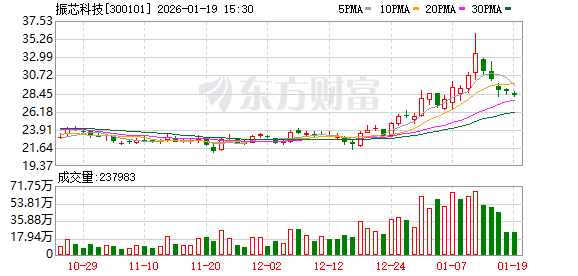
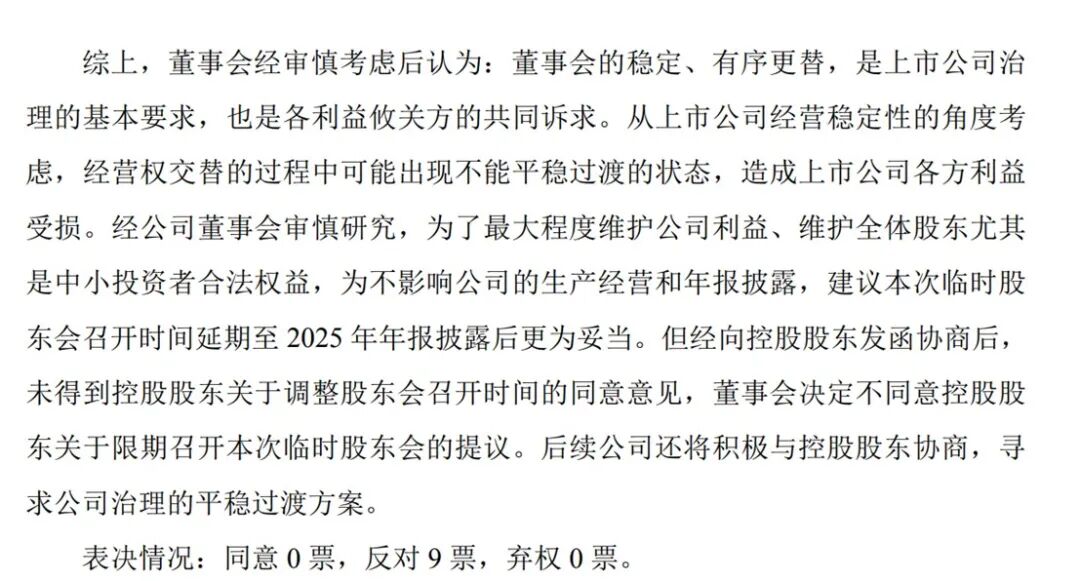
Core Viewpoint - The ongoing control dispute between the current management of Zhenxin Technology and its major shareholder, Chengdu Guoteng Electronics Group, has seen new developments, particularly regarding the proposal for an extraordinary shareholders' meeting [2][3]. Group 1: Control Dispute - Guoteng Group's main demand is to push for an early board election at Zhenxin Technology, which conflicts with the interests of the current management [3]. - Zhenxin Technology's board rejected the proposal for an extraordinary shareholders' meeting, citing concerns over the impact on the 2025 annual report and operational stability [4][5]. Group 2: Reasons for Rejection - The board provided four main reasons for opposing the early board change: 1. Changing the entire board could affect the preparation and disclosure of the 2025 annual report due to delays in the audit process [4]. 2. Compliance with industry regulations is necessary for selecting new directors, which may not be feasible within the proposed timeline [4]. 3. An abrupt board change could disrupt governance and stability, as the proposed candidates lack experience with Zhenxin Technology [4]. 4. The change could negatively impact operational stability and employee morale [5]. Group 3: Future Outlook - There is speculation about whether Guoteng Group can successfully push for an early board change, with concerns about protecting the interests of minority shareholders [7]. - Guoteng Group may attempt to convene the extraordinary shareholders' meeting through the audit committee, but it is likely that the committee will also reject the proposal [8]. - If the extraordinary meeting is convened, both parties may seek to rally support from minority shareholders, although the dispersed nature of their holdings complicates this effort [8].


董事会拒开临时股东会,振芯科技控制权之争走向何处?
Shang Hai Zheng Quan Bao· 2026-01-19 16:07
Core Viewpoint - The board of directors of Zhenxin Technology rejected the proposal for a temporary shareholders' meeting initiated by Guoteng Group, citing concerns over the impact on the company's annual report and operational stability [1][3][4]. Group 1: Proposal Rejection - The board's rejection was based on four main reasons: potential delays in the 2025 annual report due to the ongoing audit process, the need for compliance checks on new director candidates, concerns over governance stability during the transition, and the risk to operational stability [3][4][5]. - Zhenxin Technology suggested postponing the temporary shareholders' meeting until after the 2025 annual report is disclosed, but Guoteng Group did not agree to this proposal [2][3]. Group 2: Guoteng Group's Position - Guoteng Group aims to push for an early board election, which is seen as conflicting with the interests of the current management [2]. - Guoteng Group holds a significant shareholding advantage, increasing the likelihood of a successful board change if the temporary shareholders' meeting is convened [2][6]. Group 3: Future Outlook - There is uncertainty regarding the success of Guoteng Group's efforts to convene a temporary shareholders' meeting, with potential plans to approach the audit committee for this purpose [6]. - The involvement of small shareholders and their voting power is critical, but their dispersed holdings may complicate the situation [6][7]. - Legal experts suggest that regulatory intervention may be necessary to protect the interests of small shareholders and ensure proper governance [6][7].
荷兰法院开审安世半导体案
Xin Lang Cai Jing· 2026-01-14 23:36
Core Viewpoint - The ongoing legal battle between Nexperia, a Dutch semiconductor company, and its Chinese parent company, Wingtech Technology, has escalated, impacting the global automotive chip supply chain [1] Group 1: Legal Proceedings - On October 7, 2022, the Dutch court suspended Wingtech's founder, Zhang Xuezheng, from his position as CEO of Nexperia, citing "sufficient reason to suspect" mismanagement [1] - A public hearing was held by the Dutch court to discuss allegations of mismanagement against Nexperia's European executives and to determine whether a full investigation should be initiated [1] - The court's decision on whether to start an investigation could lead to the appointed trustee continuing to control Nexperia, prolonging the dispute with Wingtech [1] Group 2: Implications for the Industry - The control dispute over Nexperia has contributed to a shortage of automotive chips globally, affecting the automotive industry in Europe and beyond [1] - If the Dutch court decides not to initiate an investigation, Wingtech will regain control of Nexperia, potentially resolving the ongoing tensions that have disrupted the automotive supply chain [1]

振芯科技控制权之争白热化 控股股东发函拟提前半年“换掉”董事会
Xin Lang Cai Jing· 2026-01-09 15:40
Core Viewpoint - The control dispute over Zhenxin Technology (振芯科技) has intensified, with the controlling shareholder, Chengdu Guoteng Electronics Group Co., Ltd. (国腾电子), pushing for an extraordinary shareholders' meeting to elect a new board of directors ahead of schedule [1][2]. Group 1: Shareholder Meeting Proposal - Guoteng Electronics has submitted a proposal to convene an extraordinary shareholders' meeting to discuss two key resolutions: one for the early re-election of the non-independent directors and another for the independent directors [2]. - Guoteng Electronics holds 29.21% of Zhenxin Technology's shares, which grants it the right to request the board to convene a shareholders' meeting [2]. Group 2: Board Response and Current Management - Zhenxin Technology has not clearly stated its position regarding the request for the shareholders' meeting, indicating that the board will conduct a thorough review of the proposal and provide feedback within ten days [3]. - The current management team includes three executives who are also founding shareholders, and they collectively hold 49% of Guoteng Electronics, while the remaining 51% is held by the controlling shareholder, He Yan [3].
罕见!“卫星导航第一股”董事长带头发千字长文 声讨实控人!公司已内斗多年
Zheng Quan Shi Bao Wang· 2025-12-31 03:20
Core Viewpoint - The public letter from the management team of Zhenxin Technology highlights internal conflicts and disputes regarding the actual control of the company, particularly targeting the contributions and qualifications of the actual controller, He Yan [1][2]. Group 1: Internal Conflicts - The public letter, signed by Chairman Xie Jun, Vice Chairman Xu Jin, and Director Bai Jie, accuses He Yan of not contributing to the company's development and causing significant obstacles due to personal issues [1]. - The letter claims that He Yan has never held a position or participated in the management of the company since its establishment, and her past legal issues have negatively impacted the company's reputation and market value [1][3]. - The management team asserts that He Yan has disrupted the company's stability and decision-making processes, including repeatedly rejecting legitimate resolutions from the shareholders' meetings [1]. Group 2: Legal Background - The public letter was issued following a shareholders' meeting on December 26, where several key proposals were rejected, likely due to opposition from the controlling shareholder, Chengdu Guoteng Electronics Group, which He Yan holds a 51% stake in [3]. - Zhenxin Technology, originally named Chengdu Guoteng Electronics Technology Co., Ltd., was co-founded by He Yan and others, and it specializes in products related to the BeiDou satellite navigation system [3]. - A series of lawsuits initiated by shareholders against Guoteng Group since 2018 reflect ongoing disputes over control, with a court ruling in 2021 ultimately deciding against the dissolution of Guoteng Group [4][6]. Group 3: Governance Issues - The company has been in a state of governance deadlock, with claims that it has a controlling shareholder but lacks an actual controller, which complicates its operational stability [5][6]. - Despite the court ruling that Guoteng Group should not be dissolved, the management team of Zhenxin Technology has maintained control over the board, indicating ongoing power struggles [6]. - The situation emphasizes the need for the company to resolve shareholder disputes and ensure fair representation of all parties involved [6].
万字长文举报董事长,梦洁股份涉事董事独家回应:3.85亿股权交易“被下套”,举报实属无奈;公司否认举报内容:已报案
Sou Hu Cai Jing· 2025-12-09 14:48
Core Viewpoint - The ongoing internal conflict at Mengjie Co., Ltd. has escalated, with board member Chen Jie publicly accusing Chairman Jiang Tianwu of various misconducts, including contract fraud and fund misappropriation, which has raised concerns among minority shareholders [1][3][17]. Group 1: Internal Conflict and Allegations - Chen Jie has publicly accused Jiang Tianwu and Secretary Li Jun of multiple issues, including contract fraud and fund misappropriation, which she claims harm the rights of minority shareholders [3][12]. - Since November, Chen Jie has released six lengthy articles detailing her allegations against the management team, including audio recordings and chat screenshots [3][6]. - Chen Jie has consistently voted against the company's financial reports and other proposals, citing concerns over the authenticity of financial data and fund usage [5][6]. Group 2: Financial Concerns and Mismanagement - Chen Jie raised questions about the reasonableness of certain expenditures, such as the significant increase in terminal construction costs from 40 million to 150 million per store, which she believes lacks justification [6][12]. - The company reported a revenue of 2.463 billion and a net loss of 156 million in 2021, raising alarms about its financial health [6]. - Regulatory scrutiny has increased, with the Hunan Securities Regulatory Bureau issuing corrective measures against Mengjie Co., Ltd. for financial mismanagement and lack of internal controls [7][12]. Group 3: Shareholding and Control Issues - In 2022, Changsha Jinsen invested 385 million to become the largest shareholder of Mengjie Co., Ltd., but has since struggled to gain actual control [1][8]. - The share transfer agreement allowed Changsha Jinsen to hold 19.77% of voting rights, but this control was lost in 2025 when the agreement expired, leading to a fragmented ownership structure [9][11]. - Chen Jie claims that the original agreement was manipulated by Jiang Tianwu to prevent Changsha Jinsen from exercising its shareholder rights, resulting in significant financial losses for the investor [12][13].

科兴生物收到纳斯达克退市通知,最新回应
2 1 Shi Ji Jing Ji Bao Dao· 2025-11-20 06:38
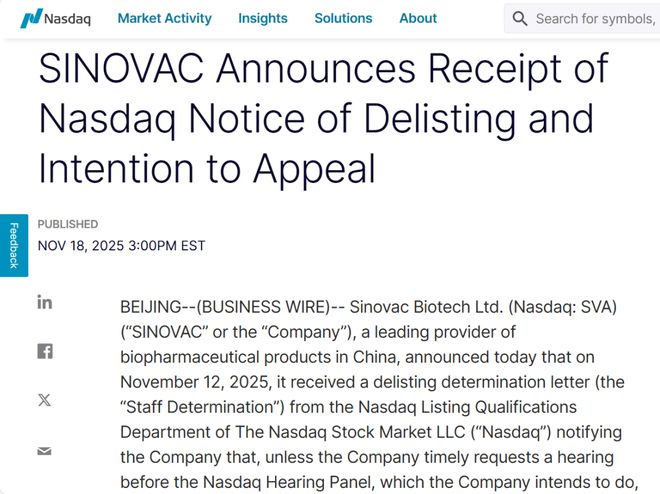
Core Points - Sinovac Biotech Ltd. received a delisting determination letter from Nasdaq due to the failure to submit its 2024 annual report by the extended deadline of November 11, 2025 [1][3] - The company intends to request a hearing to delay the delisting process, which must be submitted by November 19, 2025, to trigger a 15-day suspension of the delisting process [1][3] - The delay in submitting the annual report is attributed to a change in the auditing firm, with the previous firm resigning on April 15, 2025, leading to the appointment of UHY LLP to assist with the audit and report preparation [1][3] Company Background - Sinovac was founded in 2001 and has undergone several changes in its listing status, moving from OTCBB to AMEX and then to Nasdaq [4] - The company has been embroiled in a control dispute since 2016, with significant conflicts between founder Yin Weidong and co-founder Pan Aihua over management and privatization efforts [5][6] Financial Performance - Sinovac's sales peaked at $19.4 billion in 2021 due to the approval of its CoronaVac vaccine, up from $510.6 million in 2020 [7] - However, the company reported a sales decline of 13.6% year-on-year to $121.3 million in the first half of 2024, with a net loss of $68.6 million [7] - The company has a stable core business with several vaccines on the market, but internal control deficiencies remain unresolved [7]
科兴生物收到纳斯达克退市通知,最新回应
21世纪经济报道· 2025-11-20 06:32
Core Viewpoint - Sinovac Biotech Ltd. faces delisting from NASDAQ due to failure to submit its 2024 annual report by the extended deadline of November 11, 2025, with plans to appeal the decision [1][2] Group 1: Company Background - Sinovac Biotech was founded in 2001 by Yin Weidong and Pan Aihua, focusing on the research, development, production, and sales of human vaccines [2] - The company went public in the U.S. through a reverse acquisition in 2003 and has since transitioned to NASDAQ [2] Group 2: Control Struggles - The control struggle began in 2016 when the company planned to privatize and return to mainland China, leading to a split between Yin Weidong and Pan Aihua over management [3] - The conflict escalated with extreme actions, including seizing company seals and production facilities, resulting in temporary vaccine production halts [3] - In 2025, the UK Privy Council's ruling led to the replacement of four board members, intensifying the control dispute [3][4] Group 3: Financial Implications - Sinovac announced significant dividend payouts in 2025, including $55 per share and additional special dividends, which are seen as attempts to stabilize shareholder confidence amid ongoing disputes [4] - High dividend payments may limit funds available for R&D and operational expansion, potentially affecting the company's long-term growth [5] - The company's sales peaked at $19.4 billion in 2021 due to the approval of its COVID-19 vaccine, but recent reports indicate a decline in sales to $121.3 million in the first half of 2024, a 13.6% decrease year-over-year [5]