
内部控制管理

Search documents
商誉减值不规范、财务资助未披露,天际股份内控短板亟待补齐
Mei Ri Jing Ji Xin Wen· 2026-01-16 03:19
Core Viewpoint - The regulatory letter issued by the Shenzhen Stock Exchange highlights multiple violations by Tianji Co., including improper goodwill impairment testing, failure to follow procedures for financial assistance, and inadequate information disclosure, indicating significant internal control weaknesses and potential risks for future development [1][2]. Group 1: Goodwill Impairment Testing - The company failed to conduct goodwill impairment testing according to regulations for its subsidiaries in 2023 and 2024, which may lead to distorted financial data and obscure potential operational risks [1]. - Accurate goodwill impairment testing is crucial as it directly affects the reliability of financial statements, which are essential for investor decision-making [1]. Group 2: Financial Assistance and Disclosure Issues - From September 2023 to August 2025, the company provided financial assistance to non-related parties without proper review and disclosure, reflecting chaos in its fund management [2]. - The lack of clarity in fund allocation increases the risk of misappropriation and compliance issues, potentially harming the company's overall interests [2]. Group 3: Impact on Investor Trust and Market Position - Investor trust in the management may significantly decline due to these issues, leading to a cautious outlook on the company's future development [2]. - Regulatory penalties could follow, resulting in direct economic losses and affecting the company's ability to raise funds in the capital market [2]. Group 4: Recommendations for Improvement - The company must conduct a comprehensive review and optimization of its internal control system, particularly in financial management and information disclosure processes, to ensure compliance with accounting standards and regulatory requirements [3]. - Establishing a robust fund management system and enhancing monitoring of fund flows are essential to mitigate financial risks [3]. - Strengthening training and management of executives to enhance their accountability and compliance awareness is crucial for the company's operational integrity [3].

已报警!天地在线子公司遭诈骗,近4000万元未追回
Shen Zhen Shang Bao· 2026-01-15 00:19
Core Viewpoint - Tian Di Online (002995) reported a contract fraud incident involving its subsidiary, Beijing Quanshi Sharing Technology Co., Ltd., with a total amount of 55.09 million yuan [1][3]. Group 1: Incident Details - The subsidiary discovered that project liaison personnel, Xie Saifan and accomplices, were suspected of contract fraud [1]. - A police report was filed with the Chaoyang Branch of Beijing Public Security Bureau, and the case has been accepted [3]. - The company has established a special task force for investigation, recovery, and risk management, having recovered 15.87 million yuan so far [3]. Group 2: Financial Performance - For the first three quarters of 2025, the company reported revenue of 907 million yuan, a year-on-year decline of 17.5% [3]. - The net profit attributable to shareholders worsened from a loss of 31 million yuan in the previous year to a loss of 44.35 million yuan [3]. - The operating cash flow net amount was -95.85 million yuan, a decrease of 48.5% year-on-year [3]. Group 3: Quarterly Performance - In the third quarter, the company’s revenue was 253 million yuan, down 32.2% year-on-year [4]. - The net profit attributable to shareholders increased from a loss of 8.62 million yuan to a loss of 10.92 million yuan [4]. - The earnings per share (EPS) for the third quarter was -0.0615 yuan [4]. Group 4: Asset and Equity Status - As of the end of the third quarter, the company’s total assets were 1.18 billion yuan, a decrease of 3.6% from the end of the previous year [5]. - The net assets attributable to shareholders were 888 million yuan, down 4.8% from the end of the previous year [5].


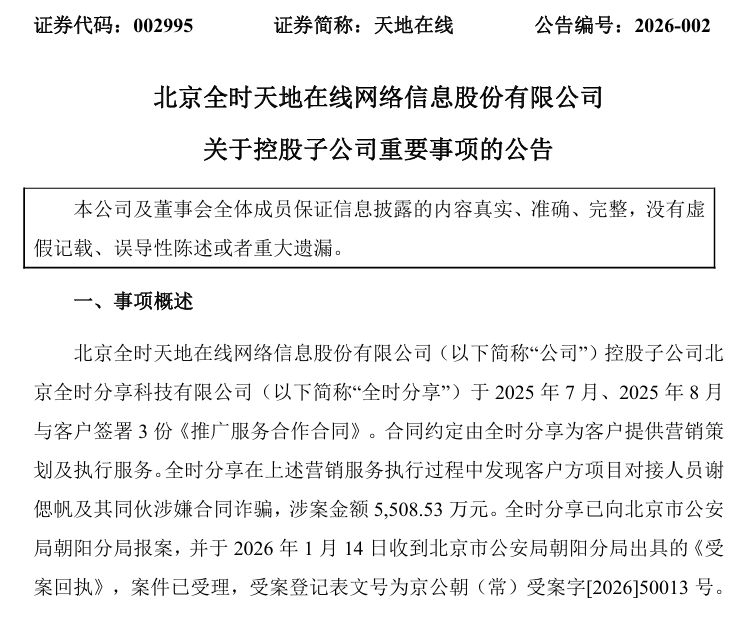
北京全时天地在线网络信息股份有限公司 关于控股子公司重要事项的公告
Zhong Guo Zheng Quan Bao - Zhong Zheng Wang· 2026-01-14 22:57
Summary of Key Points Core Viewpoint - The company has reported a case of contract fraud involving a total amount of 55.0853 million yuan, which has been reported to the police and is currently under investigation [1]. Group 1: Incident Overview - The company's subsidiary, Beijing Quanshi Sharing Technology Co., Ltd., signed three promotional service cooperation contracts in July and August 2025 [1]. - During the execution of these marketing services, the company discovered that a project liaison from the client, Xie Saifan, and his accomplices were suspected of fraud [1]. - The company has filed a report with the Chaoyang Branch of the Beijing Public Security Bureau, and the case has been accepted with a registration number [1]. Group 2: Management Response - The management has established a special task force to investigate the incident, manage aftermath, and control risks, successfully recovering 15.8693 million yuan so far [2]. - The company plans to enhance internal control management, focusing on partner qualification reviews, contract approvals, performance supervision, and payment approval processes to identify and rectify potential risks [2]. - The company will cooperate with the police investigation and take measures to recover losses while ensuring compliance with legal disclosure obligations [2].
天地在线(002995.SZ):控股子公司被合同诈骗,涉案金额5508.53万元
Ge Long Hui A P P· 2026-01-14 12:02
Core Viewpoint - Tian Di Online (002995.SZ) reported a contract fraud incident involving its subsidiary, Beijing Quanshi Sharing Technology Co., Ltd., with a total amount of 55.0853 million yuan [1] Group 1 - The subsidiary signed three promotional service cooperation contracts in July and August 2025, providing marketing planning and execution services [1] - The company discovered that project liaison personnel from the client, Xie Saifan and accomplices, were suspected of contract fraud [1] - The company has reported the case to the Chaoyang Branch of Beijing Public Security Bureau and received a case acceptance receipt on January 14, 2026 [1] Group 2 - The incident is classified as an isolated event and is not expected to significantly impact the company's normal operations [2] - The company has established a special working group to investigate the incident, manage aftermath, and control risks, having already recovered 15.8693 million yuan [2] - The company plans to enhance internal control management, focusing on partner qualification reviews, contract approvals, performance supervision, and payment approval processes to mitigate potential risks [2]
天地在线:控股子公司被合同诈骗,涉案金额5508.53万元
Ge Long Hui· 2026-01-14 11:41
Core Viewpoint - Tian Di Online (002995.SZ) reported a contract fraud incident involving its subsidiary, Beijing Quanshi Sharing Technology Co., Ltd., with a total amount of 55.0853 million yuan [1] Group 1 - The subsidiary signed three promotional service cooperation contracts with clients in July and August 2025 [1] - The fraud was discovered during the execution of marketing services, involving project liaison personnel Xie Saifan and accomplices [1] - The company has reported the case to the Chaoyang Branch of Beijing Public Security Bureau and received a case acceptance receipt on January 14, 2026 [1] Group 2 - The incident is classified as an isolated event and is not expected to significantly impact the company's normal operations [2] - A special task force has been established to investigate the incident, manage aftermath, and control risks, with 15.8693 million yuan already recovered [2] - The company plans to enhance internal control management, focusing on partner qualification reviews, contract approvals, performance supervision, and payment approval processes to mitigate potential risks [2]
东方雨虹:美国子公司疑遭电信诈骗
财联社· 2025-12-23 12:50
经初步核查,此次事件为偶发独立事件,不会对公司正常生产经营造成重大不利影响。同时,针对该事项,公司已成立专项工作组前往下属公司进 行事件核查、善后处置及风险管控工作。 北京东方雨虹防水技术股份有限公司 东方雨虹今日公告,公司近日获悉, 公司下属美国全资子公司OYH建材公司疑遭电信诈骗,涉案金额约171.83万美元(约1211.8万人民币)。 OYH建材公司在向总包方支付建设工程进度款时被犯罪分子入侵邮箱并伪造总包身份申请付款实施诈骗,在察觉到疑遭电信诈骗后,OYH建材公司 已向当地警方哈里斯县治安官办公室和W伍德斯托克警察局报案,同时已向美国联邦调查局FBI(Houston)报案,公司将全力配合当地警方工作, 争取最大限度避免损失。 7x24h电报 头条新闻 VIP资讯 实时盯盘 北京东方雨虹防水技术股份有限公司(以下简称"公司")近日获悉,公司 下属美国全资子公司 OYH Construction Materials LLC (以下简称"OYH 建材公 司")疑遭电信诈骗,涉案金额约 171.83万美元(约 1,211.80万人民币)。OYH 建材公司在向总包方支付建设工程进度款时被犯罪分子入侵邮箱并伪造总 ...


002271,突发!子公司疑遭电信诈骗
Zheng Quan Shi Bao· 2025-12-23 12:47
Core Viewpoint - Oriental Yuhong's wholly-owned subsidiary in the U.S., OYH Construction Materials LLC, is suspected to have fallen victim to a telecom fraud involving approximately $1.7183 million (about 12.118 million RMB) [1][4]. Group 1: Incident Details - The fraud occurred when criminals hacked into the email of the general contractor and forged their identity to request payment [4]. - OYH Construction Materials has reported the incident to local law enforcement and the FBI [4]. - The company has established a special task force to investigate the incident and manage risk control [4]. Group 2: Financial Performance - For the first three quarters of the year, Oriental Yuhong reported a revenue of 20.6 billion RMB, a decrease of 5.06% year-on-year [5][6]. - The net profit attributable to shareholders was 810 million RMB, down 36.61% compared to the previous year [5][6]. - The basic earnings per share were 0.1027 RMB, reflecting a decline of 26.64% year-on-year [6].
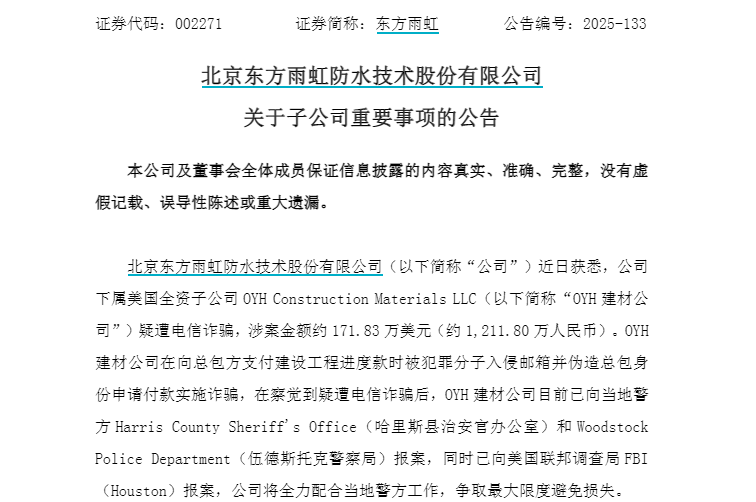
东方雨虹:美国子公司疑遭电信诈骗,涉案金额约1211万元
Xin Lang Cai Jing· 2025-12-23 10:46
Core Viewpoint - The company has reported a telecom fraud incident involving its wholly-owned subsidiary in the U.S., resulting in a loss of approximately $1.7183 million (about 12.118 million RMB) [1][2] Group 1: Incident Details - The fraud occurred when criminals hacked into the email of the general contractor and forged their identity to request payment during the construction progress payment process [1] - The company has reported the incident to local law enforcement agencies, including the Harris County Sheriff's Office and the Woodstock Police Department, as well as the FBI [1] Group 2: Company Response - Initial investigations indicate that this incident is an isolated occurrence and will not significantly impact the company's normal operations [2] - A special task force has been established to conduct investigations, manage aftermath, and implement risk control measures [2] - The management is taking the incident seriously and is enhancing internal control management, focusing on overseas subsidiaries, payment approval processes, and cybersecurity [2]
福瑞股份:内蒙古证监局对公司采取责令改正措施
Zhi Tong Cai Jing· 2025-12-10 11:51
Core Viewpoint - The company, Furuya Co., Ltd. (300049.SZ), has received a decision from the Inner Mongolia Regulatory Bureau of the China Securities Regulatory Commission, indicating several compliance issues related to internal controls and revenue recognition practices [1][2]. Group 1: Internal Control Issues - The company has inadequate internal control management over its overseas subsidiaries, lacking established risk management systems and supervision mechanisms, which violates the Corporate Governance Guidelines [1]. Group 2: Revenue Recognition Issues - The company has recognized revenue prematurely, with specific amounts of 240.89 thousand, 288.10 thousand, 567.03 thousand, and 134.17 thousand for the semi-annual and annual reports of 2023 and 2024, affecting the accuracy of financial disclosures [2]. - A specific instance in June 2023 involved the full recognition of revenue for a drug sale with a return clause, which was not properly accounted for when the product was returned in August, leading to inaccuracies in the semi-annual report [2]. - The company failed to reasonably estimate variable consideration such as sales discounts and rebates in its accounting for 2023 and 2024, resulting in full revenue recognition without appropriate adjustments [2].

双林股份: 内部控制管理制度(2025年9月)
Zheng Quan Zhi Xing· 2025-09-05 12:19
Core Viewpoint - The internal control management system of Shuanglin Co., Ltd. aims to enhance the company's operational standards and protect investors' rights by adhering to relevant laws and regulations [1][2]. Summary by Sections General Principles - The internal control system is established to ensure compliance with laws, improve operational efficiency, safeguard assets, and ensure accurate information disclosure [1]. - The board of directors is responsible for the formulation and effective execution of the internal control system [1]. Framework and Execution of Internal Control - The internal control encompasses environmental control, business control, accounting system control, electronic information system control, information transmission control, and internal audit control [1][2]. - The internal control system includes elements such as internal environment, goal setting, risk identification, risk assessment, risk response, control activities, and information communication [2][3]. Key Control Activities - The internal control system covers all business processes, including sales, procurement, production, research and development, fixed asset management, fund management, financing, investment, related party transactions, financial reporting, information disclosure, and human resource management [4][5][6]. - The company emphasizes the importance of internal audit and continuous monitoring to ensure the effectiveness of the internal control system [19][20]. Management Control of Subsidiaries - The company establishes control policies for its subsidiaries, ensuring they adhere to the internal control system and report significant business and financial matters to the board [17][18]. - The management control includes oversight of major financial and operational matters, requiring subsidiaries to report significant decisions and transactions [17][18]. Internal Control of Related Transactions - The company follows principles of honesty, equality, and fairness in related party transactions, ensuring that such transactions do not harm the interests of the company and its shareholders [22][23]. - Approval processes for related transactions are clearly defined, requiring independent directors' prior consent [22][23]. External Guarantee Control - The company implements strict controls over external guarantees, ensuring compliance with legal and regulatory requirements [31][32]. - The board must carefully evaluate the financial and operational status of the guaranteed parties before approving guarantees [32][33]. Use of Raised Funds Control - The company mandates strict management of raised funds, including storage, approval, usage, and supervision [41][42]. - Regular tracking of project progress and fund usage is required to ensure compliance with the intended purposes outlined in the prospectus [44][45]. Major Investment Control - The company adheres to principles of legality, prudence, and effectiveness in major investments, requiring thorough evaluation and monitoring of investment projects [50][51]. - A dedicated team is responsible for assessing the feasibility and risks associated with major investments [51][52]. Information Disclosure Control - The company ensures compliance with disclosure regulations, maintaining transparency in reporting significant information that may impact stock prices [57][58]. - A strict internal confidentiality policy is enforced to protect sensitive information before public disclosure [59][60]. Internal Audit and Evaluation - An internal audit department is established to oversee the implementation of the internal control system and ensure the accuracy of financial information [63][64]. - Regular audits are conducted to evaluate the effectiveness of internal controls, with findings reported to the audit committee [66][67].
