
加密寒冬

Search documents
Fundamentals Over Flows: Why Crypto Winter May Be Healthy Reset
Etftrends· 2026-02-18 14:42
Core Viewpoint - The recent performance of digital assets, particularly bitcoin, is challenging investor confidence regarding both the short-term growth potential of the category and bitcoin's role as a safe-haven asset similar to gold [1] Group 1: Digital Asset Performance - Bitcoin's recent performance has been under scrutiny, testing the conviction of investors in its growth potential [1] - The fluctuations in bitcoin's value are raising questions about its status as a reliable store of value akin to gold [1]


加密货币在流动性稀薄之际小幅走高
Sou Hu Cai Jing· 2026-02-16 14:16
Core Viewpoint - The recent sharp sell-off in the cryptocurrency market has diminished, but liquidity is thin due to the U.S. holiday, indicating that a recovery is not yet assured [1] Group 1: Market Conditions - The relative calm in the cryptocurrency market marks a significant change compared to the frantic sell-offs of recent months [1] - Precious metals continue to rise, exerting pressure on cryptocurrencies amid cautious risk appetite [1] Group 2: Price Movements - Bitcoin has increased by 0.9% to $69,498 after earlier declines, while Ethereum has risen by 1.7% to $1,989 [1] - On February 6, Bitcoin hit a 16-month low of $60,008, and Ethereum reached a nine-month low of $1,751 [1] Group 3: Future Outlook - A sustained recovery in the cryptocurrency market requires a revival in prices and market interest, especially in light of the anticipated "crypto winter" in 2025/26 [1]
比特币6万大关“命悬一线”!分析师直指:“熊市已至”,零目标价悲观预警震荡市场
美股IPO· 2026-02-06 03:52
Core Viewpoint - Bitcoin has experienced significant declines, with a drop of over 48% since its peak last October, leading to a total market capitalization reduction from $2.48 trillion to $1.27 trillion [3] Market Performance - Bitcoin fell to around $60,033, marking a 12% drop and a new low for October 2023, before rebounding to $65,605 [1] - The market sentiment has turned bearish, with analysts warning of a potential bear market for Bitcoin [5][4] Market Dynamics - Approximately $2.3 billion in leveraged long positions were liquidated in the past 24 hours, indicating a rapid acceleration in sell-offs [3] - The loss of the $70,000 psychological support level has triggered fears of larger sell-offs, with traders now focusing on whether Bitcoin can hold the $60,000 level [3] Analyst Predictions - Analysts express pessimism regarding Bitcoin's future, with some predicting a price target of zero due to its speculative nature and lack of intrinsic value [7][8] - Concerns have been raised about Bitcoin's potential to enter a "death spiral," which could lead to significant losses for major holders [5] Institutional Behavior - Institutional investors have been selling off Bitcoin positions, with significant outflows from Bitcoin ETFs contributing to downward pressure on prices [9] - The adoption rate of cryptocurrencies among U.S. consumers has declined from 17% in July 2025 to 12% currently, reflecting a broader loss of interest [9] Regulatory Environment - Regulatory uncertainty has been identified as a key factor affecting Bitcoin's performance, with stalled legislation contributing to market pressures [10] - The potential passage of the U.S. market structure bill could serve as a catalyst for restoring investor confidence and increasing capital inflows [11] Market Volatility - Bitcoin's 30-day volatility has risen to 40.72, indicating increased market fluctuations and sensitivity to negative news [10] - Historical patterns suggest that significant declines beyond 40% could lead to prolonged bear markets, raising concerns about a potential "crypto winter" [11]

比特币6万大关“命悬一线”!分析师直指:“熊市已至”,零目标价悲观预警震荡市场
智通财经网· 2026-02-06 03:10
Core Viewpoint - Bitcoin has experienced a significant decline, dropping to around $60,033, marking a 12% decrease and a new low since October 2023, with a cumulative drop of over 48% since its peak last year [1][3] Market Performance - Bitcoin's market capitalization has shrunk from $2.48 trillion to $1.27 trillion [1] - Approximately $2.3 billion in leveraged long positions were liquidated in the past 24 hours [1] - Analysts are closely monitoring whether Bitcoin can maintain the $60,000 support level, with potential downside extending to around $55,000 if it fails [2] Analyst Sentiment - Market participants are increasingly pessimistic about Bitcoin's future, with some analysts declaring it has entered a bear market [3] - Concerns have been raised about a potential "death spiral" for Bitcoin, which could lead to significant losses for companies heavily invested in it [3] - Michael Burry warns that further declines could force Bitcoin miners into bankruptcy [4] Institutional Involvement - Strategy's founder, Michael Saylor, claims the company currently faces no immediate financial pressure and has raised $2.25 billion in cash to cover future obligations [4] - However, if Bitcoin does not rebound, the company's flexibility may diminish [4] - Burry emphasizes that Bitcoin lacks intrinsic value to support its price, and the presence of nearly 200 publicly traded companies holding Bitcoin does not guarantee market stability [4] Market Dynamics - Analysts attribute the recent Bitcoin decline to factors such as reduced liquidity, slowing fund inflows, and a lack of macroeconomic appeal [6] - Institutional outflows have been significant, with over $3 billion in redemptions from Bitcoin ETFs in recent months [6] - Retail participation in the cryptocurrency market has also declined, with adoption rates dropping from 17% to 12% among U.S. consumers [6] Regulatory Environment - Regulatory uncertainty is a major factor affecting Bitcoin's performance, with the CLARITY Act stalled in Congress [7] - Delays in regulatory progress have hindered Bitcoin's momentum, which had previously benefited from early legislative advancements [7] - The potential passage of the U.S. market structure bill could act as a catalyst for restoring investor confidence [7] Economic Sensitivity - Bitcoin is highly sensitive to U.S. banking liquidity, with concerns about the Federal Reserve's potential balance sheet reduction adding to market anxiety [8] - The possibility of a prolonged "crypto winter" is increasing, as historical patterns suggest that significant declines can lead to extended bear markets [8]
比特币:“信仰交易”的终结
Hua Er Jie Jian Wen· 2026-02-05 10:28
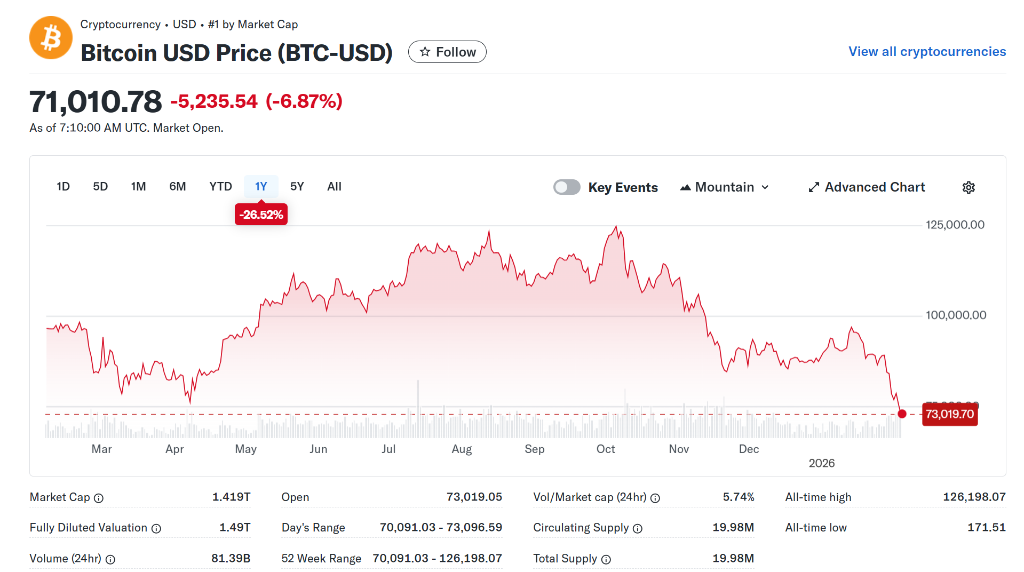
Core Viewpoint - Bitcoin is undergoing a painful transition from a purely speculative asset to an institutional asset, marked by a significant price drop from approximately $125,000 in October 2025 to around $73,000 in February 2026, a decline of over 40% [1][20]. Group 1: Market Dynamics - The recent decline in Bitcoin's price is attributed to three main drivers: hawkish signals from the Federal Reserve, continued outflows of institutional funds, and stagnation in regulatory progress [1]. - Institutional funds are experiencing significant outflows, with Bitcoin ETFs facing large-scale redemptions, leading to a cumulative outflow of over $30 billion in recent months [4]. - The overall sentiment in the cryptocurrency market is increasingly pessimistic, as indicated by the Crypto Fear and Greed Index dropping to around 15 points, reflecting "extreme fear" [4]. Group 2: Price Levels and Technical Analysis - Bitcoin has breached the average entry price of $81,600 for U.S. spot ETFs and is approaching a critical psychological level of around $70,000, which is significant due to its political implications related to the upcoming U.S. elections [12]. - The price drop has resulted in average holders being in a loss position, indicating a shift in market dynamics [12]. Group 3: Regulatory Environment - Regulatory uncertainty is hindering Bitcoin's performance, with the bipartisan CLARITY Act stalled in Congress, which aims to establish a framework for digital asset classification [11]. - The lack of regulatory momentum is affecting investor confidence and liquidity in the market, as previous regulatory advancements had helped reduce Bitcoin's volatility [11]. Group 4: Correlation with Traditional Assets - Bitcoin's price movements are increasingly decoupling from traditional assets like gold and stock indices, with its correlation to the Nasdaq and S&P 500 dropping to around 15%, compared to much higher levels during previous market sell-offs [6][8]. - This decoupling suggests a re-evaluation of Bitcoin's risk asset status, as it no longer behaves as a "digital gold" [6]. Group 5: Long-term Transition - The transition from a speculative asset to a more mature investment is evident, with Bitcoin's price increasing approximately 370% from early 2023, despite recent declines [2][20]. - The narrative surrounding Bitcoin as a payment method or currency is being challenged, as it lacks essential characteristics such as a medium of exchange and a stable store of value [21].
ZFX山海证券:比特币走低 加密寒冬
Xin Lang Cai Jing· 2026-02-04 14:14
Group 1 - The digital asset market is experiencing significant declines, with Bitcoin recently dropping below key support levels, reflecting a tightening liquidity environment and pushing cryptocurrencies into deeper technical adjustments [1][3] - The recent sell-off in the stock market, particularly in the software and technology sectors, has led to substantial declines in major companies like Adobe and Salesforce, with drops ranging from 7% to 12%, and a 14% decrease in the Technology Software ETF (IGV) over a week [2][5] - The outflow of approximately $3 billion from Bitcoin ETFs over the past two weeks indicates a bearish market trend, further confirming the characteristics of a bear market [2][5] Group 2 - The current asset volatility is attributed to a combination of tightening macro liquidity and a revaluation of technology stocks, with Bitcoin undergoing a severe winter similar to past cycles in 2018 and 2022 [3][6] - ZFX suggests that investors should closely monitor the stabilization signals of the Nasdaq index and the defense performance of the 73,000 key support level to identify opportunities for asset reallocation amid volatility [6]

比特币盘中跌近8%、跌破7.3万,抹平特朗普当选以来涨幅
Hua Er Jie Jian Wen· 2026-02-03 20:25
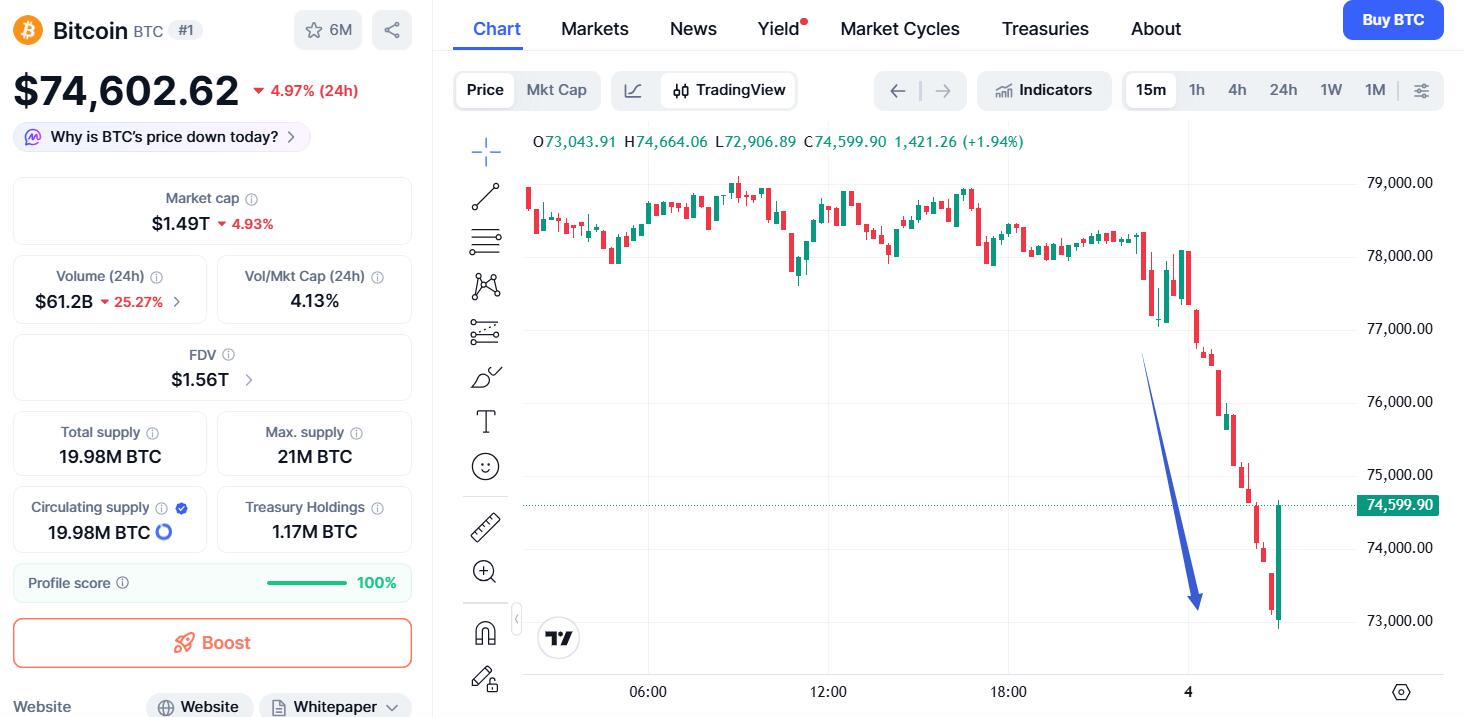
Core Viewpoint - Bitcoin has dropped to its lowest point since Trump's return to the White House, erasing gains accumulated since his election, with a decline of over 40% since its peak in October 2025 [1] Group 1: Market Performance - Bitcoin fell below $73,000, dropping over $6,000 from its earlier high of $79,100, marking an 8% decline and reaching its lowest level since early November 2024 [1] - Ethereum, the second-largest cryptocurrency by market capitalization, experienced a sharper decline, falling below $2,110, down over 10% from its earlier high of $2,350 [3] - Since the beginning of 2026, Bitcoin has accumulated a decline of over 15%, reflecting ongoing investor concerns about economic headwinds [5] Group 2: Market Sentiment and Trading Behavior - The cryptocurrency market sentiment has reached a low point, with traders operating in a bear market mode, as noted by Augustine Fan from SignalPlus [5] - Many traders attempted to buy the dip, betting on a rebound above $80,000, but continued declines led to significant liquidations, increasing selling pressure [5] - The cryptocurrency market has faced persistent downward pressure since the sell-off in October 2025, which wiped out $19 billion in leveraged token bets [5] Group 3: Institutional vs. Retail Participation - While some institutional holders remain steadfast, retail participation has decreased as major long-term Bitcoin holders sold off billions in assets [6] - The MarketVector Digital Assets 100 Small-Cap index, tracking the smallest 50 digital assets, has plummeted nearly 70% over the past year, underperforming Bitcoin and Ethereum [6] - Significant outflows from spot ETFs, largely held by retail investors, were observed in November, indicating a shift in market dynamics [6] Group 4: Market Outlook - The cryptocurrency market has been in a comprehensive winter since January 2025, akin to past bear markets in 2018 and 2022, as stated by Matt Hougan from Bitwise [6] - Hougan suggests that this bear market may be nearing its end, with historical down cycles typically lasting around 13 months, indicating a potential bottoming out in the coming weeks [6]
深夜,全线下跌!刚刚,16.39万人爆仓!
Sou Hu Cai Jing· 2026-01-01 16:01
Core Insights - The cryptocurrency market experienced a significant downturn on January 1, 2026, with Bitcoin and other major cryptocurrencies declining in value, leading to over $2 billion in liquidations and affecting more than 163,900 traders [1][2][3] Market Performance - Bitcoin fell from approximately $89,000 to around $87,800, marking a decline of over 1% within 24 hours, while other cryptocurrencies like Cardano and Dogecoin saw declines of over 3% and 2% respectively [2] - Bitcoin's price has dropped over 30% since reaching a historical high of $126,200 in October 2025, with December 2025 recording a decline of over 22%, the worst monthly performance since December 2018 [3][5] Analyst Predictions - Analysts from Cantor predict a potential "crypto winter," suggesting that Bitcoin's price may continue to decline over the next year, despite a long-term optimistic outlook on institutional adoption and regulatory clarity [4] - The market sentiment has shifted, with fears of a crypto winter potentially triggering further declines, as marginal buyers retreat due to fear [4] Market Dynamics - The options market reflects a standoff between bulls and bears, with put options concentrated around $85,000 and call options spread between $100,000 and $120,000 [3] - The recent downturn has led to a reassessment of market catalysts, with analysts noting that the excitement from the "Trump rally" and regulatory easing has faded, leaving only the potential for a rate-cutting cycle as a remaining bullish catalyst [5] Institutional Sentiment - Standard Chartered has significantly lowered its Bitcoin price target for 2026 from $300,000 to $150,000, indicating a bearish outlook for the cryptocurrency market [5] - The performance of Bitcoin and other cryptocurrencies has lagged behind stocks and precious metals since the October 2025 crash, signaling a lack of effective market catalysts [5] Liquidity Concerns - The decline in the adjusted net asset value (mNAV) of digital asset treasury companies raises concerns about potential forced liquidations in a liquidity-constrained market, which could exacerbate selling pressure [6]
深夜,全线下跌!刚刚,16.39万人爆仓!
券商中国· 2026-01-01 15:41
Core Viewpoint - The cryptocurrency market experienced a significant downturn at the beginning of 2026, with Bitcoin and other major cryptocurrencies seeing substantial declines, leading to over 16,000 liquidations and a total loss exceeding $2 billion in the past 24 hours [1][2][3]. Market Performance - As of January 1, 2026, Bitcoin dropped from approximately $89,000 to around $87,800, marking a decline of over 1% within 24 hours. Other cryptocurrencies like Cardano and Dogecoin also faced declines of over 3% and 2%, respectively [3]. - Bitcoin's price has fallen more than 30% since reaching a historical high of $126,000 in October 2025, with a monthly decline of over 22% in December 2025, the worst performance since December 2018 [4][6]. Liquidation Data - Coinglass reported that the total liquidation in the cryptocurrency market reached $2.28 billion in the last 24 hours, with long positions accounting for $1.57 billion and short positions for $0.71 billion. The largest single liquidation occurred on Hyperliquid-BTC-USD, valued at $5.8577 million [3][4]. Analyst Predictions - Analysts from Cantor predict that Bitcoin's price may continue to decline over the next year, despite a long-term optimistic outlook on institutional adoption and regulatory clarity. They suggest that the fear of a crypto winter could trigger further price drops [6]. - Some analysts believe that Bitcoin's price may stabilize between $80,000 and $100,000 in the first quarter of 2026, rather than experiencing a strong upward trend [7]. Market Sentiment - The cryptocurrency market has shown significant weakness compared to stocks and precious metals since the October 2025 crash, indicating that previous market catalysts have not met expectations, and new catalysts for 2026 have yet to emerge [8]. - The ongoing fear of a crypto winter is causing market participants to be cautious, with many analysts suggesting that the current market conditions may lead to further declines in Bitcoin's price [6][9].

机构:比特币寒冬将至,未来一年价格可能进一步走低
Xin Lang Cai Jing· 2025-12-31 12:50
Core Viewpoint - Bitcoin has dropped over 30% from its historical high of $125,000 reached in October, with analysts from Cantor predicting an impending "crypto winter" that may further depress prices in the coming year [1] Group 1: Market Analysis - Cantor's analysts maintain a long-term optimistic outlook on institutional adoption and regulatory clarity for Bitcoin, despite expecting weak trading performance to drag down prices over the next year [1] - The fear of a crypto winter itself may trigger the winter, as marginal buyers retreat due to fear [1] Group 2: Price Trends - Currently, the market is approximately 85 days into a decline from peak to trough, a process that typically lasts around 365 days [1] - Bitcoin is expected to continue weakening in the coming months as fear drives away marginal buyers [1]