
数字资产

Search documents
Bitcoin Policy Institute Voices Strong Opposition to PARITY Act
Yahoo Finance· 2026-03-27 18:47
Core Viewpoint - The introduction of the Digital Asset PARITY Act aims to clarify the U.S. tax code regarding digital assets, addressing various aspects of taxation and regulation in the digital asset space [1]. Tax Code Refinements - The Digital Asset PARITY Act seeks to refine the Internal Revenue Code of 1986 with specific provisions for digital assets [4]. - Key provisions include: - **Stablecoin Treatment**: Gains or losses on regulated payment stablecoin transactions will be eliminated if the price deviation from the dollar peg is within 1% [4]. - **Foreign Safe Harbor**: Extends existing safe harbor provisions for foreign investors to digital assets, ensuring trades within U.S. accounts of foreign investors are not subject to U.S. tax [4]. - **Lending Treatment**: Taxpayers will not recognize capital gains or losses when transferring digital assets under lending agreements, similar to securities [4]. - **Wash Trading Treatment**: Wash trading prohibitions will be extended to all digital assets, not just stocks or securities [4]. - **Staking Tax Treatment**: Allows "passive stakers" to defer tax consequences on income earned from staking digital assets [4]. Industry Opposition - The Bitcoin Policy Institute (BPI) opposes the staking tax provisions, arguing that the act favors proof-of-stake networks and lacks technological neutrality regarding proof-of-work networks like Bitcoin [3][4].
TeraWulf 2025 年营收增长 20.3% 至 1.685 亿美元 净亏损扩大至 6....
Xin Lang Cai Jing· 2026-02-27 04:25
Core Insights - TeraWulf reported total revenue of $168.5 million for the year 2025, representing a year-over-year increase of 20.3% [1] - The company experienced a significant net loss of $661.4 million, compared to a loss of $72.4 million in 2024 [1] - Adjusted EBITDA loss was $23.1 million [1] Revenue Breakdown - The HPC leasing business contributed $16.9 million to the total revenue [1] - Digital asset revenue for the fourth quarter was $26.1 million, showing a quarter-over-quarter decline from $43.4 million in the third quarter [1] - HPC leasing revenue for the fourth quarter was $9.7 million, reflecting a quarter-over-quarter increase from $7.2 million in the third quarter [1]
Fundamentals Over Flows: Why Crypto Winter May Be Healthy Reset
Etftrends· 2026-02-18 14:42
Core Viewpoint - The recent performance of digital assets, particularly bitcoin, is challenging investor confidence regarding both the short-term growth potential of the category and bitcoin's role as a safe-haven asset similar to gold [1] Group 1: Digital Asset Performance - Bitcoin's recent performance has been under scrutiny, testing the conviction of investors in its growth potential [1] - The fluctuations in bitcoin's value are raising questions about its status as a reliable store of value akin to gold [1]


Btc Digital股价下跌5.60%,受加密货币市场整体调整及公司基本面偏弱影响
Jing Ji Guan Cha Wang· 2026-02-11 18:21
Group 1: Core Viewpoint - Btc Digital Ltd. experienced a 5.60% decline in stock price on February 11, 2026, closing at $1.18, primarily due to overall pressure in the cryptocurrency market, weak company fundamentals, technical sell-offs, and insufficient liquidity [1][2]. Group 2: Recent Stock Performance - In early February 2026, the cryptocurrency market faced significant adjustments, with Bitcoin dropping over 8% on February 5, falling below the $70,000 mark, which negatively impacted related stocks, including Btc Digital Ltd. [2]. Group 3: Company Fundamentals - Btc Digital Ltd. reported relatively small revenue figures and negative net profit in its recent financial statements, indicating weak fundamentals that may make the company more susceptible to selling pressure during market volatility [3]. - The company currently lacks coverage from major brokerage firms, resulting in a lack of clear valuation benchmarks, which weakens liquidity support during market panic [3]. Group 4: Market and Technical Analysis - On the day of the stock price decline, the trading volume was only $41,700, with a turnover rate of 0.37%, indicating low market participation. In a low liquidity environment, even small sell orders can significantly amplify price fluctuations [4]. Group 5: Future Outlook - As of February 11, 2026, the stock has declined 9.23% year-to-date, with a 29.76% drop over the past 20 days. This long-term downward trend may undermine investor confidence, leading to behavior of reducing holdings upon any rebounds [5].
Hong Kong ready to issue first stablecoin licenses in March, Financial Secretary says
Yahoo Finance· 2026-02-11 09:39
Group 1 - Hong Kong is set to issue its first stablecoin licenses next month, with a focus on ensuring licensees have innovative use cases, credible business models, and strong regulatory compliance [1] - A small batch of licenses will be issued initially as part of the regulatory framework for the digital asset ecosystem [2] - The licensing regime for custodian service providers is also being finalized, with legislation expected to be introduced this summer [2] Group 2 - Three key trends are emerging: the growth of tokenized products, the interaction between decentralized finance (DeFi) and traditional finance, and the integration of artificial intelligence (AI) with digital assets [3] - Tokenization is moving from proof of concept to real-world applications, with institutional adoption of government bonds and money market funds being issued on-chain to improve settlement efficiency and liquidity [4] - AI agents are evolving to make independent decisions, potentially leading to a "machine economy" where they can hold and transfer digital assets and transact on-chain [5]
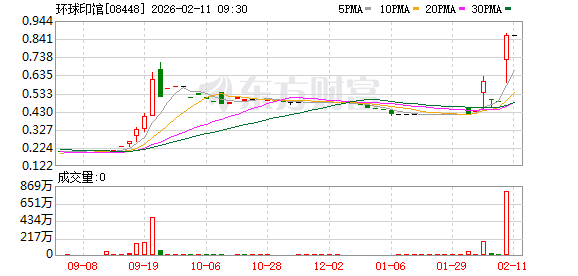
名品世家要“借壳上市”?陈明辉拟入主环球印馆 股价暴涨
Nan Fang Du Shi Bao· 2026-02-11 01:01
Group 1 - The founder of Mingpin Shijia, Chen Minghui, is set to acquire a controlling stake in Global Printing Holdings, leading to a significant stock price increase of over 75% [2][3][7] - The acquisition involves Digital Intelligence Holdings Limited, which is fully controlled by Chen Minghui, and aims to purchase approximately 65.54% of Global Printing Holdings for about 22.89 million HKD at a price of 0.35 HKD per share [3][4] - Mingpin Shijia has plans to potentially integrate some of its business operations into the Hong Kong-listed company following the acquisition [2][4] Group 2 - Mingpin Shijia, established in 2008, focuses on the construction and operation of wine retail chains and had previously been listed on the New Third Board before delisting in early 2024 [4][5] - As of the end of 2022, Mingpin Shijia had over 1,180 franchise and cooperative stores, employing a diversified business model that includes offline retail, e-commerce, and cross-industry operations [5] - The company reported fluctuating financial performance, with revenues of 1.02 billion, 1.34 billion, and 1.05 billion CNY from 2020 to 2022, and a net profit of approximately 56 million CNY in the first half of 2023 [10] Group 3 - The liquor distribution industry is facing challenges, with many companies, including Mingpin Shijia, exploring alternative routes to public listing due to difficulties in A-share IPOs [8] - Analysts highlight the complexities of reverse mergers in the Hong Kong market, particularly regarding regulatory hurdles and the potential for significant changes in the business model of the listed company [8][9] - The liquor market in China exceeds one trillion CNY but remains fragmented, with leading companies like Huazhi Wine and 1919 facing operational difficulties amid a downturn in the industry [8][9]
德勤:香港家办数量两年增加25%,超六成计划重新配置香港资产
2 1 Shi Ji Jing Ji Bao Dao· 2026-02-10 12:23
Group 1 - The core finding of Deloitte's report indicates that the number of single-family offices in Hong Kong is projected to reach 3,384 by the end of 2025, representing an increase of 681 offices or 25% from the end of 2023 [1] - The report highlights that Hong Kong is perceived as more attractive for family offices compared to Singapore, with a noticeable trend of clients shifting their focus from Singapore to Hong Kong [1] - Key factors attracting family offices to Hong Kong include the lack of government approval required to establish a family office, high flexibility, and the absence of restrictions on investing in local assets [1] Group 2 - The report categorizes family offices by wealth levels, revealing that there are 1,095 offices with over $100 million in wealth, 859 offices in the $51 million to $100 million range, 744 offices in the $31 million to $50 million range, and 686 offices in the $10 million to $30 million range [2] - It is estimated that these family offices contribute approximately HKD 12.6 billion to the Hong Kong economy annually and create over 10,000 professional service jobs [2] - The Hong Kong government is expected to include digital asset trading in the tax exemption scope for single-family offices by the first half of 2026, with suggestions for tax rate reductions on management fees for larger management companies [2] Group 3 - Currently, 53% of family offices hold digital assets, and 58% have allocated investments in commodities and precious metals [3] - Future investment plans indicate that 40% of family offices intend to increase their investment in digital assets, second only to public market stocks at 45% [3] - The technology, media, and telecommunications (TMT) sector, along with health and medical care, are areas of increasing interest, with 62% of family offices planning to boost investments in artificial intelligence and data science over the next three years [3]
Nomura (NMR) - 2026 Q3 - Earnings Call Transcript
2026-01-30 10:32
Financial Data and Key Metrics Changes - Return on equity was 10.3%, meeting the 2030 target of 8%-10% for the seventh consecutive quarter [3] - Group-wide net revenue reached JPY 551.8 billion, a 7% increase from the previous quarter [3] - Income before income taxes decreased by 1% to JPY 135.2 billion, while net income also fell by 1% to JPY 91.6 billion [3] - Earnings per share for the quarter were JPY 30.19 [3] Business Line Data and Key Metrics Changes - Wealth Management saw a growth of approximately 30% compared to the previous quarter, with net revenue increasing by 14% to JPY 132.5 billion [4][8] - Investment Management's business revenue reached an all-time high, but profits fell due to weaker investment gains and one-time expenses related to the Macquarie acquisition [4][12] - Wholesale net revenue rose by 12% to JPY 313.9 billion, with investment banking net revenue increasing by 31% to JPY 57.1 billion [15][17] Market Data and Key Metrics Changes - Recurring revenue assets saw a net inflow of JPY 503.9 billion, reaching an all-time high of JPY 28.1 trillion by the end of December [10][11] - The number of flow business clients increased by around 270,000 to 1.53 million, driven by buoyant market conditions [11] Company Strategy and Development Direction - The company announced a share buyback program with a limit of 100 million shares and JPY 60 billion in amount, aimed at enhancing shareholder return and capital efficiency [5] - The company is focused on maximizing synergies between existing and newly acquired businesses, particularly in the Investment Management division [26] Management's Comments on Operating Environment and Future Outlook - Management noted that client sentiment remains favorable despite some selling pressures in the market, with a shift from savings to investment being a sustainable trend [21][22] - The company expects a solid pipeline in investment banking, despite a slower start in Q4 due to seasonal factors [22] Other Important Information - Group-wide expenses increased by 10% to JPY 416.5 billion, driven by one-time costs associated with acquisitions and strategic investments [19] - The common equity Tier 1 ratio at the end of December was 12.8%, with a slight decrease attributed to changes in regulatory capital calculations following the Macquarie acquisition [20] Q&A Session Summary Question: Regarding Laser Digital's losses and position management - Management acknowledged the losses due to market fluctuations and emphasized the importance of precise position management to control volatility [31] Question: Sustainability of Wealth Management's net inflow - Management refrained from making definitive comments on sustainability but noted a significant shift in retail investor behavior towards investment [32] Question: Wealth Management pricing strategy - Management declined to comment on internal discussions regarding commission rate increases, focusing instead on value provision to customers [38] Question: Timing and scale of buyback - Management explained that the timing was influenced by the recent acquisition and the need to meet investor expectations [39] Question: Impact of personnel costs and deferred compensation - Management provided details on the expected impact of accounting changes on personnel costs, estimating around JPY 8 billion for Q4 [52] Question: Long-term strategy for Laser Digital - Management discussed the need for a thorough strategy to manage the growth and volatility of the digital asset business while ensuring diverse activities [54]

香港银公调查:愈来愈多市民将数字资产纳入整体财富管理策略中
智通财经网· 2026-01-29 08:07
Core Insights - Digital banks are becoming a crucial bridge for citizens to access the Web3 ecosystem and diversify wealth management strategies, leveraging their flexibility and innovation [1][2] - A significant portion of the public recognizes the advantages of digital banks, including a broad service range (60.4%) and competitive exchange rates and terms (56.4%), which enhance asset allocation flexibility and efficiency [1] - There is a growing emphasis on the innovation capabilities and user experience of financial institutions, with digital banks complementing traditional banks by offering high flexibility in digitalization and Web3 applications [1] Group 1 - The survey indicates that 57.6% of the public and 81.5% of small and medium enterprises are aware of the recently passed Stablecoin Bill, reflecting increased attention on digital asset applications [2] - Respondents expect digital banks to provide services related to digital asset "storage management," "daily payments," and "risk management," expanding the wealth management toolset [2] - The spokesperson for the Hong Kong Banking Association emphasizes the unique value of digital banks in providing innovative wealth management experiences, particularly in the context of digital assets and the Web3 ecosystem [2]
香港证监会与阿联酋资本市场管理局签订谅解备忘录 加强跨境数字资产合作共创新里程
Xin Lang Cai Jing· 2026-01-27 10:49
Group 1 - The core point of the article is the signing of a memorandum of understanding (MoU) between the Hong Kong Securities and Futures Commission (SFC) and the Capital Market Authority of the United Arab Emirates (UAE) to enhance cross-border regulatory cooperation on digital assets [1] - This MoU is the first agreement signed by the Hong Kong SFC with an overseas regulatory body regarding the regulation of digital asset entities [1] - The memorandum establishes a framework for enhanced regulatory cooperation, including mutual consultation and information exchange on the regulation of cross-border digital asset entities [1]
