
多层次多支柱养老保险体系

Search documents
全省养老金融知识宣讲活动启动
Xin Hua Ri Bao· 2026-02-10 00:23
Core Viewpoint - The Jiangsu province is enhancing public awareness of pension planning and financial literacy through a series of public welfare activities aimed at building a multi-tiered pension insurance system [1] Group 1: Event Overview - The first public welfare activity for pension financial knowledge was held in Nanjing on February 6, initiated by the Jiangsu Regulatory Bureau of the National Financial Regulatory Administration and the Jiangsu Provincial Human Resources and Social Security Department [1] - The activities will continue until June of this year, with a focus on educating the public about pension insurance systems, enterprise annuities, personal pensions, and commercial pension insurance [1] Group 2: Financial Development in Jiangsu - Jiangsu has been actively channeling financial resources into the pension sector, resulting in significant growth in pension finance [1] - By the end of 2025, the balance of commercial pension pilot accounts in the province is expected to exceed 7.6 billion yuan, with over 16 million personal pension accounts opened [1] - The annual premium income from pension annuity insurance reached 24.639 billion yuan, marking a year-on-year increase of 110.76% [1] - Under policy guidance, the "Hui Min Bao" insurance has covered over 10 million people, and long-term care insurance has achieved full coverage in municipal districts, benefiting 9.5 million elderly individuals with inclusive accident insurance [1] Group 3: Future Directions - The Jiangsu Provincial Human Resources and Social Security Department plans to strengthen information sharing and policy collaboration with the financial regulatory bureau to create a synergistic development force [2] - The Jiangsu Financial Regulatory Bureau emphasizes the need for financial institutions to continuously enrich product offerings and deepen the entire pension service industry chain to support the establishment of a "Su Suitable Pension" financial ecosystem [2]
专注养老主责主业 服务经济社会发展 访新华养老保险股份有限公司党委书记、董事长李文峰
Jin Rong Shi Bao· 2026-01-26 02:04
Core Viewpoint - The article discusses the strategic initiatives of Xinhua Pension Insurance Co., Ltd. in response to the 14th Five-Year Plan, emphasizing the importance of enhancing the social security system and developing a multi-tiered pension insurance framework to support economic and social development during this period [1]. Group 1: Company Strategy - Xinhua Pension Insurance aims to integrate the Party's leadership into corporate governance, ensuring that business development aligns with national financial policies and high-quality growth objectives [2]. - The company focuses on its core pension business while expanding its investment in related sectors, aiming to meet diverse pension and wealth management needs of the public [2]. - Xinhua Pension Insurance plans to leverage its capital to support the real economy, with a projected investment balance in financial "five major articles" expected to grow nearly 63% by the end of 2025 [3]. Group 2: Product Development - The company recognizes the need for diversified pension products to address the varied demands arising from an aging population, developing commercial pension insurance and annuity products that cater to different risk preferences and payout options [4]. - Xinhua Pension Insurance is committed to integrating high-quality resources to support the Healthy China strategy, offering standardized solutions that combine pension management with health and long-term care services [5]. Group 3: Investment and Risk Management - The company has established a robust investment management system tailored to the characteristics of second and third pillar pension funds, achieving competitive returns with annual interest rates of 4% for stable return products [6]. - Xinhua Pension Insurance has optimized its operational model for annuity funds, successfully securing contracts with major enterprises and enhancing service quality for corporate clients [7]. Group 4: Market Adaptation - The company has developed a comprehensive product system covering all life stages, with over 40 billion yuan in commercial annuity scale, and plans to introduce nearly 10 new products in 2025 [8]. - Xinhua Pension Insurance is adapting to changing consumer purchasing habits by creating a multi-channel sales system, enhancing accessibility and convenience for customers seeking pension insurance products [8].
养老保险将如何改革?
Xin Lang Cai Jing· 2026-01-23 04:16
Core Insights - The current pension insurance mechanism is facing a significant crisis, with many individuals reluctant to contribute to social insurance due to perceived unprofitability and an unclear expectation of future pension returns [1][16]. Group 1: Key Adjustments in Pension Policy - The recent "15th Five-Year Plan" has made three key adjustments in the pension insurance sector: 1. The strategic importance of pension insurance has been elevated, moving from 10th to 9th in the planning sequence [3][18]. 2. The language has become broader, shifting from "achieving national coordination of enterprise employee basic pension insurance" to "implementing national coordination of pension insurance," removing the limitation to "enterprise employees" [3][18]. 3. There is an increased emphasis on a multi-tiered pension system, with a focus on accelerating development compared to the previous plan [3][18]. Group 2: Pension System Performance During the 14th Five-Year Plan - The growth rate of pensions has shown a declining trend, decreasing from 4.5% in 2021 to 2% by 2025 [5][20]. - The number of participants in pension insurance increased from 1.03 billion to 1.06 billion between the end of 2021 and early 2025 [6][21]. - Despite a decrease in GDP growth from over 6% to approximately 5.5% and increased local fiscal pressure, pensions have continued to grow annually [22][23]. Group 3: Nationwide Coordination of Pension Insurance - Nationwide coordination aims to unify pension policies across urban and rural residents, addressing long-standing disparities in pension levels between regions and demographics [7][23]. - The historical contribution of various regions and labor groups is acknowledged, emphasizing the need for a fairer pension distribution system [8][24]. Group 4: Enhancing Social Security and Economic Stability - The "15th Five-Year Plan" aims to enhance the resilience of the social security system by transitioning from local to centralized management of pension funds, thereby mitigating payment crises in financially strained regions [13][29]. - Increasing pension levels for low-income retirees is seen as a direct method to stimulate domestic consumption, especially in a deflationary environment [13][29]. Group 5: Addressing Psychological Barriers in Pension Contributions - The current pay-as-you-go system creates a disconnect for urban workers whose parents remain in rural areas, leading to concerns about the sustainability of their own pension contributions [14][30]. - The plan includes measures to strengthen the basic pension system and encourage supplementary pension investments, aiming for a more equitable distribution of pension benefits [14][30]. Group 6: Future Directions for Pension Reform - The focus for the next five years will shift towards structural reforms in the pension system, aiming to create a fairer, more sustainable, and higher-quality pension framework [15][31].
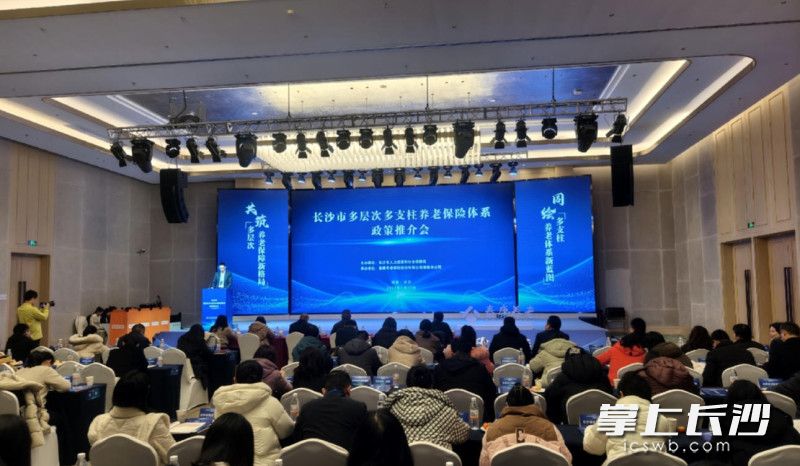
长沙初步建成多层次多支柱养老保险体系
Xin Lang Cai Jing· 2026-01-22 15:07
Group 1 - The core viewpoint of the article emphasizes the need for a multi-tiered pension insurance system in Changsha to address the growing demand for diverse and quality retirement solutions due to increasing population aging [3]. - The current pension system in Changsha includes a basic pension insurance as the first pillar, supplemented by enterprise (occupational) annuities and personal pensions as the second and third pillars, respectively [3]. - By the end of 2025, the number of participants in the basic pension insurance in Changsha is expected to reach 8.42 million, with significant progress in enterprise annuities and personal pensions [3]. Group 2 - The meeting highlighted specific policies regarding enterprise annuities and personal pensions, including participation conditions, contribution standards, and tax incentives [5]. - Representatives from various sectors shared successful practices in implementing enterprise annuities and personal pensions, showcasing the benefits for employees and the importance of these systems [5]. - Participating enterprises expressed a renewed understanding of the significance of the second and third pillars of pension insurance and committed to advancing their establishment and encouraging employee participation [5].

企业年金怎么用、换工作了怎么办?这篇文章说清楚了→
Sou Hu Cai Jing· 2026-01-19 23:22
Core Viewpoint - The Ministry of Human Resources and Social Security and the Ministry of Finance have issued opinions to enhance the enterprise annuity system, aiming to expand its coverage and simplify the establishment process. Group 1: Overview of Enterprise Annuity - The enterprise annuity is a supplementary pension system established by enterprises and their employees on top of the basic pension insurance. As of Q3 2025, there are 175,000 employers with 33.32 million participating employees, accumulating funds of 4.09 trillion yuan [1]. - Participation in enterprise annuities allows employees to smooth their current and future income, enjoy personal income tax benefits, and transfer their annuity rights when changing jobs without loss. For employers, it helps attract and retain talent [1]. Group 2: Payment Flexibility - The new opinions clarify that various types of organizations, including social groups and private non-enterprise units, can establish enterprise annuities, thus broadening the coverage [2]. - Employers can contribute up to 8% of the total salary of their employees annually, while the combined contributions from employers and employees cannot exceed 12%. This allows for flexible payment ratios based on economic capacity [2]. - Employers can choose to establish a single plan or participate in a collective plan, which significantly reduces management costs and simplifies the process of joining the enterprise annuity [2][4]. Group 3: Withdrawal and Transfer Conditions - Employees can withdraw their enterprise annuity upon reaching the national retirement age, complete loss of labor ability, or emigration. They may also use the funds to purchase commercial pension insurance products [5]. - In the event of an employee's death, the balance in their enterprise annuity account can be inherited [6]. - When changing jobs, if the new employer has an enterprise annuity, the original account rights should be transferred. If not, the original account can be managed by the previous institution or a reserved account set up by a collective plan [7].
企业年金有啥用、怎么用?一文说清
Zhong Guo Zheng Quan Bao· 2026-01-16 04:28
Core Viewpoint - The Ministry of Human Resources and Social Security and the Ministry of Finance have issued opinions to enhance the enterprise annuity system, aiming to expand its coverage and simplify the establishment process. Group 1: Overview of Enterprise Annuity - Enterprise annuity is a supplementary pension system established by enterprises and their employees on top of the basic pension insurance [1] - As of Q3 2025, there are 175,000 employers with enterprise annuities, covering 33.32 million employees and accumulating funds of 4.09 trillion yuan [1] Group 2: Benefits for Individuals and Employers - Participation in enterprise annuities allows employees to smooth income over time and enjoy personal income tax benefits; rights can be transferred without loss when changing jobs [2] - For employers, establishing enterprise annuities helps attract and retain talent, enhancing competitiveness [2] Group 3: Contribution Flexibility and Cost Reduction - The new opinions allow various types of organizations, including social groups and private non-enterprise units, to establish enterprise annuities, broadening the coverage [3] - Employers can contribute up to 8% of the total salary of employees annually, with a combined contribution limit of 12%; flexibility in contribution rates is emphasized [3][4] - The introduction of single and collective plans reduces management costs and simplifies the process for enterprises [4] Group 4: Withdrawal and Transfer of Enterprise Annuity - Employees can withdraw their enterprise annuity upon reaching retirement age, complete loss of labor ability, or settling abroad [5] - Withdrawal methods include lump-sum, installment, or annual payments [6] - When changing jobs, the enterprise annuity account remains stable and can be transferred to the new employer's annuity plan or managed by the original institution [7]
人社部、财政部发文进一步做好企业年金工作
Yang Shi Wang· 2026-01-15 07:58
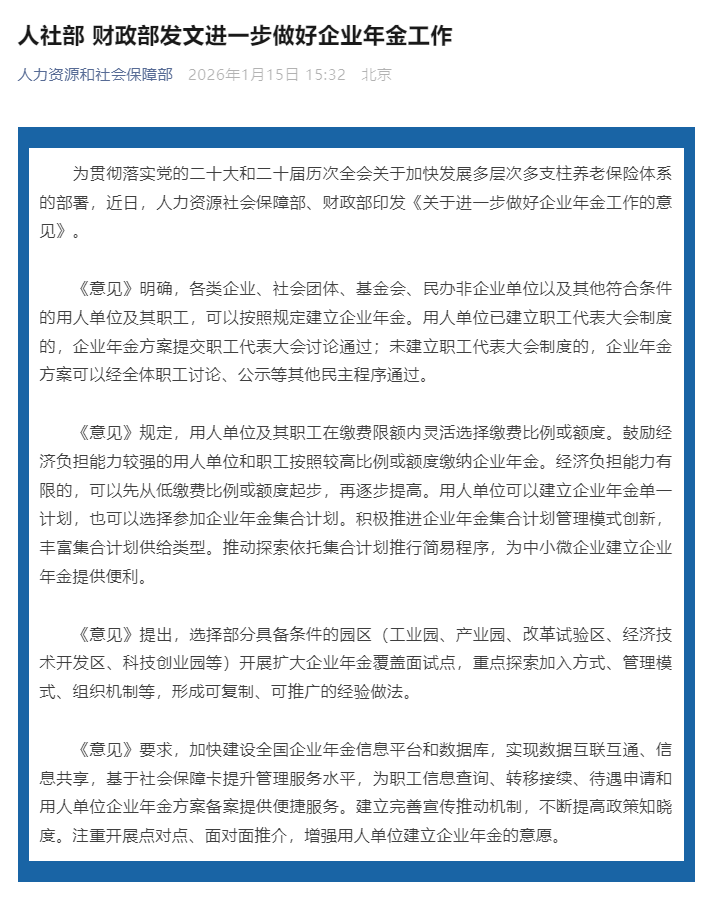
Core Viewpoint - The recent issuance of the "Opinions on Further Improving Enterprise Annuity Work" by the Ministry of Human Resources and Social Security and the Ministry of Finance aims to accelerate the development of a multi-level and multi-pillar pension insurance system in China [1][3]. Group 1: Establishment of Enterprise Annuities - Various entities, including enterprises, social organizations, foundations, and other eligible employers and their employees, are allowed to establish enterprise annuities according to regulations [1][3]. - For employers with a workers' representative assembly, the enterprise annuity plan must be discussed and approved by this assembly; if not established, the plan can be approved through other democratic procedures involving all employees [1][3]. Group 2: Contribution Flexibility - Employers and employees can flexibly choose contribution ratios or amounts within the specified limits, encouraging those with stronger financial capabilities to contribute at higher rates [1][3]. - Employers with limited financial capacity can start with lower contribution rates and gradually increase them over time [1][3]. - Employers can either establish a single enterprise annuity plan or participate in a collective enterprise annuity plan, promoting innovation in the management model of collective plans [1][3]. Group 3: Pilot Programs and Information Systems - The "Opinions" propose selecting certain qualified parks (such as industrial parks and economic development zones) to conduct pilot programs aimed at expanding the coverage of enterprise annuities, focusing on exploring methods of participation, management models, and organizational mechanisms [2][4]. - There is a push to accelerate the construction of a national enterprise annuity information platform and database to achieve data interconnectivity and information sharing, enhancing service levels for employee inquiries, transfers, benefit applications, and employer plan filings [2][4]. - A comprehensive promotional mechanism will be established to continuously improve policy awareness, with an emphasis on direct and face-to-face promotion to enhance employers' willingness to establish enterprise annuities [2][4].
企业年金扩围至所有用人单位,建立程序大简化
Di Yi Cai Jing Zi Xun· 2026-01-15 07:21
Core Viewpoint - The recent policy issued by the Ministry of Human Resources and Social Security and the Ministry of Finance aims to enhance the enterprise annuity system in China, making it more accessible and flexible for various types of employers and employees [2][4]. Group 1: Policy Changes - The new policy allows all employers participating in the basic pension insurance to establish enterprise annuities, significantly simplifying the establishment process and allowing for flexible contribution rates [2][4]. - The policy focuses on expanding coverage and simplifying the establishment process, aiming to make the second pillar of the pension system more accessible and manageable [4][6]. Group 2: Coverage and Participation - As of Q3 2025, there are 175,000 employers with enterprise annuities covering 33.32 million employees, with accumulated funds reaching 4.09 trillion yuan, indicating the initial success of the supplementary pension function [3]. - The policy addresses the low participation rates among employers and employees by clarifying that various types of organizations, including social groups and private non-enterprise units, can establish enterprise annuities [4][6]. Group 3: Establishment Procedures - Employers with a representative assembly can submit their annuity plans for discussion, while those without can use alternative democratic procedures, making it easier for small and medium-sized enterprises to initiate annuities [5][6]. - The policy allows for the establishment of either a single enterprise annuity plan or participation in a collective plan, promoting innovation in management models and providing more options for small businesses [6][7]. Group 4: Contribution Flexibility - Employers can choose contribution rates, with a maximum of 8% of total employee wages for employer contributions and a combined maximum of 12% for both employer and employee contributions [7]. - The policy introduces a flexible contribution mechanism, allowing employers to adjust their contributions based on financial capacity, thereby alleviating concerns about long-term costs [8]. Group 5: Fund Management and Performance - The enterprise annuity system has accumulated over 4 trillion yuan in funds, with an average annual return exceeding 6%, highlighting its potential for asset preservation and growth [10]. - The new policy emphasizes the need for a long-term assessment mechanism to promote sustainable investment practices and enhance the safety and performance of enterprise annuity funds [10][11].

企业年金扩围至所有用人单位,建立程序大简化
第一财经· 2026-01-15 07:16
Core Viewpoint - The article discusses a significant policy improvement in China's enterprise annuity system, aimed at expanding coverage and simplifying the establishment process for enterprises, thereby enhancing the multi-tiered pension insurance system [3]. Group 1: Policy Changes - The Ministry of Human Resources and Social Security and the Ministry of Finance released an opinion on January 15, 2026, which allows all employers participating in the basic pension insurance to establish enterprise annuities, significantly simplifying the establishment process and allowing flexible contribution ratios [3][5]. - The opinion aims to enhance the inclusivity, flexibility, and convenience of the enterprise annuity system, encouraging more employees to benefit from it [3][5]. Group 2: Coverage Expansion - As of Q3 2025, there are 175,000 employers with enterprise annuities covering 33.32 million employees and accumulating funds of 4.09 trillion yuan, indicating the initial success of the supplementary pension function [5]. - The new policy breaks the perception that only enterprises can establish annuities, expanding the potential participant base to include various organizations and non-profits, thus broadening the second pillar pension system [6][7]. Group 3: Simplified Establishment Process - The opinion provides a more inclusive framework for establishing enterprise annuities, allowing for flexible democratic processes such as discussions among all employees or public announcements, especially beneficial for small and medium-sized enterprises [6][7]. - Employers can choose to establish either a single enterprise annuity plan or participate in a collective plan, promoting innovation in management models and easing the establishment process for smaller firms [7][8]. Group 4: Cost Concerns - The enterprise annuity system is not mandatory, allowing employers to choose their participation level, which can help attract and retain talent while improving workplace cohesion [9]. - Employers can set contribution rates flexibly, with a maximum of 8% of total employee wages for employer contributions and a combined maximum of 12% with employee contributions, addressing cost concerns for smaller businesses [9][10]. Group 5: Long-term Assessment Mechanism - The article emphasizes the need for a long-term assessment mechanism to shift the focus from short-term investment strategies to long-term growth, which is crucial for the enterprise annuity system [11][12]. - The new policy introduces a three-year cumulative return rate for enterprise annuity funds, promoting a more rational view of investment performance over time and enhancing the investment advantages of long-term capital [12].

企业年金重大改革:扩围至所有用人单位,建立程序大大简化
Di Yi Cai Jing· 2026-01-15 07:07
Core Viewpoint - The recent policy changes regarding enterprise annuities in China aim to simplify the establishment process and broaden the coverage, allowing more employers to set up these retirement plans for their employees, thereby enhancing the multi-tiered pension system [1][2][3]. Group 1: Policy Changes - The Ministry of Human Resources and Social Security and the Ministry of Finance released an opinion that allows all employers participating in the basic pension insurance to establish enterprise annuities, significantly simplifying the establishment process and allowing flexible contribution rates [1][2]. - The policy aims to accelerate the development of a multi-tiered pension system, enhancing inclusivity, flexibility, and convenience, and expanding coverage to more employees [1][2]. Group 2: Coverage and Participation - As of Q3 2025, there are 175,000 employers with enterprise annuities covering 33.32 million employees, accumulating funds of 4.09 trillion yuan, indicating the initial success of the supplementary pension function [2]. - The new policy addresses the low participation rates and narrow benefits by clarifying that various types of organizations, including social groups and private institutions, can establish enterprise annuities if they participate in the basic pension insurance [2][3]. Group 3: Simplification of Establishment - The policy breaks the perception that only enterprises can establish annuities, expanding the potential participant base and facilitating a unified labor market [3]. - It introduces more flexible procedures for establishing annuities, allowing for democratic discussions among employees, which is particularly beneficial for small and medium-sized enterprises that may lack formal employee representative bodies [3][4]. Group 4: Contribution Flexibility - Employers can choose to contribute up to 8% of the total employee wages annually, with a combined contribution limit of 12% from both employers and employees [5]. - The policy allows employers to start with lower contribution rates based on their financial capabilities, addressing concerns about the cost of establishing annuities [5][6]. Group 5: Long-term Assessment and Performance - The enterprise annuity system has accumulated over 4 trillion yuan in funds with an average annual return rate exceeding 6%, indicating its effectiveness as a means for employees to preserve and grow their assets [7]. - The new policy emphasizes the need for a long-term assessment mechanism to promote sustainable investment practices and mitigate risks, enhancing the safety and performance of enterprise annuity funds [7][8].