散户投资

Search documents
研究显示美国散户投资者推动杠杆ETF交易激增
Xin Lang Cai Jing· 2026-02-24 07:41
近几个月来,美国资产管理公司多次推动美国证券交易委员会允许他们提供单股杠杆产品,让持有者有 机会在一天内获取标的股票3至5倍的收益。而SEC也一再对这些提议予以回绝。 上周五,Direxion再次提交申请,希望推出一套包含20只与单一股挂钩的ETF,标的股票从英伟达到 Palantir。若获批,交易者将在单个交易日内获得标的股票波动三倍的风险敞口。斯帕克斯表示他无法 讨论正在接受SEC审核的待批申请。 研究表明,自2022年底在美国面世以来,杠杆ETF的交易量以每年29%的速度增长,超过了股票或期权 交易的增长速度。 Direxion公司联合Vanda Research与The Compound Insights两家分析公司共同进行的一项新研究显示,美 国市场上近90%的杠杆单股ETF交易可追溯至个人投资者的交易。 数据表明,这些允许投资者对单一标的股票短期波动进行投机的交易所交易工具的激增,几乎完全是由 其对散户投资者的吸引力所驱动。该研究还发现,去年杠杆单股ETF的交易量占美国所有交易所总交易 量的8%。 "大量新产品的推出说明了市场对投机行为的依赖日益增长,"晨星的ETF分析师布莱恩·阿莫尔表示。 根据 ...
尽管白银暴跌,散户仍加倍押注
Xin Lang Cai Jing· 2026-02-08 13:12
Core Insights - Despite a significant drop in silver prices, retail investors have invested nearly $500 million into the silver market over the past week [1] - Retail investors contributed $430 million to the largest silver ETF, SLV, during six trading days ending Thursday, including over $100 million on January 30 when silver prices fell by 27%, marking the largest single-day drop in history [1] - Analysts suggest that the allure of silver has increased due to the "massive sell-off," with some investors viewing the price drop as an opportunity to buy at lower prices [1]
尽管白银暴跌 散户仍加倍押注
Xin Lang Cai Jing· 2026-02-08 13:12
Core Insights - Despite a significant drop in silver prices, retail investors have invested nearly $500 million into the silver market over the past week [1] - Retail investors contributed $430 million to the largest silver ETF, SLV, during six trading days, including over $100 million on January 30 when silver prices fell by 27%, marking the largest single-day drop in history [1] - Analysts suggest that the allure of silver has increased due to the "massive sell-off," with some investors viewing the price drop as an opportunity to buy at lower prices [1]
1月散户投资者向白银ETF投入10亿美元,创纪录
Xin Lang Cai Jing· 2026-02-03 05:25
Group 1 - Retail investors invested a record $1 billion into silver ETFs in January [1] - This significant investment led to retail investors being the first to suffer from the subsequent market crash [1]
白银市场“散户”强势交易 伦敦银试图重获动能
Jin Tou Wang· 2026-01-16 06:29
Group 1 - The core viewpoint of the articles indicates that personal investors are rapidly purchasing silver, leading to it becoming one of the most crowded commodity trades in the market [1] - Vanda Research reported that personal investors bought $921.8 million worth of silver-related ETFs in the past 30 days, highlighting a significant surge in retail investment [1] - The iShares Silver Trust ETF saw a record inflow of $69.2 million from retail investors on Wednesday, marking the largest single-day purchase since 2021, with the ETF up 31.3% year-to-date and 210.9% over the past 12 months [1] Group 2 - London silver prices are experiencing a downward trend due to a solid resistance level at $92.00, despite attempts to gain bullish momentum [2] - The trading above the EMA50 indicates a dynamic support that reinforces the stability of the bullish trend in the short term [2] - Positive signals from the relative strength index and the removal of overbought conditions suggest potential for further price increases in the near term [2]
芝商所推出100盎司白银期货合约,抢滩散户交易热潮
Feng Huang Wang· 2026-01-13 23:00
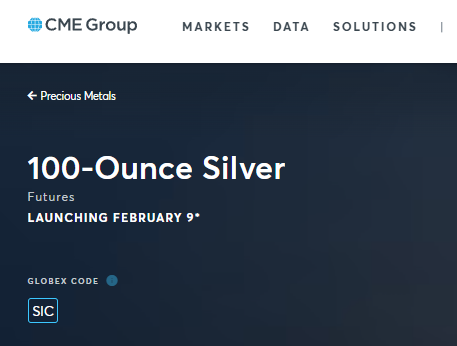
Group 1 - CME plans to launch a 100-ounce silver futures contract on February 9, 2026, to meet record retail demand [1] - The new contract, coded "SIC" on the Globex electronic trading system, aims to provide a low-cost and accessible entry point for traders [3][4] - The introduction of the SIC contract allows traders to control more resources with less capital, avoiding strict geographical requirements and high borrowing costs [3] Group 2 - Jin Hennig, CME's Managing Director of Metals, stated that the new contract enhances accessibility for retail investors seeking to diversify their investments amid geopolitical uncertainties [4] - The new contract aligns with Robinhood Markets' goal of providing customers with a way to participate in silver trading with less capital [4] - In 2025, driven by retail demand, CME's metal futures trading volume reached a historical high, with micro gold futures averaging 301,000 contracts daily and micro silver futures at 48,000 contracts [4]

2025年美国散户炒股资金破纪录,倒逼华尔街机构跟风!
Jin Shi Shu Ju· 2025-12-24 13:42
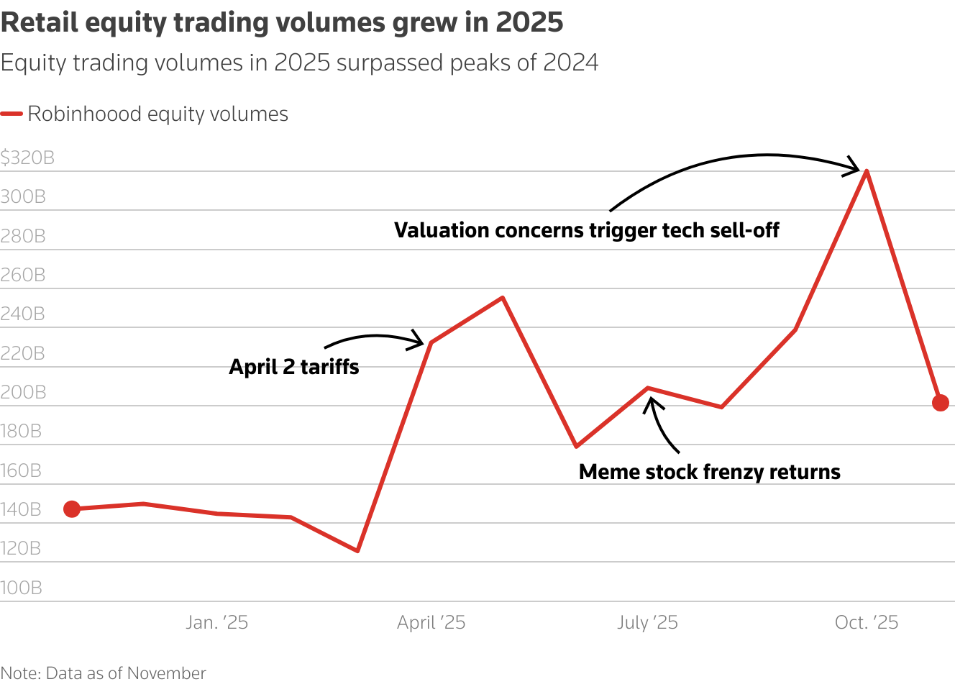
Core Insights - Retail investors have become the main driving force behind the stock market rally, with expected record inflows into the U.S. stock market in 2025 supported by anticipated interest rate cuts from the Federal Reserve [1][9] - Retail investment in the U.S. stock market has increased by 53% year-over-year to $3,020 billion in 2025, surpassing the peak of $2,700 billion during the retail trading frenzy in 2021 by 14% [1][4] - Retail trading volume accounted for 20% to 25% of total trading this year, peaking at approximately 35% in April [1][4] Retail Investor Behavior - Retail investors have been actively buying quality stocks during market sell-offs, notably after the "Liberation Day tariffs" announcement by former President Trump, which contributed to the S&P 500 index reaching a historical high with a year-to-date increase of nearly 17% [4] - The rise of low-cost, commission-free brokers like Robinhood and Interactive Brokers has made it easier and cheaper for ordinary Americans to enter the stock market, leading to a steady increase in retail participation [4] - Retail investors are increasingly favoring exchange-traded funds (ETFs) that track stock indices, cryptocurrencies, and commodities, attracted by their advantages such as all-day trading and tax efficiency [6] Market Trends and Predictions - Analysts predict that the potential for interest rate cuts by the Federal Reserve will continue to boost the market and maintain retail investor momentum into 2026 [9] - The frequency and duration of "meme stock frenzies" have decreased, indicating that retail trading decisions are becoming more informed [7][8] - Despite the current enthusiasm, there are indications that retail investor interest in market volatility may be declining, and the influx of retail funds in 2026 may not exceed the record set in 2025 due to a potential shift towards diversified investment portfolios [10]
散户成美股上涨核心力量:2025年净流入将创新高, AI、ETF受热捧
智通财经网· 2025-12-24 03:55
Group 1 - Analysts indicate that individual investors are becoming the main force driving stock market increases, with net inflows of retail funds into U.S. stocks expected to reach a historical high in 2025 [1] - According to JPMorgan, retail cash injections into U.S. stocks in 2025 have increased by 53% compared to the same period last year, reaching $3 trillion, and are 14% higher than the peak of $2.7 trillion in 2021 [1] - Retail trading accounted for 20-25% of total trading volume this year, peaking at approximately 35% in April [1] Group 2 - Popular stocks among retail investors this year include Nvidia and Palantir Technologies, with Palantir's stock price more than doubling as retail investors bought in while institutional investors exited due to valuation concerns [2] - Tesla's stock reached a record high on December 17, marking the first time since the end of 2024 that it hit such a peak [2] - Retail investors are increasingly influencing market narratives, often prompting institutional investors to follow their lead [2] Group 3 - A key trend for retail trading in 2025 is the growing preference for exchange-traded funds (ETFs) that track stock indices, cryptocurrencies, and commodities [3] - Analysts note that retail investors are making more rational trading decisions, with fewer instances of "meme stock mania" [3] - Potential interest rate cuts by the Federal Reserve are expected to continue boosting the market and maintain retail investment momentum into 2026 [3] Group 4 - The current environment is described as a "golden age" for retail investing, with improved access to information, market entry, and advanced trading platforms [4] - Despite concerns surrounding AI concept stocks, analysts predict that retail fund inflows will not exceed the record levels of 2025, as investors may consider diversifying their portfolios [4] - Retail investors are expected to continue focusing on technology stocks, especially if market volatility arises [4]


美股散户的“黑色星期二”:财报与空头夹击之下,妖股与币圈齐跌
美股IPO· 2025-11-05 06:05
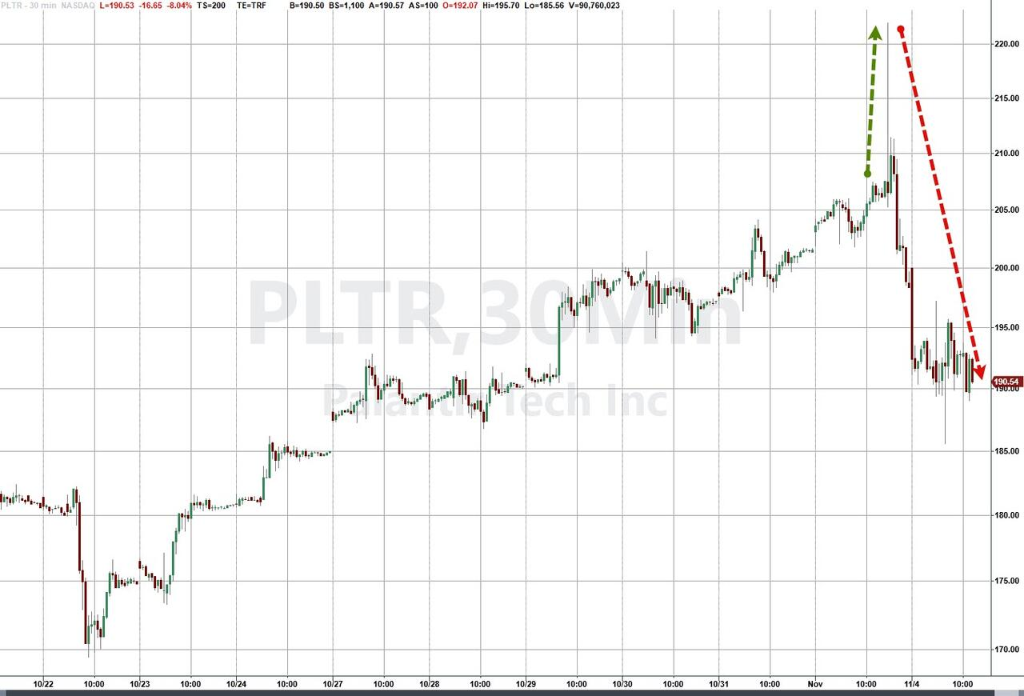
Core Viewpoint - The article highlights a significant sell-off in popular stocks among retail investors, driven by disappointing earnings reports and increased bearish sentiment from notable investors, alongside turmoil in the cryptocurrency market [2][3][5]. Group 1: Stock Market Impact - On Tuesday, the Goldman Sachs-tracked retail investor heavy stock index plummeted by 3.6%, marking its largest single-day decline since April 10, and approximately three times the drop of the S&P 500 index [1][3]. - Despite retail investors net buying $560 million worth of stocks and ETFs on the same day, this did not prevent the Nasdaq from falling over 2% [1][3]. - The sell-off was exacerbated by the earnings report from Palantir, which raised concerns about its growth prospects, leading to a nearly 8% drop in its stock price [5][6]. Group 2: Influential Events - The bearish sentiment was intensified by Michael Burry's regulatory filing, revealing that he had established short positions in Palantir and Nvidia, which confirmed his warning about market overvaluation [7]. - The combination of these factors led to a panic sell-off among retail investors, as described by Melissa Armo, CEO of Stock Swoosh, indicating that fear triggers such market reactions [3][7]. Group 3: Cryptocurrency Market Turmoil - The cryptocurrency market also faced significant turmoil, with Bitcoin dropping below $100,000 for the first time since June, and Ethereum experiencing a decline of over 10% [9]. - In the past 24 hours, over 342,000 individuals in the crypto market faced liquidation, resulting in losses exceeding $1.3 billion, with long positions accounting for 85% of these losses [9][10]. - The recent downturn in the crypto market follows a previous liquidity crisis that had already shaken the market, contributing to the overall negative sentiment [11].

美股散户的“黑色星期二”:财报与空头夹击之下,妖股与币圈齐跌
Hua Er Jie Jian Wen· 2025-11-05 00:43
Core Viewpoint - Retail investors faced the worst trading day since April, with significant sell-offs in previously favored stocks and assets due to Palantir's earnings report, bearish bets from notable short-sellers, and turmoil in the cryptocurrency market [1][2]. Group 1: Market Performance - The retail investor-heavy stock index tracked by Goldman Sachs plummeted by 3.6%, approximately three times the decline of the S&P 500, marking the largest single-day drop since April 10 [2]. - Despite initial enthusiasm, retail investors net bought $560 million worth of stocks and ETFs by 11 AM NY time, contributing to a brief market rebound that was ultimately unsustainable [2]. Group 2: Earnings Reports and Short Selling - Palantir's earnings report raised concerns about its growth prospects, leading to a nearly 8% drop in its stock price, which had previously surged over 150% this year [3]. - Michael Burry's regulatory filing revealed that he established bearish positions on Palantir and Nvidia, intensifying market fears following his recent warnings about excessive market exuberance [5]. Group 3: Cryptocurrency Market Impact - The cryptocurrency market's volatility exacerbated the selling pressure on retail investors, with Bitcoin dropping below $100,000 for the first time since June, and Ethereum falling over 10% to around $3,225 [6]. - Over the past 24 hours, 342,000 individuals were liquidated in the crypto market, with losses exceeding $1.3 billion, predominantly affecting long positions [7][8]. Group 4: Market Outlook - Market sentiment remains tense, with expectations of potential further declines. Analysts suggest that traders prepare a list of potential stocks to buy if they can withstand some pain, or consider selling if they cannot [9].