
白名单制度

Search documents
样本城市周度高频数据全追踪:2月推盘未售去化周期较1月上升-20260322
CMS· 2026-03-22 13:06
Investment Rating - The report maintains a "Recommended" rating for the industry, indicating a positive outlook for the sector's fundamentals and expectations for the industry index to outperform the benchmark index [8]. Core Insights - The report highlights that the sales decline in new homes has narrowed, while the decline in second-hand homes has expanded, with both categories experiencing low levels compared to the same period in the past five years [9][14]. - The liquidity outlook for March 2026 suggests an increase in macro-level liquidity, with a reduction in tightening measures compared to the previous year [49]. - The report notes a rise in the unsold inventory cycle for new homes in February compared to January, indicating a potential challenge in inventory management [32]. Industry Scale - The industry comprises 257 listed companies, with a total market capitalization of 2,966.1 billion and a circulating market capitalization of 2,812.4 billion [1]. Industry Index Performance - The absolute performance of the industry index shows a decline of 6.7% over one month, 4.1% over six months, but a positive increase of 7.6% over twelve months [2]. New Home and Second-Hand Home Transactions - As of March 19, 2026, the year-on-year decline in new home transaction area is reported at -13%, while the second-hand home transaction area shows a decline of -15% [4][5]. - The average number of viewings for second-hand homes in 12 sample cities has turned negative, indicating a significant drop in buyer interest [43]. Land Acquisition Trends - In January-February 2026, the area of land transactions decreased by 30% year-on-year, while the average transaction price saw a smaller decline of 21% [20]. - The report indicates a decrease in the number of unsold new homes in first and second-tier cities, while third and fourth-tier cities saw an increase in unsold inventory [35].
政府工作报告点评:判断当下房地产发展新模式的推进优先级或更高
CMS· 2026-03-06 09:06
Investment Rating - The report maintains a "Recommended" rating for the industry, indicating a positive outlook for the sector's fundamentals and expectations for the industry index to outperform the benchmark index [4]. Core Insights - The government work report emphasizes the need for high-quality urban renewal, which aligns with previous central economic meetings, suggesting that urban renewal will be a key driver for investment and demand in the real estate sector in the second half of the year [2][9]. - The focus on stabilizing the real estate market is consistent with previous government directives, indicating that policies will prioritize quantity stability to support price stabilization in the future [2][3]. - The report highlights the potential of the "white list" system to provide a pathway for continued development loans, especially as the "Financial 16 Measures" approach its expiration [10][12]. - There is a shift in the narrative regarding the new model of real estate development, moving from "accelerating construction" to "deepening promotion," with a focus on foundational systems and supporting policy development [11][12]. Summary by Sections Urban Renewal - The report identifies the second half of the year as a critical period for observing the impact of urban renewal on real estate demand and investment [12]. - It stresses the importance of revitalizing existing land and underutilized properties, as well as enhancing urban infrastructure safety [2][9]. Market Stabilization - The report indicates that policies will focus on controlling inventory and optimizing supply, with an emphasis on multi-channel strategies to revitalize existing housing stock [2][10]. - It also mentions the need for reforms in the housing provident fund system and the promotion of high-quality housing construction [2][11]. Development Model - The report discusses the transition to a new real estate development model, emphasizing project company systems, main bank systems for financing, and the promotion of current housing sales to mitigate delivery risks [11][12]. - It notes that the government aims to enhance housing security for newly married couples and families with multiple children [11]. Investment Opportunities - The report suggests focusing on companies with stable performance and high dividend yields, such as China Resources Land and China Resources Mixc Lifestyle, as well as those showing positive operational momentum like Binjiang Group and China Jinmao [12]. - It also highlights companies with reduced debt repayment pressures and low valuations, such as Gemdale and Longfor Group, as potential investment opportunities [12].
保交楼全面完成
21世纪经济报道· 2026-03-05 13:07
Core Viewpoint - The government is implementing proactive macro policies to stabilize the economy, particularly focusing on the real estate sector, with an emphasis on risk prevention and management in 2026 [1][9]. Group 1: Government Policies and Real Estate Market Stability - The government aims to stabilize the real estate market by controlling new supply, reducing inventory, and optimizing supply through city-specific measures [1][6]. - The "保交房" (guarantee delivery of housing) task has been fully completed, with over 7.5 million units delivered nationwide by October last year [3]. - The government is encouraging the acquisition of existing housing for use as affordable housing, which will help alleviate financial pressures on real estate companies [6][7]. Group 2: Real Estate Delivery and Company Performance - Major real estate companies like Country Garden and Greenland Holdings are nearing the completion of their delivery tasks, with Country Garden aiming to finish most of its deliveries by mid-2026 [3][4]. - In 2025, the top three companies in terms of delivery volume are expected to be Country Garden (170,000 units), China Overseas Land & Investment (133,200 units), and Poly Developments (130,000 units), with a significant decrease in total delivery volume compared to 2024 [3]. - The overall delivery scale of the top 10 real estate companies is projected to decline by 36% in 2025 compared to 2024 [3]. Group 3: Financial Tools and Risk Management - The government is utilizing special bonds to acquire idle land and optimize resource allocation, with over 5,500 parcels of land valued at over 750 billion yuan planned for acquisition [7]. - The "白名单" (white list) system is being leveraged to support reasonable financing needs of real estate companies, with loans exceeding 7 trillion yuan supporting nearly 20 million housing units [9][10]. - The financing environment for the real estate sector is improving, with a total financing amount of 414.31 billion yuan for 65 typical real estate companies in 2025 [10].



防范化解风险 房地产融资协调机制持续扩围增效
Zheng Quan Ri Bao· 2026-02-12 15:48
Core Viewpoint - The urban real estate financing coordination mechanism is crucial for promoting the stable and healthy development of the real estate market and mitigating risks in key areas. Recent reports from various regions, including Beijing, Guangdong, and Sichuan, highlight the operational status of this mechanism and its impact on financing projects [1][2][3]. Group 1: Financing Coordination Mechanism - The Guangdong Financial Regulatory Bureau reported that banks in the region (excluding Shenzhen) have provided credit for 1,929 "white list" projects amounting to 12,123 billion yuan, with an actual disbursement of 9,119 billion yuan [1]. - The Sichuan Financial Regulatory Bureau indicated that it has facilitated loans of 2,917.86 billion yuan to 974 "white list" projects as part of the financing coordination mechanism [1]. - In Beijing, the Financial Regulatory Bureau announced that it has disbursed loans totaling 2,218 billion yuan to 225 "white list" projects [1]. Group 2: Impact and Effectiveness - The "white list" system has effectively injected funds into quality projects, ensuring the construction and delivery of ongoing projects while protecting the rights of homebuyers [2]. - The establishment of good communication channels among government, banks, and enterprises has helped address financing difficulties and prevent the uncontrolled spread of risks [2]. - The mechanism is expected to remain a key focus in 2026 for supporting reasonable financing needs of real estate companies and stabilizing the market [2]. Group 3: Future Directions - Regions like Anhui, Gansu, Guangxi, and Tianjin are also working on the 2026 urban real estate financing coordination mechanism, emphasizing the need for thorough management of "white list" projects [3]. - Future efforts should include enhancing project promotion and feedback mechanisms, holding companies accountable for at-risk projects, and converting non-compliant projects into compliant ones [3]. - There is a call for expanding the "white list" to include quality private real estate companies and improving the efficiency of fund usage by streamlining approval processes and enhancing inter-departmental collaboration [4].
对话中国首席经济学家论坛理事长连平:房地产金融修复将与市场基本面联动,呈现循序渐进态势
Xin Lang Cai Jing· 2026-02-04 02:07
Core Viewpoint - The Chinese financial system is at a historical juncture, with a focus on building a strong financial nation and supporting the real economy through financial reforms during the upcoming "14th Five-Year Plan" period [1][16]. Group 1: Current State of Real Estate Finance - Real estate finance has entered a structural and deep adjustment phase, moving away from traditional financing models such as residential mortgage loans and developer loans, which previously dominated the market [4][19]. - The current market is characterized by a significant contraction in demand and a decline in transaction volumes, leading to a corresponding drop in mortgage loan scales [4][19]. - Developers are under considerable operational pressure, leading to adjustments in their balance sheets and a reduced willingness to invest and leverage [4][19]. Group 2: Role of the "White List" Mechanism - The "White List" mechanism, established by the Ministry of Housing and Urban-Rural Development and the National Financial Regulatory Administration, supports compliant real estate projects and encourages financial institutions to increase financing support [4][20]. - The approved loan scale for "White List" projects has exceeded 7 trillion yuan, significantly replacing traditional developer loans and maintaining the basic loan volume for banks [5][20]. - The "White List" is expected to play a crucial role in the future, as it helps stabilize bank lending to real estate companies [5][20]. Group 3: Future Prospects for Real Estate Finance - The recovery of real estate finance depends on two key factors: the restoration of market transactions and the effective release of demand, which are prerequisites for a rebound in mortgage loans [2][17]. - As transaction volumes improve, the operational conditions of real estate companies are expected to gradually recover, potentially leading to a resurgence in development loans and other financing forms [2][17]. - The future of real estate finance will likely see a shift towards direct financing methods, such as bond issuance and public offerings, while traditional indirect financing methods may not expand significantly [6][21]. Group 4: Policy Adjustments and Market Signals - There is limited room for significant adjustments in nominal interest rates, but policies such as fiscal interest subsidies are being considered to lower financing costs for businesses and homebuyers [8][23]. - The central bank may consider interest rate cuts, but current weak loan demand poses challenges to the effectiveness of such policies [9][24]. - A key signal for market recovery will come from the stabilization and potential increase in housing prices in first-tier cities, which could encourage hesitant buyers to enter the market [12][26].
解码助贷新规下的生存与增长
Nan Fang Du Shi Bao· 2026-01-08 23:12
Core Insights - The Chinese consumer finance industry is transitioning from extensive growth to high-quality development as of 2025, marked by the implementation of the "Internet Lending Business Management Measures" on October 1, 2025, which introduces a 24% annualized financing cost cap and a lending "white list" system [2][10] Group 1: Lending "White List" - The new lending regulations have restructured the cooperation ecosystem within the consumer finance industry, mandating banks to manage partnerships through a white list, prohibiting collaboration with non-listed entities [2][3] - Major internet platforms and leading licensed financial institutions are prioritized in the white list, aligning with the new regulatory requirements [2] Group 2: 24% Interest Rate Cap - The new regulations fundamentally alter the industry's profit logic by imposing a hidden constraint on comprehensive financing costs, which must now include all fees, such as credit enhancement service fees, in the calculation [4][5] - The previous practice of splitting loan costs to circumvent the 24% cap has been effectively terminated, as all fees must now be clearly stated in contracts and included in the total financing cost [5] Group 3: Non-Performing Asset Disposal - The pace of non-performing asset disposal in the consumer finance sector has accelerated, with a trend towards "unlitigated sales" becoming the mainstream method for asset management [6] - New rules regarding the disclosure of starting prices for asset sales aim to eliminate price anchoring effects, encouraging buyers to focus on the underlying asset data [6] Group 4: Executive Changes - Significant executive turnover has occurred across the consumer finance industry, with at least 25 licensed consumer finance companies experiencing leadership changes, reflecting the industry's transformation and regulatory environment [7] - Key drivers for these changes include shareholder adjustments, the need for specialized talent due to regulatory upgrades, and normal personnel transitions [7] Group 5: Capital Increases - A wave of capital increases has been observed in the consumer finance sector, driven by regulatory pressures and intense market competition, with several companies raising significant funds to meet new capital requirements [8][9] - The capital influx is seen as a positive indicator of institutional confidence in the industry's future, beyond just compliance with regulations [9] Group 6: "Self-Operated + Technology" - The implementation of the new lending regulations signifies a shift towards regulated development, with a focus on balancing compliance and innovation [9] - Companies are encouraged to adopt a "self-operated + technology" model to enhance operational efficiency and risk management through technology integration [9]

万科母公司账面货币资金不足10亿元
Di Yi Cai Jing· 2025-12-02 12:28
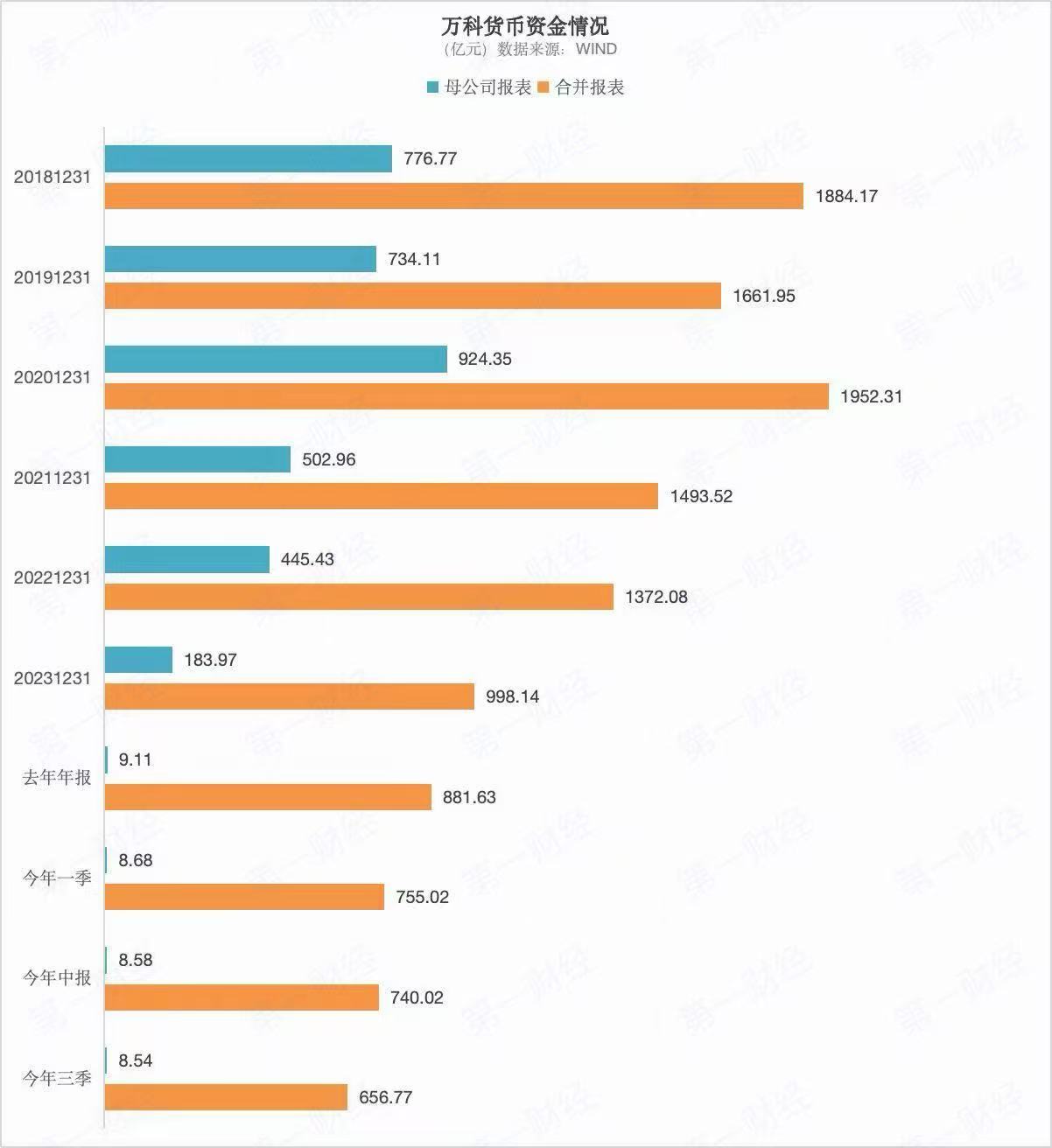
Core Viewpoint - Vanke's bond extension controversy has led to significant declines in both stock and bond markets, raising concerns about the company's liquidity and debt management amidst a broader real estate crisis in China [2][3]. Financial Situation - As of the end of Q3, Vanke's interest-bearing liabilities totaled approximately 3629.3 billion yuan, with 1553.7 billion yuan maturing in the second half of this year and the first half of next year [2][3]. - Vanke reported cash and cash equivalents of 656.8 billion yuan, but the liquidity at the parent company level has drastically decreased, with only 8.6 billion yuan available [6][7]. - The company's contract liabilities have also declined, with a total of 1319 billion yuan as of Q3, down 31.43% from the previous year [6][7]. Debt Management - Vanke's debt structure is heavily reliant on bank loans, which account for over 70% of its interest-bearing liabilities, totaling approximately 2641 billion yuan [11][12]. - The company has received significant financial support from its major shareholder, Shenzhen Metro Group, which has provided over 300 billion yuan in loans [7][10]. - Vanke's financing strategy has shifted towards "white list" loans and operational property loans, but the effectiveness of these measures in alleviating debt pressure is expected to take time [7][8]. Market Performance - Vanke's sales have significantly declined, with a 44% drop in total sales amounting to 1004.6 billion yuan in the first three quarters of the year [6][8]. - The company's revenue and net profit attributable to shareholders have also decreased by 26.61% and 56.14%, respectively, with a net loss of 280.2 billion yuan reported [8][10]. Risk Factors - The ongoing real estate crisis has raised concerns about the liquidity and financial stability of Vanke, with market participants questioning the effectiveness of government support measures [2][8]. - The complexity of coordinating support for nationwide real estate companies poses significant challenges, particularly in light of declining asset values and the need for effective debt management [8][12].

万科母公司账面货币资金不足10亿元
第一财经· 2025-12-02 12:19
Core Viewpoint - Vanke's bond extension controversy has led to significant declines in both stock and bond markets, raising concerns about the company's liquidity and debt management amidst a broader real estate crisis in China [3][5]. Group 1: Financial Situation - As of the end of Q3, Vanke's total interest-bearing debt was approximately 362.93 billion yuan, with 155.37 billion yuan maturing in the second half of this year and the first half of next year [5]. - Vanke reported cash and cash equivalents of 656.8 billion yuan, but the liquidity at the parent company level has drastically decreased, with only 8.58 billion yuan available [8]. - The company's contract liabilities have also declined, totaling 131.9 billion yuan by the end of Q3, a 31.43% decrease from the previous year [8]. Group 2: Debt Management and Support - Vanke has relied heavily on external financing, securing 948 billion yuan in new financing and refinancing last year, with a significant portion coming from major banks [11][12]. - The "white list" financing mechanism has been implemented to support real estate companies, but its effectiveness in alleviating debt pressure is expected to take time [12]. - Vanke's major shareholder, Shenzhen Metro Group, has provided over 300 billion yuan in loans, highlighting the importance of external support for debt repayment [12][15]. Group 3: Market Conditions and Risks - The real estate market is experiencing a downturn, with Vanke's sales declining by 44% year-on-year, leading to increased liquidity pressure [7][8]. - The company's debt structure is heavily reliant on bank loans, which account for over 70% of its interest-bearing debt, raising concerns about potential risks to financial institutions [14][19]. - Despite the ongoing support from banks, there are indications that some banks have begun to refuse further loans to Vanke, reflecting tightening credit conditions in the real estate sector [18].

万科母公司账面货币资金不足10亿元,“白名单”制度如何缓解房企债务压力
Di Yi Cai Jing· 2025-12-02 11:53
Core Viewpoint - Vanke's bond extension controversy has led to significant declines in both stock and bond markets, raising concerns about the company's liquidity despite having over 65 billion yuan in cash on hand [1][3]. Group 1: Debt Structure and Financial Position - Vanke's total interest-bearing debt amounts to approximately 362.9 billion yuan, with over 70% of this debt being bank loans, highlighting the company's reliance on traditional financing [2][12]. - As of the end of Q3, Vanke has 155.4 billion yuan of interest-bearing debt maturing in the second half of this year and the first half of next year, indicating a pressing debt repayment schedule [3][12]. - The company's cash position has significantly deteriorated, with only 8.6 million yuan in cash at the parent company level, a 95% decrease from the end of 2022 [6][7]. Group 2: Sales and Revenue Performance - Vanke's total contract sales for the first three quarters of this year reached 100.5 billion yuan, a decline of 44.6% year-on-year, reflecting a broader downturn in the real estate market [7][10]. - The company's revenue and net profit attributable to shareholders have also seen substantial declines, with a 26.61% drop in revenue and a 56.14% drop in net profit for the first three quarters [10]. Group 3: Financing and Support Mechanisms - Vanke has secured 948 million yuan in new financing and refinancing last year, with a significant portion coming from a 20 billion yuan syndicated loan led by China Merchants Bank [8][9]. - The "white list" financing mechanism has been implemented to support real estate companies, but its effectiveness in alleviating Vanke's debt pressure is expected to take time due to the need for project sales to generate cash flow [9][10]. - The company has received over 300 million yuan in loans from its major shareholder, Shenzhen Metro Group, indicating reliance on external support for debt repayment [11][14].
房地产融资制度持续改革完善
Zheng Quan Ri Bao· 2025-10-29 17:25
Core Viewpoint - The report emphasizes the importance of improving the financing system for real estate development to support high-quality growth in the sector, with a focus on the urban real estate financing coordination mechanism and the "white list" project loan approval system [1][2][3] Group 1: Financing System Improvement - The improvement of the real estate financing system is a crucial task in constructing a new model for real estate development and promoting high-quality growth [1] - The "white list" project loan approval amount has exceeded 7 trillion yuan, effectively supporting the construction and delivery of commercial housing projects [1] - The guidance for commercial banks to provide an additional 2.2 trillion yuan in loans through the "white list" mechanism has been highlighted as a significant achievement in financial work since November 2024 [1] Group 2: New Financing Model - The new financing system under the real estate development model includes a lead bank system, ensuring that funds for project development, construction, and sales are managed by a designated bank or syndicate [2] - The focus for the 15th Five-Year Plan period will be on establishing a clear responsibility and risk isolation framework within the real estate financial and operational order [2] - Effective measures such as the urban real estate financing coordination mechanism and the project "white list" system will be promoted to provide stable and predictable financing channels for compliant projects [2] Group 3: Policy Direction - The implementation of project development company systems and urban real estate financing coordination mechanisms will remain key policy directions during the 15th Five-Year period [3] - Efforts to regulate fund supervision and improve the financing environment for enterprises are expected to be further implemented, ensuring project construction and delivery while protecting the legal rights of homebuyers [3]