税务优化

Search documents
又一A股实控人股份捐赠,近年已近20例,背后有一套税务逻辑
Xin Lang Cai Jing· 2026-02-27 04:34
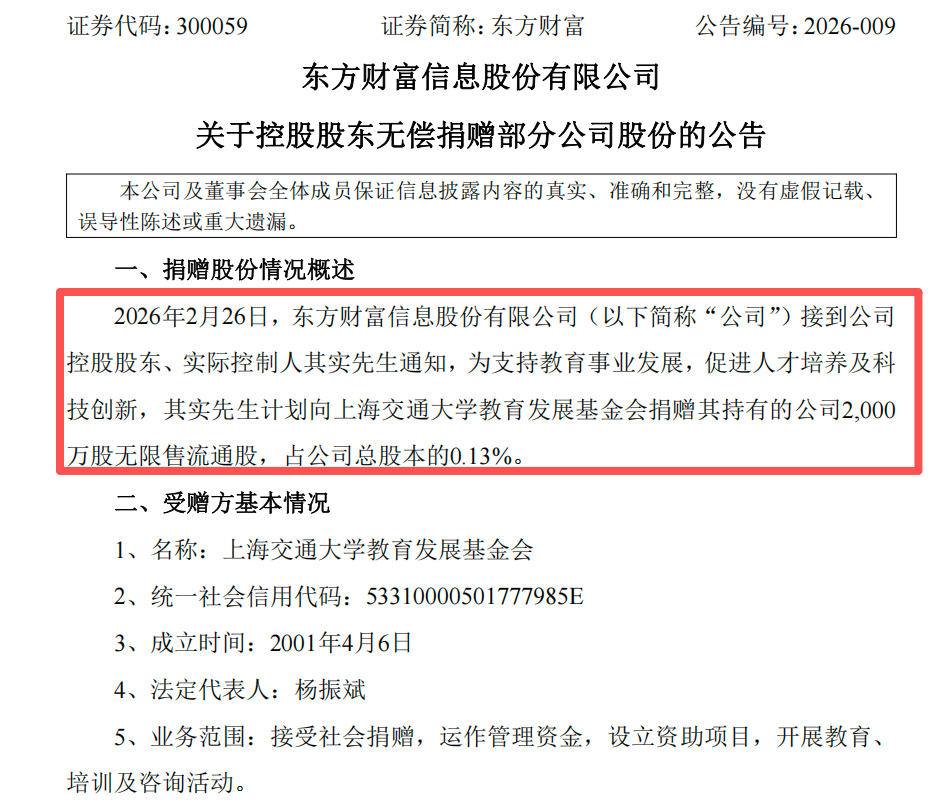
Core Viewpoint - The trend of listed company controlling shareholders donating shares or cash to support educational institutions has become increasingly common, reflecting a normalization of such philanthropic activities in the capital market [6][9][10]. Group 1: Recent Donations - On February 26, Dongfang Caifu announced that its controlling shareholder plans to donate 20 million shares, representing 0.13% of the company's total equity, to Shanghai Jiao Tong University, with a market value of 450 million yuan [1][8]. - On the same day, Ji Qi, founder of Huazhu Group and an alumnus of Shanghai Jiao Tong University, donated 100 million yuan to support the university's development [4]. - A total of at least 18 A-share listed companies' controlling shareholders or major shareholders have donated, with total donations amounting to 41.139 billion yuan, with 2025 being a particularly active year for such donations [4][10]. Group 2: Donation Statistics - Historical data indicates that there have been over 24 instances of donations from controlling shareholders or major shareholders of A-share companies, totaling 41.139 billion yuan [10]. - Share donations are the predominant form, accounting for 87.5% of total donations, with a total market value of approximately 40.539 billion yuan [11]. - The majority of donations have been directed to educational foundations, with 79.2% of donations going to such institutions [12]. Group 3: Motivations Behind Donations - These donations reflect not only the social responsibility and philanthropic intentions of entrepreneurs but also provide benefits such as tax optimization, improvement of shareholding structure, and stabilization of market expectations [7][14]. - Tax policies incentivize these donations, allowing for significant tax deductions and exemptions, which enhances the willingness of controlling shareholders to donate [15][16]. - From a corporate governance perspective, donations can help optimize shareholding structures while signaling confidence in the company's long-term value, thus stabilizing stock prices [17]. Group 4: Future Implications - The integration of "capital + charity + education" is expected to deepen, with more controlling shareholders likely to engage in share donations to support educational and technological advancements [18].


家族信托的主要功能有哪些方面?
Sou Hu Cai Jing· 2026-02-23 06:05
Group 1: Core Functions of Family Trusts - Wealth inheritance is one of the fundamental functions of family trusts, allowing the grantor to specify the beneficiaries, conditions for exercising rights, and methods of asset distribution to ensure precise transmission of family wealth across generations, avoiding potential family disputes from statutory inheritance [1] - Asset isolation is a prominent feature of family trusts, as per the revised trust law in 2025, which states that trust assets are separated from the grantor's, trustee's, and beneficiaries' inherent properties, protecting them from the grantor's debts and the trustee's bankruptcy risks, thus creating a protective barrier for family wealth [1] - Legal and compliant tax optimization is an important function of family trusts, where grantors can design trust structures to reduce tax costs during wealth transmission, such as estate and gift taxes, thereby enhancing the efficiency of wealth transfer while adhering to national tax laws [1] Group 2: Additional Functions of Family Trusts - Family trusts can also serve charitable purposes, allowing grantors to include clauses in the trust contract to allocate part or all of the trust assets for supporting education, poverty alleviation, and environmental protection, thus transforming family wealth into social value [2] - Family trusts possess professional wealth management capabilities, with trustees acting as professional financial institutions that can diversify asset allocation and manage trust assets dynamically, ensuring the preservation and appreciation of trust assets while providing stable long-term returns for beneficiaries [2]
欧洲收紧政策,迪拜“铺开红毯”:欧洲富人财富大迁徙?
Di Yi Cai Jing Zi Xun· 2026-01-20 10:41
Core Insights - European elites are relocating to Dubai, driven by high taxes and regulatory burdens in Europe, with an expected influx of thousands of millionaires seeking business opportunities and luxury living [1][3] - The UAE is projected to see a net inflow of 9,800 high-net-worth individuals by 2025, bringing an estimated $63 billion in investable wealth [1][3] Group 1: Trends and Motivations - The number of European high-net-worth individuals moving to Dubai is steadily increasing, with a significant acceleration expected in 2024 and 2025 due to discussions around wealth and inheritance taxes in countries like France and the UK [3][5] - The UK is set to abolish the "Non-Dom" status in April 2025, leading to higher tax burdens for wealthy individuals, while France is seeing a resurgence in calls for a "wealth tax" [3][5] Group 2: Immigration and Investment - There is a noticeable increase in inquiries about residency and citizenship in Dubai, particularly from UK citizens, driven by the changing political and financial landscape in the UK [4][5] - Tax efficiency is a primary motivator for relocation, but factors such as personal safety, quality of life, and access to international education also play significant roles [5][6] Group 3: Demographics of Movers - The majority of European clients seeking advice on moving to Dubai come from France, the UK, Germany, Italy, and parts of Scandinavia, with a rising proportion of young founders and second-generation business owners [6][7] - Many individuals maintain remote management of their European businesses after relocating, with some restructuring their income streams to significantly reduce tax burdens [6][7] Group 4: Real Estate Market Dynamics - Dubai's real estate market has seen a 122% increase in central residential prices over the past five years, driven by an influx of wealth [7][8] - The Dubai government anticipates real estate transactions to reach AED 917 billion (approximately 1.74 trillion RMB) in 2025, marking a 20% increase from the previous year [8] - The market is becoming more stable and transparent, with a decrease in speculative flipping and new regulations requiring buyers to pay 80% of property costs before completion [8]

传承有道!好买臻承家办:科技+专业,构建高净值家庭家业长青体系
Xin Lang Cai Jing· 2025-12-22 14:11
Core Insights - Since 2025, high-net-worth families have upgraded their wealth management demands to focus on "safety, compliance, and long-term inheritance" due to global market uncertainties and frequent cross-border tax policy adjustments [1] - Good Buy Wealth's Zhencheng Family Office leverages 18 years of investment research expertise and Tencent's technological support to provide integrated solutions for ultra-high-net-worth families, covering investment planning, family trusts, tax optimization, and identity planning [1] Company Overview - Good Buy Wealth is recognized as an independent wealth management institution in China, having developed a core competitive system characterized by "strong research, full licensing, reallocation, and deep companionship" over 18 years [2] Competitive Advantages - Strong Research: Backed by strategic investor Tencent, the founding team possesses excellent professional backgrounds [3] - Full Licensing: Good Buy Wealth and its subsidiaries have established a comprehensive licensing system covering both domestic and international assets [3] - Reallocation: The Good Buy Fund Research Center has developed a recognized fund screening system and scientific allocation model over 18 years [3] - Deep Companionship: The company manages over 180 billion yuan in assets, serving millions of investors and over ten thousand high-net-worth clients [3] Zhencheng Family Office Core Services - Family Trust Services: Offers various types of trusts, including financial, equity, and insurance trusts, with personalized customization to meet asset isolation and inheritance needs [4] - Legal and Tax Consulting: Provides integrated legal and tax consulting, equity trust structure design, and family charter customization to address complex legal and tax issues [4] - Identity Consulting: Offers identity consulting services based on tax policies in countries like the USA, Canada, Europe, Singapore, and Hong Kong, addressing multiple goals such as education and asset allocation [4] - One-Stop Comprehensive Solutions: Integrates identity consulting, offshore trusts, tax optimization, and asset allocation into a cohesive plan [4] Reasons to Choose Zhencheng Family Office - Deep Experience: Originating from Good Buy Wealth, Zhencheng has successfully served hundreds of high-net-worth families with a focus on sustainable wealth growth [5] - Problem-Oriented Approach: Focuses on clients' real needs rather than product sales, providing neutral and customized solutions [5] - Professional Collaboration: Recognizes the need for global collaboration with experts in various fields to ensure high-quality service delivery [5] - Platform Empowerment: Leverages Good Buy Wealth's comprehensive capabilities to offer full-process services from consultation to execution [6] - Maximizing Client Interests: Prioritizes client interests without compromising quality due to complexity or cost [6] - Long-Term Companionship: Extends services from investment management to family governance, ensuring long-term support for wealth growth and family legacy [6] Case Study: Cross-Border Tax Optimization - Background: High-net-worth individuals holding overseas financial assets have become more aware of tax laws due to reporting requirements starting in 2025 [6] - Solution: Zhencheng Family Office recommends using family trust structures to hold assets, optimizing tax structures fundamentally [6] - Value: Achieves tax optimization through top-level design while ensuring compliance, preventing unnecessary wealth loss [6]
5 Powerful Ways To Use Your Year-End Bonus
Yahoo Finance· 2025-12-05 16:00
Core Insights - American firms provided an average year-end bonus of $2,503 in 2024, reflecting a 2% increase from the previous year [1][2] Financial Strategies - Utilizing a year-end bonus to eliminate high-interest debt is highly recommended, especially given the average credit card interest rate of nearly 22%, which can significantly impact financial stability [4] - For individuals without debt, using the bonus for tax-related purposes, such as contributing to retirement accounts like Traditional IRA or Roth IRA, can enhance future financial security [5][6] - Opening a high-yield savings account is suggested for those uncertain about immediate use of their bonus, as these accounts typically offer better interest rates compared to traditional banks [7]
全球资管深研系列(二):组合个性化,税务效率化
Guoxin Securities· 2025-11-19 13:07
Core Insights - Separate Managed Accounts (SMA) are customized investment tools for high-net-worth and institutional clients, allowing investors to directly own each security in their account while benefiting from professional management, combining the advantages of fund-like management with personal asset control [3][6][10] - Compared to Model Portfolios, SMAs offer significant differences in customization, ownership, and tax management, enabling tailored investment strategies based on individual risk preferences and ESG considerations [3][10] - The global SMA market is evolving towards digitalization, deeper ESG customization, and scalability, with opportunities for domestic accounts to adopt similar strategies to enhance personalization and tax efficiency [3][10] Overview of SMA Business - SMA allows investors to have direct ownership of securities, providing transparency and tax efficiency, making it a preferred choice for high-net-worth and institutional investors [6][10] - Various forms of SMA exist, including discretionary, non-discretionary, model-driven, multi-manager, and tax-optimized types, catering to different investor preferences and needs [12][10] International SMA Practices - J.P. Morgan is a leading SMA provider with over $300 billion in assets under management, utilizing a tax-driven index strategy that has significantly outperformed benchmarks [24][3] - Vanguard's SMA strategy focuses on low-cost, direct indexing, enhancing tax efficiency through coordinated rebalancing, with a minimum investment threshold of $10,000 [31][3] - Fidelity employs a tax-smart investing approach, utilizing a proprietary STAR Score system for stock selection and achieving a tax efficiency rate of 85% in 2024 [34][35] Key Features of SMA Providers - J.P. Morgan's SMA includes a comprehensive management structure with dedicated teams for investment management and client service, ensuring tailored solutions and compliance monitoring [16][24] - Vanguard's SMA leverages a direct indexing platform to provide personalized investment solutions, enhancing tax management and cost efficiency [31][32] - Morgan Stanley's SMA platform emphasizes professional management and tax optimization, allowing clients to directly hold assets while benefiting from expert guidance [51][53] Investment Strategies and Performance - J.P. Morgan's Large Cap Growth Strategy SMA achieved a five-year annualized net return of 15.25%, significantly outperforming the Russell 1000 Growth Index [24][3] - Morgan Stanley's ClearBridge Small Cap SMA focuses on undervalued small-cap stocks, employing a probability distribution valuation model to identify long-term growth opportunities [59][60] - Fidelity's cross-account tax loss harvesting technology enhances after-tax returns by 0.5%-1.2%, demonstrating the effectiveness of tax optimization strategies [35][3]


【锋行链盟】港交所IPO员工持股平台设计流程及核心要点
Sou Hu Cai Jing· 2025-10-25 13:39
Design Process Overview - The design of the Employee Share Ownership Plan (ESOP) for the Hong Kong Stock Exchange (HKEX) IPO involves five main stages: preliminary planning, structural design, compliance review, establishment and implementation, and post-listing management [2][7]. Structural Design - The choice of legal entity and registration location for the ESOP significantly impacts tax costs, control, and regulatory compliance. Common structures include Limited Partnerships (LP) or corporate entities, with LPs being preferred due to "tax transparency" [3][5]. Compliance Requirements - The ESOP must comply with HKEX and regulatory requirements, including the Listing Rules, which stipulate that the total ESOP shares cannot exceed 10% of the company's issued share capital unless a waiver is granted [4][8]. Strategic Positioning - The core objectives of the ESOP include attracting talent, binding key teams, reducing cash compensation pressure, and enhancing corporate governance. The selection of participants must adhere to the principle of "reasonableness" [5][7]. Scale and Proportion - The total scale of the ESOP is typically set between 5% to 15% of the total share capital before listing, with individual participant holdings generally not exceeding 1% to avoid excessive dilution [5][8]. Funding Sources - Employees usually contribute their own funds, but the company may provide loans under specific conditions. The interest rates on loans must be reasonable and not affect the employees' repayment ability [5][8]. Entity Type Selection - Employees as shareholders must pay corporate income tax (16.5% in Hong Kong) and personal income tax on dividends/capital gains, which may lead to double taxation issues. The choice between LP and corporate structures depends on the need for independent legal status or complex financing [5][8]. Documentation and Internal Approval - Core agreements must be drafted, including the ESOP agreement and Limited Partnership Agreement (if applicable), outlining participant conditions, funding methods, share calculations, lock-up periods, exit mechanisms, and breach handling [6][8]. Ongoing Management - Post-listing, the ESOP must be managed effectively, including annual disclosures of changes in participation, share transfers, and compliance with HKEX requirements [8][10]. Valuation and Tax Optimization - The entry price for the ESOP must be fair to avoid being perceived as "benefit transfer" to employees. Tax optimization strategies should be employed to minimize tax burdens on both the employees and the platform [9][10]. Control Arrangements - Founders or designated management companies typically act as General Partners (GP) to maintain control over the platform, ensuring that employee shareholding does not excessively dilute control [10]. Information Disclosure - Comprehensive disclosure of the ESOP's key information, including purpose, scale, participant criteria, valuation methods, lock-up periods, and exit mechanisms, is required in the prospectus and ongoing reports to maintain investor confidence [10].

How the Ultra-Rich Ensure They’re Staying Ultra-Rich
Yahoo Finance· 2025-10-12 12:00
Core Insights - The focus on tax management is becoming increasingly important for wealth management, particularly for clients with concentrated assets who are concerned about capital gains taxes [1][4] - Wealthy clients are diversifying their portfolios not only for investment performance but also for protection against financial risks and to align with personal tastes [2][3] - Financial advisors are urged to adopt comprehensive strategies that include tax optimization and alternative investments to better serve ultra-high-net-worth clients [4] Tax Management Strategies - New clients are seeking assistance with managing tax consequences from major assets, highlighting the need for tax-aware investment strategies [1] - Popular tax management strategies include tax-aware long-short strategies and exchange funds, which help in reducing tax liabilities while maintaining investment value [5][6] Wealth Preservation Concerns - Ultra-high-net-worth individuals are increasingly focused on protecting their wealth from various risks, including financial system risks and generational transfer taxes [3][8] - There is a growing interest in investments that are less correlated with stock market fluctuations, such as commodities and cryptocurrencies, as a means of wealth protection [9] Diversification and Asset Protection - The ultrawealthy are diversifying their assets in ways that reflect personal preferences, including rare collectibles and digital assets [2] - Geographic diversification and advanced protective measures are being implemented to safeguard valuable collections from potential losses [10][11] Emerging Trends in Wealth Management - There is a trend towards customization in insurance solutions for ultra-high-net-worth clients, with a focus on flexibility and tailored coverage options [11] - Advisors are encouraged to implement proactive measures for risk management, which can benefit both ultra-high-net-worth and affluent families [11]
【锋行链盟】纳斯达克IPO企业VIE架构设计重点
Sou Hu Cai Jing· 2025-09-23 16:49
Core Design Logic - The essence of the VIE structure is to replace equity control with contractual control, addressing two types of contradictions [2] - The VIE structure achieves actual control and financial consolidation of the OPCO through a chain of entities: overseas listing entity → overseas holding layer → domestic WFOE → contractual control of domestic OPCO [2] Key Layer Design - The VIE structure typically includes 4-5 layers, with each layer's registration location, function, and design points precisely matching the objectives such as listing, holding, tax optimization, and compliance [3] - The overseas listing entity is usually a Cayman Islands company, while the overseas holding layer may be a BVI or Cayman intermediary company [3] Functional Design - The Cayman company is preferred for overseas listing due to no corporate income tax and a mature legal system allowing for "dual-class shares" [4] - The BVI company serves as a holding platform for founders, providing privacy and tax benefits [4] - The Hong Kong company acts as an intermediary layer, requiring substantial operations to avoid being classified as a "shell company" [4] Agreement Control System - The contractual control is the "soul" of the VIE structure, requiring 5-7 core agreements to ensure decision-making control, profit transfer, and risk isolation [6] - Key agreements include exclusive technology/service agreements, equity pledge agreements, voting rights entrustment agreements, and exclusive purchase rights agreements [6][8][10][12] Compliance and Risk Prevention - The compliance of the VIE structure directly impacts the ability to pass NASDAQ's listing review and ongoing compliance [18] - The WFOE must have a business scope closely related to the OPCO to avoid being classified as a "shell company" [18] - The OPCO must maintain an "internal capital control" structure to avoid triggering foreign investment restrictions [18] Tax Optimization - The VIE structure's tax design must balance profit transfer efficiency with tax risks, focusing on profit distribution between WFOE and OPCO [19] - The Hong Kong company can benefit from a reduced withholding tax rate of 5% under the "Mainland-Hong Kong Tax Arrangement" if it meets substantial operation requirements [19] Latest Regulatory Trends - The necessity of the VIE structure must be clearly justified in the prospectus to avoid being seen as regulatory evasion [20] - Compliance with data cross-border flow regulations is essential, especially if the OPCO handles user data [20] Industry Differentiation Design - For encouraged industries like renewable energy and biomedicine, a mixed structure of "equity control + contractual control" may be attempted to reduce policy risks [21] - Sensitive industries such as education and fintech require stricter contractual controls and contingency plans for structural adjustments [21]

做电商应该注册什么公司比较好?
Sou Hu Cai Jing· 2025-08-07 03:24
Group 1: Main Company Types and Their Scenarios - Individual business owners have advantages such as simple registration processes and low costs, suitable for small-scale e-commerce with monthly sales ≤ 100,000 yuan enjoying tax exemptions [3] - Limited liability companies are the most common choice in the e-commerce sector, allowing shareholders to limit their liability to their investment amount, suitable for long-term development and compliance requirements [4] - Joint-stock companies are suitable for large e-commerce projects planning to go public or attract venture capital, with strict establishment conditions requiring 2-200 founders [5] Group 2: Key Decision Factors - Individual business owners face unlimited liability, risking personal assets, while limited liability companies effectively isolate risks through independent legal status [6] - Chengdu offers tax incentives for technology and innovation enterprises, such as a low personal income tax rate of 0.3% for certain individual businesses, and limited liability companies can apply for general taxpayer status [7] - Limited liability companies are better for brand building, especially when entering platforms like Tmall and JD, where corporate qualifications are crucial [9] Group 3: Local Policies and Practical Suggestions - Chengdu supports flexible registration addresses, including business proxy addresses, suitable for e-commerce teams without fixed offices [10] - Professional service providers like Chengdu Zhengbang Financial can offer comprehensive solutions, ensuring tax burdens remain low [11] - Entrepreneurs are advised to reserve space for equity adjustments and plan funding usage according to the new regulations on registered capital [12] Group 4: Brand Operation Logic - The choice of company type should align with brand strategy, as individual business owners face challenges in trademark applications and large-scale marketing [13] Group 5: Compliance and Risk Avoidance - Companies should set reasonable registered capital amounts to avoid scrutiny from regulatory authorities [14] - It is essential to define the business scope accurately to avoid compliance issues, especially for cross-border e-commerce [15] Group 6: Conclusion - E-commerce entrepreneurs should consider risk control, tax optimization, and brand potential when making registration decisions, with individual business owners suitable for testing the waters, limited liability companies as the mainstream choice, and joint-stock companies paving the way for capital operations [16]