
耕地保护和质量提升

Search documents
全国人大常委会委员分组审议建议,明确农民在耕地保护中合法权益
Xin Jing Bao· 2025-10-28 08:00
Core Viewpoint - The draft law on farmland protection and quality improvement is under review by the 18th meeting of the 14th National People's Congress Standing Committee, emphasizing the importance of farmland for food security and sustainable development in China [1] Group 1: Role of Farmers - The draft law is seen as crucial for protecting farmers' interests, with suggestions to explicitly state the maintenance of farmers' basic rights in the legislation [2] - Farmers are recognized as key stakeholders in farmland protection, with calls for clearer definitions of their rights and responsibilities in the law [2][3] Group 2: Legal and Institutional Framework - There is a consensus among committee members to include public interest litigation clauses in the draft law to enhance legal mechanisms against illegal occupation and destruction of farmland [4] - Recommendations include establishing a collaborative mechanism between natural resource departments and judicial authorities for addressing farmland-related crimes [4] Group 3: Technological Support - The importance of technology in improving farmland quality and protection is highlighted, with suggestions to enhance the draft law to support technological advancements in agricultural practices [5] - Proposals include the use of modern monitoring technologies such as remote sensing and drones for dynamic oversight of farmland conditions [5]
中国首次专门立法加强耕地保护和质量提升 完善“三位一体”保护举措筑牢粮食安全根基
Chang Jiang Shang Bao· 2025-10-27 01:52
Core Viewpoint - The draft law on farmland protection and quality improvement has been submitted for review, aiming to establish a comprehensive legal framework to ensure food security in China by addressing issues related to farmland quantity, quality, and ecological protection [1][2][3]. Summary by Sections Farmland Protection and Quality Improvement - The draft law consists of 8 chapters and 65 articles, emphasizing the need for strict farmland protection and quality enhancement to secure food production [3]. - It aims to address the challenges of "non-agriculturalization" and "non-grainization" of farmland, which are significant issues in China's context of limited arable land [2][3]. Legal Framework and Measures - The law integrates existing regulations and introduces new measures to strengthen the protection of farmland, ensuring that the total area of farmland does not decrease while its quality improves [2][3]. - It includes strict controls on the conversion of farmland to non-agricultural uses and mandates that farmland primarily be used for food production and essential crops [3]. Food Security and Agricultural Strategy - The law is part of a broader strategy to ensure food security, with the government committing to maintain a minimum of 1.8 billion mu of farmland and stabilize grain production at over 1.3 trillion jin annually [5][6]. - The government has invested over 700 billion yuan in farmland protection and quality improvement initiatives during the 14th Five-Year Plan period, with a focus on high-standard farmland construction [6]. Soil Quality and National Survey - A national soil survey has been initiated to assess the quality of approximately 1.1 billion mu of farmland, which will provide essential data for optimizing agricultural production [7].
南农晨读丨七星有阁 揽月听风
Nan Fang Nong Cun Bao· 2025-10-25 07:35
Group 1 - The first legislation in China specifically aimed at strengthening farmland protection and quality improvement was submitted for review on October 24 [3][4]. - The draft law consists of 8 chapters and 65 articles, focusing on clarifying overall requirements for farmland protection, enhancing target constraints, and improving protection layout [4][5]. - Key measures include strict control over farmland occupation, efforts to enhance farmland quality, and rigorous accountability [5]. Group 2 - The 2025 "Dabeinong Cup" Healthy Pig Farming Technology Competition has officially launched, focusing on feed nutrition [8][9]. - Participating pig farms can submit samples of the feed types they use for free, with the competition assessing feed quality through simulated digestion tests [9][10]. - The competition will evaluate various feed categories and award first, second, and third prizes in each category during the 52nd Pig Industry Conference in Guangzhou from December 11-13, 2025 [11][12]. Group 3 - The harvest season for the unique Lingnan fruit, olive, is underway in Sanbai Cave Village, which has a long history of olive cultivation [14][20]. - The village has approximately 1,000 acres of olive cultivation, with an expected yield of over 300,000 pounds this year, generating an estimated income of around 2 million yuan for the village and its residents [21][22]. Group 4 - The 2025 Global High-end Food and Quality Agricultural Products Expo was held in Shenzhen, featuring an exhibition area of 60,000 square meters and showcasing products from over 30 countries and regions [26][27]. - The Heyuan exhibition group, consisting of 81 enterprises and 297 ecological quality products, participated in the expo, highlighting its unique ecological heritage and Hakka characteristics [28][29].


新华鲜报丨守好粮食生产的命根子!我国拟立法加强耕地保护和质量提升
Xin Hua She· 2025-10-25 03:25
Core Points - The draft law on farmland protection and quality improvement was first submitted for review by the National People's Congress Standing Committee on October 24, aiming to strengthen the protection of farmland quantity, quality, and ecology in a comprehensive manner [1] - As of the end of 2024, the total farmland area in the country is projected to be 1.94 billion acres, with a commitment to maintaining the farmland protection red line [1] - The draft law integrates requirements from existing laws such as the Land Management Law and the Food Security Law, establishing a systematic framework for farmland protection and quality improvement [1] Summary by Sections Farmland Protection and Quality Improvement - The draft law emphasizes a systematic protection approach, focusing on maintaining farmland quantity, improving quality, and stabilizing ecological functions [3] - It aims to establish a restoration system for ecological protection of farmland, enhancing ecological functions [3] Responsibilities and Measures - The draft law imposes strict responsibilities on local party committees and governments for farmland protection and food security, with the main leaders being the first responsible persons [5] - It includes measures for supervision and inspection, with national resources inspection agencies authorized to conduct farmland protection inspections [5] - The law promotes a collaborative approach among various departments, including ecological environment and water administration, to ensure effective supervision and management [5]
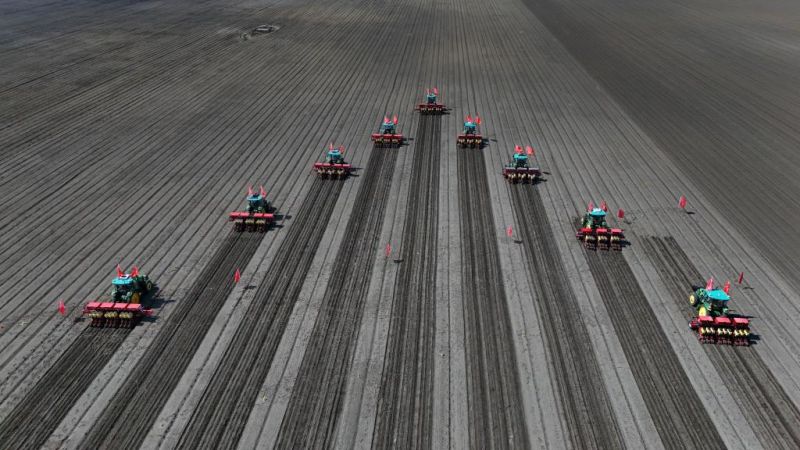
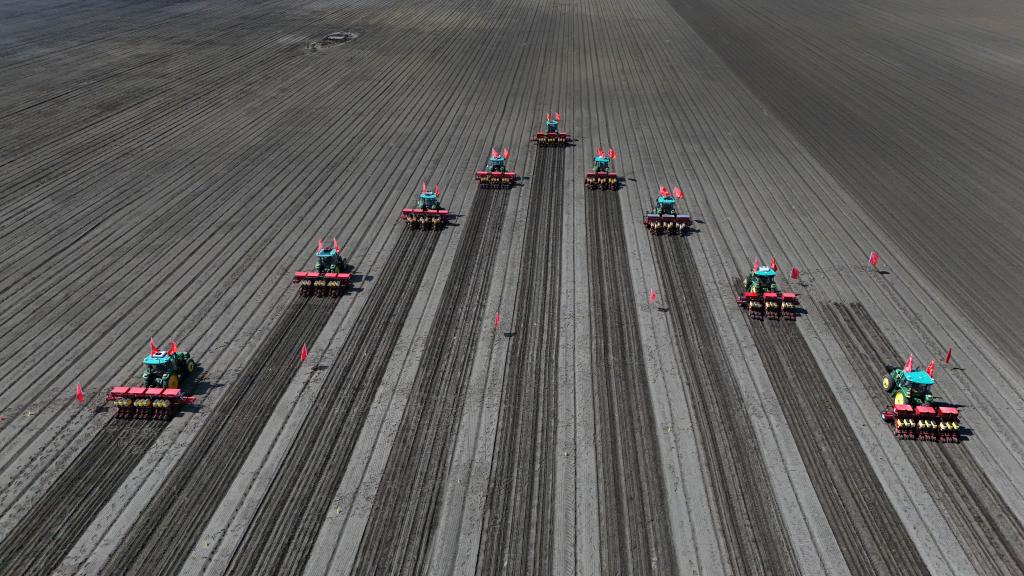
守好粮食生产的命根子!我国拟立法加强耕地保护和质量提升
Xin Hua She· 2025-10-24 19:50
Core Viewpoint - The draft law on farmland protection and quality improvement was presented for review by the National People's Congress Standing Committee on October 24, aiming to strengthen the "three-in-one" protection of farmland quantity, quality, and ecology [1] Group 1: Farmland Protection Measures - The draft law integrates requirements from existing laws such as the Land Management Law and the Food Security Law, emphasizing strict adherence to the protection of farmland and permanent basic farmland [1] - It establishes a mechanism for controlling the use of farmland primarily for the production of food and other agricultural products, and sets legal responsibilities for illegal occupation and degradation of farmland quality [1] Group 2: Ecological Protection and Systematic Approach - The draft law highlights a systematic protection concept, ensuring that the total area of farmland does not decrease, quality improves, and ecological functions remain stable [2] - It emphasizes the integration of protection across mountains, water, forests, fields, lakes, grasslands, and deserts to maintain a favorable ecological environment for farmland protection [2] Group 3: Accountability and Oversight - The draft law enforces accountability for local party committees and governments regarding farmland protection and food security, making provincial leaders the primary responsible persons [3] - It mandates national assessments of farmland protection and food security responsibilities, with enhanced supervision and inspection by relevant departments [3]
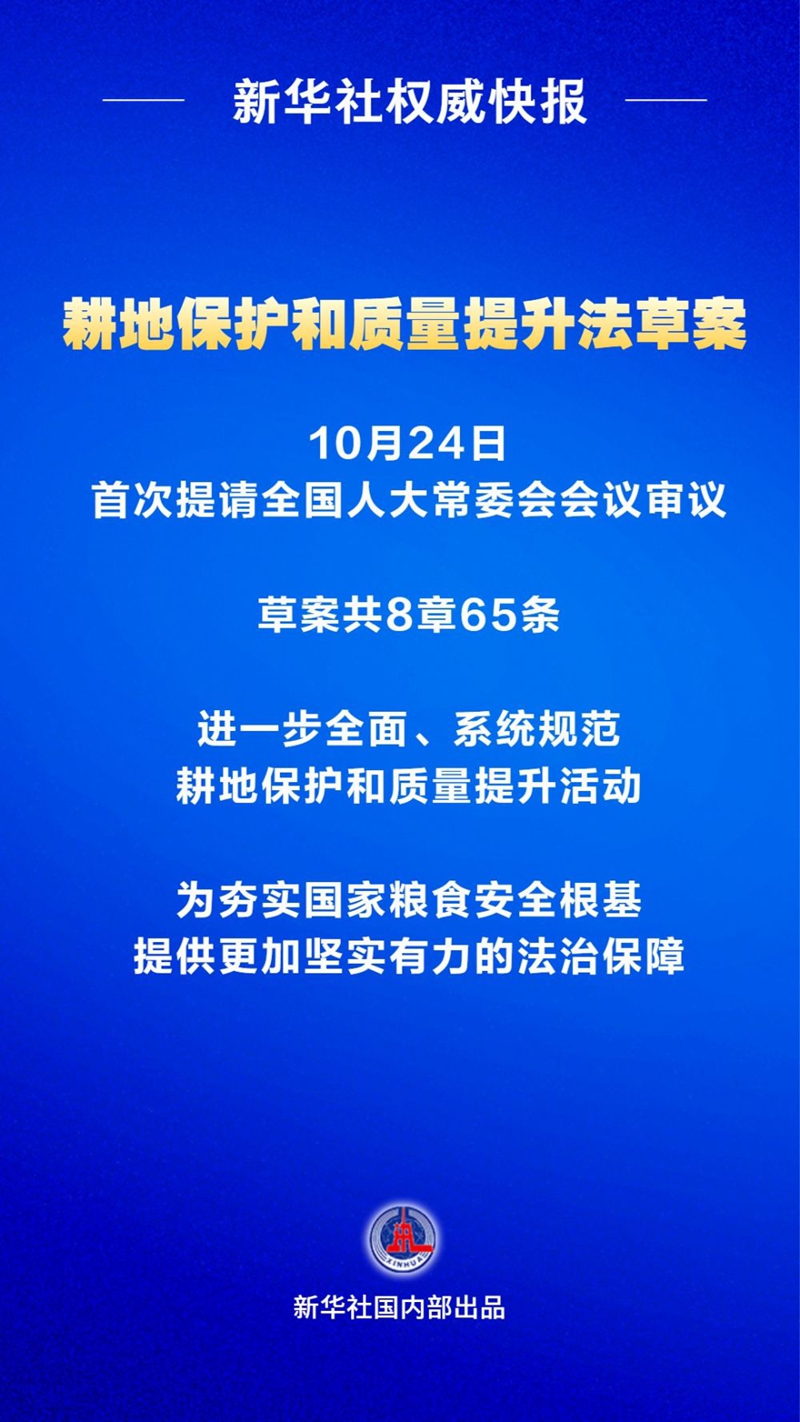
新华社权威快报丨我国首次专门立法加强耕地保护和质量提升
Xin Hua She· 2025-10-24 10:33
Core Points - The draft law on farmland protection and quality improvement was submitted for review by the National People's Congress Standing Committee on October 24 [2] - The draft consists of 8 chapters and 65 articles, aiming to systematically regulate farmland protection and quality enhancement activities [2] Summary by Sections Overall Requirements - The draft law clarifies the overall requirements for farmland protection, emphasizing the need for strict control over farmland occupation and enhancing the quality of farmland [2] Legal Framework - This legislation is designed to address issues related to the limited land resources in China, such as the non-agricultural and non-grain use of farmland, building upon existing laws like the Land Management Law and the Food Security Law [2] Protection Measures - The law aims to strengthen the "three-in-one" protection of farmland quantity, quality, and ecology, providing a robust legal guarantee for national food security [2]
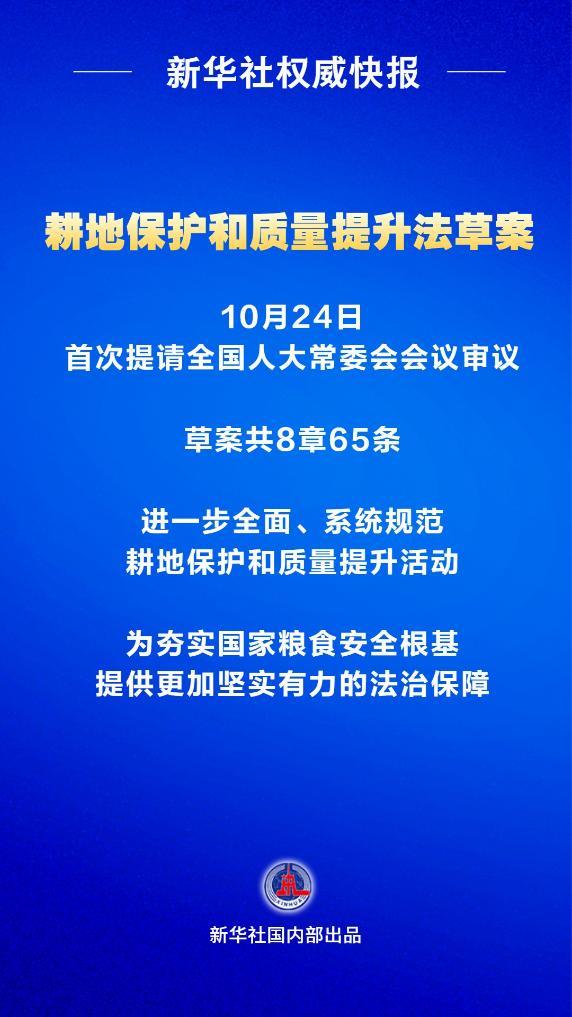
新华社权威快报|我国首次专门立法加强耕地保护和质量提升
Xin Hua She· 2025-10-24 09:18
Core Viewpoint - The draft law on farmland protection and quality improvement was submitted for review to the Standing Committee of the National People's Congress on October 24, aiming to provide a stronger legal guarantee for national food security through comprehensive and systematic regulation of farmland protection and quality enhancement [2][4]. Summary by Relevant Sections Overall Requirements - The draft law outlines the overall requirements for farmland protection, emphasizing the need to strengthen target constraints and improve protection layout [4]. Control Measures - It includes strict controls on the occupation of farmland, addressing issues such as the non-agricultural and non-grain use of farmland, which are significant concerns given China's population density and limited land resources [4]. Quality Improvement - The law aims to enhance the quality of farmland, ensuring a three-pronged approach to protect quantity, quality, and ecological aspects of farmland [4]. Legal Framework - This draft law is designed to complement existing laws such as the Land Management Law and the Food Security Guarantee Law, establishing a dedicated legal framework for farmland protection and quality improvement activities [4].
农业农村部:全力推进耕地保护和质量提升
Zhong Guo Xin Wen Wang· 2025-09-16 04:59
Core Points - The Ministry of Agriculture and Rural Affairs is committed to promoting farmland protection and quality improvement during the 14th Five-Year Plan period, aiming to strengthen the foundation of food security [1] Group 1: Farmland Protection - The government is strictly adhering to the 1.8 billion mu farmland red line, with a national farmland area reaching 1.94 billion mu by the end of last year, an increase of 28 million mu since 2020 [1] - A new round of land spatial planning has been implemented, with strict assessments and accountability for farmland quantity [1] Group 2: High-Standard Farmland Construction - Over 1 billion mu of high-standard farmland has been constructed, with central government investment exceeding 700 billion yuan during the 14th Five-Year Plan period [2] - The average central financial input per mu has increased to over 2,000 yuan since 2020, focusing on leveling fields, ensuring water and road access, and enhancing soil quality and productivity [2] - The construction of high-standard farmland has significantly improved agricultural production capacity and efficiency, with many previously drought-prone areas now able to manage water effectively [2] Group 3: Degraded Farmland Management - Efforts are being made to address the degradation of black soil, with over 400 million mu of black soil protected and 33,000 erosion gullies treated [3] - The pH level of treated acidic farmland has improved by 0.5, leading to a 10% increase in productivity [3] - A comprehensive soil survey was initiated in 2022, covering approximately 1.1 billion mu of farmland, to provide foundational data for optimizing agricultural production [3]
李强主持召李强主持召开国务院常务会议开国务院常务会议
Xin Hua Wang· 2025-08-01 09:26
Core Viewpoint - The State Council, led by Premier Li Qiang, emphasizes the importance of understanding the economic situation and enhancing the effectiveness of macro policies to ensure economic recovery and growth in the second half of the year [3]. Group 1: Economic Policy and Strategy - The meeting highlighted the need to deepen the understanding of the economic situation and enhance the sense of responsibility and mission in economic work for the second half of the year [3]. - There is a focus on stimulating internal economic growth, continuing reforms in key areas, and achieving more results in building a unified national market and optimizing the business environment [3]. - The government aims to ensure safety and prevent systemic risks while effectively managing disaster response and safeguarding people's lives and property [3]. Group 2: Artificial Intelligence Initiatives - The meeting approved the "Artificial Intelligence+" action plan, aiming to promote large-scale commercial applications of AI and leverage China's complete industrial system and large market scale [4]. - Emphasis was placed on optimizing the AI innovation ecosystem, enhancing computing power, algorithms, and data supply, and increasing policy support and talent development [4]. - The government and state-owned enterprises are encouraged to lead by example and support the implementation of AI technologies [4]. Group 3: Financial Policies - The meeting discussed the implementation of interest subsidy policies for personal consumption loans and loans for service industry entities, aimed at reducing credit costs and stimulating consumption [4]. - There is a call for effective organization and implementation of the subsidy policies, with a focus on simplifying procedures and ensuring efficient use of financial resources [4]. Group 4: Agricultural Legislation - The meeting discussed and approved the draft of the "Law on the Protection and Quality Improvement of Arable Land," emphasizing the need for strict adherence to regulations and the integrated protection of arable land quantity, quality, and ecology [5]. - The focus is on restoring and enhancing the ecological functions of arable land to ensure sustainable use [5].
国务院常务会议通过实施“人工智能+”行动意见
Xin Hua She· 2025-08-01 08:22
Group 1 - The State Council emphasizes the need to enhance the sense of responsibility and mission for economic work in the second half of the year, focusing on consolidating and expanding the economic recovery momentum [1] - The government aims to boost the effectiveness of macro policies and tackle challenges to ensure the implementation of the Central Committee's decisions [1] - There is a strong emphasis on stimulating the internal driving force of economic development and deepening reforms in key areas, such as building a unified national market and optimizing the business environment [1] Group 2 - The meeting approved the implementation of the "Artificial Intelligence+" initiative, aiming to promote large-scale commercial applications of AI and leverage China's complete industrial system and large market scale [2] - The government plans to optimize the AI innovation ecosystem by enhancing computing power, algorithms, and data supply, while also increasing policy support and talent development [2] - A personal consumption loan interest subsidy policy and a service industry loan interest subsidy policy were discussed to lower credit costs and stimulate consumption potential [2] Group 3 - The meeting discussed and approved the draft of the "Law on Cultivated Land Protection and Quality Improvement," emphasizing the need for strict protection of cultivated land and the restoration of its ecological functions [3]