
财政收支平衡

Search documents
地方政府债与城投行业监测周报2022年第9期:隐性债务监管高压态势不变强调防范“处置风险的风险”-20260325
Zhong Cheng Xin Guo Ji· 2026-03-25 02:59
1. Report Industry Investment Rating No relevant content provided. 2. Core Viewpoints of the Report - In 2026, China's fiscal policy will balance short - term stimulus and long - term stability, focusing on both "activeness" and "sustainability", and shifting from "leveraging up" to "optimizing leverage". The fiscal situation will feature low revenue growth and rigid expenditure, with the revenue side facing challenges such as tax structure imbalance and weak non - tax revenue sustainability, while the expenditure side will see increased intensity in key areas and face issues like low - efficiency capital use and debt - servicing pressure [24][27][49]. - To address these challenges, the fiscal policy in 2026 should focus on boosting domestic demand, supporting infrastructure investment, fostering new - quality productivity, and promoting reform. Specific measures include expanding the expenditure scale, optimizing the expenditure structure, strengthening fiscal - financial coordination, improving transfer payment efficiency, deepening tax system reform, expanding zero - based budget reform pilots, and establishing a government asset - liability table for debt management [39][40][49]. 3. Summary by Relevant Catalogs 2025 Fiscal Operation Review Fiscal Operation Overview - Revenue: Generalized fiscal revenue declined for two consecutive years, falling short of the budget target by 860 billion yuan. General public budget revenue was 21.60 trillion yuan, a 1.7% year - on - year decrease, and government fund budget revenue was 5.77 trillion yuan, a 7.0% year - on - year decrease [8]. - Expenditure: Generalized fiscal expenditure increased slightly year - on - year but was 2.16 trillion yuan less than the budget target. General public budget expenditure was 28.74 trillion yuan, a 1.0% year - on - year increase, and government fund budget expenditure was 11.29 trillion yuan, an 11.3% year - on - year increase [9]. - Revenue - Expenditure Gap: The gap between actual generalized fiscal revenue and expenditure reached 12.65 trillion yuan, an increase of 1.3 trillion yuan from the previous year. Government bond issuance reached a record high, with national debt issuance at 16.01 trillion yuan and local government bond issuance at 10.31 trillion yuan [11]. Structural Characteristics of Fiscal Operation - Tax and Non - tax Revenue: Tax revenue increased by 0.8% year - on - year, with the four major taxes all showing positive growth. Non - tax revenue decreased by 11.3% year - on - year. The proportion of tax revenue in general public budget revenue rose to 81.6% [15]. - Livelihood and Infrastructure Expenditure: Livelihood expenditure remained a priority, with the combined expenditure on social security, employment, education, and health exceeding 10 trillion yuan, and the proportion increasing to 38.0%. Infrastructure - related expenditure decreased by 6.6% year - on - year, and its proportion dropped to 21.6%. Science and technology expenditure grew by 4.8% year - on - year, and debt - servicing pressure continued to increase [18][19]. - Central and Local Fiscal Expenditure: Central fiscal expenditure increased significantly, with the central government's generalized fiscal expenditure growing at 19.0%, much higher than the local government's 1.6%. The central government's government fund budget expenditure grew at 130%, far higher than the local government's 5.3%. The proportion of local fiscal expenditure in GDP decreased to 24.7% [21]. Fiscal Situation and Revenue - Expenditure Forecast for the "15th Five - Year Plan" Opening Year Fiscal Situation in 2026 - Revenue: Revenue will continue to grow at a low rate and show structural differentiation, with an increased reliance on debt funds. Tax structure imbalance remains prominent, non - tax revenue has weak sustainability, and government fund revenue is dragged down by land finance [25][26]. - Expenditure: Expenditure rigidity will increase, with key areas receiving more support. However, challenges such as low - efficiency capital use and debt - servicing pressure need to be addressed [27]. Revenue - Expenditure Growth Rate Forecast for 2026 - General Public Budget: Revenue may grow by about 0.5%, and expenditure may grow by about 2.6% [28][30]. - Government Fund Budget: Revenue decline may narrow to 5.9%, and expenditure may be roughly the same as in 2025, with a possibility of issuing additional government bonds during the year [34][35]. - Generalized Fiscal Revenue and Expenditure: Generalized fiscal revenue may decline by 0.84% year - on - year, and expenditure may grow by 1.55% year - on - year. The revenue - expenditure gap is expected to expand by over 800 billion yuan [37]. Core Demand Points for Fiscal Policy in 2026 - Boosting Micro - entity Confidence and Expanding Domestic Demand: Insufficient effective demand is the main contradiction. Fiscal policy should increase leverage, especially through the central government, and optimize the expenditure structure [40]. - Supporting Infrastructure Investment: In 2025, the expansion of generalized fiscal expenditure did not significantly improve investment. In 2026, fiscal expenditure should be expanded to create incremental demand and adjust the economic structure to support infrastructure investment [41]. - Fostering New - quality Productivity: China is in a critical period of new - old kinetic energy transformation. Fiscal policy should support the cultivation of new - quality productivity to make up for market failures and ensure key expenditures [46]. - Promoting Reform: Fiscal policy is essential for various reforms, such as income distribution, the construction of a unified national market, and the adjustment of central - local relations [47][48]. Fiscal Policy Outlook and Seven Key Measures in 2026 - Expand the Expenditure Scale and Act in Advance: The budget deficit rate is recommended to be 4% or above, with the central government taking the main responsibility. 5 trillion yuan of new special bonds and 1.8 trillion yuan of special treasury bonds should be issued. The generalized deficit may reach about 15 trillion yuan, an increase of over 1 trillion yuan from the previous year. The pace of fiscal expenditure and government bond issuance and use should be accelerated [53][55][56]. - Optimize the Expenditure Structure: Combine investment in physical assets and in people. Increase livelihood security expenditure, boost consumption, support infrastructure investment, and increase investment in new - quality productivity and the low - carbon economy. Special bonds should be optimized and their investment areas expanded [60]. - Strengthen Fiscal - Financial Coordination: Promote the coordinated implementation of fiscal and monetary policies. Use fiscal tools such as interest subsidies, rewards, and risk compensation, deepen the function of treasury bonds as a core link, and establish an evaluation and feedback mechanism. Explore financial cooperation models and tools to magnify the leverage effect of fiscal funds [62]. - Improve the Efficiency of Transfer Payments: Transfer payments may be arranged at over 10 trillion yuan. The structure of transfer payments should be optimized, the proportion of general transfer payments increased, and a direct - access mechanism for fiscal funds improved [63]. - Deepen Tax System Reform with Consumption Tax Reform: Speed up consumption tax reform, including the post - transfer of the collection link and the transfer to local governments. Cultivate local - specific main taxes and explore new taxes [64][65]. - Expand Zero - based Budget Reform Pilots: Expand zero - based budget reform pilots in an orderly manner, set phased and classified reform goals, and promote supporting system construction. At the same time, clarify the division of central - local fiscal powers and expenditure responsibilities [66]. - Establish a Government Asset - Liability Table: Establish and improve the government asset - liability table, promote debt risk resolution, and build a long - term debt management mechanism. Promote the transformation of government debt from leveraging up to optimizing leverage and address the root causes through deep - seated fiscal and tax system reforms [67][69].
2025年财政收支如何实现平衡?
第一财经· 2026-03-09 08:19
Core Viewpoint - The article discusses the financial balance of China's national budget for 2025, highlighting a deficit of 566 billion yuan, which is offset by government bond issuance, reflecting the resilience and flexibility of China's fiscal policy [3][4]. Group 1: National Budget Overview - The total revenue for the national general public budget in 2025 is approximately 21,604.5 billion yuan, which is 98.3% of the budget, showing a decrease of 1.7% compared to 2024 [4]. - Central general public budget revenue is about 93,963 billion yuan, which is 96.9% of the budget, representing a decline of 6.5% [4]. - Local general public budget revenue is approximately 224,007 billion yuan, achieving 98.9% of the budget with a growth of about 1% [4]. Group 2: Revenue Adjustments - The balance of the central general public budget was achieved by increasing transfers from the central state-owned capital operating budget and reducing expenditures [5]. - The central government transferred 1,000 billion yuan from the central budget stabilization fund and 2,400 billion yuan from the central state-owned capital operating budget, resulting in a total central general public budget revenue of approximately 97,363 billion yuan [5]. - The actual revenue from the central state-owned capital operating budget was about 3,903 billion yuan, exceeding the initial estimate of 2,250 billion yuan by 1,653 billion yuan [5]. Group 3: Expenditure Management - The central general public budget expenditure for 2025 is approximately 144,959 billion yuan, completing 98.3% of the budget, with a growth of 2.8% [6]. - The total expenditure, including the stabilization fund, is about 145,963 billion yuan, resulting in a central fiscal deficit of 48,600 billion yuan, which aligns with the budget [6]. - Local general public budget expenditure is around 244,361 billion yuan, showing a growth of 0.2%, but is reduced by approximately 8,599 billion yuan compared to previous estimates [7]. Group 4: Overall Budget Balance - The overall balance of the national general public budget was achieved primarily through a reduction of about 1 trillion yuan in expenditures, while ensuring that key expenditures related to people's livelihoods were maintained [8]. - The total national general public budget expenditure is 287,395.42 billion yuan, completing 96.8% of the budget, with a growth of 1% [8]. - Expenditures related to infrastructure saw a decline, while social security and health expenditures grew by 6.7% and 5.7%, respectively, indicating a focus on social welfare [8]. Group 5: Government Fund Budget - The national government fund budget revenue for 2025 is approximately 57,704 billion yuan, which is 92.3% of the budget, reflecting a decrease of 7% mainly due to lower land use rights revenue [9]. - The total government fund budget expenditure is about 112,874 billion yuan, completing 90.4% of the budget, with an increase of 11.3% [9]. - The Ministry of Finance allocated 5,000 billion yuan in the fourth quarter to support local government financial capacity and stimulate effective investment [9].


31省份披露去年财政收入
Di Yi Cai Jing Zi Xun· 2026-02-09 06:53
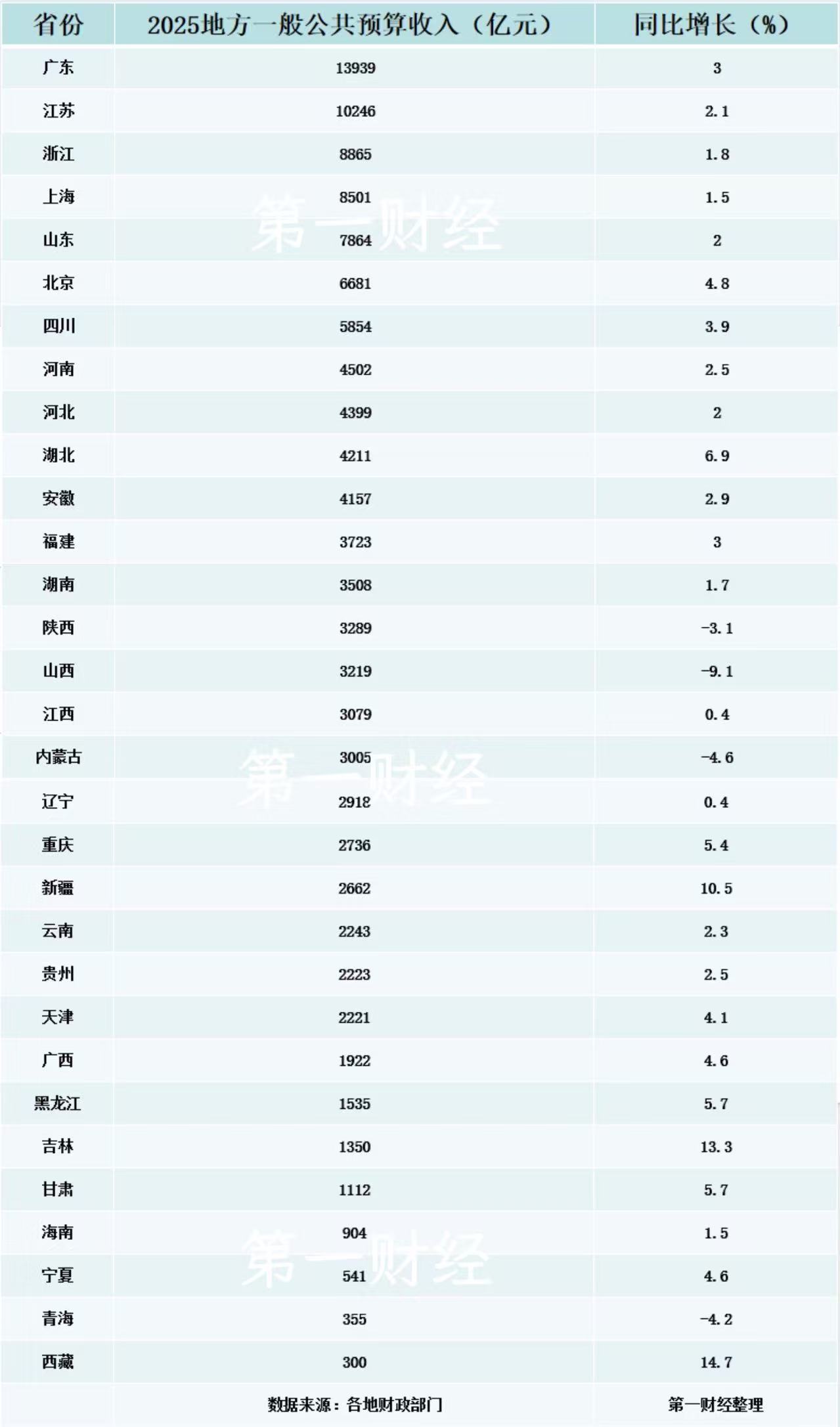
Core Insights - The article discusses the fiscal revenue of 31 provinces in China for 2025, revealing a total public budget revenue of approximately 31 trillion yuan, with significant contributions from eastern provinces [2][5]. Group 1: Fiscal Revenue Overview - Guangdong's fiscal revenue for 2025 is projected to be nearly 1.4 trillion yuan, maintaining its position as the highest in the country for 35 consecutive years [3][5]. - Jiangsu's fiscal revenue surpasses 1 trillion yuan, ranking second nationally, while Zhejiang, Shanghai, Shandong, and Beijing follow in third to sixth positions [3][5]. - The eastern provinces collectively contribute about 46% of the national local public budget revenue, highlighting their critical role in supporting central fiscal resources [5]. Group 2: Revenue Growth and Trends - The overall growth rate of local fiscal revenue in 2025 is expected to be 2.4%, with 17 provinces, including Tibet and Jilin, experiencing growth rates above this average [8]. - Jilin province reports a significant revenue growth of 13.3%, driven by increased non-tax revenue, particularly from the management of state assets [7][8]. - In contrast, provinces like Shanxi, Inner Mongolia, and Shaanxi are facing declines in fiscal revenue due to falling commodity prices, particularly in coal [8][9]. Group 3: Economic Correlation - The fiscal revenue of provinces is closely linked to their economic scale and industrial structure, with larger economies generally yielding higher tax contributions [6]. - The article notes that the fiscal revenue growth rates in major economic provinces like Guangdong and Jiangsu have rebounded compared to 2024, indicating a recovery trend [9]. Group 4: Challenges and Strategies - Many provinces are facing tight fiscal balances due to rising mandatory expenditures, leading to significant fiscal pressure [11]. - Strategies to address fiscal challenges include increasing revenue through asset management reforms and optimizing expenditure structures [11].

31省份披露去年财政收入
第一财经· 2026-02-09 06:41
Core Viewpoint - The article discusses the fiscal revenue of 31 provinces in China for 2025, highlighting the overall growth trends, regional disparities, and the impact of economic conditions on local government finances [3]. Group 1: Fiscal Revenue Overview - In 2025, Guangdong's fiscal revenue reached approximately 1.4 trillion yuan, maintaining its position as the highest in the country for 35 consecutive years [5]. - Jiangsu's fiscal revenue surpassed 1 trillion yuan, securing the second position nationally, while Zhejiang, Shanghai, Shandong, and Beijing followed in third to sixth places [5]. - The top six provinces in fiscal revenue are all located in Eastern China, contributing nearly 46% of the national local fiscal revenue [5]. Group 2: Revenue Growth and Decline - The overall fiscal revenue for local governments in 2025 grew by 2.4% compared to the previous year, with 17 provinces exceeding this average growth rate [8]. - Provinces such as Shanxi, Inner Mongolia, and Shaanxi experienced declines in fiscal revenue, attributed to falling prices of major commodities like coal [8]. - Notably, Jilin province reported a significant growth in fiscal revenue of 13.3%, driven by a substantial increase in non-tax revenue [7]. Group 3: Economic Impact on Fiscal Revenue - The fiscal revenue of local governments is closely linked to the economic scale and industrial structure of the region, with larger economies generally yielding higher tax contributions [6]. - The article emphasizes that the fiscal revenue growth rate is a critical indicator to observe, alongside changes in revenue composition [6]. - The fiscal challenges faced by provinces, such as rising rigid expenditures and debt repayment pressures, indicate a tight balance in fiscal operations [10]. Group 4: Strategies for Revenue Enhancement - Many provinces are addressing fiscal imbalances by enhancing revenue through asset management reforms and optimizing expenditure structures [10]. - For instance, Hubei province is exploring various paths to activate state-owned resources and assets to increase non-tax revenue [9]. - The article suggests that with more proactive fiscal policies, there is potential for improved tax revenue growth in the coming periods [8].

31省份披露去年财政收入:粤苏浙规模居前三
Di Yi Cai Jing· 2026-02-09 06:18
Core Viewpoint - The overall local fiscal operation is stable, with most provinces achieving growth in their 2025 general public budget revenue, reflecting a stable economic performance [1][14]. Group 1: Fiscal Revenue Overview - In 2025, the total general public budget revenue for 31 provinces was disclosed, with Guangdong leading at approximately 1.4 trillion yuan, marking 35 consecutive years at the top [2][3]. - The top six provinces in fiscal revenue are all located in the eastern region, contributing nearly 46% of the national local general public budget revenue [4]. - The fiscal revenue of major economic provinces like Guangdong, Jiangsu, Shandong, and Zhejiang remains high, correlating with their large economic scales [5]. Group 2: Revenue Growth Rates - The national local general public budget revenue increased by 2.4% compared to the previous year, with 17 provinces, including Tibet and Jilin, showing growth rates above this average [9]. - Jilin province reported a significant revenue growth of 13.3%, driven by increased non-tax revenue from asset management [7][9]. - Some provinces, such as Shanxi and Inner Mongolia, experienced declines in revenue due to falling commodity prices, particularly in coal [10]. Group 3: Challenges and Strategies - Despite the overall growth, many provinces face tight fiscal balances due to rising rigid expenditures for public welfare and debt repayment [14]. - Provinces are adopting strategies such as enhancing asset management and tax source cultivation to address fiscal imbalances and ensure stable revenue growth [11][14]. - Reports from provinces like Hebei and Henan highlight ongoing challenges in stabilizing revenue, particularly in the real estate sector, which affects tax income [14].
境外所得补税或成今年征管重点
经济观察报· 2026-02-08 05:26
Core Viewpoint - The article emphasizes the increasing focus on the collection of personal income tax on overseas income, predicting that this trend will strengthen in 2026 [14]. Revenue Analysis - In 2025, the national tax revenue reached 176,363 billion yuan, showing a growth of 0.8% compared to the previous year. The main tax categories maintained positive growth, with personal income tax increasing by 11.5% [6][9]. - The structure of general public budget revenue is improving, with tax revenue accounting for 81.6% of the total, up by 2.0 percentage points from 2024, indicating enhanced stability and sustainability of fiscal revenue [6][7]. Expenditure Analysis - Expenditures related to "people" are increasing, with education spending at 43,417 billion yuan (up 3.2%), social security and employment spending at 44,416 billion yuan (up 6.7%), and health spending at 21,446 billion yuan (up 5.7%) [3][7]. - The overall fiscal policy for 2025 is characterized by a commitment to "sustained effort and increased support," with a focus on maintaining necessary spending levels despite revenue pressures [4]. Personal Income Tax Insights - The significant growth in personal income tax is attributed to improved tax administration and an increase in dividend income. The growth rate of 11.5% is notably higher than that of other major tax categories [9][10]. - The tax authority has intensified its efforts in regulating high-income individuals, with substantial amounts of unpaid personal income tax being collected from various cases [12][13]. Overseas Income Taxation - The article highlights the importance of overseas income taxation, with the tax authority having the capability to track residents' overseas financial accounts since the implementation of the Common Reporting Standard (CRS) in 2017 [13]. - The trend of strengthening the collection of personal income tax on overseas income is expected to continue into 2026, as the tax authority aims to improve data collection and compliance [14].

雄安新区财政收入增长约45%
第一财经· 2026-02-04 02:35
Core Viewpoint - The article discusses the financial performance and budget outlook of Hebei Province, highlighting stable economic growth and significant revenue increases, particularly in the Xiong'an New Area, while also addressing challenges in fiscal management and revenue stability [2][4][8]. Group 1: Financial Performance - In 2025, Hebei's general public budget revenue reached 439.86 billion yuan, a 2% increase, aligning with local expectations and slightly above the national average growth rate of 2.2% [4]. - Tax revenue in Hebei for 2025 was 263.84 billion yuan, growing by 3.4%, while non-tax revenue remained stable at 176.02 billion yuan [5]. - The government fund revenue in Hebei for 2025 was 184.07 billion yuan, a decrease of 2%, which is an improvement compared to the previous year's decline of 15.8% [5][6]. Group 2: Xiong'an New Area - The Xiong'an New Area's general public budget revenue for 2025 was 3.08 billion yuan, showing a remarkable growth of approximately 45%, significantly higher than the national average [6]. - The government fund revenue for Xiong'an in 2025 was 25.4 billion yuan, with a modest growth of about 2% [6]. Group 3: Fiscal Expenditure - In 2025, Hebei's general public budget expenditure was 1,024.36 billion yuan, a slight decrease of 0.8%, but a comparable growth of 7.2% when adjusted for one-time factors [7]. - Social welfare spending accounted for 81.7% of the general public budget expenditure, totaling 836.96 billion yuan, indicating a focus on public welfare [7]. Group 4: Future Outlook - For 2026, Hebei's general public budget revenue is projected to be 448.66 billion yuan, with an expected growth of around 2%, consistent with the previous year's growth [12]. - The government fund revenue for 2026 is anticipated to be 224.97 billion yuan, reflecting a growth of approximately 22%, contingent on the stabilization of the real estate market [13]. - The budget for 2026 includes significant allocations for public welfare, strategic national projects, and technological innovation, with a total expenditure of 987.98 billion yuan [15].

经济大省河南晒政府账本,收支形势如何
Di Yi Cai Jing Zi Xun· 2026-01-26 11:24
Core Insights - The latest fiscal report from Henan Province reveals a clear picture of a trillion-level fiscal expenditure for the year, with a balanced revenue and expenditure situation despite ongoing fiscal challenges [2][4]. Fiscal Revenue and Expenditure - In 2025, Henan's general public budget revenue is projected to reach 450.17 billion yuan, reflecting a growth of 2.5%, slightly below the previous year's forecast of 4% [3][4]. - The province's general public budget revenue has shown slight fluctuations in recent years, with a small decline in 2024 followed by growth in 2025, although it remains slightly below the 2023 level of 451.8 billion yuan [4]. - Government fund revenue, primarily from land sales, is expected to decline to 158.33 billion yuan in 2025, a decrease of 14.8%, with land transfer income dropping by 27.7% to 106.92 billion yuan due to a sluggish real estate market [4][5]. Debt Management and Fiscal Policy - To maintain fiscal spending and mitigate debt risks, Henan plans to issue 517.82 billion yuan in government bonds in 2025, with a total government debt balance of 2.48843 trillion yuan, remaining below the limit set by the Ministry of Finance [5]. - The province's fiscal expenditure is focused on ensuring public welfare and major project construction, with general public budget expenditure expected to reach 1.15161 trillion yuan in 2025, a growth of 0.5% [5][6]. Challenges and Future Projections - The fiscal report highlights ongoing challenges, including declining tax revenues from the real estate sector and insufficient support from emerging industries, leading to significant fiscal pressure [6]. - For 2026, Henan's general public budget revenue is projected to grow by 4% to 468.07 billion yuan, while government fund revenue is expected to increase by 57% to 248.46 billion yuan [7]. - The focus for fiscal spending in 2026 will continue to prioritize public welfare, with specific allocations for increasing minimum standards for pensions and social assistance [8].
经济大省河南晒政府账本,收支形势如何
第一财经· 2026-01-26 10:54
Core Viewpoint - The article discusses the financial situation of Henan Province, highlighting a balanced budget for 2025 but emphasizing ongoing fiscal challenges and the need for proactive fiscal policies to stimulate economic growth and optimize expenditure structures [3][5]. Fiscal Revenue and Expenditure - In 2025, Henan's general public budget revenue reached 450.17 billion yuan, a growth of 2.5%, slightly below the initial expectation of 4% [4][5]. - The province's GDP for 2025 is projected at 6.66 trillion yuan, with a year-on-year growth of 5.6% [5]. - Government fund revenue, primarily from land sales, is expected to decline to 158.33 billion yuan, a decrease of 14.8%, with land transfer income dropping by 27.7% to 106.92 billion yuan due to a sluggish real estate market [5][6]. Debt Management - To maintain fiscal spending and mitigate debt risks, Henan plans to issue 517.82 billion yuan in government bonds in 2025, with total government debt expected to reach 2.48843 trillion yuan, remaining below the limit set by the Ministry of Finance [6][7]. Fiscal Policy Focus - The 2025 budget allocates 1.15161 trillion yuan for general public budget expenditure, a growth of 0.5%, with 849.94 billion yuan (73.8% of total expenditure) dedicated to social welfare [7][8]. - Education spending is set at 207.99 billion yuan, reflecting a commitment to improving educational resources [7]. Future Projections - For 2026, Henan's general public budget revenue is projected to grow by 4% to 468.07 billion yuan, while government fund revenue is expected to increase significantly by 57% to 248.46 billion yuan [9][10]. - The anticipated expenditure for 2026 includes 1.1672 trillion yuan for the general public budget and 357.35 billion yuan for government fund budget [10]. Social Welfare and Debt Management Initiatives - The 2026 budget emphasizes social welfare, with 94.03 billion yuan allocated to increase minimum pension and social assistance standards [11]. - The report stresses the importance of managing hidden debts and transforming local government financing platforms to prevent the establishment of new financing entities [11].

经济大省河南晒政府账本,收支形势如何丨地方预算观察
Di Yi Cai Jing· 2026-01-26 09:59
Core Insights - Henan Province's public budget revenue reached 450.17 billion yuan in 2025, marking a 2.5% increase, although slightly below the initial forecast of 4% [2][3] - The province ranks eighth nationally in public budget revenue and first among central provinces, with a projected GDP of 6.66 trillion yuan in 2025, reflecting a 5.6% year-on-year growth [3] - Government fund revenue is expected to decline significantly, with a forecast of 158.33 billion yuan in 2025, a 14.8% decrease, primarily due to a sluggish real estate market [3] Financial Performance - The total public budget expenditure for Henan in 2025 is projected at 1.15161 trillion yuan, a modest increase of 0.5%, with 849.94 billion yuan allocated for public welfare, accounting for 73.8% of total expenditure [5] - The government plans to issue 517.82 billion yuan in bonds in 2025, with total government debt expected to reach 2.48843 trillion yuan, remaining below the limit set by the Ministry of Finance [4] Future Projections - For 2026, the expected public budget revenue is projected at 468.07 billion yuan, indicating a 4% growth, while government fund revenue is anticipated to rise by 57% to 248.46 billion yuan [6] - The budget for public welfare and education will continue to be a priority, with significant allocations planned for improving social security and educational funding [6]