AI医疗

Search documents
恒指跌0.98% 科指跌0.59% 港股通净流入创新高
Xin Hua Cai Jing· 2025-08-15 11:34
Market Overview - The Hang Seng Index closed down 0.98% at 25,270.07 points, while the Hang Seng Tech Index fell 0.59% to 5,543.17 points, and the National Enterprises Index decreased by 0.98% to 9,039.09 points [1] - The index opened down 197.22 points, briefly rose, but then expanded its losses, ultimately closing down 249.25 points with a total turnover exceeding 312.6 billion HKD [1] - There were 1,168 stocks that rose, 1,074 that fell, and 918 that remained unchanged [1] Sector Performance - Most sectors experienced gains, particularly in AI healthcare, pharmaceuticals, brokerage, real estate, and semiconductor stocks [1] - Mixed performance was noted in gold, semiconductors, new energy vehicle companies, and insurance stocks, while sectors like technology, banking, stablecoin concepts, and coal saw declines [1] Individual Stock Movements - JD.com fell by 3.44%, while SenseTime rose by 1.76% [1] - CITIC Securities increased by 10.98%, China Galaxy by 9.48%, and Huahong Semiconductor by 5.21% [1] - SMIC rose by 1.44%, BYD Electronics by 3.92%, and Silver诺医药 surged by 206.48% [1] - Other notable movements included Lao Pu Gold rising by 3.17%, Ganfeng Lithium by 4.29%, Shandong Gold down by 0.29%, China Resources Power up by 0.65%, Li Auto down by 0.94%, and Yuexiu Property up by 3.90% [1] Top Traded Stocks - Tencent Holdings rose by 0.34% with a turnover exceeding 13.1 billion HKD [2] - Alibaba fell by 3.04% with a turnover exceeding 13 billion HKD [2] - Meituan decreased by 2.17% with a turnover exceeding 7.5 billion HKD [2]
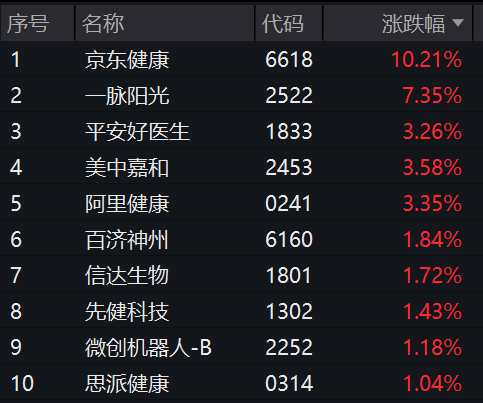
港股收盘(08.15) | 恒指收跌0.98% 互联网医疗股逆势走强 银诺医药-B(02591)首挂暴涨200%
智通财经网· 2025-08-15 09:27
Market Overview - The Hong Kong stock market continued its downward trend, with all three major indices in the red but maintaining above the 25,000 mark. The Hang Seng Index closed down 0.98% at 25,270.07 points, with a total turnover of HKD 312.69 billion [1] - Short-term market focus is on mid-year performance and value for money, with potential volatility from US-China trade negotiations and fluctuations in US stocks [1] - The outlook for the second half of the year remains positive, with expectations of upward movement and new highs for the Hong Kong stock market, supported by potential interest rate cuts from the Federal Reserve [1] Blue Chip Performance - JD Health (06618) led blue-chip stocks, rising 11.67% to HKD 61.25, contributing 11.31 points to the Hang Seng Index. The company's H1 2025 performance exceeded market expectations due to strong growth in the pharmaceutical category [2][4] - Other notable blue-chip movements included Xinyi Solar (00968) up 5.96%, Alibaba Health (00241) up 4.92%, while Sun Hung Kai Properties (00016) fell 5.35% [2] Sector Highlights - Internet healthcare stocks showed strong performance, with Dingdang Health (09886) up 36.07% and JD Health (06618) up 11.67% [3] - The recent surge in the two financing balances indicates a high level of market trading sentiment, with Chinese brokerage stocks performing well [5][6] - The photovoltaic sector saw a general rise, attributed to a shortage and price increase of solar components, with Xinyi Solar (00968) up 8.15% [6][7] Company-Specific Developments - JD Health reported a 24.5% year-on-year revenue increase to HKD 35.3 billion for H1 2025, driven by strong user growth and performance in the pharmaceutical sector [4] - Silver诺医药-B (02591) debuted with a significant increase of 206.48%, reflecting strong market interest in GLP-1 drug treatments [9] - Lijin Technology (00558) rose 46.02% after announcing a strategic partnership for the development of magnesium alloy humanoid robots [10] - Yuanda China (02789) saw an 84.34% increase following a profit warning, projecting a net profit of HKD 150-210 million for H1 2025 [11]
医渡科技尾盘涨超5% 公司近日携智能临床研究一体化解决方案亮相T20+大会
Zhi Tong Cai Jing· 2025-08-15 08:29
Core Viewpoint - Yidu Technology (02158) saw a significant increase in stock price, rising over 5% to HKD 6.43, with a trading volume of HKD 36.58 million, following its presentation at the T20+ Conference focused on innovation in new drug development [1] Group 1: Company Developments - Yidu Technology showcased its integrated AI-driven clinical research solution at the T20+ Conference, emphasizing its role in enhancing clinical research efficiency [1] - The company has served over 350 domestic and international pharmaceutical enterprises, accumulating experience from 686 clinical trial projects and conducting 275 real-world research projects [1] - The Vice President of Life Sciences Clinical Trials at Yidu Technology highlighted the advantages of their proprietary "AI Medical Brain" YiduCore, which optimizes the entire clinical trial process [1] Group 2: Industry Impact - The integrated solution presented by Yidu Technology significantly accelerates key drug development processes, improving efficiency by over 30% in areas such as trial design, patient recruitment, and clinical operations [1] - The advancements in AI-driven solutions are positioned to enhance research efficiency, optimize product launch pathways, and reduce innovation costs within the pharmaceutical industry [1]
港股异动 | 医渡科技(02158)尾盘涨超5% 公司近日携智能临床研究一体化解决方案亮相T20+大会
Zhi Tong Cai Jing· 2025-08-15 08:09
Core Viewpoint - Yidu Technology (02158) experienced a significant stock increase of over 5%, closing at 6.43 HKD with a trading volume of 36.58 million HKD, following its participation in the T20+ Conference focused on innovation in new drug development [1] Group 1: Company Developments - Yidu Technology showcased its integrated AI-driven clinical research solution at the T20+ Conference, emphasizing its role in enhancing clinical research efficiency [1] - The company has served over 350 domestic and international pharmaceutical enterprises, accumulating experience from 686 clinical trial projects and conducting 275 prospective and retrospective real-world research projects [1] - Yidu Technology's Vice President of Life Sciences Clinical Trials, Liu Ying, highlighted the advantages of the company's medical big data processing capabilities and the proprietary "AI Medical Brain" YiduCore, which supports the entire clinical trial process [1] Group 2: Industry Insights - The T20+ Conference, guided by the China Food and Drug Enterprise Quality Safety Promotion Association, focused on key issues related to industrial upgrading and innovation in the entire chain of new drug research and development [1] - The integrated solution presented by Yidu Technology significantly accelerates critical drug development processes, improving efficiency by over 30% in areas such as clinical trial protocol optimization, patient recruitment, and clinical operations [1]
AI医疗赋能加速,港股医疗ETF(159366)逆势涨超2%,重仓股京东健康涨超13%
Sou Hu Cai Jing· 2025-08-15 05:12
Group 1 - The core viewpoint of the articles highlights the strong performance of AI healthcare and smart medical indices in the Hong Kong stock market, with the Hong Kong medical ETF (159366) rising by 2.58% and achieving a trading volume exceeding 300 million RMB, indicating active market participation [1] - JD Health reported a significant increase in its mid-year performance for 2025, with total revenue reaching 35.3 billion RMB, a year-on-year growth of 24.5%, and a Non-IFRS net profit of 3.57 billion RMB, up 35% [1] - Over the past three months, the Hong Kong medical ETF (159366) has seen a remarkable increase of over 37% in its adjusted net asset value [1] Group 2 - The National Development and Reform Commission has approved the establishment of a "National AI Application Pilot Base" in the medical field, led by Zhongshan Hospital affiliated with Fudan University, focusing on clinical research and addressing industry pain points [2] - AI healthcare is expected to shift the diagnostic and treatment paradigm from an "experience-driven" model to a "data-driven" model, despite current challenges such as data barriers [2] - The Hong Kong medical ETF (159366) includes a selection of 50 listed companies in the medical field, reflecting the overall performance of the sector within the Hong Kong Stock Connect [2] Group 3 - As of June 30, 2025, the top ten weighted stocks in the CSI Hong Kong Stock Connect Medical Theme Index (932069) include WuXi Biologics, JD Health, WuXi AppTec, Alibaba Health, Sinopharm, Kingstar Bio, Weigao Group, China Biologic Products, CanSino Biologics, and MicroPort Scientific, collectively accounting for 56.9% of the index [3]
470亿港元BD大单“出海”背后:国产AI医疗赛道正在崛起
Hua Xia Shi Bao· 2025-08-15 05:01
Core Viewpoint - The recent announcement by Crystal Tech Holdings regarding a collaboration with DoveTree has created significant excitement in the capital market, marking a breakthrough in the commercialization of AI in healthcare [2] Market Dynamics - The AI healthcare sector is experiencing explosive growth, driven by supportive policies and increasing capital investment [4] - The Chinese AI healthcare market is projected to grow from 8.8 billion yuan in 2023 to 315.7 billion yuan by 2033, with a compound annual growth rate of 43.1% [5] - The average financing amount in the AI healthcare sector has increased significantly, from 80 million yuan in 2019 to 320 million yuan in 2024 [5] Policy Support - The Chinese government has implemented a series of policies to promote the integration of AI in healthcare, including the "Artificial Intelligence +" initiative [4] - Local governments are also providing financial support for AI healthcare projects, with significant funding allocated to pilot programs [4] Challenges in the Industry - Despite the enthusiasm, the industry faces challenges such as data barriers, clinical validation, and commercialization pathways [3] - Regulatory scrutiny remains stringent, with no relaxation of IPO standards for AI healthcare companies [6] - Issues related to revenue recognition and the commercial viability of AI solutions are critical for companies seeking to go public [6] Investment Landscape - The investment community is increasingly focused on the efficiency and cost optimization potential of AI applications in healthcare [7] - Companies are exploring international markets, but face significant regulatory hurdles in the U.S. healthcare system [7][9] Sector Differentiation - There is a growing divergence within the AI healthcare sector, with emerging profitable cases in niche areas such as surgical robotics and intelligent supply management [8] - The market may favor companies that can establish service barriers and address clinical pain points without overly relying on insurance payments [9]


“第五套标准”重启进程加速,科创板吸引创新药企上市,同标的费率最低的科创医药ETF(588860)受关注
2 1 Shi Ji Jing Ji Bao Dao· 2025-08-15 04:42
Group 1 - The core viewpoint of the articles highlights the recent approval of an unprofitable biopharmaceutical company for IPO under the fifth listing standard of the Sci-Tech Innovation Board, signaling a positive shift in the financing environment for similar companies [1] - The fifth listing standard, which had previously faced a "zero acceptance" situation, is now being revitalized, indicating a renewed confidence from regulators in the long-term value of hard technology [1] - There are currently four other similar companies awaiting review for IPO under the same standard, suggesting a potential increase in market activity for unprofitable biopharmaceutical firms [1] Group 2 - The Sci-Tech Innovation Board's biopharmaceutical ETF (588860) has shown active trading, with an average daily trading volume of 31.1566 million yuan as of August 14, indicating strong investor interest [1][2] - The ETF tracks the Shanghai Stock Exchange Sci-Tech Innovation Board Biopharmaceutical Index, which includes 50 large-cap companies in the biopharmaceutical sector, reflecting the overall performance of this industry [2] - The top three weighted industries within the index are chemical pharmaceuticals (39.7%), medical devices (33%), and biological products (18.7%), highlighting the sector's composition [2] Group 3 - The innovation drug sector is expected to maintain its growth momentum, driven by policy support, increasing global competitiveness, and the realization of commercial profitability [3] - There is an anticipated recovery in demand for the domestic market by 2025, particularly in the consumer healthcare sector, which includes medical services and traditional Chinese medicine [3] - The medical device sector is also projected to see improvements by 2025, indicating a broader recovery trend within the healthcare industry [3]
济民健康连续2日涨停,细胞基因治疗+AI医疗+股份回购三重利好
Sou Hu Cai Jing· 2025-08-15 02:59
Core Viewpoint - Jimin Health has experienced a significant stock price increase of 10.00%, achieving a price of 8.91 yuan and a total market capitalization of 4.679 billion yuan, indicating strong investor interest and confidence in the company's future prospects [1] Group 1: Strategic Collaborations - The company has entered into a strategic partnership with Dabo Bio in the field of cell gene therapy, focusing on the development of oncolytic virus drugs, which aligns with the biotechnology sector within the healthcare industry [1] - Jimin Health is participating in an AI entrepreneurship development fund, integrating AI with medical technology, thus tapping into the emerging trend of AI and healthcare convergence [1] Group 2: Market Confidence Initiatives - The company has announced a share repurchase plan worth 100-200 million yuan, aimed at strengthening market confidence and supporting the buyback concept [1] Group 3: Business Segments - Jimin Health is primarily involved in several key sectors including biotechnology, artificial intelligence, medical devices, medical services, and share buybacks, reflecting a diversified approach to growth and investment opportunities [1]

京东健康领涨超13%,AI医疗或将迎来加速发展,港股通医疗ETF(520510)现涨超2%
Mei Ri Jing Ji Xin Wen· 2025-08-15 02:33
Core Insights - The Hong Kong internet healthcare stocks experienced a significant rally, with JD Health rising over 13%, Ping An Good Doctor nearly 10%, and Alibaba Health close to 7% [1] - JD Health reported a mid-term revenue of RMB 35.29 billion for the six months ending June 30, 2025, representing a year-on-year increase of 24.5%, and a non-IFRS profit of RMB 3.57 billion, up 35% year-on-year [1] - The strong performance of JD Health has boosted market confidence and injected vitality into the AI healthcare sector, which is characterized by a comprehensive service loop covering medical, testing, diagnosis, and pharmacy [1] - The Chinese government has reinforced its support for AI applications in healthcare, with a focus on AI pathology diagnosis, AI imaging, and AI pharmaceuticals, which are expected to accelerate commercialization [1] Company and Industry Summary - JD Health has established itself as a leader in AI healthcare and internet pharmacy, continuously upgrading and launching full-scenario AI medical products to meet diverse patient and doctor needs [1] - The Hong Kong Stock Connect Medical ETF (520510), which includes major players like JD Health, Ping An Good Doctor, and Alibaba Health, has become a convenient tool for investors looking to capitalize on this high-potential sector [2] - The ongoing exploration of AI applications in healthcare is expected to provide continuous growth momentum for pharmaceutical innovation [1]
京东健康涨超10%,差异化覆盖AI医疗的港股医疗ETF(159366)涨超2%
Sou Hu Cai Jing· 2025-08-15 02:10
Core Viewpoint - The Hong Kong Medical ETF (159366) has shown significant growth, with JD Health (6618) being a major contributor, reflecting strong performance in the healthcare sector driven by AI integration and innovative service offerings [1][4]. Group 1: ETF Performance - As of August 15, 2025, the Hong Kong Medical ETF has risen over 2%, with JD Health increasing by more than 10%, making it the second-largest component of the ETF, accounting for over 10% [1]. - The ETF has seen active trading, with an average daily turnover of 292 million RMB over the past month as of August 14 [1]. Group 2: Company Performance - JD Health reported a revenue of 35.3 billion RMB for the first half of 2025, marking a 24.5% increase, with Q2 revenue reaching 18.645 billion RMB, up 23.67% [4]. - The company is accelerating the construction of an AI-enabled healthcare ecosystem, integrating services across various medical fields [5]. Group 3: AI Integration in Healthcare - JD Health is enhancing its online medical service capabilities, offering a comprehensive service loop from online consultations to medication delivery, and expanding its at-home nursing services [5]. - The company has launched AI-driven products, including AI doctors and AI pharmacists, to improve health management services [5]. - A partnership with Wenzhou Medical University First Affiliated Hospital has been established to create a closed-loop service process for outpatient patients, serving over 2.2 million patients [5]. Group 4: Industry Trends - The National Development and Reform Commission has approved the establishment of a national AI application pilot base in the medical field, focusing on clinical research and addressing industry challenges [6]. - AI is becoming a core driver of transformation in the healthcare sector, although challenges such as data standardization and clinical application integration remain [6]. - The collaboration between CRO companies and AI technology is enhancing drug discovery efficiency, as seen in the partnership between Crystal Holdings and DoveTree [6].