数字化技术

Search documents
研判2025!中国无损检测设备行业政策汇总、产业链图谱、市场规模及发展趋势分析:市场竞争较为缓和,主要以技术竞争为主[图]
Chan Ye Xin Xi Wang· 2025-06-28 01:22
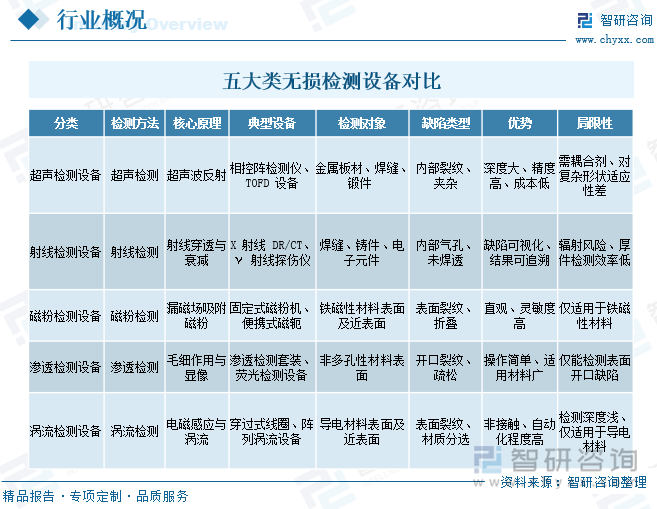
Overview - Non-destructive testing (NDT) technology is crucial in various sectors of China's economy, ensuring and improving product quality across industries from aerospace to everyday consumer goods [1][13] - The NDT equipment market in China is projected to reach a scale of 6.363 billion yuan in 2024, with a year-on-year growth of 3.87% [1][13] - The demand for advanced NDT technology is increasing as traditional methods are gradually replaced, leading to higher investments in advanced NDT equipment by enterprises [1][13] Market Policies - China has implemented several regulations and standards to enhance product quality and safety, creating a favorable policy environment for the NDT equipment industry [6][8] - Key policies include the "Action Plan for the Development of Intelligent Testing Equipment Industry (2023-2025)" and various guidelines aimed at promoting high-quality development in manufacturing and resource utilization [6][8] Industry Chain - The upstream of the NDT equipment industry includes suppliers of electronic components, metals, optical materials, and sensors, which directly impact the quality and scale of NDT equipment production [9] - The midstream involves the design, research, and production of NDT equipment, while the downstream consists of inspection and testing institutions that utilize these technologies [9] Development Status - The NDT market in China has seen rapid growth, with the industry becoming a key player in ensuring product quality across various sectors [1][13] - The number of qualified inspection and testing institutions reached 53,057 in 2024, generating revenues of 487.597 billion yuan, indicating a robust growth in the downstream market [11] Competitive Landscape - The NDT equipment industry is characterized by high technical barriers and a focus on technological competition, with few major players dominating the market [15][16] - Domestic companies like Chaoyan Co., Duopule Co., and Ultrasonic Electronics are gradually increasing their market share and closing the gap with international competitors [16][19][21] Future Trends - The future of NDT equipment will see increased adoption of digital technologies for data collection, storage, and transmission, enhancing decision-making in maintenance and quality control [23] - Collaboration among upstream and downstream players in the industry will be crucial for technological innovation and market expansion, improving overall competitiveness [23]


驻哥伦比亚大使朱京阳见证中哥签署关于共建数智工匠学院的合作备忘录
news flash· 2025-06-27 07:06
2025年6月26日,驻哥伦比亚大使朱京阳会见哥国家培训服务中心政企关系总监卡万佐,并见证《重庆 电子科技职业大学与哥伦比亚国家培训服务中心合作备忘录》签署仪式。朱大使表示,该备忘录是日前 佩特罗总统访华的又一重要成果。中方愿积极推进双方在数字化技术和人工智能等领域的人才培训、认 证合作,为中国企业在哥伦比亚发展提供本土化的人才支撑,助力哥新一代信息技术产业发展。根据协 议,中哥双方将在电子信息通讯、人工智能等新兴科技领域开展职业培训合作,为哥方培养相关产业发 展所需的更多技术人才。(外交部网站) ...
华控赛格(000068) - 000068华控赛格投资者关系管理信息20250626
2025-06-26 11:24
Group 1: Company Overview and Business Operations - The company specializes in water environment management, urban water system services, sponge city construction, municipal design, EPC contracting, and engineering consulting [2] - The company is expanding its business scope through acquisitions and integrating digital technologies to enhance traditional operations and explore new profit models [2] Group 2: Personnel Changes and Management - Recent personnel adjustments are part of the major shareholder's overall management strategy and are considered normal operational changes [2] Group 3: Legal Matters - The company is involved in an arbitration case with Tongfang Investment, which is currently under review by the Supreme People's Court after an appeal for retrial [3] - A professional legal team has been engaged to manage the case and minimize its impact on the company [3] Group 4: Sponge City Projects - The company has undertaken three sponge city projects located in Hebei, Yunnan, and Sichuan, covering the entire process from planning to operation [4] - No new sponge city projects have been won recently; existing projects are focused on risk management and operational tasks [4] Group 5: Lithium Battery Material Business - The company's subsidiary in Inner Mongolia focuses on the deep processing of graphite for lithium battery anodes [5] - The business has faced significant challenges, including a decline in sales and increased losses due to market fluctuations and a lack of a complete industrial chain [5] Group 6: Land Development Projects - The company's land in Pingshan was included in Shenzhen's 2023 urban renewal plan, with a compensation agreement signed in November 2023 [6][7] - The land development project is progressing steadily, with updates to be disclosed through official channels [7] Group 7: Employee Count - As of December 31, 2024, the company has a total of 343 employees [7] Group 8: Shareholder and Competition Issues - The indirect controlling shareholder, Shanxi Construction Investment, is exploring business adjustments and asset restructuring to address competition issues [7] - The commitment to resolve competition issues has been extended due to various operational challenges and financial pressures [7] Group 9: Future Growth and M&A Plans - The company's development strategy for 2025 will be detailed in the 2024 annual report [8] - Any potential merger and acquisition plans will be disclosed in accordance with regulatory requirements [8]

数字化技术让中国古文明焕发崭新生命力
Xin Hua She· 2025-06-22 13:11
Core Insights - The integration of digital technology is revitalizing ancient agricultural practices and cultural heritage in Chengdu, Sichuan, showcasing a blend of tradition and modernity [1][4][6] Agriculture and Technology - Agricultural scientists are utilizing AI technology to model and simulate hybrid rice varieties, significantly reducing breeding time compared to traditional methods [3] - Advanced agricultural machinery, such as autonomous tractors and intelligent rice yield measurement platforms, are being employed to explore new paradigms in biological breeding [3] Cultural Heritage and Innovation - The Sichuan Silk Museum displays a large-scale traditional weaving machine, highlighting the historical significance of silk production in the region [3] - The Shujing Cultural Communication Company is innovating traditional embroidery by using digital image processing and AI technology, enhancing design efficiency and ensuring uniqueness in each piece [4][5] Modern Applications of Traditional Culture - The Chengdu Plain is historically significant for silk production, with records indicating that ancient Shu people traded silk fabrics as early as the Spring and Autumn period [3] - Cultural products inspired by ancient artifacts, such as the Sun Bird gold ornament from the Sanxingdui site, are being marketed to younger consumers through live streaming platforms [5][6] Interactive Cultural Experiences - The use of virtual intelligent beings, like the AI guide "Athena," in museums enhances visitor engagement by providing interactive and immersive experiences [5]
最后报名机会!500+药企、科研机构、检测中心都在关注的实验室破局之道!
仪器信息网· 2025-06-17 06:28
特别提示 微信机制调整,点击顶部"仪器信息网" → 右上方"…" → 设为 ★ 星标,否则很可能无法看到我们的推送。 与 500+ 行业决策者共探 实验室智能化转型新范式! 当前,全球医药健康产业加速创新,中国实验室行业也迎来发展新机遇。一方面,2025年版《中国药典》的即将实施,推动药品质量标准与国 际接轨;另一方面,以AI和大数据为核心的数字化技术加速渗透实验室场景,驱动研发模式向智能化、精准化方向迭代升级。在政策驱动与技 术赋能的双重叠加下,实验室作为医药创新的核心载体,正迎来需求爆发期。 为应对全球制药行业技术变革与监管升级挑战, 2025实验室创新与发展论坛 将于 2025年6月24-25 日 在 上海新国际博览中心 W12馆 B61展位 举办。本次论坛汇聚了药典委专家、跨国企业技术领袖、高校科研团队及行业实践者,他们将围绕 "政策解读""数字化创新"和"降 本增效" 三大主题展开深度研讨,通过多维度思想碰撞与案例分享,为实验室智能化转型与可持续发展提供战略路径。 会议免费报名倒计时开启 (截至2025年6月19日24:00) 即刻扫码报名 论坛一:政策解读——《2025年新药典》 时间: 6月24 ...

“十五五”,塑料加工业如何创新突围
Zhong Guo Hua Gong Bao· 2025-06-10 03:08
Core Viewpoint - The Chinese plastic processing industry is undergoing a comprehensive transformation driven by innovation and green circular economy, facing challenges such as market demand insufficiency, environmental pressures, and technological bottlenecks as it moves towards the "14th Five-Year Plan" [1][3]. Group 1: Industry Overview - The Chinese plastic processing industry has become the world's largest in terms of production, consumption, and export, with a total production of 77.076 million tons in 2024, representing a year-on-year growth of 2.9% [2]. - The total export value of plastic products reached $106.09 billion in 2024, an increase of 5.4% year-on-year, while imports totaled $17.8 billion, up 3.6%, resulting in a trade surplus of $88.29 billion [2]. Group 2: Challenges Faced - The industry is grappling with insufficient effective market demand, rapid changes in demand structure, severe internal competition, and intense competition in low-end products [3]. - Environmental pressures and sustainability challenges are significant, with increasing restrictions on single-use plastic products and high costs associated with recycling [3]. Group 3: Strategic Directions for Transformation - The China Plastic Processing Industry Association has proposed four strategic directions for the upcoming "14th Five-Year Plan": focusing on world-class technology, enhancing public health, addressing national needs, and promoting resource integration [4]. - The market for the plastic processing industry is expected to grow steadily during the "14th Five-Year Plan," with technological innovation as the core driving force, particularly in high-performance engineering plastics and smart manufacturing [4][5]. Group 4: Green Transformation - Green transformation is elevated to a strategic level, with a focus on the large-scale application of bio-based plastics, breakthroughs in chemical recycling technology, and the establishment of low-carbon certification systems [5]. - The EU's Carbon Border Adjustment Mechanism (CBAM) will compel export companies to accelerate their low-carbon transformation, intensifying competition over technological standards [5].
建工修复(300958) - 2025年6月6日投资者关系活动记录表
2025-06-06 11:36
Legal Matters - The company has won first-instance judgments in two out of the lawsuits disclosed on March 21, 2025, and five cases have been settled through mediation [1][2]. Market Management - Since establishing its market value management system, the company has focused on enhancing soil pollution prevention solutions and expanding into new environmental remediation businesses, securing multiple large-scale solid waste resource utilization and safe disposal projects [2][3]. - The company has implemented a stable cash dividend policy, completing cash dividends for the fiscal years 2020-2023 since its listing in 2021 [2][3]. Financial Performance - The company reported an order backlog of 1.183 billion yuan as of December 31, 2024, with new orders to be announced [5][6]. - The company acknowledges that its stock price is influenced by macroeconomic conditions, market cycles, and investor sentiment, urging investors to remain rational and aware of investment risks [3][4]. Business Development - The company is actively expanding its business in various sectors, including: - Solid waste disposal, with breakthroughs in technology and market reach [5][6]. - Phosphogypsum disposal, with rapid expansion into regions like Yunnan and Inner Mongolia [5][6]. - Comprehensive utilization of red mud and oil sludge treatment technologies [5][6]. - The company has secured significant projects, including a comprehensive land remediation project with a total investment of approximately 1.14 billion yuan [5][6]. Technological Advancements - The company has developed a range of advanced remediation technologies, achieving international leading and advanced levels in several areas, including chemical oxidation, thermal desorption, and in-situ remediation techniques [16][17]. - The application of AI and digital technologies in project management has been effective, with over 20 projects utilizing the developed ecological data information system since 2022 [8][9]. Future Outlook - The company plans to continue focusing on research and development in sustainable remediation technologies, digital platforms, and solid waste resource utilization [12][16]. - The company is exploring potential mergers and acquisitions to expand its business scale and market share, with any plans to be disclosed in accordance with legal requirements [10][12].
Ecolab (ECL) FY Conference Transcript
2025-06-03 18:00
Ecolab (ECL) FY Conference Summary Company Overview - Ecolab is a leading provider of chemical-based solutions for institutional and industrial end markets, with a strong focus on water-related services and technologies [2][10][11] - The company has been in business for over 102 years and has a strong balance sheet, positioning itself well for growth [5][6] Financial Performance - Ecolab's stock has been on an upward trajectory since late 2022, attributed to successful navigation through product cost inflation and strong customer relationships [2][3] - The company aims for a long-term target of 20% operating income margin by 2027, with an expected margin of 18% in 2025, reflecting a 150 basis points improvement from the previous year [14][15] - Financial targets include 5% to 7% top-line growth and 12% to 15% earnings per share growth [17] Market Position and Opportunities - Ecolab serves over 1 million customers in 172 countries across 40 different industries, with 90% of sales being recurring [12][13] - The company is positioned as a leader in a fragmented global market, with no direct competitors offering the same breadth of services [20] - Ecolab's market opportunity is estimated at EUR 152 billion, with a penetration opportunity of EUR 55 billion [32] Growth Strategies - Ecolab is focusing on several key growth areas, including: - **Global High-Tech Business**: Targeting data centers and microelectronics manufacturers, with a market opportunity exceeding EUR 5 billion [32][33] - **Life Sciences**: A growing segment with a current business of CHF 300 million and a 30% margin, focusing on safe drug production [39][40] - **Ecolab Digital**: Transitioning to a subscription model for digital services, with an annualized sales figure of EUR 320 million and a growth rate of 12% [42][43] Technological Innovations - Ecolab has invested significantly in R&D, with 3,000 employees dedicated to developing breakthrough technologies [8][21] - Innovations include: - Water-free cooling technologies for data centers, reducing energy consumption [22][36] - Advanced water recycling systems for semiconductor manufacturing [37] - Digital monitoring systems for hotels and restaurants, enhancing operational efficiency and guest satisfaction [54][55] Environmental and Social Impact - Ecolab's ambition by 2030 is to protect 2 billion people from infection and provide enough water for 1 billion people [7][44] - The company emphasizes sustainability, aiming for net-zero water usage and reducing environmental impact through its services [11][19] Customer Relationships and Value Proposition - Ecolab's value proposition focuses on helping customers improve operational efficiency while reducing costs and environmental impact [21][27] - The company has a strong emphasis on customer satisfaction, with digital solutions enhancing service delivery and operational performance [55][59] Conclusion - Ecolab is well-positioned for future growth, leveraging its technological innovations, strong market presence, and commitment to sustainability to drive financial performance and customer satisfaction [45][46]

践行 “两山” 理念 塔子坝污水处理厂的生态担当
Xin Hua Wang· 2025-05-28 07:09
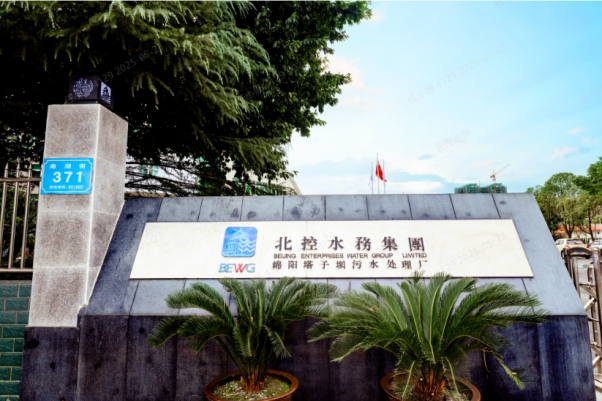
Core Viewpoint - The Mianyang Taziba Wastewater Treatment Plant, operated by Beijing Enterprises Water Group, plays a crucial role in environmental protection and resource recycling in Mianyang, Sichuan, contributing to the ecological civilization and sustainable development of the region [1][3][8] Group 1: Plant Operations and Technology - The Taziba Wastewater Treatment Plant processes approximately 200,000 tons of wastewater daily, equivalent to the volume of 100 standard swimming pools [3] - The plant has implemented advanced technologies such as intelligent aeration and dosing, achieving automated operations without manual intervention [5] - The integration of IoT technology allows for real-time monitoring of equipment status, significantly reducing emergency incidents from 23 times per month to 1-2 times [5] Group 2: Environmental Education and Community Engagement - The plant serves as one of the first environmental education bases in Sichuan, promoting ecological awareness through public open days and various environmental activities [7] - Community members, including school groups, are invited to tour the facility, enhancing public understanding of wastewater treatment processes and their importance [8] Group 3: Commitment to Sustainable Development - The plant aims not only for compliance with discharge standards but also to ensure that every drop of water contributes to ecological cycles, aligning with the principle that "green mountains and clear waters are as valuable as mountains of gold and silver" [8] - The Taziba Wastewater Treatment Plant is committed to exploring more efficient and low-carbon wastewater treatment models, supporting Mianyang's vision of a livable ecological city [8]
让“人工智能+”加速为企业“变现”
Xin Hua Ri Bao· 2025-05-26 23:27
Group 1 - The core viewpoint of the articles highlights the integration of AI and digital technologies in manufacturing, particularly in Jiangsu, which is driving innovation and efficiency in various industries [1][9][10] - Jiangsu's high-tech manufacturing sector saw a 12.9% increase in value-added output in April, with digital product manufacturing growing by 11.4% [1] - Companies like SANY Heavy Industry are utilizing smart factories to enhance production efficiency, with the ability to produce 3,000 excavators per month on a single assembly line [2][3] Group 2 - The fiber optic industry is experiencing high levels of digital collaboration, with companies like Hengtong Group implementing intelligent manufacturing systems to optimize production processes [3] - AI tools are being leveraged across various sectors, with companies like Ecovacs Robotics focusing on enhancing their products' AI capabilities for better user interaction and functionality [5][6] - The integration of AI in manufacturing processes is seen as a common trait among tech companies, enabling rapid development and innovation [5][6] Group 3 - Companies such as Bozhong Precision are establishing a competitive edge through strong R&D capabilities, with over 1,800 engineers and an annual R&D investment exceeding 12% [8] - The adoption of AI is viewed as a significant opportunity for companies to enhance their operational efficiency and product development capabilities [8][10] - Jiangsu's manufacturing sector is recognized for its ability to harness AI and digital technologies, creating a robust ecosystem for industrial innovation [9][10]