AI泡沫

Search documents
AI创业暗战2025,有人半年签单破亿
3 6 Ke· 2025-11-04 12:53
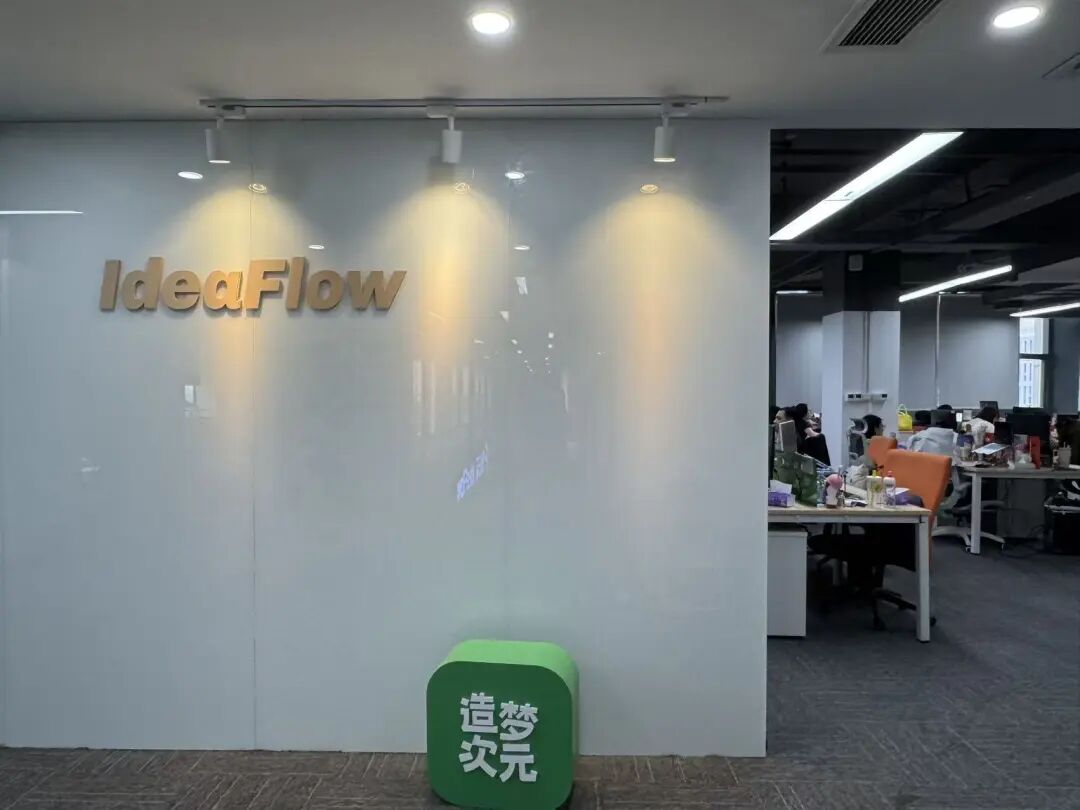
Core Insights - The AI wave is a transformative force that has leveled the playing field for established companies, elite returnees, and newcomers alike, presenting new solutions to past business challenges and future opportunities [1][2] Investment Landscape - Global tech giants continue to invest heavily in AI, but concerns about whether generative AI represents a "bottomless pit" for capital without long-term returns are rising [2][14] - The debate between "bubble theory" and the ongoing AI hype is critical for entrepreneurs and investors, emphasizing the need for agility, risk-taking, and keen market insight [2][12] Entrepreneurial Strategies - Entrepreneurs are exploring diverse approaches within the AI landscape, such as AI content ecosystems, robotic interactions, and intelligent agent technologies, each aiming to carve out a niche amid competition from tech giants [2][11] - Founders like Shen Qiaojin and Lai Jie are leveraging their unique backgrounds and insights to innovate in AI-driven content and robotics, respectively, with Shen's company, IdeaFlow, targeting interactive content and Lai's Astribot focusing on AI robots [5][8][9] Market Dynamics - The AI startup ecosystem is characterized by a mix of established industry veterans and new entrants, all vying for survival and success in a competitive environment dominated by major players [11][12] - The emergence of AI applications is broad, with significant investment in various sectors, including content creation, robotics, and AI chips, indicating a robust growth trajectory [16][17] Financial Performance - Companies like DeepWisdom have reported rapid revenue growth, with their product MGX achieving an annual recurring revenue of over $1 million shortly after launch, highlighting the potential for profitability in the AI sector [10][12] - The overall investment in AI, particularly in the robotics sector, has surged, with significant funding recorded in the first eight months of the year, suggesting a strong market appetite for AI innovations [17] Future Outlook - The AI industry is at a critical juncture, with discussions around whether it is experiencing a bubble or entering an "iPhone moment," where transformative products and companies will emerge [14][18] - The potential for AI to revolutionize various sectors is immense, with predictions of substantial market growth in AI chips and applications, indicating a promising future for the industry [16][17]


市场需要带动全场的“领军者”出现
Mei Ri Jing Ji Xin Wen· 2025-11-04 12:48
Group 1: Palantir Financial Performance - Palantir reported a 63% year-over-year revenue growth in Q3, with net profit increasing more than twofold [1] - The company raised its annual revenue guidance to $4.4 billion, up from the previous range of $4.14 billion to $4.15 billion, and free cash flow expectations were increased to $1.9 billion to $2.1 billion [1] - Q4 revenue is projected at $1.33 billion, exceeding market expectations of $1.19 billion [1] Group 2: Business Growth and Market Position - The commercial business segment became the new growth driver for Palantir, with U.S. commercial revenue increasing by 121%, nearly double analysts' expectations [1] - The total contract value from U.S. commercial clients grew more than fourfold, with the number of U.S. commercial customers reaching 530 [1] - CEO Alex Karp criticized financial analysts who have been bearish on the company, stating they have been wrong at every price point [1] Group 3: Market Reactions and Broader Context - The news of Palantir's performance comes amid ongoing debates about the AI bubble, with notable investors like Michael Burry heavily shorting Palantir and Nvidia [2] - SK Hynix's stock dropped 5.48% following warnings from the Korean stock exchange about its significant price increase of 240% this year [3] - A-shares also experienced a collective pullback, with major indices declining, indicating a broader market reaction to various factors [4][5]
为更快赚钱,AI助手就要有用户专属广告了
3 6 Ke· 2025-11-04 11:47
Core Viewpoint - The recent scrutiny surrounding OpenAI's financing model, particularly after its significant computing power orders with Nvidia, AMD, and Oracle, raises concerns about potential AI market bubbles and the sustainability of its revenue model [1][3]. Group 1: OpenAI's Financial Situation - OpenAI currently reports an annual revenue of $12 billion but is operating at a loss of $8 billion, indicating a critical need for profitability [3][10]. - The company is exploring new revenue streams, including targeted advertising through the memory feature of ChatGPT, which allows for personalized user interactions [6][12]. Group 2: ChatGPT Memory Feature - The memory feature enables ChatGPT to remember user interactions, providing a more personalized experience, which could enhance user engagement and satisfaction [4][6]. - This feature allows for the potential of highly targeted advertising, as ChatGPT can gather detailed user information, leading to more effective ad placements compared to traditional methods [8][10]. Group 3: Advertising as a Revenue Stream - OpenAI's current revenue sources, including API calls and subscriptions, are under pressure due to rising costs and low conversion rates, with only 5% of users opting for paid subscriptions [10][12]. - The introduction of targeted advertising is seen as a necessary step for OpenAI to achieve immediate revenue growth, especially given the challenges in its existing business models [13].
看空AI泡沫!“大空头”用钱说话:80%仓位做空Palantir和英伟达
华尔街见闻· 2025-11-04 11:02
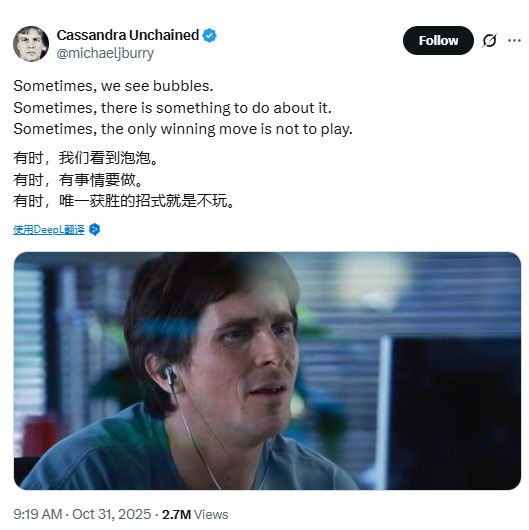
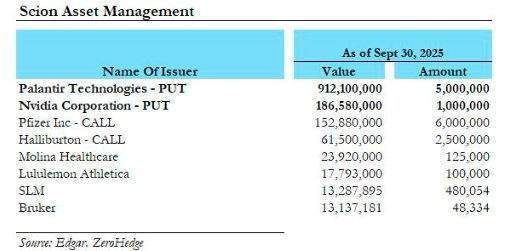
警告泡沫后,"大空头"仓位曝光:80%仓位做空Palantir和英伟达。 因电影《大空头》而闻名的投资者Michael Burry正将其对AI泡沫的警告付诸行动。最新监管文件显示,他管理的Scion Asset Management约80%的持仓集中 于做空Palantir和英伟达这两家AI热潮的标志性公司,押注规模之大引发市场关注。 据华尔街见闻此前文章,Burry近日通过社交媒体X发布神秘帖文,引用经典电影《战争游戏》和《大空头》称:"有时我们看到泡沫。有时可以采取行动。有时 唯一的制胜策略就是不参与游戏。"他随后暗示,AI投资回报过低,类似互联网泡沫时期光纤资本支出过度,当前AI热潮中许多领先公司最终将崩溃。 | | As of Sept 30, 2025 | | | --- | --- | --- | | Name Of Issuer | Value | Amount | | Palantir Technologies - PUT | 912,100,000 | 5,000,000 | | Nvidia Corporation - PUT | 186,580,000 | 1,000,000 | | P ...



AI教父Hinton末日警告,你必须失业,AI万亿泡沫豪赌才能「赢」
3 6 Ke· 2025-11-04 10:50
Core Insights - The article discusses the impending risks associated with AI advancements, highlighting concerns from AI pioneer Geoffrey Hinton about potential mass unemployment and existential threats posed by superintelligent AI [2][12][18]. Group 1: AI Investment and Financial Implications - Major tech companies, including Microsoft, Meta, Google, and Amazon, are projected to spend $420 billion on AI in the coming year, up from $360 billion this year [5]. - OpenAI has signed contracts exceeding $1.4 trillion for computing power, indicating a significant financial commitment to AI development [5]. - Nvidia is identified as the biggest winner in the AI boom, with its market value soaring to $5 trillion and predictions suggesting it could exceed $8.5 trillion in the future [8]. Group 2: Employment and Labor Market Impact - Hinton warns that to achieve profitability, companies must replace human labor with AI, leading to increased risks of job displacement, particularly for ordinary workers [9][21]. - Since the launch of ChatGPT, job vacancies have reportedly decreased by approximately 30%, while the stock market has risen by 70% [21]. - Amazon's recent announcement of a 4% workforce reduction, affecting 14,000 employees, exemplifies the trend of job losses driven by AI investments [23]. Group 3: AI Safety and Ethical Concerns - Hinton criticizes tech giants for prioritizing commercial competition over safety, suggesting that their focus is more on winning the AI race than on ensuring human survival [17]. - He emphasizes the need for a serious discussion on how to coexist with superintelligent AI, likening the situation to an impending alien invasion [15][28]. - Hinton's perspective is that the current approach to AI development is flawed, as executives mistakenly believe they can control AI as a subordinate [28]. Group 4: Future of AI and Economic Growth - The article suggests that the current AI investment bubble could lead to significant economic repercussions, with AI and data center investments contributing to 92% of GDP growth in the first half of 2025 [35]. - OpenAI's revenue is estimated at $13 billion, with an IPO valuation around $1 trillion, indicating a potentially unsustainable bubble in the AI sector [37]. - Despite the massive influx of capital into AI, a study indicates that 95% of enterprises applying generative AI have failed, highlighting the challenges in finding effective applications [45].





OpenAI计划上市,非盈利的招牌,还有几分保真?
Sou Hu Cai Jing· 2025-11-04 07:48
一、重组上市 美国时间10月28日,OpenAI官宣公司完成了重组,业界普遍认为这是在为上市扫清障碍。公司高层此前也曾透露,公司的IPO可能会提 前至2026年底前后。从重组后的控股比例可以看出各个相关方的利益分配,OpenAI基金会占26%的股份,微软占27%的股份,员工与投 资人共同占有47%的股份。 按当前5000亿美元的估值计算,三方的财富分配为:1300亿美元、1350亿美元、2350亿美元。按照2026年上市10000亿美元的目标估值, 三方的财富分配为:2600亿美元、2700亿美元、4700亿美元。预计2030年前后50000亿美元的预期市值,三方的财富分配为13000亿美 元、13500亿美元、23500亿美元。 不要怀疑五年后5万亿美元的美好期待,股东和高管会委屈地说:英伟达作为AI硬件头部,现在的市值就5万亿美元了,我们作为AI软件 的头部五年后5万亿过分吗,说不定到时能够和英伟达平起平坐达到8-10万亿了(如果泡沫不破的话)。 二、引发质疑 但是巨量的白花花的银子会进入了投资者、创立者、高管、员工的口袋里。因为市值在狂飙,相关人员不知不觉中就会成了首富或者在 福布斯排行榜上跃升。就像现 ...
“大空头”原型人物真出手了!最新持仓曝光:10亿美元80%仓位做空Palantir和英伟达,以实际行动押注AI泡沫破裂
Sou Hu Cai Jing· 2025-11-04 07:36
【免责声明】本文仅代表作者本人观点,与和讯网无关。和讯网站对文中陈述、观点判断保持中立,不 对所包含内容的准确性、可靠性或完整性提供任何明示或暗示的保证。请读者仅作参考,并请自行承担 全部责任。邮箱:news_center@staff.hexun.com Burry近日通过社交媒体X发布神秘帖文,引用经典电影《战争游戏》和《大空头》称:"有时我们看到 泡沫。有时可以采取行动。有时唯一的制胜策略就是不参与游戏。"他随后暗示,AI投资回报过低,类 似泡沫时期光纤资本支出过度,当前AI热潮中许多领先公司最终将崩溃。 格隆汇11月4日|在上周时隔两年"复出"并发出泡沫警告后,电影《大空头》的原型人物Michael Burry 正以实际行动押注AI泡沫破裂。Burry执掌的Scion资产管理公司罕见的提前两周披露三季度13F报告。 报告显示,Scion基金约80%仓位集中做空英伟达和Palantir,名义价值逾10亿美元,押注规模之大引发 市场关注。其中,针对Palantir的看跌期权名义价值高达9.12亿美元(相当于500万股),针对英伟达的看 跌期权名义价值达1.86亿美元。不过,文件未披露期权的实际支付权利金、行 ...
“大空头”真出手了!最新持仓曝光:80%仓位做空Palantir和英伟达
Ge Long Hui A P P· 2025-11-04 07:32
| | As of Sept 30, 2025 | | | --- | --- | --- | | Name Of Issuer | Value | Amount | | Palantir Technologies - PUT | 912,100,000 | 5,000,000 | | Nvidia Corporation - PUT | 186,580,000 | 1,000,000 | | Pfizer Inc - CALL | 152,880,000 | 6.000.000 | | Hallibuton - CALL | 61.500.000 | 2,500,000 | | Molina Healthcare | 23,920,000 | 125,000 | | Lululemon Athletica | 17,793,000 | 100.000 | | SLM | 13,287,895 | 480.054 | | Bruker | 13,137,181 | 48.334 | Burry近日通过社交媒体X发布神秘帖文,引用经典电影《战争游戏》和《大空头》称:"有时我们看到 泡沫。有时可以采取行动。有时唯 ...
“大空头”真出手了!Burry 提前两周发13F报告:80%仓位做空Palantir和英伟达
美股IPO· 2025-11-04 07:24
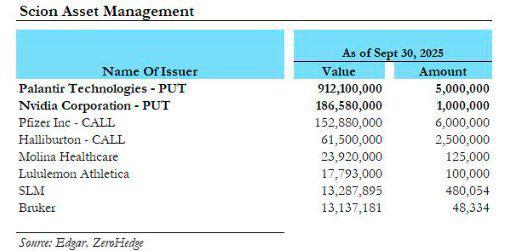
因电影《大空头》而闻名的投资者Michael Burry正将其对AI泡沫的警告付诸行动。最新监管文件显示,他管理的Scion Asset Management约80%的持 仓集中于做空Palantir和英伟达这两家AI热潮的标志性公司,押注规模之大引发市场关注。 Burry近日通过社交媒体X发布神秘帖文,引用经典电影《战争游戏》和《大空头》称:"有时我们看到泡沫。有时可以采取行动。有时唯一的制胜策略 就是不参与游戏。"他随后暗示,AI投资回报过低,类似互联网泡沫时期光纤资本支出过度,当前AI热潮中许多领先公司最终将崩溃。 Michael Burry正以实际行动押注AI泡沫破裂。监管文件显示,他管理的Scion基金约80%仓位集中做空英伟达和Palantir,名义价值逾10亿美元。然 而两股自9月底以来持续上涨,使其仓位陷入账面亏损。 警告泡沫后,"大空头"仓位曝光:80%仓位做空Palantir和英伟达 提前两周公布的13F文件证实,Burry确实在"采取行动"。 他针对Palantir的看跌期权名义价值高达9.12亿美元(相当于500万股),针对英伟达的看跌 期权名义价值达1.86亿美元。 不过,文件未披露 ...
警告泡沫后,“大空头”最新持仓曝光:80%仓位做空Palantir和英伟达
Hua Er Jie Jian Wen· 2025-11-04 07:06
警告泡沫后,"大空头"仓位曝光:80%仓位做空Palantir和英伟达 因电影《大空头》而闻名的投资者Michael Burry正将其对AI泡沫的警告付诸行动。最新监管文件显示,他管理的Scion Asset Management约80%的 持仓集中于做空Palantir和英伟达这两家AI热潮的标志性公司,押注规模之大引发市场关注。 据华尔街见闻此前文章,Burry近日通过社交媒体X发布神秘帖文,引用经典电影《战争游戏》和《大空头》称:"有时我们看到泡沫。有时可以采 取行动。有时唯一的制胜策略就是不参与游戏。"他随后暗示,AI投资回报过低,类似互联网泡沫时期光纤资本支出过度,当前AI热潮中许多领 先公司最终将崩溃。 提前两周公布的13F文件证实,Burry确实在"采取行动"。他针对Palantir的看跌期权名义价值高达9.12亿美元(相当于500万股),针对英伟达的看 跌期权名义价值达1.86亿美元。不过,文件未披露期权的实际支付权利金、行权价及到期日。 | | As of Sept 30, 2025 | | | --- | --- | --- | | Name Of Issuer | Value | Amo ...