智能制造

Search documents
信宇人:公司将依托“装备+工艺+材料”三位一体布局深耕智能制造高端装备的研发、制造与销售
Zheng Quan Ri Bao Wang· 2025-12-05 07:11
Group 1 - The company emphasizes the importance of shareholder rights and acknowledges that secondary market performance is significantly influenced by macroeconomic conditions, market preferences, and investor expectations [1] - The company plans to leverage a "equipment + technology + materials" integrated approach to further develop its capabilities in high-end intelligent manufacturing equipment research, production, and sales [1] - The company aims to improve its operational performance to provide better returns to shareholders in the future [1]

微观高质量发展丨一辆汽车里的“智能制造”
Xin Hua Wang· 2025-12-05 07:06
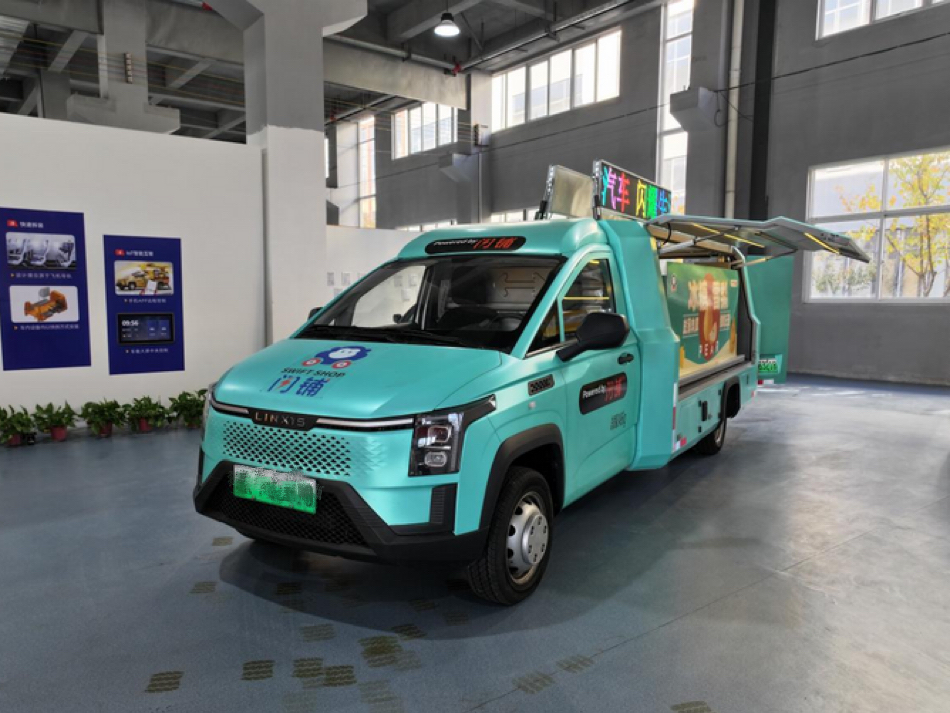
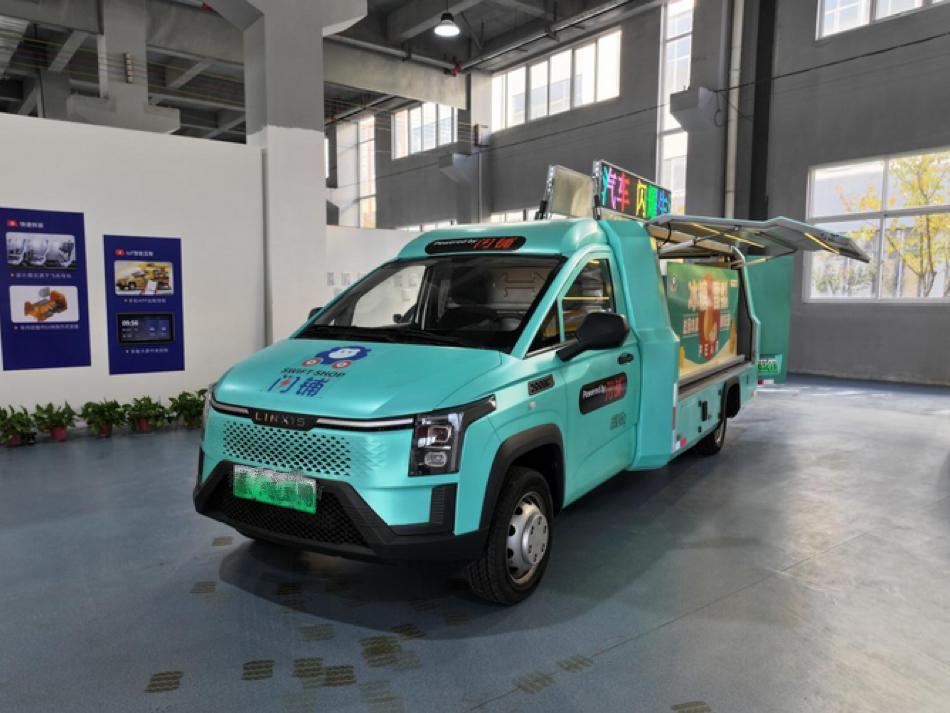
"只要我这里轻轻一点,一辆车就变成了一座'移动商铺'。" 中国汽车流通协会乘用车市场信息联席分会秘书长崔东树表示,"'十四五'期间,中国以技术创新,以新能源(汽车)为发展的龙头,推动了 智能网联新能源车的强力的发展,尤其是在新能源车的整个产业链方面获得了巨大成功。" 这里是安徽祺力专用车制造有限公司"闪铺"新能源汽车的线下测试现场。随着研发人员的指令,一台浅蓝色新能源汽车缓缓展开侧翼,液压 装置平稳抬升车顶,短短2分钟内,便变身为15平方米的整洁商铺。 这是安徽祺力专用车制造有限公司打造的"闪铺"新能源汽车。帅玉豪 摄 近年来,这家企业组建以本土优秀人才为主体的研发团队,自主搭建数字化生产管理体系,攻克柔性车辆生产线、"一键变形"等关键技术。 "'十四五'这五年,是企业从0到1的突破期。从2022年获得工信部专用车企业认定、填补国内自主品牌高端礼仪用车空白,到打造出'闪铺'系 列产品,订单已经突破3000辆,2025年产值有望达到1.2亿元。"安徽祺力专用车制造有限公司总经理赵祺介绍。 这是安徽祺力专用车制造有限公司打造的"闪铺"新能源汽车。帅玉豪 摄 从2020年的140万辆左右跃升到2024年的1300多 ...

微观高质量发展|一辆汽车里的“智能制造”
Xin Hua She· 2025-12-05 06:40
05:47"只要我这里轻轻一点,一辆车就变成了一座'移动商铺'。"这里是安徽祺力专用车制造有限公司"闪铺"新能源汽车的线下测试现场。随着研发人员的指 令,一台浅蓝色新能源汽车缓缓展开侧翼,液压装置平稳抬升车顶,短短2分钟内,便变身为15平方米的整洁商铺。 2025年10月9日,浙江省湖州市长兴经济技术开发区的长兴地通汽车部件有限公司技术人员操控工业机器人生产新能源汽车配件(无人机照片)。新华社发 (谭云俸 摄)在国新办举行的"高质量完成'十四五'规划"系列主题新闻发布会上,工业和信息化部副部长张云明表示,"我们扎实推进智能制造工程,建成 7000余家先进级和230余家卓越级智能工厂,推动工艺、装备、软件集成创新。数据显示,制造业机器人密度达470台/万人,远超全球平均水平。光伏、动 力电池、新能源汽车等领域,智能制造装备和系统解决方案取得群体性突破。" 这是2025年11月3日在郑州航空港区比亚迪总装工厂拍摄的新能源汽车"宋Pro"生产线。新华社记者 李嘉南 摄安徽合肥是新能源汽车产业的重要集聚地,江 淮、比亚迪、蔚来、大众等6家整车企业在此落户。记者在蔚来先进制造新桥二工厂看到,部分制造场景已实现AI智能决 ...


绽放杯载誉领航 安徽联通5G赋能千行百业彰显实效
Xin Hua She· 2025-12-05 05:33
Group 1 - The "Shining Cup" 5G application competition concluded successfully in Hefei, with a focus on promoting the maturity and innovative integration of 5G-A technology across various industries [1] - Anhui Unicom achieved remarkable results, winning 1 first prize and 2 third prizes in the national finals, along with a silver award in the national benchmark competition, setting a new record for the company [1] Group 2 - The "5G Leading Nonferrous Metal Intelligent Production Integration New Demonstration" project, developed by the Copper Industry Group in collaboration with Anhui Unicom, won the first prize at the national finals, showcasing a comprehensive 5G private network system across the entire group [2] - The project implemented 84 5G integration application scenarios, significantly enhancing production efficiency in the nonferrous metal industry [2] Group 3 - The "Smart Factory Neural Network: 5G-Driven Chery Flexible Production Transformation" project, a collaboration between Anhui Unicom and Chery Automobile, won a silver award in the national benchmark competition [3] - This project integrated advanced technologies such as cloud-based PLC and AI visual inspection, achieving large-scale applications of 5G in critical production processes [3] Group 4 - The "5G + 'Su Shi Su Ban' Government Service" project and the "Anhui Qianyingzi: 5G Redcap Restructuring the Power Generation Industry" project, both in collaboration with local entities, won third prizes in the national competition [4] - The "Su Shi Su Ban" project utilized 5G and AI technologies to optimize government service processes, enhancing efficiency and citizen satisfaction [4] - The Qianyingzi project leveraged 5G private networks and RedCap technology to improve the digital transformation of the power plant, ensuring communication and data security while enhancing overall production efficiency [4]
全球与中国搅拌摩擦焊接设备市场现状及未来发展趋势
QYResearch· 2025-12-05 01:53
Core Viewpoint - Friction Stir Welding (FSW) technology has matured and is now widely adopted in various industries, particularly in the manufacturing of lightweight components for electric vehicles and other sectors, marking a significant shift towards automation and efficiency in production processes [4][21]. Group 1: Current Status of the FSW Equipment Industry - FSW technology has transitioned from experimental applications in aerospace to large-scale production in industries such as electric vehicles, rail transportation, and shipbuilding, indicating its broadening industrial application [4][21]. - The demand for FSW equipment is driven by the need for lightweight, high-performance, and environmentally friendly manufacturing technologies, particularly in strategic emerging industries [6][7]. Group 2: Acceleration of Domestic Substitution - Chinese companies are rapidly gaining market share in the mid-to-high-end and general markets due to lower procurement and maintenance costs, faster localization response, and flexible customization capabilities [5]. - Despite existing gaps in core components and top-tier technology databases compared to international leaders, some leading domestic firms have made breakthroughs in specific application areas through continuous R&D investment [5]. Group 3: Market Expansion - The FSW equipment market is expanding, fueled by the urgent demand for lightweight materials in sectors like new energy and aerospace, with significant growth in the production of core components such as battery trays and electric drive housings [6][7]. - The market is also benefiting from technological upgrades in traditional sectors like shipbuilding and power equipment, as well as the increasing demand for automated and digital welding solutions [7]. Group 4: Development Trends - There is a strong focus on the localization and performance breakthroughs of core components, with efforts to develop more durable and high-performance materials for FSW tools and systems [8]. - The trend towards specialization and customization in FSW equipment is growing, requiring manufacturers to provide comprehensive services tailored to specific industry needs [9]. - Integration and automation of FSW processes are becoming essential, with advancements in robotics and automated systems enhancing production efficiency [10]. Group 5: Global Market Analysis - The global FSW equipment market is projected to grow significantly, with sales expected to reach $404 million in 2024 and $606 million by 2031, reflecting a compound annual growth rate (CAGR) of 5.89% from 2025 to 2031 [15]. - China is anticipated to dominate the market, accounting for approximately 46.82% of the global share in 2024, with expectations to increase to 48.28% by 2031 [19]. - The automotive sector is projected to hold a significant market share, with an estimated 47.50% in 2024 and a CAGR of about 4.05% in the coming years [19]. Group 6: Policy Analysis - Policies are being implemented to promote the upgrade and technological transformation of high-end equipment, particularly in the production of electric vehicles and their components [22][23]. - The focus is on establishing a robust manufacturing technology innovation system by 2025, enhancing the overall technological capabilities of the manufacturing sector [23][26].

中经评论:打造智能工厂金字塔
Jing Ji Ri Bao· 2025-12-04 23:57
Core Insights - The Ministry of Industry and Information Technology and five other departments have announced the first batch of 15 leading smart factories, covering key industries such as equipment manufacturing, raw materials, electronics, and consumer goods, providing a clear path for the intelligent transformation of manufacturing enterprises [1] - Leading smart factories represent the pinnacle of smart manufacturing in China, serving as benchmarks for future manufacturing models and global competitiveness [1][2] - The cultivation of smart factories follows a gradient approach, categorized into four levels: basic, advanced, excellent, and leading, allowing enterprises at different stages to set achievable goals [1][2] Group 1 - Leading smart factories have an intelligent penetration rate exceeding 80% and are accelerating integration into high-value upstream and downstream supply chain segments [1] - The gradient cultivation strategy aims to prevent ecological imbalance by fostering a broad base of basic smart factories, enabling small and medium-sized enterprises to keep pace with technological advancements [2] - Advanced and excellent smart factories act as a core force, disseminating experiences from leading factories to specialized fields, creating a ripple effect [2] Group 2 - To enhance global competitiveness, leading smart factories must leverage artificial intelligence, with a requirement for at least 60% of their applications to involve AI technology [2] - Small and medium-sized enterprises face challenges in transformation due to high costs, risks, and a lack of technology and talent, necessitating low-cost transformation solutions and shared service platforms [3] - The evolution of smart manufacturing in China has progressed from isolated breakthroughs to systemic collaboration, indicating a significant historical leap towards becoming a manufacturing powerhouse [3]
长沙持续用力打造国家重要先进制造业高地,锻造高质量发展核心引擎 | 非凡“十四五”
Chang Sha Wan Bao· 2025-12-04 23:19
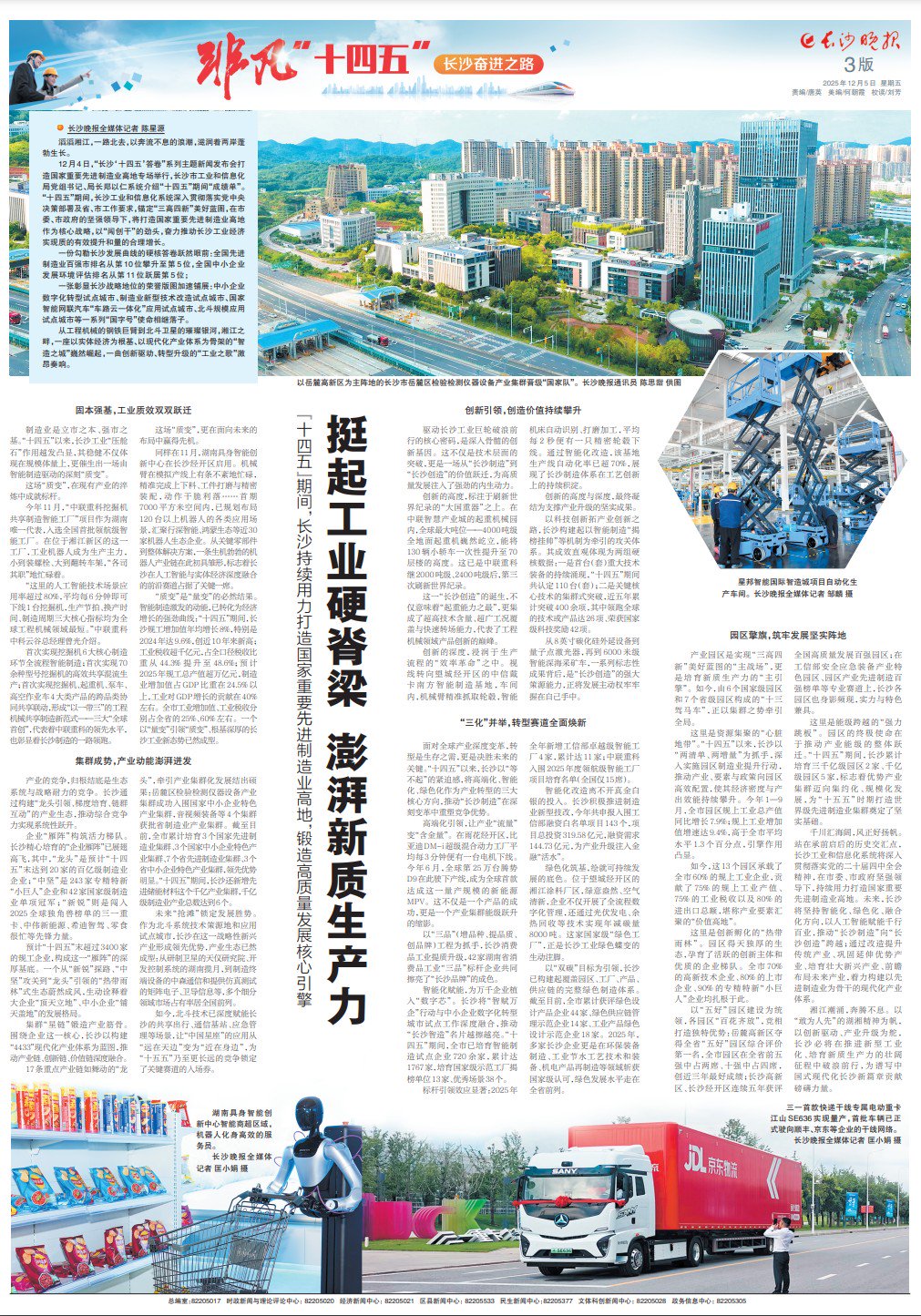
"十四五"期间,长沙持续用力打造国家重要先进制造业高地,锻造高质量发展核心引擎 挺起工业硬脊梁 澎湃新质生产力 长沙晚报全媒体记者 陈星源 滔滔湘江,一路北去,以奔流不息的浪潮,滋润着两岸蓬勃生长。 12月4日,"长沙'十四五'答卷"系列主题新闻发布会打造国家重要先进制造业高地专场举行,长沙市工业和信息化局党组书记、局长郑以仁系统 介绍"十四五"期间"成绩单"。"十四五"期间,长沙工业和信息化系统深入贯彻落实党中央决策部署及省、市工作要求,锚定"三高四新"美好蓝 图,在市委、市政府的坚强领导下,将打造国家重要先进制造业高地作为核心战略,以"闯创干"的劲头,奋力推动长沙工业经济实现质的有效 提升和量的合理增长。 一份勾勒长沙发展曲线的硬核答卷跃然眼前:全国先进制造业百强市排名从第10位攀升至第5位,全国中小企业发展环境评估排名从第11位跃居 第5位; 一张彰显长沙战略地位的荣誉版图加速铺展:中小企业数字化转型试点城市、制造业新型技术改造试点城市、国家智能网联汽车"车路云一体 化"应用试点城市、北斗规模应用试点城市等一系列"国字号"使命相继落子。 从工程机械的钢铁巨臂到北斗卫星的璀璨银河,湘江之畔,一座以实体经济 ...
【中国制造新观察】打造智能工厂金字塔
Zhong Guo Jing Ji Wang· 2025-12-04 23:01
Core Insights - The Ministry of Industry and Information Technology and five other departments have announced the first batch of 15 leading smart factories, covering key industries such as equipment manufacturing, raw materials, electronic information, and consumer goods, providing a clear path for the intelligent transformation of manufacturing enterprises [2] - Leading smart factories represent the pinnacle of smart manufacturing in China, with a high entry threshold requiring companies to be industry leaders with globally competitive core products and smart manufacturing capabilities [2] - The penetration rate of intelligence in the selected leading smart factories exceeds 80%, accelerating penetration into high-value chain segments [2] Summary by Categories Smart Factory Classification - Smart factories in China are categorized into four levels: basic, advanced, excellent, and leading, with each level having distinct goals to facilitate a structured growth path [2][3] - Basic smart factories exceed the average level of their industry within their province, while leading smart factories must achieve global leadership [2] Role of Leading Smart Factories - Leading smart factories serve as industry benchmarks, tasked with exploring cutting-edge technology applications and overcoming key bottlenecks [3] - The focus is not solely on selecting top performers but also on fostering a broad base of basic smart factories to support the overall ecosystem [3] Importance of Artificial Intelligence - To enhance global competitiveness, excellent smart factories must apply artificial intelligence in at least 20% of their scenarios, while leading smart factories must achieve a minimum of 60% [3] - Artificial intelligence is seen as a crucial tool for overcoming traditional manufacturing challenges and optimizing the entire production chain [3] Challenges for Small and Medium Enterprises (SMEs) - SMEs face significant barriers to transformation, including high costs, risks, and a lack of technology and talent, necessitating low-cost, lightweight transformation solutions [4] - Establishing shared service platforms led by the government and major enterprises can help SMEs transition from bystanders to active participants in the smart factory ecosystem [4] Future of Smart Manufacturing - The evolution of smart manufacturing in China is marked by a shift from isolated breakthroughs to systemic collaboration, aiming for comprehensive upgrades across the manufacturing sector [5]

打造智能工厂金字塔
Jing Ji Ri Bao· 2025-12-04 22:16
Group 1 - The Ministry of Industry and Information Technology and five other departments have announced the first batch of 15 leading smart factories, covering key industries such as equipment manufacturing, raw materials, electronic information, and consumer goods, providing a clear path for the intelligent transformation of manufacturing enterprises [2] - Leading smart factories represent the pinnacle of smart manufacturing in China, serving as benchmarks for future manufacturing models and requiring companies to be industry leaders with globally competitive core products and smart manufacturing capabilities [2] - The smart factory cultivation approach is structured in a gradient manner, categorizing factories into four levels: basic, advanced, excellent, and leading, allowing enterprises at different stages to have clear and achievable goals [2] Group 2 - The cultivation of smart factories is not just about selecting top performers; it aims to prevent ecological imbalance by widely nurturing basic smart factories, enabling small and medium-sized enterprises to keep pace with technological advancements through digital transformation [3] - Advanced and excellent smart factories act as a backbone, disseminating experiences from leading factories and creating a ripple effect in specific sectors, ultimately forming a robust and dynamic smart factory pyramid [3] - To enhance global competitiveness, leading smart factories must effectively utilize artificial intelligence, with a requirement that at least 60% of their applications involve AI technology [3] Group 3 - To strengthen the foundation of smart factories, it is essential to address the transformation challenges faced by small and medium-sized enterprises, which often struggle due to high costs, risks, and a lack of technology and talent [4] - Proposals for lightweight and low-cost transformation solutions are necessary to lower the barriers for small and medium-sized enterprises, alongside the establishment of shared service platforms to facilitate access to technology and resources [4] - The evolution of smart manufacturing in China has progressed from isolated breakthroughs to widespread implementation, indicating a significant historical leap towards becoming a manufacturing powerhouse [5]

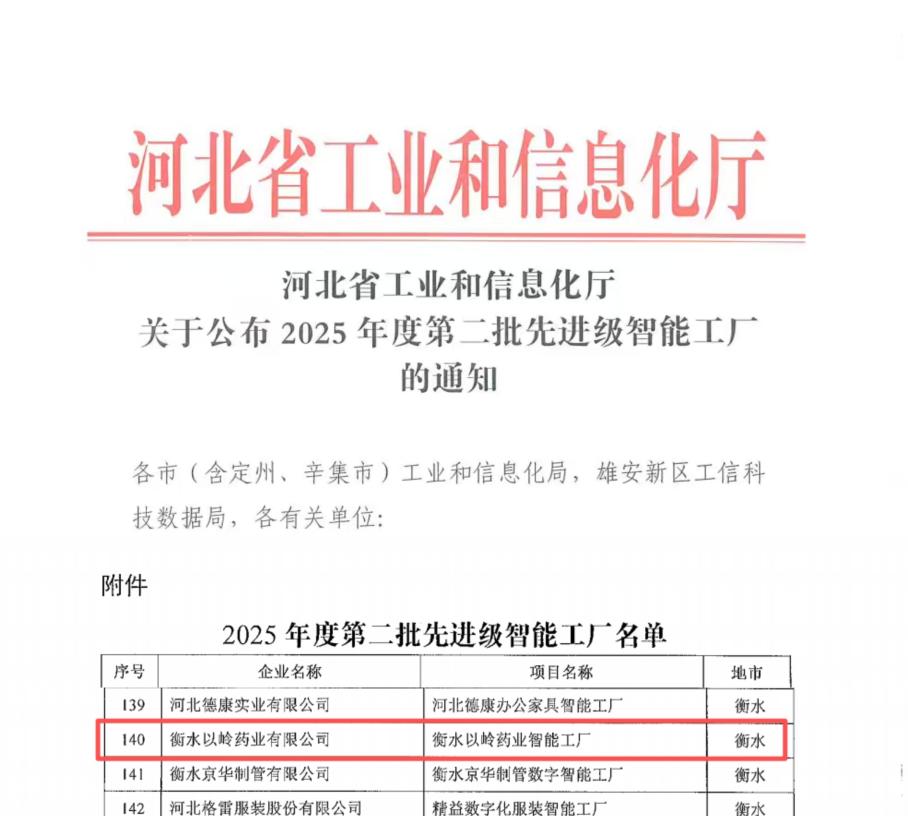
衡水以岭药业获评河北省“先进级智能工厂”
Zhong Guo Jing Ji Wang· 2025-12-04 15:10
Core Viewpoint - Hebei Yiling Pharmaceutical has been recognized as an advanced intelligent factory in Hebei Province, highlighting its successful digital transformation in traditional Chinese medicine production [1][4]. Company Overview - Hebei Yiling Pharmaceutical, a wholly-owned subsidiary of Shijiazhuang Yiling Pharmaceutical, has established a modern high-tech production base for traditional Chinese medicine extraction, formulations, and health products [3]. - The company aims to create a modern, digital, and intelligent shared supply chain ecosystem [3]. Intelligent Factory Project - The intelligent factory project is a key initiative for Yiling Pharmaceutical's strategy in modernizing traditional Chinese medicine production [3]. - The project integrates automated production lines, artificial intelligence, and big data analysis to enhance precision control and traceability in core processes [4]. Digital Transformation and Innovation - The company is advancing full-chain digital integration, utilizing AI and industrial internet technologies to build a smart operation system covering energy management, production execution, and quality control [4]. - A notable innovation is the "shared manufacturing" platform model, which offers flexible processing and R&D services to small and medium-sized enterprises in the industry [4]. Environmental Sustainability - Yiling Pharmaceutical is responding to green manufacturing initiatives by implementing energy-saving projects such as biogas utilization, photovoltaic power generation, and condensate water recovery [4]. - This approach optimizes energy use and creates a new model where "intelligent manufacturing" and "green energy saving" mutually empower each other, enhancing production efficiency, management effectiveness, and environmental benefits [4]. Industry Context - The recognition of advanced intelligent factories aims to set benchmarks for smart manufacturing and guide industrial upgrades in Hebei Province [4]. - A total of 217 units were recognized in this evaluation, emphasizing the importance of intelligent factories in optimizing production processes and supporting high-quality development in the real economy [4].