
新材料

Search documents
苏文电能(300982.SZ):子公司拟与专业投资机构共同投资产业基金
Ge Long Hui A P P· 2026-02-04 10:40
Core Viewpoint - Suwen Electric Power (300982.SZ) aims to enhance its strategic development in the new energy and new materials sectors by investing in a partnership fund to improve its sustainable development and competitive capabilities [1] Group 1: Investment Details - Suwen Electric's wholly-owned subsidiary, Sibell Electric Power Investment Co., Ltd., has signed a partnership agreement to invest in the Ningbo Jianshi Zhisheng Venture Capital Partnership [1] - The total committed capital for the partnership fund is RMB 215.01 million, with Sibell contributing RMB 15 million, representing 6.9764% of the total [1] Group 2: Investment Focus - The primary investment directions for the partnership fund include new materials, new energy, semiconductor industry chain, and biomedicine [1]
【中欣氟材(002915.SZ)】25年业绩扭亏为盈,拟募集1.86亿元扩建BPEF等项目——2025年度业绩预告点评(赵乃迪/周家诺)
光大证券研究· 2026-02-03 23:07
Core Viewpoint - The company is expected to turn a profit in 2025, with a projected net profit of 16-20 million yuan, compared to previous losses [4] Group 1: Company Performance - In 2025, the company anticipates a significant recovery in the agricultural pesticide sector, leading to improved performance due to the effective digestion of high inventory levels [5] - The subsidiary Fujian Gaobao has significantly reduced its losses, with a projected net profit loss of approximately -68.98 million yuan in 2024 [5] - The company has implemented technological upgrades to reduce material and energy consumption, optimizing production efficiency and adjusting product structures, resulting in a double-digit revenue growth year-on-year for 2025 [5] Group 2: Capital Raising and Expansion Plans - The company plans to raise 186 million yuan through a private placement to fund the construction of new projects, including an annual production capacity of 2,000 tons of BPEF and 500 tons of BPF [6] - The total investment for the BPEF and BPF projects is estimated at 194 million yuan, with 134 million yuan coming from the raised funds [6] - The expansion aims to meet the rapid growth in downstream product demand and ensure raw material supply for the new production lines [6]



捷邦科技:投入加码,散热业务动能强劲-20260203
Huaxin Securities· 2026-02-03 05:45
Investment Rating - The report maintains a "Buy" investment rating for the company [4][8] Core Insights - The company is experiencing short-term pressure on performance due to intensified competition in the consumer electronics sector and price reductions from clients, leading to a decline in gross margins for certain precision components [4] - Despite the current challenges, the company is accelerating investments in new businesses, particularly in the cooling solutions sector, which is expected to drive future growth [5] - The acquisition of Sainogao has strengthened the company's position in the cooling business, with significant production capacity and new client engagements in North America [5] - The introduction of high surface area carbon black products for lithium battery applications is anticipated to contribute additional revenue, as these products have already secured production approvals from major clients [6] Financial Projections - Revenue forecasts for 2025, 2026, and 2027 are projected at 12.7 billion, 23.1 billion, and 36.6 billion yuan respectively, with corresponding EPS of -0.57, 2.62, and 4.67 yuan [8][10] - The company is expected to achieve a significant revenue growth rate of 60.5% in 2025 and 81.2% in 2026, with a net profit margin turning positive by 2026 [10]
上海石化,年产3万吨大丝束碳纤维项目一阶段提前机械竣工
DT新材料· 2026-02-02 16:05
Core Viewpoint - The article highlights the progress of Shanghai Petrochemical's large tow carbon fiber project, emphasizing its significance in supporting the renewable energy sector and positioning Shanghai Petrochemical as a leader in carbon fiber production in China by 2027 [1]. Group 1: Project Overview - On February 1, Shanghai Petrochemical's large tow carbon fiber project reached mechanical completion for its first phase, one month ahead of schedule, entering the production preparation stage [1]. - The first phase includes two production lines with a combined capacity of 6,000 tons per year, expected to officially commence production in the second quarter of this year [1]. - The project is set to be fully operational by the end of 2027, with Shanghai Petrochemical's carbon fiber capacity projected to rank first in the country [1]. Group 2: Technological and Environmental Aspects - The project leverages Shanghai Petrochemical's proprietary large tow carbon fiber technology and the abundant green electricity resources in Inner Mongolia, focusing on producing specifications such as 48K and 60K large tow carbon fibers [1]. - The design and equipment of the project are optimized for safety, environmental protection, and reliability, achieving international leading standards [1]. Group 3: Future Developments - A complementary project with an annual production capacity of 60,000 tons of large tow carbon fiber precursor will be constructed at Shanghai Petrochemical's existing site, with expected commencement in the first half of this year [1]. - Inner Mongolia Xinjingshan Carbon Fiber Co., Ltd. aims to establish a leading domestic production base for large tow carbon fiber, focusing on low-cost, large-scale, and green production [1].

光刻胶材料上市公司,跨界“抢”PEEK!
DT新材料· 2026-02-02 16:05
Core Viewpoint - The article discusses the recent financial performance of Zhongyan Co., a leading player in the PEEK materials sector, highlighting a significant decline in net profit projections for 2025, attributed to increased R&D investments and the lack of scale in new business ventures [2]. Group 1: Financial Performance - Zhongyan Co. expects a net profit of approximately 11.8 million yuan for 2025, representing a year-on-year decline of about 69.96% [2]. - The company's net profit after deducting non-recurring items is projected to be around 4.79 million yuan, down 80.47% year-on-year [2]. - Despite the overall decline in net profit, the parent company's revenue and net profit have shown growth compared to the previous year [2]. Group 2: Industry Developments - The PEEK materials sector is experiencing significant activity, with major players engaging in acquisitions and expansions, indicating a dynamic market environment [2]. - Baihehua Group announced plans to invest up to 100 million yuan in a project to produce 1,000 tons of PEEK materials annually, with the first phase expected to have a capacity of 200 tons [3]. - The project is strategically located in Hangzhou and aims to capitalize on the growing demand for PEEK materials in various industries, including aerospace, electronics, automotive, energy, and healthcare [4]. Group 3: Company Background and Market Position - Baihehua Group, established in 1989 and listed in 2016, has subsidiaries involved in pigment production and has recently expanded into new materials [5]. - The company holds a significant share of the global organic pigment market, with over 40,000 tons of production capacity, accounting for approximately 10% of global consumption [7]. - Baihehua Group is diversifying its product offerings, including high-performance organic pigments and sodium-ion battery materials, to create a new growth trajectory [8][11]. Group 4: Competitive Landscape - The global pigment market is undergoing changes, with opportunities arising from the bankruptcy of major players like Heubach, prompting Chinese companies to seek international expansion and high-end product development [12]. - Competitors in the pigment industry, such as Suzhou Shiming Technology, are also investing in similar technologies, indicating a trend of cross-industry collaboration and competition [9]. - The market for sodium-ion battery materials is expanding, with Baihehua Group's recent acquisition of Hunan Sodium New Materials positioning it well in this emerging sector [11].

攀高向新 把握主动——我国民营企业内生动力持续增强
Xin Hua Wang· 2026-02-02 13:32
Group 1: Private Enterprises and Market Trends - The core viewpoint emphasizes the increasing internal motivation of private enterprises in China, showcasing their confidence and innovative spirit in navigating challenges and seizing new opportunities [1][6] - Private enterprises are focusing on innovation and practical solutions, as seen in the case of Anhui Shenghua Bo Automotive Electric Co., which invested 150 million yuan in automating its production lines, achieving a product qualification rate of 99% and capturing over 30% of the national market share for wipers [1] - The health food sector is also expanding, with companies like Binzhou Zhongyu Food Co. planning to invest 2.7 billion yuan in new product lines, including dietary fibers and protein peptides, to tap into the growing health consumption market [2] Group 2: Technological Advancements and Consumer Services - Companies are leveraging technology to enhance consumer services, as demonstrated by Xiaoxiang Supermarket, which has optimized its supply chain for deep-sea fish, reducing the time from catch to delivery to under 36 hours [3] - The instant retail market in China is projected to reach 971.4 billion yuan by 2025, with expectations to exceed 1 trillion yuan by 2026, indicating significant growth potential in this sector [3] - The introduction of smart air conditioning products by companies like Aux is a response to market demand, with plans for increased R&D investment to develop new health-focused air management systems [4] Group 3: International Expansion and Supply Chain Strategies - Private enterprises are increasingly looking to expand internationally, as seen with Yadea Technology's strategy to establish a factory in Vietnam, contributing to double-digit growth in overseas sales [5] - Payment platforms like PingPong are addressing the challenges faced by chain brands in international markets by offering comprehensive management solutions for global operations [5] - The Chinese manufacturing system is positioned to rapidly develop in the field of embodied intelligence, supported by a highly coordinated supply chain [5] Group 4: Policy Support for Private Enterprises - Recent policy measures, including structural interest rate cuts and expanded financial support for equipment upgrades, are aimed at fostering the growth of private enterprises [6] - The introduction of a 500 billion yuan special guarantee plan for private investment is expected to stimulate innovation and provide substantial momentum for high-quality economic development in China [6]
事关格陵兰岛稀土矿,A股稀土龙头遭遇利空!公司回应
Mei Ri Jing Ji Xin Wen· 2026-02-02 13:20
Core Viewpoint - The company, Shenghe Resources, is facing a significant decline in stock price and market value due to the unilateral termination of a strategic partnership with Greenland Minerals, which has led to concerns about its future growth prospects [1][3]. Group 1: Strategic Partnership with Greenland Minerals - In 2016, Shenghe Resources and its subsidiary, Leshan Shenghe, signed a share subscription agreement with Greenland Minerals, agreeing to subscribe for 125 million shares at a total price of 4.625 million AUD (approximately 22.5 million RMB) [2]. - The partnership aimed to expand Shenghe's rare earth resource base outside of China and optimize its business layout [3]. - Following multiple rounds of share issuance by Greenland Minerals, Shenghe's stake was reduced to approximately 6.5% as of January 2024, after exercising anti-dilution rights [3]. Group 2: Termination of Partnership - Recently, Greenland Minerals announced the termination of the strategic partnership and claimed that Shenghe's "increased shareholding rights" had expired, intending to formally confirm this with the Australian Stock Exchange [3]. - Shenghe Resources disputes this claim and plans to take legal action to protect its rights, while preliminarily assessing that this matter is not expected to have a significant impact on its operations [3]. Group 3: Company Performance and Market Reaction - Shenghe Resources is a key player in the rare earth industry, involved in mining, smelting, and processing, with products used in various sectors including new energy and aerospace [4]. - On January 29, the company announced a projected net profit for 2025 of between 790 million to 910 million RMB, representing a year-on-year increase of 581 million to 703 million RMB, or a growth of 281.28% to 339.20% [6]. - Despite the positive earnings forecast, the stock price experienced volatility, hitting a limit down the day after the announcement, leading to a market value drop to 42.681 billion RMB [6].


【太平洋科技-每日观点&资讯】(2026-02-03)
远峰电子· 2026-02-02 12:37
Market Overview - Major indices experienced declines: North Stock 50 (-2.03%), ChiNext Index (-2.46%), Shanghai Composite Index (-2.48%), Shenzhen Component Index (-2.69%), and Sci-Tech Innovation 50 (-3.88%) [1] - TMT sector showed mixed performance with SW Communication Application Value-Added Services increasing by 0.42% while SW Integrated Circuit Packaging and Testing decreased by 6.52% [1] Domestic News - Chenxian Optoelectronics plans to expand its new factory with an investment of 3 billion yuan, adding a glass-based Micro LED display production line with an annual capacity of 22,000 square meters, increasing total capacity to 40,000 square meters [1] - SMIC established an Advanced Packaging Research Institute focusing on cutting-edge packaging technologies and industry challenges, aiming to create a leading domestic and internationally advanced R&D and collaborative innovation alliance [1] - Xi'an Yicai reported that it remains a leader in the 12-inch silicon wafer sector, achieving a monthly capacity of approximately 850,000 pieces by December 2025, with an overall utilization rate exceeding 90% [1] - China's exports of laptops reached 133 million units, down 7.1% year-on-year, while mobile phone exports totaled 751 million units, down 7.7%. In contrast, integrated circuit exports increased by 17.4% to 3.495 billion units [1] Overseas News - Meta's Ray-Ban Display Glasses received better-than-expected feedback in the market, leading to a significant increase in key component orders, with global AR glasses shipments projected to reach 950,000 units by 2026, a 53% annual growth rate [2] - Global demand for MLCCs is surging due to the rise of electric vehicles and complex automotive electronics, with Samsung Electro-Mechanics reporting a 30% year-on-year increase in orders for its Tianjin factory by Q4 2025 [2] - Seagate announced that its nearline capacity is fully sold out until the end of 2026, with an average capacity increase of 22% for nearline mechanical hard drives in the last quarter [2] - NVIDIA is investing an additional $2 billion in CoreWeave, providing comprehensive support for AI data center construction and promoting CoreWeave's AI software and architecture design solutions [2] AI Insights - NVIDIA launched three open-source AI weather models, including one for 15-day global forecasts and another for precise storm predictions in the U.S. [3] - xAI released the Grok Imagine 1.0 version, which has generated 12.45 billion videos in the past 30 days [3] - The Step 3.5 Flash model, featuring a sparse MoE architecture with 196 billion parameters, has been launched, achieving high inference speeds and efficiency improvements [3] - Kimi reported that overseas revenue has surpassed domestic revenue, with a fourfold increase in global paid users following the release of the new K2.5 model [3] Industry Tracking - Quantum technology firm Zhongweidaxin launched three new products in quantum measurement and control, enhancing its integrated technology system [4] - Global humanoid robot sales are expected to reach 20,000 units by 2025, with a market size exceeding 8 billion yuan, and projections of over 600,000 units and a market size exceeding 100 billion yuan by 2030 [4] - The first implantable brain-computer interface surgery in Anhui has been completed, achieving a 95% accuracy in decoding brain signals and significant recovery in limb function [4] - The domestic production of POE (polyolefin elastomer) is set to reach nearly 60,000 tons by 2025, marking a significant step towards reducing reliance on imported products in strategic emerging industries [4]
化工板块重挫,三股跌停!化工ETF(516020)跌近6%,后市如何看?
Xin Lang Cai Jing· 2026-02-02 05:42
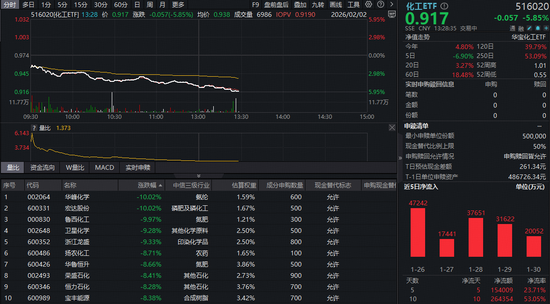
Core Viewpoint - The chemical sector experienced a significant pullback on February 2, with the chemical ETF (516020) declining by 5.85% during trading, reflecting a broader downturn in the industry [1][7]. Market Performance - The chemical ETF (516020) opened lower and saw a decline of 5.85%, with a trading price of 0.917 as of the latest update [2][7]. - Key stocks in the sector, including Huafeng Chemical, Hongda Co., and Luxi Chemical, hit the daily limit down, while others like Satellite Chemical and Zhejiang Longsheng fell over 9% [1][7]. Supply Chain and External Factors - A cold wave in the U.S. Gulf Coast has led to the shutdown of several chemical plants, affecting over 30% of the chemical production capacity in Texas, which accounts for about one-third of the U.S. chemical output [3][10]. - The cold weather has increased natural gas prices, raising the costs of ethylene and polyethylene, while supply constraints are expected to strengthen the pricing outlook for chemical products [10]. Future Outlook - Analysts predict that the chemical industry will face low demand in 2025, but measures to counteract "involution" may help restore profitability by 2026, alongside growth in new materials driven by rapid downstream demand [10]. - The current low valuation of the industry presents potential opportunities for investors, particularly through the chemical ETF (516020), which tracks a specialized index covering various themes including AI and new energy [10]. Investment Strategy - Investors are encouraged to consider the chemical ETF (516020) for efficient exposure to the sector, as it tracks the CSI segmented chemical industry index and includes stocks related to trending themes [10].


面向“十五五”完善上海未来产业发展政策的对策建议
Guo Ji Jin Rong Bao· 2026-02-02 04:45
Core Insights - Shanghai's strategic focus on future industries during the "14th Five-Year Plan" period aims to enhance its global competitiveness in technology and industry, while improving its core functions as an international economic, financial, trade, shipping, and innovation center [1] Group 1: Current Development and Characteristics of Future Industries - Shanghai ranks second nationally with 14,281 high-potential future industry enterprises, following Beijing's 27,788, indicating a robust foundation for cultivating high-quality, specialized market entities [2] - The enterprise ecosystem in Shanghai is characterized by a "specialized and steady" development pattern, with 136 listed companies, 594 high-tech enterprises, and 25 unicorns, highlighting the need for stronger top-tier enterprises [2] - A multi-node networked spatial layout has emerged, with various districts specializing in different sectors, such as biomedicine in Fengxian and artificial intelligence in Pudong, creating a collaborative development environment [3] Group 2: Core Industry Matrix and Competitive Strength - Shanghai has established a competitive matrix in five key future industries: artificial intelligence, synthetic biology, energy storage technology, new materials, and deep-sea exploration, with significant advancements in patents and market activity [4] Group 3: Challenges and Bottlenecks in Development - Key challenges include a lack of collaborative platforms for industry chains (50% of enterprises) and difficulties in market promotion (48.67%), indicating inefficiencies in cross-enterprise collaboration and market access for new technologies [5] - Talent acquisition faces significant pressure, with 71.33% of enterprises citing high salary costs as a major issue, alongside a 56.67% shortage in the quantity and quality of talent [6][7] - Innovation is hindered by difficulties in accessing critical resources (53.33%) and a lack of supportive trial scenarios (52%), reflecting weaknesses in the support system for transitioning from research to commercialization [8] Group 4: Recommendations for Policy Improvement - Strengthening top-level design and global vision is essential, with a focus on regional collaboration and a differentiated layout to enhance Shanghai's role in the Yangtze River Delta [9] - Establishing an open digital collaboration platform to improve industry chain resilience and cooperation is crucial, leveraging new technologies for data sharing and collaboration [11][12] - Implementing a "nuclear explosion" special attack plan targeting major breakthroughs in key areas, supported by a resource-sharing platform among enterprises and research institutions, is recommended [14]