
5G

Search documents
有研新材涨2.04%,成交额4.84亿元,主力资金净流入104.54万元
Xin Lang Cai Jing· 2025-09-11 04:28
Core Insights - The stock price of Youyan New Materials increased by 2.04% on September 11, reaching 21.48 CNY per share, with a total market capitalization of 18.184 billion CNY [1] - The company has seen a year-to-date stock price increase of 38.04%, with notable gains of 4.37% over the last five trading days and 12.17% over the last twenty days [1] Financial Performance - For the first half of 2025, Youyan New Materials reported a revenue of 4.096 billion CNY, a year-on-year decrease of 9.76%, while the net profit attributable to shareholders increased by 218.47% to 130 million CNY [2] - Cumulative cash dividends since the company's A-share listing amount to 562 million CNY, with 290 million CNY distributed over the last three years [3] Shareholder Structure - As of June 30, 2025, the number of shareholders increased to 158,100, with an average of 5,356 circulating shares per person, a decrease of 1.78% from the previous period [2] - The top ten circulating shareholders include various ETFs, with notable changes in holdings, such as an increase of 555,600 shares for Guolian An Zhongzheng Semiconductor Products and Equipment ETF [3]

盛路通信涨2.06%,成交额3.14亿元,主力资金净流出210.03万元
Xin Lang Cai Jing· 2025-09-11 04:26
Core Viewpoint - 盛路通信's stock price has shown significant growth this year, with a year-to-date increase of 36.03% and a recent 5-day increase of 4.82% [1] Financial Performance - For the first half of 2025, 盛路通信 reported revenue of 614 million yuan, representing a year-on-year growth of 9.10% [2] - The net profit attributable to shareholders for the same period was 57.55 million yuan, reflecting a year-on-year increase of 16.02% [2] Stock Market Activity - As of September 11, 盛路通信's stock was trading at 8.91 yuan per share, with a market capitalization of 8.156 billion yuan [1] - The stock experienced a trading volume of 314 million yuan and a turnover rate of 4.22% [1] - The net outflow of main funds was 2.1 million yuan, with large orders showing a buy-sell ratio of 22.47% to 23.12% [1] Shareholder Information - As of June 30, 2025, the number of shareholders decreased by 1.86% to 78,600, while the average circulating shares per person increased by 1.89% to 10,789 shares [2] - The company has cumulatively distributed 109 million yuan in dividends since its A-share listing, with no dividends distributed in the past three years [3] Major Shareholders - The top circulating shareholders include 前海开源公用事业股票, holding 15.56 million shares, and 前海开源新经济混合A, holding 11.70 million shares [3] - 香港中央结算有限公司 increased its holdings by 1.32 million shares, while 广发聚丰混合A reduced its holdings by 1.36 million shares [3]

亨通光电涨2.01%,成交额10.38亿元,主力资金净流出2104.72万元
Xin Lang Cai Jing· 2025-09-11 03:24
Core Viewpoint - Hengtong Optic-Electric has shown significant stock price growth in 2023, with a year-to-date increase of 22.42% and notable gains over various trading periods, indicating strong market performance and investor interest [2]. Company Overview - Hengtong Optic-Electric, established on June 5, 1993, and listed on August 22, 2003, is located in Suzhou, Jiangsu Province. The company specializes in high-end technology, product research and development, and system integration services in the communication network and energy interconnection sectors, particularly in global submarine cable communication network construction [2]. - The company's revenue composition includes: Smart Grid 36.98%, Copper Conductor 25.02%, Industrial and New Energy Intelligence 11.28%, Optical Communication 10.94%, Marine Energy and Communication 9.57%, Other 5.33%, and Other (Supplementary) 0.88% [2]. Financial Performance - For the first half of 2025, Hengtong Optic-Electric achieved a revenue of 32.049 billion yuan, representing a year-on-year growth of 20.42%. The net profit attributable to shareholders was 1.613 billion yuan, with a slight increase of 0.24% [2]. - The company has distributed a total of 2.614 billion yuan in dividends since its A-share listing, with 1.121 billion yuan distributed over the past three years [3]. Shareholder Structure - As of June 30, 2025, the number of shareholders for Hengtong Optic-Electric was 161,700, a decrease of 11.80% from the previous period. The average circulating shares per person increased by 13.38% to 15,118 shares [2]. - Major shareholders include Hong Kong Central Clearing Limited, which holds 64.5046 million shares (an increase of 10.1831 million shares), and Southern CSI 500 ETF, holding 29.3348 million shares (an increase of 3.8346 million shares) [3].

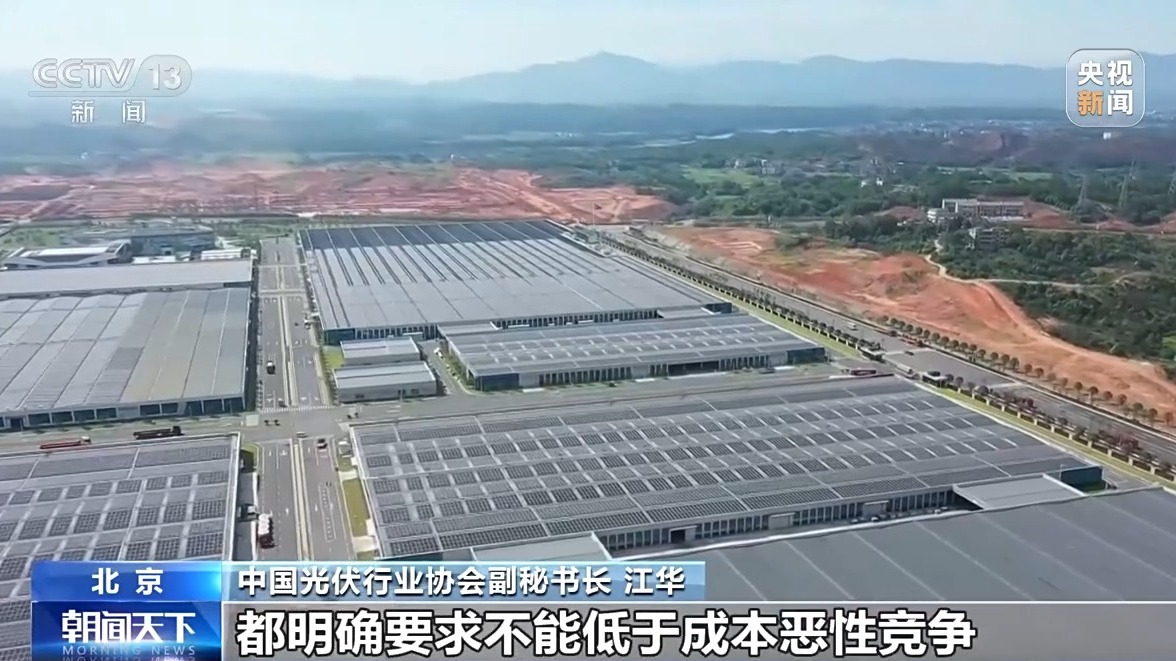
以创新拓展需求 光伏行业自律显现积极效果
Yang Shi Xin Wen· 2025-09-11 01:43
Core Viewpoint - The recent meeting held by the Ministry of Industry and Information Technology and five other departments aims to further regulate the competitive order of the photovoltaic industry, with a call for self-discipline within the industry to maintain fair competition and a healthy market environment [1]. Group 1: Industry Self-Regulation - The self-regulation initiative from the China Photovoltaic Industry Association focuses on three main aspects: enhancing industry chain regulation, promoting capacity clearance through market-oriented and legal methods, and eliminating sales below cost [2][4]. - The initiative emphasizes the prohibition of malicious competition, including dumping, and calls for companies to refrain from selling below cost [4]. - The third aspect of the initiative is to strengthen quality supervision and industry self-discipline, aiming to standardize market behavior and improve product quality for the healthy development of the industry [4]. Group 2: Positive Effects of Self-Regulation - Since last year, the push for self-regulation in the photovoltaic industry has shown positive effects, with many companies shifting from competing on scale and cost to focusing on innovation and exploring new application scenarios [5]. - The integration of photovoltaic power generation with various application scenarios is increasing, with innovative developments in areas such as photovoltaic + architecture, photovoltaic + fishery, and photovoltaic + desertification [7]. Group 3: Market Trends and Price Recovery - The future application of new information technologies, such as artificial intelligence, 5G, and industrial internet, is expected to lead to explosive growth in the photovoltaic sector [9]. - The market price for polysilicon has rebounded from 35-36 yuan per kilogram to 45-55 yuan, positively impacting confidence across various segments of the industry chain, including silicon wafers, battery cells, modules, and photovoltaic glass [9].

瑞银最新报告:2025 年长期投资该押注哪些方向?这 5 大主题被重点看好
Zhi Tong Cai Jing· 2025-09-10 15:29
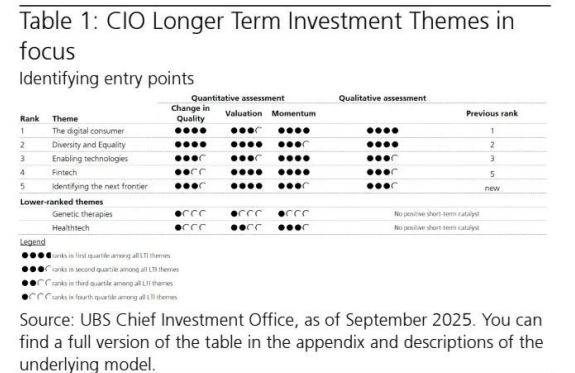
Core Conclusion - UBS identifies five key themes for long-term investment, which are: Digital Consumers, Diversity and Equality, Enabling Technologies, Fintech, and Identifying the Next Frontier [2][3] Group 1: Investment Themes - **Digital Consumers**: The younger generation, particularly Gen Z, is reshaping consumption patterns, focusing on shared experiences rather than ownership. AI plays a crucial role in transforming traditional sectors like travel and entertainment [3][4] - **Diversity and Equality**: Global regulations are pushing companies to disclose diversity data, which can help reduce wealth gaps and potentially drive GDP growth over the next decade. Companies with strong diversity frameworks are likely to outperform the market [5][6] - **Enabling Technologies**: Technologies such as AI, AR/VR, big data, and 5G are expected to reshape multiple industries, with the AI market projected to reach $2.6 trillion by 2030, growing at a CAGR of 41% from 2024 [6][7] - **Fintech**: The fintech sector is anticipated to grow from $310 billion in 2024 to $580 billion by 2030, driven by urbanization, demand from younger demographics, and supportive policies [7][8] - **Identifying the Next Frontier**: Emerging and frontier economies are expected to be the main drivers of global GDP growth over the next decade, with over 50% of the population in the top 10 developing economies by 2024 [8][9] Group 2: Short-term Cautions - **Gene Therapy & Medical Technology**: These themes currently rank low in quantitative models, lacking short-term catalysts for improvement. The biotech sector faces significant capital constraints, and medical technology companies need to prove their profitability [9][10] - **Smart Mobility**: This theme has shown improvement in valuation and momentum, moving off the cautious list. The automotive decarbonization trend is expected to continue, with upcoming events showcasing advancements in electric and autonomous vehicles [11] Group 3: Long-term Investment Logic - **Population Growth**: The global population is projected to increase from 8.1 billion in 2024 to over 10 billion by 2100, primarily in low- and middle-income countries [12] - **Urbanization**: The urban population is expected to rise from 55% in 2018 to 68% by 2050, with most growth occurring in Asia and Africa [12] - **Aging Population**: By 2024, 1 in 10 people globally will be over 65, increasing to 1 in 6 by 2050, with developed countries facing more severe aging issues [12]
Is Super Micro Computer Stock Underperforming the Dow?
Yahoo Finance· 2025-09-10 14:22
Company Overview - Super Micro Computer, Inc. (SMCI) has a market cap of $25.5 billion and is a leading provider of high-performance, energy-efficient server and storage solutions built on modular and open-standard architectures [1] - The company designs and manufactures a wide range of systems, including AI-optimized servers, blade and multi-node platforms, storage solutions, and edge computing systems, serving industries such as cloud computing, artificial intelligence, 5G, and enterprise data centers [2] Stock Performance - Shares of Super Micro Computer have decreased over 34% from its 52-week high of $66.44, while over the past three months, its shares have risen 3.9%, underperforming the broader Dow Jones Industrials Average's 6.4% gain during the same period [3] - Over the past 52 weeks, shares have returned nearly 8%, lagging behind the Dow Jones Industrials Average's nearly 12% increase, but are up 46.2% on a year-to-date basis, outperforming the Dow's 7.2% gain [4] Financial Results - Following its Q4 2025 results on August 5, Super Micro Computer's shares tumbled 18.3%. The company reported adjusted EPS at $0.41 and revenue at $5.76 billion, missing Wall Street expectations [5] - The company cut its long-term outlook, projecting at least $33 billion in fiscal 2026 revenue, down from its earlier forecast [5] Competitive Position - Super Micro Computer's stock has performed weaker than its rival, Pure Storage, Inc. (PSTG), which has climbed nearly 33% year-to-date and 74.9% over the past 52 weeks [5] Analyst Sentiment - Analysts remain cautious about Super Micro Computer's prospects, with a consensus rating of "Hold" from 18 analysts in coverage. The mean price target of $47.62 represents a premium of 5.6% to current levels [6]

慧智微跌0.78%,成交额1.04亿元,今日主力净流入-1041.21万
Xin Lang Cai Jing· 2025-09-10 07:56
Core Viewpoint - The company, Guangzhou Huizhiwei Electronics Co., Ltd., specializes in the research, design, and sales of RF front-end chips and modules, with a significant focus on 5G and 4G modules, primarily serving the mobile phone and IoT sectors [2][3][7]. Group 1: Company Overview - The company was established on November 11, 2011, and went public on May 16, 2023 [7]. - As of June 30, the company had a total market capitalization of 5.373 billion yuan, with a trading volume of 1.04 billion yuan and a turnover rate of 2.77% [1][7]. - The company's revenue composition includes 55.01% from 5G modules, 44.80% from 4G modules, and 0.19% from technical services and others [7]. Group 2: Financial Performance - For the period from January to June 2025, the company achieved a revenue of 355 million yuan, representing a year-on-year growth of 39.97% [7]. - The net profit attributable to the parent company was -65.28 million yuan, showing a year-on-year increase of 64.41% [7]. Group 3: Shareholding and Market Position - The National Integrated Circuit Industry Investment Fund holds 26.03 million shares, accounting for 5.75% of the total share capital [2]. - The company has been recognized as a "specialized, refined, distinctive, and innovative" small giant enterprise, which is a prestigious title for SMEs in China [3]. Group 4: Market Dynamics - The company benefits from the depreciation of the RMB, with overseas revenue accounting for 98.18% of total revenue [3]. - The average trading cost of the stock is 12.48 yuan, with the current stock price near a resistance level of 11.75 yuan, indicating potential for upward movement if the resistance is broken [6].

联特科技涨0.12%,成交额6.49亿元,近5日主力净流入-1.57亿
Xin Lang Cai Jing· 2025-09-10 07:49
Core Viewpoint - The company, Wuhan LianTe Technology Co., Ltd., is positioned in the optical communication module market, focusing on high-speed optical devices and modules, with significant growth potential driven by 5G and data center applications [2][3]. Company Overview - Wuhan LianTe Technology was established on October 28, 2011, and went public on September 13, 2022. The company specializes in the research, production, and sales of optical communication transceiver modules [7]. - The main revenue composition includes 92.72% from optical modules of 10G and above, 5.57% from optical modules below 10G, and 1.71% from material sales and leasing [7]. Market Position and Growth - The company has developed core capabilities in optical chip integration, high-speed optical devices, and module design, focusing on technologies such as EML, SIP, and TFLN for 800G optical modules [2]. - The optical module market is experiencing rapid growth, particularly in the data communication sector, which has surpassed the telecom market to become the largest market segment [2]. - The company’s products are critical components for data centers and 5G communication applications, benefiting from the increasing demand in these sectors [3]. Financial Performance - For the first half of 2025, the company achieved a revenue of 504 million yuan, representing a year-on-year growth of 15.43%, and a net profit of 34.81 million yuan, up 14.02% year-on-year [8]. - As of June 30, 2025, the company had a shareholder base of 23,300, an increase of 10.93% from the previous period [8]. International Exposure - The company has a high overseas revenue ratio of 89.07%, benefiting from the depreciation of the Chinese yuan [3]. Technical Aspects - The company’s low-power design technology for optical modules significantly reduces power consumption, providing a competitive advantage in 5G and data center applications [3]. Shareholder Composition - As of June 30, 2025, notable shareholders include Hong Kong Central Clearing Limited and new entrants like Zhonghang Opportunity Leading Mixed Fund, indicating growing institutional interest [9].
兆龙互连涨0.26%,成交额4.41亿元,今日主力净流入1979.32万
Xin Lang Cai Jing· 2025-09-10 07:43
Core Viewpoint - The company, Zhejiang Zhaolong Interconnect Technology Co., Ltd., is experiencing growth in revenue and profit, driven by its product offerings in high-speed data cables and optical products, as well as benefiting from the depreciation of the RMB [3][7]. Group 1: Company Performance - For the first half of 2025, the company achieved a revenue of 972 million yuan, representing a year-on-year growth of 14.29% [7]. - The net profit attributable to the parent company for the same period was 89.61 million yuan, showing a significant year-on-year increase of 50.30% [7]. - The company has distributed a total of 113 million yuan in dividends since its A-share listing, with 82.34 million yuan distributed over the past three years [8]. Group 2: Product Offerings and Market Position - The company specializes in high-speed components, including DAC products used in large data center switches and servers, with successful development of 800G transmission speed cables [2]. - It is one of the few domestic companies capable of designing and manufacturing data cables of categories 6, 7, and 8, meeting the new data transmission demands of the 5G era [2]. - The company's optical products include fiber jumpers and connectors, primarily serving high-end projects in finance, education, and healthcare, while also expanding into overseas markets [2]. Group 3: Market Dynamics - The company's overseas revenue accounted for 61.93% of total revenue in the 2024 annual report, benefiting from the depreciation of the RMB [3]. - The stock has shown a recent trading volume of 441 million yuan with a turnover rate of 3.22%, and a total market capitalization of 16.608 billion yuan [1]. - The average trading cost of the stock is 56.74 yuan, with a recent price near a resistance level of 53.50 yuan, indicating potential for upward movement if the resistance is broken [6].
中兴通讯:FTTR年发货量突破1000万套,PON CPE、IP机顶盒发货量全球第一
Ge Long Hui· 2025-09-10 07:42
Core Viewpoint - ZTE Corporation focuses on breakthroughs in core technologies related to connectivity (CT technology) and computing power (IT technology), enhancing its core competitiveness through innovation in 5G, optical networks, computing power, terminals, and value patent layout [1] Group 1: Core Technology Development - In the field of core technologies, the company emphasizes independent innovation in chips, operating systems, and databases, showcasing industry-leading capabilities in chip design and industrial-grade operating systems [1] - The self-developed GoldenDB database supports over 10 trillion financial transactions daily and more than 10 billion core transactions, catering to over 900 million mobile users [1] - New server operating systems and GoldenDB distributed databases have passed national security assessments [1] Group 2: Connectivity Solutions - The company ranks second globally in the cumulative shipment of 5G base stations and core networks, with solid network products also holding a global second position [1] - The company has developed specialized product solutions for various 5G scenarios, enhancing network quality and supporting the evolution towards 6G technology [1] - In the fixed network sector, the company has developed a prototype for 50G PON technology, facilitating smooth upgrades for operators [1] Group 3: Computing Power Innovations - The company is enhancing its intelligent computing product development and ecosystem collaboration to meet the demands of AI large models [1] - It has created a low-latency, high-bandwidth GPU computing network, which received recognition at the 2025 World Artificial Intelligence Conference [1] - The intelligent computing super-node system, based on self-developed AI switching chips, won a significant breakthrough award at the 2025 China Computing Power Conference [1] Group 4: Terminal Products - The company is actively promoting AI applications in consumer electronics, expanding the use of AI in mobile devices, PCs, and smart wearables [1] - It has launched innovative AI cloud computer terminals, including the world's first 2-in-1 cloud PAD, to enhance user experience [1] - The company achieved over 10 million units in FTTR annual shipments and holds the top global market share in PON CPE and IP set-top boxes [1] Group 5: Patent Strategy - The company is among the top global players in patent layout, significantly contributing to 5G technology research and standard-setting [1] - As of June 30, 2025, the company holds approximately 94,000 global patent applications and over 50,000 granted patents [1] - In the chip sector, the company has around 5,700 patent applications, with over 3,700 granted, and in AI, nearly 5,500 applications, with a substantial portion already authorized [1]
