企业转型

Search documents
这一次,“俞老板”为啥没得到员工共情?|新京报快评
Xin Jing Bao· 2025-11-18 13:37
Core Viewpoint - The internal letter from New Oriental's founder, Yu Minhong, sent from Antarctica, sparked criticism among employees for its perceived disconnect from their struggles and realities, highlighting a growing tension between management and staff [2][4][5]. Group 1: Employee Reactions - Employees expressed dissatisfaction with the letter, feeling it was tone-deaf given their hard work while the founder enjoyed leisure time in Antarctica [4][5]. - The sentiment among employees reflects a broader shift in attitudes, where they seek more tangible recognition and empathy from leadership rather than motivational rhetoric [5][6]. Group 2: Leadership Perspective - Yu Minhong's letter was characterized as a typical motivational message, reflecting his entrepreneurial spirit and vision for the future of New Oriental [2][3]. - The letter's content, while well-intentioned, failed to resonate with employees who are facing significant pressures and challenges in their roles [4][6]. Group 3: Suggestions for Improvement - Recommendations for future communications include offering bonuses or small gifts to employees, or providing time off to acknowledge their contributions, fostering a sense of shared success [6]. - A more grounded and relatable approach in leadership communication is suggested to bridge the gap between management and employees [6][7].



遭员工吐槽后,俞敏洪连发10条南极游视频!此前发全员信引争议,有员工表示无法与正在旅游的老板共情
Mei Ri Jing Ji Xin Wen· 2025-11-18 07:17
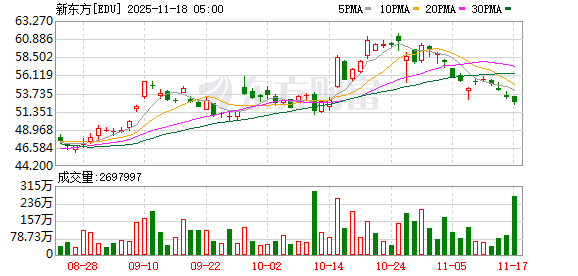
Group 1 - The core message of the article revolves around New Oriental's chairman, Yu Minhong, facing criticism from employees after sending an internal letter from Antarctica, which contrasted with the employees' current work pressures [2] - Yu Minhong's internal letter, celebrating the company's 32nd anniversary, emphasized themes of perseverance and future aspirations, positioning New Oriental as a "sower of hope" and promoting its new business initiatives [2] - Employee reactions included mockery and dissatisfaction, highlighting a disconnect between the leadership's experiences and the challenges faced by staff, with comments reflecting the stark contrast between Yu's travels and employees' realities [2] Group 2 - New Oriental is currently undergoing a critical transformation phase, facing significant operational pressures, as evidenced by a 73.7% drop in net profit to $7.1 million for Q4 of fiscal year 2025, primarily due to the underperformance of the Dongfang Zhenxuan business and goodwill impairment [4] - The company's core education business is experiencing a slowdown, with revenue growth decreasing from 43.9% in the previous fiscal year to 13.6% [4] - For Q1 of fiscal year 2026, New Oriental reported net revenue of $1.523 billion, a 6.1% year-over-year increase, driven by new educational business initiatives, although net profit attributable to shareholders fell by 1.9% to $241 million [4] - The company anticipates Q2 fiscal year 2026 net revenue between $1.132 billion and $1.163 billion, with a year-over-year growth rate of 9% to 12%, and expects total annual net revenue to range from $5.1453 billion to $5.3903 billion, reflecting a growth rate of 5% to 10% [4] - As of the report, New Oriental's stock on the Hong Kong market declined by 2.60% [4]
俞敏洪南极旅游发周年贺信引争议,员工:只觉得讽刺
Guan Cha Zhe Wang· 2025-11-18 02:31
Core Points - The founder of New Oriental, Yu Minhong, sent an internal letter from Antarctica on the company's 32nd anniversary, expressing gratitude to employees and supporters while reflecting on the significance of time and perseverance [1][3] - The letter emphasized New Oriental's mission to be a "sower of hope" and positioned Dongfang Zhenxuan as a representative of "business conscience" [1] - The company is currently undergoing a critical transformation phase and is facing significant operational pressures, with a reported 73.7% drop in net profit to $7.1 million for Q4 of fiscal year 2025, primarily due to the underperformance of Dongfang Zhenxuan and goodwill impairment [7] Employee Reactions - The internal letter did not resonate as expected with employees, leading to comments on social media that highlighted the contrast between the founder's vacation and the employees' work environment [3][5] - Observations noted that the letter frequently mentioned "I" 17 times and "Antarctica" 5 times, while largely neglecting the current work pressures faced by employees [5] Financial Performance - New Oriental's core education business has shown a declining growth rate, with revenue growth dropping from 43.9% in the previous fiscal year to 13.6% in fiscal year 2025 [7] - The company is still awaiting a response from Yu Minhong or New Oriental regarding the controversy surrounding the internal letter [8]
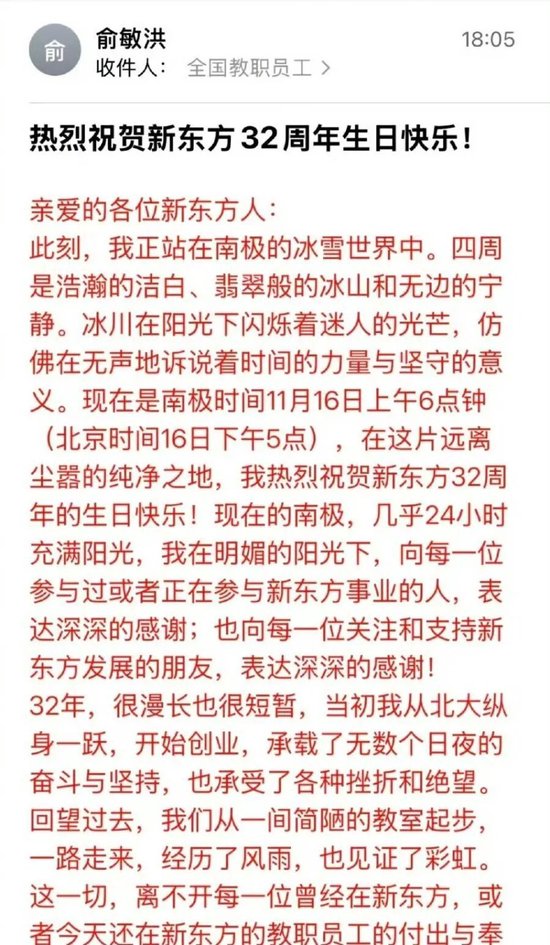
“老板在南极,员工在加班”,俞敏洪南极旅游发内部贺信引争议,员工:“只觉得讽刺”
Sou Hu Cai Jing· 2025-11-18 02:03
Core Insights - New Oriental celebrated its 32nd anniversary on November 16, with founder Yu Minhong expressing gratitude to employees and supporters from Antarctica, emphasizing themes of perseverance and future vision [1][3] - The internal letter aimed to position New Oriental as a "sower of hope" and to establish Dongfang Zhenxuan as a representative of "merchant conscience" [3] Employee Reactions - The internal letter received mixed reactions, with some employees feeling disconnected from Yu's Antarctic experience, leading to discussions on social media about the disparity between the leadership's situation and employees' work pressures [5][6][8] - Employees expressed feelings of irony regarding the letter's content, as many were still working late on the anniversary, highlighting a lack of empathy from leadership [6][7] Company Background - New Oriental was founded in 1993 and became the first Chinese education institution to be listed on the New York Stock Exchange in 2006, expanding into various sectors including study abroad consulting and online education [8] - The company has faced significant challenges in recent years, including a sharp decline in stock price and market value, prompting a shift towards live-streaming e-commerce and diversification into cultural tourism [8] Financial Performance - For the fourth quarter of fiscal year 2025, New Oriental reported a net profit drop of 73.7% to $7.1 million, primarily due to losses from Dongfang Zhenxuan and goodwill impairment [9] - The company's revenue growth slowed significantly, with fiscal year 2025 revenue growth dropping from 43.9% to 13.6% [9] - In the first quarter of fiscal year 2026, New Oriental's net revenue was $1.523 billion, a 6.1% year-over-year increase, driven by new educational business growth [9] - The company projects second-quarter fiscal year 2026 net revenue between $1.132 billion and $1.163 billion, with an expected year-over-year growth rate of 9% to 12% [9] Market Performance - On November 17, New Oriental's stock in Hong Kong rose by 0.35% to HKD 41.48, with a market capitalization of HKD 65.6 billion [10] - In the U.S. market, New Oriental's stock fell by 1.24% to $53.27, with a market capitalization of $8.373 billion [12]

俞敏洪南极旅游发全员信,员工称只觉得讽刺
2 1 Shi Ji Jing Ji Bao Dao· 2025-11-18 00:57
记者丨刘雪莹 编辑丨江佩霞 "老板在南极,员工在加班。"这是不少网友在看到俞敏洪的最新全员信后的第一反应。 11月16日,新东方迎来成立32周年纪念日,创始人俞敏洪身处南极发布内部信,向全体员工及支持者致 谢。该文开篇即细致描绘"浩瀚的洁白、翡翠般的冰山"等南极景观,称当地"几乎24小时充满阳光"的环 境让他对"时间的力量与坚守的意义"有了更深感悟。 新东方仍处于转型关键期,面临着现实经营压力。据2025财年第四季度财报显示,其净利润骤降73.7% 至710万美元,主要受东方甄选业务拖累及商誉减值影响。此外,核心教育业务增速逐季放缓,2025财 年营收增速从上一财年的43.9%降至13.6%。() (声明:文章内容仅供参考,不构成投资建议。投资者据此操作,风险自担。) SFC 出品 | 21财经客户端 21世纪经济报道 21君荐读 然而这封饱含"南极感悟"的信函并未收获预期的共鸣,有员工在社交媒体暗指老板的"远方"与员工 的"现场"形成鲜明对比。更直白的吐槽来自企业邮箱留言称,看到信中对南极风光的描述"只觉得讽 刺"。 亲爱的老板 此刻,我现在正在晚八点 半下课的地铁上。十个小 时的课程是折磨的、享受 周末快 ...
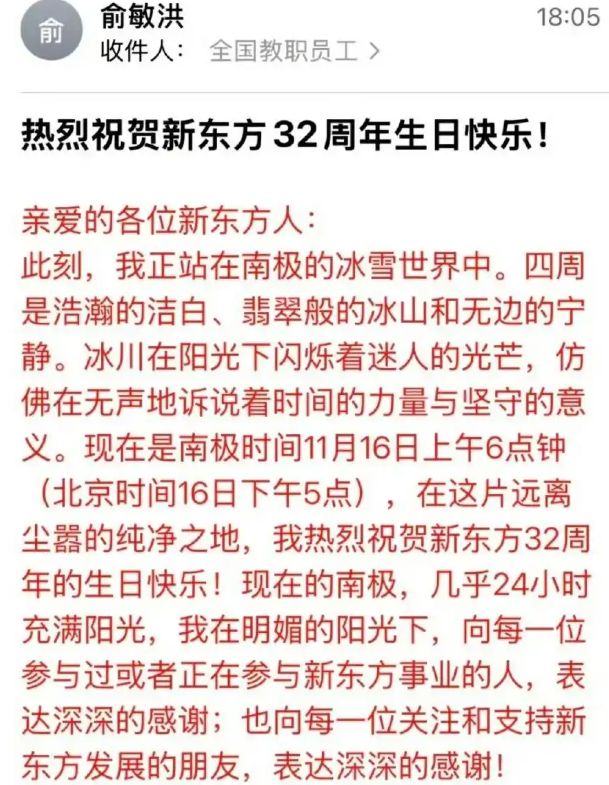
俞敏洪南极旅游发全员信,员工称只觉得讽刺
21世纪经济报道· 2025-11-18 00:49
记者丨刘雪莹 编辑丨江佩霞 "老板在南极,员工在加班。" 这是不少网友在看到俞敏洪的最新全员信后的第一反应。 11月16日,新东方迎来成立32周年纪念日,创始人俞敏洪身处南极发布内部信,向全体员工及 支持者致谢。该文开篇即细致描绘"浩瀚的洁白、翡翠般的冰山"等南极景观,称当地"几乎24 小时充满阳光"的环境让他对"时间的力量与坚守的意义"有了更深感悟。 然而这封饱含"南极感悟"的信函并未收获预期的共鸣,有员工在社交媒体暗指老板的"远方"与 员工的"现场"形成鲜明对比。更直白的吐槽来自企业邮箱留言称,看到信中对南极风光的描述 "只觉得讽刺" 。 截至发稿,新东方官方及俞敏洪本人尚未对相关争议作出回应。 新东方仍处于转型关键期,面临着现实经营压力。据2025财年第四季度财报显示,其净利润骤 降73.7%至710万美元,主要受东方甄选业务拖累及商誉减值影响。此外,核心教育业务增速 逐季放缓,2025财年营收增速从上一财年的43.9%降至13.6%。( 详情 ) (声明:文章内容仅供参考,不构成投资建议。投资者据此操作,风险自担。) 出品 | 2 1财经客户端 2 1世纪经济报道 道指大跌超500点,多数中概股下跌, ...

“老板在南极,员工在加班”,俞敏洪南极旅游发全员信引争议
Mei Ri Jing Ji Xin Wen· 2025-11-17 22:54
Core Viewpoint - The internal letter from Yu Minhong, founder of New Oriental, while expressing gratitude to employees, has sparked controversy as employees feel disconnected from the founder's experience in Antarctica during a time of significant work pressure [4][6][9]. Group 1: Company Background - New Oriental was founded in 1993 by Yu Minhong, starting from a small classroom and expanding into a major educational institution, becoming the first Chinese education company to be listed on the New York Stock Exchange in 2006 [9]. - The company has diversified its services to include study abroad consulting, preschool education, and online education, but has faced significant challenges in recent years, leading to a substantial decline in stock price and market value [9][10]. Group 2: Recent Developments - As of the fourth quarter of the 2025 fiscal year, New Oriental reported a 73.7% drop in net profit to $7.1 million, primarily due to losses in the Oriental Selection business and goodwill impairment [10]. - The company’s revenue growth has slowed, with a decrease from 43.9% in the previous fiscal year to 13.6% [10]. - For the first quarter of the 2026 fiscal year, New Oriental reported net revenue of $1.523 billion, a year-on-year increase of 6.1%, driven by new educational business growth [10]. Group 3: Market Performance - On November 17, New Oriental's stock in Hong Kong rose by 0.35% to HKD 41.48, with a market capitalization of HKD 65.6 billion [10]. - In the U.S. market, New Oriental's stock fell by 1.8% to $52.31, with a market capitalization of $8.3 billion [11].

俞敏洪身处南极发全员信,疑遭员工吐槽
Di Yi Cai Jing Zi Xun· 2025-11-17 13:30
Core Points - The founder of New Oriental, Yu Minhong, celebrated the company's 32nd anniversary from Antarctica, emphasizing themes of perseverance and hope in his internal letter to employees [2][4] - The letter aimed to inspire employees by reflecting on the company's journey and future vision, positioning New Oriental as a "sower of hope" and promoting its various business segments [2][4] - The internal communication sparked controversy among employees, with some expressing feelings of disconnect between the founder's vacation and their ongoing work pressures [4][7] Company Performance - New Oriental's financial performance shows significant challenges, with a 73.7% drop in net profit to $7.1 million for the fourth quarter of fiscal year 2025, primarily due to losses in the Oriental Selection business and goodwill impairment [7] - The company's revenue growth has slowed, with fiscal year 2025 revenue growth decreasing from 43.9% to 13.6% [7] - For the first quarter of fiscal year 2026, New Oriental reported net revenue of $1.523 billion, a 6.1% year-over-year increase, driven by new educational business initiatives, although net profit attributable to shareholders fell by 1.9% to $241 million [7]

俞敏洪身处南极发全员信,疑遭员工吐槽
第一财经· 2025-11-17 12:24
Core Viewpoint - The internal letter from the founder of New Oriental, Yu Minhong, delivered from Antarctica, aimed to celebrate the company's 32nd anniversary and inspire employees, but it sparked controversy due to the stark contrast between the founder's location and the employees' working conditions [3][5]. Summary by Sections Company Overview - New Oriental is celebrating its 32nd anniversary, with Yu Minhong reflecting on the company's journey and future aspirations in his letter [3]. - The company aims to position itself as a "sower of hope" and represent "the conscience of merchants" through its various business segments [3]. Employee Sentiment - The letter received mixed reactions from employees, with some expressing feelings of disconnect and frustration over the founder's vacation while they were working late [5][8]. - Employees noted the irony in the founder's descriptions of the Antarctic scenery, contrasting it with their own challenging work conditions [5][8]. Financial Performance - New Oriental is currently undergoing a critical transformation phase, facing significant operational pressures [8]. - The financial report for Q4 of fiscal year 2025 showed a 73.7% drop in net profit to $7.1 million, primarily due to the underperformance of the Oriental Selection business and goodwill impairment [8]. - Revenue growth for the core education business has slowed, with fiscal year 2025 revenue growth decreasing from 43.9% to 13.6% [8]. - The unaudited financial report for Q1 of fiscal year 2026 indicated net revenue of $1.523 billion, a 6.1% year-over-year increase, driven by new educational business segments [8].

Why Is Everyone Talking About Krispy Kreme Stock?
The Motley Fool· 2025-11-17 09:25
Core Insights - Krispy Kreme is at a critical juncture, attempting to transform its nostalgic brand into a sustainable growth business through various strategic initiatives [2][5] - The company has faced challenges with inconsistent profitability, highlighted by a decline in operating income from $13 million in 2023 to a loss of $9 million in 2024 [4] - Management is focusing on refranchising, reducing capital intensity, and improving efficiency to drive sustainable revenue growth [7][9] Business Performance - The brand has a strong emotional connection with consumers but has struggled with delivering high returns consistently [3][4] - Recent efforts have shown mixed results, with adjusted EBITDA margin improving to 10.8% from 9.1% year-over-year, while net revenue declined by 1.2% due to divestments and store closures [8][9] - The termination of the partnership with McDonald's highlights the importance of profitable unit economics over mere expansion [11][12] Strategic Focus - Management is prioritizing profitability over expansion, which is a shift from previous strategies [14] - The company aims to improve the economics of its existing business, which could lead to better long-term returns [13][14] - Future success will depend on sustaining margin gains, executing a capital-light strategy, and rekindling revenue growth [15]