去中心化

Search documents
五年后,500万投哪类资产最值钱?
Sou Hu Cai Jing· 2025-09-12 12:05
Group 1 - The article discusses the performance of seven asset classes over a period of one and a half years, originally valued at 5 million [2][4] - The seven asset classes include stocks (Moutai, Nvidia, Microsoft), cryptocurrencies (Bitcoin), precious metals (gold), real estate (small apartment in Beijing), and luxury goods (LV bags) [2][3] - Nvidia has shown the highest return, with a price increase of 100.1%, while the real estate investment has suffered the most with a decline of 17.9% [5][6] Group 2 - Nvidia is highlighted as a leader in the AI sector, with expectations of a price increase of 50%-100% over the next 3-5 years, despite potential risks from competition and policy changes [10][12] - Bitcoin has experienced significant volatility, with a historical increase of 600% over the past decade, but it faces risks related to regulatory scrutiny and market consensus [13][15] - Microsoft benefits from its Azure cloud services and plans to increase subscription prices, although it faces intense competition from Amazon and Google [16] Group 3 - Gold prices have surged significantly, with a current price of 3644 USD per ounce, driven by factors such as increased money supply and central bank purchases [17][20][21] - Moutai, as a leading domestic liquor brand, has seen a decline in stock price and sales, but it retains a strong market position due to its brand value and cultural significance [23][27] - Luxury goods, particularly LV bags, are generally not good investments due to depreciation, but limited edition items may retain or increase in value [28] Group 4 - Real estate investments in core urban areas like Beijing have shown poor performance, with low rental yields and depreciation concerns [30][32] - The article suggests that each asset class has its own logic and cycle, emphasizing the importance of diversification in investment strategies [34]





图灵奖得主萨顿:人们对人工智能的恐惧被夸大了
Di Yi Cai Jing· 2025-09-11 04:06
Core Insights - The evolution of artificial intelligence (AI) is seen as a necessary next step in the universe, and humanity should embrace it with courage, pride, and a spirit of adventure [5] Group 1: AI Development and Data Sources - Richard Sutton emphasizes the need for a new type of data source that can continuously grow and optimize alongside the capabilities of intelligent agents, moving beyond traditional static databases [1] - The current phase is described as the "human data era," where AI systems primarily rely on predicting human language and labels, but the utilization of human data is nearing its limits [1] - The transition to the "experience era" is highlighted, where intelligent agents will interact with the world from a first-person perspective, generating new data sources termed "experiences" [1] Group 2: Political and Philosophical Implications - AI has become a highly politicized topic, with increasing calls for regulation and control due to public concerns about bias, unemployment, and existential risks [2] - Sutton argues that the fear surrounding AI is exaggerated and reflects a human tendency to demonize the unknown, advocating for a decentralized cooperative model rather than centralized control [3] - He posits that AI is one of humanity's oldest pursuits, closely aligned with human nature, and understanding intelligence is a shared goal of both science and the humanities [3] Group 3: Future Predictions and Human Role - Sutton outlines four principles regarding the future of AI, including the lack of consensus on how the world should operate, the eventual understanding of intelligence by humans, the surpassing of current human intelligence, and the inevitable shift of power and resources towards the most intelligent agents [3] - As AI evolves, humanity must redefine its role, with humans acting as catalysts and pioneers in the "design era," where machines increasingly resemble living forms [4]
2025年数字资产系列研究-中银国际
Sou Hu Cai Jing· 2025-09-10 11:21
Core Insights - The report titled "2025 Digital Asset Series Research - CCB International" analyzes the differences between the real world and the virtual/digital world, emphasizing the concepts of "centralization" and "decentralization" [1] - It highlights stablecoins as a crucial bridge connecting virtual and real value, with a projected trading volume of approximately $37 trillion in 2024, surpassing Bitcoin [1] - The report discusses the implications of stablecoins on monetary supply, the U.S. Treasury market, and the dominance of the U.S. dollar, as well as the differences in digital currency strategies between China and the U.S. [1] Summary by Sections Historical and Technical Analysis - The report examines the historical, cultural, and technical aspects of digital assets, focusing on the fundamental differences between centralized and decentralized systems [1] - It identifies fiat currencies and cryptocurrencies (excluding Bitcoin) as two incentive carriers within these systems, with their value dependent on ecosystem activity, integrity, and consensus [1] Focus on Stablecoins - Stablecoins are defined as digital currencies pegged to specific assets to maintain value stability, with the top two stablecoins (USDT and USDC) accounting for 60% and 23% of the market, respectively [1] - The report categorizes stablecoins based on their collateralization methods and discusses the "impossible trinity" challenge of achieving price stability, capital efficiency, and decentralization simultaneously [1] Macroeconomic Implications - The report analyzes the macroeconomic impact of stablecoins on monetary supply and the U.S. Treasury market, as well as the implications for U.S. dollar hegemony [1] - It contrasts China's approach to digital currency (promoting the digital yuan) with the U.S. focus on dollar stablecoin tokenization [1] Hong Kong's Stablecoin Development - The report explores the reasons behind Hong Kong's development of stablecoins, including the aim to establish a digital asset hub and activate the RMB ecosystem [1] - It discusses the coexistence of stablecoins with central bank digital currencies (CBDCs) and outlines the differences in regulatory frameworks between Hong Kong and the U.S./Europe [1] Applications and Infrastructure - Stablecoins are examined in various applications, including retail payments, cross-border transfers, virtual asset trading, RWA, and DeFi [1] - The report introduces the stablecoin economic ecosystem in Hong Kong and the business models of key service providers, as well as the impact of stablecoins on traditional financial institutions and the necessary infrastructure for expanding specific use cases [1]

德林控股陈宁迪:拥抱优质金融资产,拥抱未来!
Sou Hu Cai Jing· 2025-09-10 05:51
Core Viewpoint - The article discusses the significant gap between the heated discussions around Real World Assets (RWA) and their actual implementation, highlighting the potential to bring trillions of dollars in physical assets into the blockchain space, thus initiating a new era of value interconnection [2]. Group 1: Compliance Costs - The compliance costs for issuing RWA are extremely high due to the "same risk, same regulation" principle adopted by Hong Kong regulators, which leads to initial RWA projects being concentrated in low-risk standardized products like money market funds and government bonds [3]. - Once RWA assets move beyond these low-risk products, compliance costs increase exponentially, as seen with Robinhood's attempt to tokenize standardized assets in Europe, which drew regulatory scrutiny [3]. - Many RWA projects in Hong Kong involve assets located in mainland China, adding extra regulatory costs related to sensitive data and cross-border capital [3]. Group 2: Investor Behavior - Currently, RWA projects in Hong Kong's sandbox are limited to qualified investors, primarily institutions, which leads to more rational investment decisions and reduces the likelihood of speculative behavior [4]. - An example is provided where a real estate token financing project failed due to the high premium over market value, demonstrating that qualified investors are less likely to take risks compared to retail investors [5]. Group 3: Future Outlook - The company expresses optimism about the future of RWA projects, citing the proven credibility of blockchain technology in providing decentralized trust and the potential for tokenizing quality assets to lower transaction costs [6]. - The ultimate goal is to democratize access to high-quality assets, which are currently monopolized by traditional financial institutions, aligning with the direction of Hong Kong's Web3.0 efforts [6].

XBIT Wallet守护加密财富 硬件钱包建铸数字资产堡垒
Sou Hu Cai Jing· 2025-09-06 11:31
Core Insights - The article highlights the increasing importance of hardware wallets as a secure solution for cryptocurrency storage amid market volatility and economic uncertainty [1][9] - XBIT Wallet is positioned as an innovative hardware wallet that addresses the dual demands for security and convenience in the current market [1][7] Economic Context and Market Volatility - Recent U.S. non-farm payroll data showed a significant shortfall, with only 22,000 jobs added compared to the expected 75,000, and the unemployment rate rising to 4.3%, the highest since October 2021 [1][3] - These economic indicators suggest a slowdown in U.S. economic growth, which may influence Federal Reserve monetary policy and increase financial market volatility [1][3] Demand for Asset Security - In light of economic uncertainty and market fluctuations, there is a notable increase in investor demand for asset security [3][4] - Hardware wallets, by storing private keys offline, effectively isolate users from network attacks and exchange risks, making them the preferred tool for long-term holders [3][4] Centralized Custody Risks - The recent WLFI incident, where over 272 addresses were frozen to "protect user assets," underscores the risks associated with centralized platforms controlling user assets [3][4] - Hardware wallets provide users with complete control over their assets, mitigating the risks of third-party intervention [3][4] Technological Innovations in Hardware Wallets - XBIT Wallet employs military-grade encryption and dual verification mechanisms to enhance security, ensuring users have absolute control over their assets [4][7] - The wallet features triple security verification (physical confirmation, biometric recognition, and PIN protection) while supporting multi-chain asset management [7] Future Outlook for Hardware Wallets - As regulatory frameworks improve and technical standards unify, hardware wallets are expected to become the standard for digital asset management [8] - The offline storage feature combined with user-friendly experiences will drive broader adoption of hardware wallets [8][9] - XBIT Wallet is positioned as a benchmark in the industry, providing a secure bridge for users entering the Web3 space [9]
{比特币难以复制之谜:代码易得,信仰难铸,社区与人成关键
Sou Hu Cai Jing· 2025-09-06 02:15
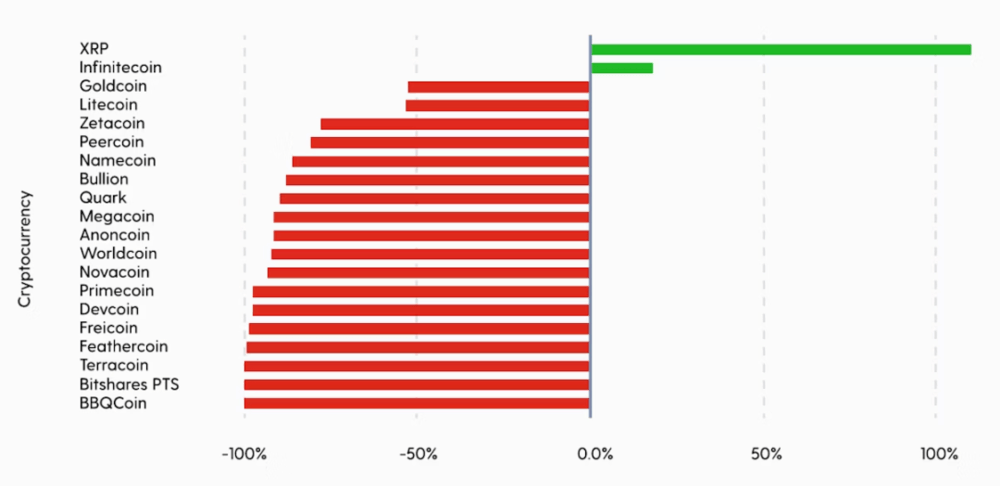
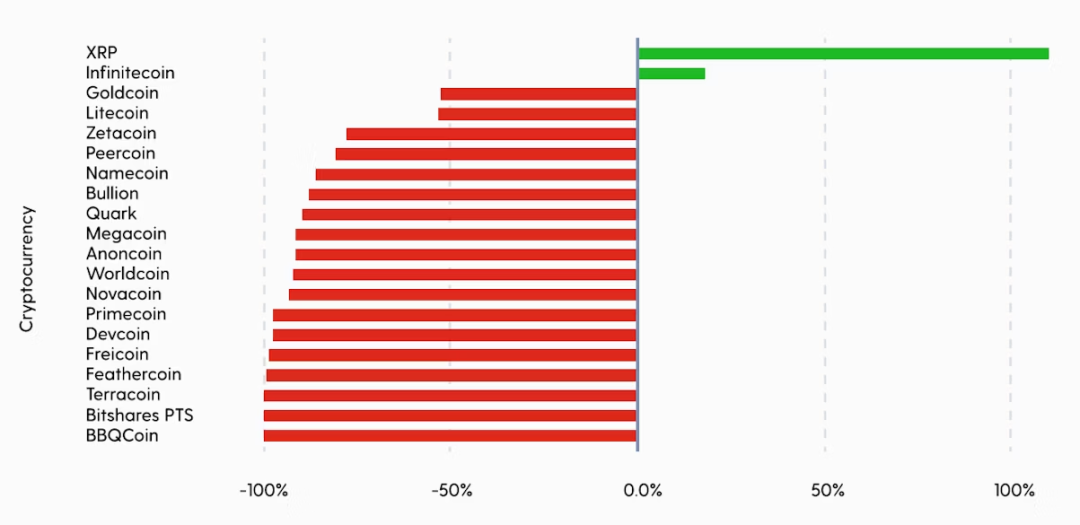
Core Insights - Bitcoin holds a unique position in the cryptocurrency world, having evolved from an anonymous developer's experiment to the most recognized digital asset globally, unlike many altcoins that have failed to replicate its success [1][4] Group 1: Bitcoin's Unique Attributes - The success of Bitcoin lies in its non-replicability, as highlighted by the author of "The Bitcoin Standard," emphasizing that while its code is open-source, the lack of genuine community demand hampers the survival of imitation coins [3][6] - Bitcoin's decentralized community contrasts sharply with the corporate structures of most altcoins, which often prioritize quick profits over long-term development, leading to significant information asymmetry and moral hazard [3][4] Group 2: Market Dynamics of Altcoins - Despite the risks, many investors are drawn to altcoins due to the mythos surrounding Bitcoin, often overlooking that Bitcoin's success is rooted in its underlying ideology rather than just technology [4][6] - Historical data shows a grim survival rate for altcoins, with many from the top 20 market cap lists in 2013, 2017, and 2021 experiencing significant devaluation by 2022, indicating their inability to match Bitcoin's fairness, stability, and longevity [4][6] Group 3: Evolution of Altcoin Strategies - Initially, many altcoins attempted to compete by claiming to be "faster" or "cheaper" alternatives to Bitcoin, but these strategies have lost traction, leading to a shift towards proof-of-stake (PoS) and other mechanisms that emphasize unique functionalities [6][7] - Bitcoin's dominance, holding 97% of the market value through its proof-of-work (PoW) mechanism, has created a significant barrier for other cryptocurrencies to cultivate a similar following [6][7] Group 4: Cultural and Ideological Significance - Bitcoin's mission as a peer-to-peer electronic cash system and a store of value is supported by its fixed supply of 21 million and 10-minute block time, reinforcing its core principles of decentralization and anti-inflation [6][7] - The historical context of Bitcoin's creation during a financial crisis imbues it with a rebellious spirit against the old order, symbolizing a belief in a currency independent of state control, which has been perpetuated by its decentralized community [6][7] Group 5: Power Dynamics in the Cryptocurrency Space - The power dynamics within the cryptocurrency sector are complex, with many project failures attributed to the structure of founding teams and economic incentives, highlighting the risks of information asymmetry [7] - Bitcoin's non-replicability is ultimately rooted in the collective belief and ideology of its community, making it a movement rather than just a technological innovation, which is difficult for later entrants to replicate [7]
比特币难以撼动之谜:技术易仿,信仰难铸,社区与精神成核心壁垒
Sou Hu Cai Jing· 2025-09-05 20:16
Core Insights - Bitcoin has maintained an unshakeable position in the cryptocurrency market since its inception, despite the existence of numerous altcoins attempting to replicate its success [1] - The unique power dynamics and ideological competition within the cryptocurrency market contribute to the challenges faced by these altcoins [3] Group 1: Market Dynamics - The barrier to creating new cryptocurrencies appears low, yet market acceptance of these replicas is highly stringent [3] - Altcoins often rely on aggressive marketing or price surges to attract investors, leading to a speculative environment [3] - Most altcoins operate under a corporate model, where founding teams control token distribution and project exit strategies, often prioritizing quick profits [3] Group 2: Bitcoin's Unique Position - Bitcoin's success is rooted not in technical parameters but in the strong belief of its decentralized community, which has been reinforced over a decade [4] - The market data reveals the fragility of altcoins, with many top altcoins from 2013 and 2017 experiencing significant devaluation compared to Bitcoin [4] - Bitcoin's market capitalization in the proof-of-work sector exceeds 97%, showcasing its stability and community resilience compared to later entrants [4] Group 3: Evolution of Altcoins - Early altcoins attempted to compete with Bitcoin by offering faster transactions and lower fees, but this strategy has lost effectiveness as Bitcoin's ideological position solidified [6] - Surviving altcoins are now shifting towards proof-of-stake and smart contract mechanisms, emphasizing governance and voting rights, yet they still lack Bitcoin's foundational rebellious spirit [6] - The power dynamics in the cryptocurrency space are complex, with internal project control often stemming from early holders' evasion of regulation [6] Group 4: Bitcoin as a Social Movement - Bitcoin's revolutionary nature relies on the trust of its holders, transcending mere technology to become a social movement and a vehicle for values [6] - The historical path dependency of Bitcoin makes it fundamentally unshakeable, as its development is fully transparent and community-driven [6]

美国商务部授权波场TRON发布美GDP数据, 手续费下调 60% 推动用户规模激
Cai Fu Zai Xian· 2025-09-05 06:51
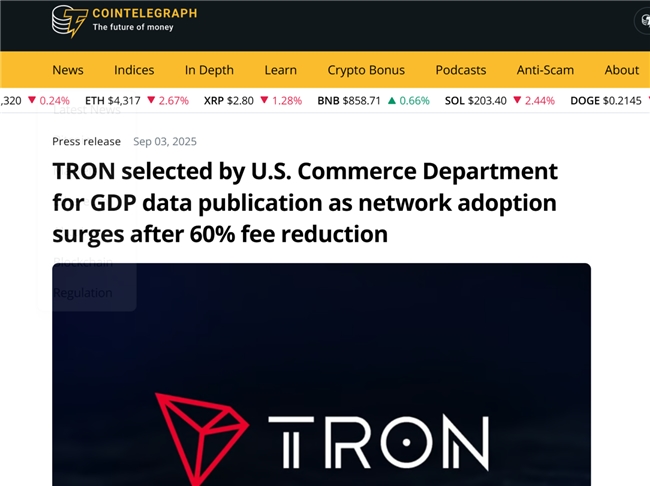
Group 1 - TRON blockchain network has been officially recognized by the U.S. Department of Commerce as a primary platform for releasing official economic data, starting with the GDP data for Q2 2025 [1][3] - The U.S. Bureau of Economic Analysis reported a GDP annual growth rate of 3.3% for Q2 2025, with the data's tamper-proof hash recorded on the TRON blockchain [1][3] - This marks the first instance of a federal agency publishing official GDP data on a public blockchain, highlighting the advantages of decentralized technology in ensuring data transparency and global sharing of key economic indicators [1][3] Group 2 - The U.S. Department of Commerce has acknowledged the scale, efficiency, and global reach of the TRON network by recording the SHA256 hash of its official GDP report [3] - TRON's daily settlement amount has surpassed $22 billion, with over 8.8 million transactions, establishing it as a trusted infrastructure layer in financial markets and a reliable platform for government data publication [3] - TRON's founder emphasized that the on-chain GDP data reinforces TRON's role as public infrastructure and demonstrates the potential of blockchain technology to enhance transparency and trust [3] Group 3 - In August 2025, the TRON community approved a proposal to reduce network energy fees by 60%, significantly lowering transaction costs and rapidly increasing network adoption [4] - Following the fee reduction, TRON's daily active user count exceeded 2.5 million, surpassing both BNB Chain and Solana in on-chain activity [4] - TRON leads the stablecoin sector with a circulation volume exceeding $82 billion, focusing on providing low-cost, high-efficiency on-chain services to create long-term value for global users [4]
关于比特币,你可能不知道的(三)
Hu Xiu· 2025-09-05 06:26
Group 1 - The core argument is that Bitcoin's success is difficult to understand due to its lack of intrinsic value in the Graham sense, leading to a wave of imitation cryptocurrencies that seek to capitalize on perceived arbitrage opportunities [2][12] - Imitating Bitcoin is easy, but creating genuine demand for these imitations is challenging, requiring either extensive marketing or sudden price surges [3][4] - Most cryptocurrencies operate in a corporate manner, with founding teams primarily motivated by profit, which contrasts with Bitcoin's decentralized community-driven ethos [7][14] Group 2 - Bitcoin has absorbed 97% of the market value in the proof-of-work (PoW) sector, leaving little room for altcoins, which must now pivot to new mechanisms like proof-of-stake (PoS) to survive [24] - The fundamental differences between Bitcoin and its imitators include Bitcoin's simple mission as a peer-to-peer electronic cash system, its historical context of rebellion against the old financial order, and its highly decentralized community structure [26][27] Group 3 - The cryptocurrency space is fundamentally driven by power dynamics rather than technology, with internal team structures and economic incentives often leading to risks and failures [28][29] - The historical context of Bitcoin's creation and its community's evolution are crucial for understanding its unique position in the market, as it embodies a blend of technological innovation and ideological significance [31][32][33]
ETH最新价格行情分析,分析师预计突破4530美元,XBIT平台价值赋能
Sou Hu Cai Jing· 2025-09-02 12:46
Core Viewpoint - The cryptocurrency market is currently focused on Ethereum (ETH) price movements, with discussions on whether it can break the $5000 mark in September after showing strong recovery capabilities following a short-term adjustment in late August [1][3]. Price Trends and Technical Analysis - ETH has maintained a stable trading price of $4386, continuing its upward channel formed since June, with a recent rebound from the $4200 support level, indicating market consensus on a mid-term upward trend [1][3]. - Key technical indicators are showing neutral to positive signals, with the Relative Strength Index (RSI) returning to a balanced range and the Moving Average Convergence Divergence (MACD) remaining above the zero line, suggesting that bullish momentum has not completely faded [3]. - Analysts note similarities between the current price action and the breakout patterns seen in 2017, with a potential upward movement towards $4800 and $5000 if the price can hold above the $4530 resistance level [3]. Market Sentiment and On-Chain Data - There is a significant divergence in capital flows, with a notable net inflow into spot exchanges on September 2, indicating that institutions and high-net-worth investors are increasing their positions [4]. - The marginal easing of the U.S. macro policy environment is providing liquidity support to the cryptocurrency market, reducing the traditional financial market's crowding out effect on risk assets [4]. - However, short-term resistance and market divergence remain, with potential tests of support levels at $4015 and $3533 if the price fails to recover the $4500 area [4]. XBIT Decentralized Exchange Advantages - XBIT's decentralized exchange platform offers unique value in a high-volatility and regulatory-uncertain environment by providing a trustless trading environment based on blockchain technology [5][6]. - The platform's design allows for user-controlled asset management, eliminating the risks associated with centralized exchanges, especially in light of increasing regulatory differences globally [6]. - XBIT's non-mandatory identity verification mechanism enhances user autonomy in trading, aligning with the decentralized nature of cryptocurrencies and providing compliance flexibility across different regulatory environments [6]. Investor Support and Risk Management - XBIT provides comprehensive support for investors navigating the critical price movements of ETH, integrating professional-level market analysis tools and real-time data visualization [8]. - The platform has developed an intelligent risk control system that monitors price volatility and leverage ratios, automatically adjusting margin requirements and triggering risk alerts to maintain industry-leading risk management levels [8]. - XBIT's cross-chain trading functionality allows users to convert ETH into tokenized assets without fiat conversion, facilitating asset allocation in both cryptocurrency and traditional markets [9]. Conclusion - The current market environment serves as a test for ETH's value and the professionalism of trading tools, with XBIT's decentralized platform offering a technology-driven ecosystem to help users achieve information symmetry and risk control [11].