新能源产业链

Search documents
惠云钛业(300891) - 2025年9月19日投资者关系活动记录表(2025年广东辖区投资者集体接待日活动)
2025-09-19 10:24
Group 1: Company Overview and Strategy - Huayun Titanium Industry has over 20 years of experience in the titanium dioxide and fine chemical sectors, focusing on production processes and circular economy operations [2][5] - The company is open to evaluating opportunities for transformation that align with its strategic goals and can create synergies [3] Group 2: Automation and Technology - The company has gradually introduced automation equipment in key production processes to enhance efficiency and ensure safety [4] - Future plans include exploring intelligent equipment applications to achieve higher operational efficiency and sustainability [4] Group 3: Mining and Resource Management - As of September 2025, the company completed the registration for the acquisition of Guangnan Chenxiang Mining, with mining procedures currently in progress [5] - The company is actively advancing exploration work related to its mining assets in Qinghe County, Xinjiang [8] Group 4: Market Position and Financial Performance - The company has not signed any direct orders with Ningde Times as of now [6] - The decline in net profit in the first half of the year is attributed to global economic conditions and intensified market competition, but the company has implemented measures to maintain production and sales growth [8] Group 5: Innovation and Digital Transformation - The company is gradually advancing digital transformation in its sales system to enhance communication with customers and improve operational efficiency [8] - There are currently no holdings in high-tech companies, but the company is focused on leveraging its core business advantages in the upstream materials segment of the new energy industry [7]
方正中期期货新能源产业链日度策略-20250917
Fang Zheng Zhong Qi Qi Huo· 2025-09-17 08:50
期货研究院 新能源产业链日度策略 New Energy Industry Chain daily Report 能源化工团队|有色贵金属与新能源团队 | 作者: | 魏朝明 | | --- | --- | | 从业资格证号: | F3077171 | | 投资咨询证号: | Z0015738 | | 联系方式: | 010-68578971 | | 作者: | 胡彬 | | 从业资格证号: | F0289497 | | --- | --- | | 投资咨询证号: | Z0011019 | | 联系方式: | 010-68576697 | 投资咨询业务资格:京证监许可【2012】75号 成文时间:2025年09月16日星期二 更多精彩内容请关注方正中期官方微信 摘要 碳酸锂: 【市场逻辑】 现货方面,周二SMM电池级碳酸锂指数价格72835元/吨,环比上 一工作日上涨455元/吨;电池级碳酸锂7.19-7.38万元/吨,均价7. 285万元/吨,环比上一工作日上涨400元/吨;工业级碳酸锂7-7.1 2万元/吨,均价7.06万元/吨,环比上一工作日上涨400元/吨,现 货成交价格重心呈震荡上行态势。 碳酸锂期货 ...
押中人形机器人“黑马”浙江荣泰,牛散章建平再赢一局
Huan Qiu Lao Hu Cai Jing· 2025-09-16 13:16
Core Viewpoint - Zhejiang Rongtai has experienced significant stock price appreciation, with a year-to-date increase of over 382% and a cumulative rise of 735% since the "924" market in 2024, driven by its entry into the humanoid robot sector and strong performance in its core business related to the new energy industry [1][2][3]. Group 1: Stock Performance and Market Position - On September 16, Zhejiang Rongtai's stock rose by 2.82%, bringing its total market capitalization to nearly 39 billion yuan [1]. - The stock has seen a remarkable increase of 735% since the "924" market in 2024, indicating strong investor interest [2][3]. - The company has established itself as a key player in the new energy industry, with its main products closely linked to this sector [2]. Group 2: Business Expansion and Acquisitions - Zhejiang Rongtai has made strategic acquisitions, including a 51% stake in Diz Precision and a 15% stake in Jinli Intelligent, to enhance its capabilities in the humanoid robot components market [1][3]. - The establishment of Zhejiang Rongtai Intelligent Robot Co., Ltd. marks the company's commitment to entering the humanoid robot industry [3]. - The company has also been recognized as a supplier to Tesla, which has contributed to its revenue growth [4]. Group 3: Financial Performance - In the first half of the year, Zhejiang Rongtai reported revenue of 572 million yuan, a year-on-year increase of nearly 15%, and a net profit of 123 million yuan, up approximately 22.2% [4]. - The second quarter saw revenue of 310 million yuan, reflecting an 8.4% year-on-year growth, with a net profit of 60 million yuan, an 18% increase [4]. Group 4: Shareholder Activity - Notable investors, including Zhang Jianping, have increased their stakes in Zhejiang Rongtai, with Zhang holding 10.91 million shares as of the second quarter [6][7]. - Other funds, such as Yongying Advanced Manufacturing and Penghua Carbon Neutrality, have also entered the top shareholders list, indicating strong institutional interest [6][7]. Group 5: Leadership and Company History - The company was founded by Ge Tai Rong and Cao Mei Sheng, who have a background in the woolen sweater business and transitioned into the production of high-temperature resistant insulation materials for the new energy sector [8][9]. - Zhejiang Rongtai has expanded its production bases in various regions, including Hunan, Zhejiang, and Vietnam, and is establishing warehouses in Germany to support its international operations [10].

龙蟠科技2025年9月16日涨停分析:新能源业务布局+大客户订单+亏损收窄
Xin Lang Cai Jing· 2025-09-16 02:01
Group 1 - The core viewpoint of the news is that Longpan Technology (龙蟠科技) has reached its daily limit up, indicating strong market interest and positive sentiment towards the company's recent strategic moves in the new energy sector [1][2]. - Longpan Technology is primarily engaged in the research, production, and sales of lithium iron phosphate cathode materials, which are used in electric vehicle power batteries. The company is currently undergoing a strategic transformation, raising 2 billion yuan through a private placement to invest in cathode material projects [2]. - The company has signed a long-term procurement agreement with CATL for a total of 157,500 tons of lithium iron phosphate from 2026 to 2031, with an annual transaction value not exceeding 6 billion yuan. Additionally, LGES has become a strategic investor, further enhancing the company's position in the new energy supply chain [2]. Group 2 - The new energy industry is experiencing a positive development trend, and Longpan Technology's initiatives align with this industry growth. The company's losses narrowed by 61.7% year-on-year in the first half of 2025, indicating signs of operational improvement [2]. - Longpan Technology holds 474 patents and maintains high research and development investment, amounting to 190 million yuan in the first half of the year, showcasing its strong technical reserves. The company's Indonesian project has commenced production, and it has signed long-term agreements with LGES and BlueOval, marking a breakthrough in internationalization [2]. - On September 16, 2025, there was a notable inflow of funds into the new energy vehicle sector, with several stocks in the industry performing actively, contributing to a sector-wide effect that benefited Longpan Technology [2].

ETF收评 | A股冲高回落,游戏板块全天强势,游戏ETF、游戏ETF华泰柏瑞涨4%
Ge Long Hui· 2025-09-15 08:30
Market Overview - The three major A-share indices showed mixed results, with the Shanghai Composite Index down 0.26%, the Shenzhen Component Index up 0.63%, and the ChiNext Index up 1.52% [1] - The total trading volume in the Shanghai, Shenzhen, and Beijing markets was 23,031 billion yuan, a decrease of 2,452 billion yuan compared to the previous day [1] - Over 3,300 stocks in the market experienced declines [1] Sector Performance - The gaming, pork, film and television, automotive parts, and CRO sectors saw the largest gains [1] - The semiconductor and new energy industry chains experienced a pullback, while precious metals, satellite internet, and copper cable high-speed connection sectors faced the largest declines [1] ETF Highlights - The AI application sector performed strongly, with gaming ETFs leading the gains: Huaxia Fund's gaming ETF rose by 4.38%, Huatai-PB's gaming ETF increased by 4.02%, and Guotai Junan's gaming ETF went up by 3.88% [1] - The film and television sector saw afternoon gains, with Yinhua Fund's film ETF rising by 3.09% and Guotai Fund's film ETF increasing by 2.85% [1] - The new energy sector experienced a pullback, with ICBC Credit Suisse's lithium battery ETF rising by 2.92% and Invesco Great Wall's battery 30 ETF increasing by 2.82% [1] Declines in Specific Sectors - The AI hardware sector faced a correction, with communication ETFs, 5G50 ETF, and communication equipment ETF declining by 1.75%, 1.72%, and 1.68% respectively [1] - The telecommunications sector weakened, with telecom ETFs and telecom 50 ETF both down by 1.5% [1] - Hong Kong financial stocks were in the red, with non-bank ETFs and Hong Kong securities ETF both declining by 1.3% [1]
新能源赛道强势归来?1.6万亿“宁王”狂飙,产业链嗨了!
Ge Long Hui A P P· 2025-09-15 06:49
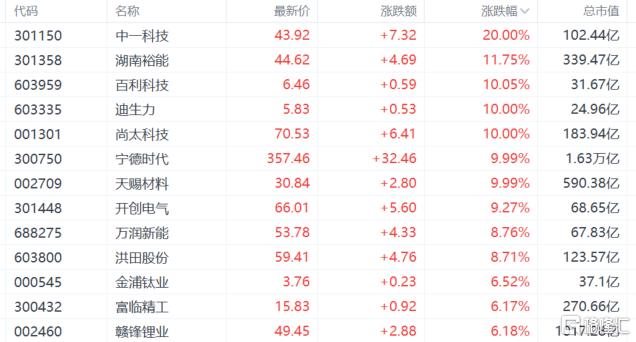
Core Viewpoint - The A-share market is experiencing a resurgence in the hard technology sector, particularly in the new energy industry chain, with significant stock price increases for key players like CATL and Ganfeng Lithium [1][11]. Group 1: Stock Performance - CATL's A-share price surged nearly 10% to 357.46 CNY, reaching a market capitalization of 1.63 trillion CNY, marking a historical high [3][10]. - Other companies such as Zhongyi Technology, Hunan YN, and Dishi Power also saw substantial gains, with Zhongyi Technology increasing by 20% to 43.92 CNY [2][3]. - The overall market sentiment is positive, with multiple stocks in the new energy sector hitting their daily price limits [1][2]. Group 2: Industry Outlook - CATL has revised its production guidance for 2026 to 1.1 TWh, indicating a growth of over 50%, driven by higher-than-expected demand [9]. - The global market share of CATL in the power battery sector is 38.1%, maintaining its leading position [10]. - The Chinese government has set ambitious targets for the automotive industry, aiming for 3.23 million total vehicle sales in 2025, with 1.55 million being new energy vehicles [12]. Group 3: Investment Sentiment - Morgan Stanley has noted that CATL's leadership position in the industry has strengthened, and its A-share valuation is now considered the cheapest in the sector [11]. - Recent policy initiatives from various government departments aim to stabilize the supply chain and promote growth in the new energy sector, further enhancing investor confidence [12][14].


创业板涨超2%,新能源产业链爆发,“宁王”大涨10%,恒科指涨1%,半导体芯片活跃,国债、商品齐涨
Sou Hu Cai Jing· 2025-09-15 02:10
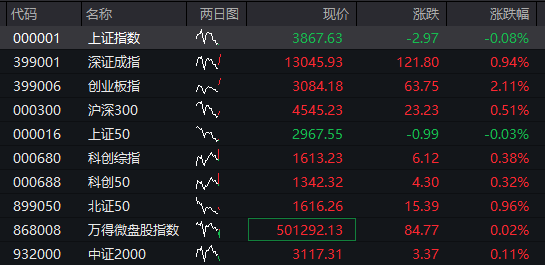
Market Overview - A-shares experienced fluctuations with the ChiNext index rising by 2.11%, driven by strong performances in solid-state batteries and energy storage sectors, particularly with CATL surging by 10.15% [1][10][15] - The Hong Kong market also saw gains, with the Hang Seng Index up by 0.20% and the Hang Seng Tech Index increasing by 1.04% [3][24] - The bond market showed a positive trend, with government bond futures rising across the board [3][4] Sector Performance - The solid-state battery and energy storage sectors witnessed significant growth, with CATL's stock price increasing by 10.15% and a trading volume exceeding 10 billion yuan [10][12] - Semiconductor stocks were notably active, with several companies like Sanan Optoelectronics and Shanghai Belling hitting their daily price limits [20][21] - The pre-made food sector also saw a surge, with companies like DeLis and Huihua Foods reaching their daily price limits [6][7] Commodity Market - Domestic commodity futures mostly rose, with coking coal and coke prices increasing by over 2% [1][27] - Lithium carbonate prices also saw a rise, reflecting the ongoing demand in the battery sector [4][27] Financing and Investment Trends - As of September 12, the financing balance on the Shanghai Stock Exchange reached 1.183985 trillion yuan, an increase of 7.544 billion yuan from the previous trading day [5]

石油巨头,2000亿投资新能源材料
DT新材料· 2025-09-14 16:05
Core Viewpoint - ExxonMobil is strategically transitioning from a traditional oil giant to a player in the renewable energy sector by acquiring the Superior Graphite battery materials plant in Hopkinsville, Kentucky, aiming for commercial production of synthetic graphite by 2029. This move reflects the broader trend of energy giants expanding into the battery materials supply chain to adapt to the changing energy structure [4][5]. Group 1: Market Demand and Supply Chain - The demand for high-performance battery materials is experiencing explosive growth due to the continuous increase in global electric vehicle (EV) sales and the rapid expansion of the energy storage market. Synthetic graphite, as a core material for lithium-ion battery anodes, significantly impacts battery performance, including charge/discharge speed, cycle life, and energy density. It is expected that synthetic graphite will account for over 30% of total graphite demand in the next five years [4][5]. - The U.S. government has implemented policies to promote the development of the domestic renewable energy supply chain, particularly in critical mineral resources, reducing reliance on foreign supplies. ExxonMobil's acquisition allows for the establishment of a stable domestic supply of synthetic graphite, enhancing its influence in the renewable energy supply chain [5]. Group 2: Technological and Strategic Developments - Synthetic graphite offers advantages such as high electrical conductivity, good cycling stability, and longer lifespan compared to natural graphite. ExxonMobil plans to utilize by-products from its refineries and proprietary materials for synthetic graphite production, which can enable faster charging, longer range, and higher cycle life, making it suitable for high-end electric vehicles and large-scale energy storage systems [5][6]. - ExxonMobil is also advancing in the lithium resource sector with its direct lithium extraction (DLE) technology in Arkansas, aiming to improve lithium resource acquisition efficiency and environmental friendliness. The company has signed a non-binding lithium supply agreement with LG Chem to supply up to 100,000 tons of lithium from its Arkansas project [5][6]. Group 3: Investment and Industry Trends - By integrating its graphite and lithium businesses, ExxonMobil aims to cover the upstream core segments of the battery materials supply chain, creating a closed-loop system from raw material extraction to high-performance anode material supply, preparing for the rapid expansion of the EV and energy storage markets. The company plans to invest $30 billion (approximately 213.6 billion RMB) in battery materials and low-carbon technologies from 2025 to 2030 [6]. - The global graphite production sector is facing dual pressures of technological upgrades and capacity expansion. ExxonMobil must navigate challenges such as technological barriers, production costs, raw material stability, and uncertainties in the global supply chain [6].

“0-1”爆发在即!资金提前布局
Ge Long Hui A P P· 2025-09-11 12:51
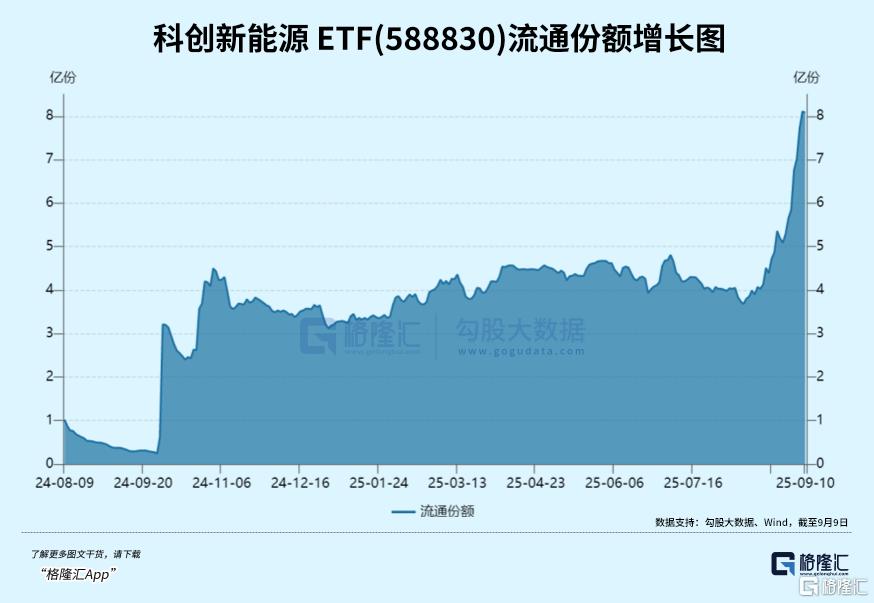
Group 1 - The A-share market has shown a strong recovery, with the Shanghai Composite Index rising by 1.65% and the ChiNext Index increasing by 5.15%, indicating renewed investor confidence after a brief adjustment [1] - Key sectors attracting significant investment include AI computing, CPO, PCB, servers, and semiconductors, which have experienced substantial price increases recently [1][2] - The new energy sector, particularly the battery and photovoltaic industries, has also performed well, with the Innovation Energy Index rising by 3.12% and the Shanghai Stock Exchange's new energy index increasing by 1.90% [2] Group 2 - The new energy sector has seen remarkable performance, with over 60 stocks in the battery industry doubling in price since April, and more than 220 stocks increasing by over 50% [3] - The Innovation Energy ETF has attracted significant capital inflow, with a net inflow of 6.61 billion yuan this year, indicating strong investor interest [3][5] - The "anti-involution" policy has positively impacted the industry, leading to significant price increases in upstream materials like polysilicon and lithium carbonate, with prices rising by 90% and over 60% respectively [5][6] Group 3 - The demand for energy storage has surged, with global battery storage installations reaching 86.7 GWh, a 54% year-on-year increase, and domestic installations growing by 120% [6][8] - The market is experiencing a "one cell hard to find" situation due to increased orders and production capacity in energy storage companies, indicating strong demand [8] - The solid-state battery industry is entering a large-scale production phase, with major companies planning to launch solid-state batteries by 2027, which is expected to accelerate the industry's growth [10][12] Group 4 - The current market conditions suggest a recovery in the new energy sector, with many leading companies still undervalued despite significant stock price increases [16] - Investment strategies should focus on core leading companies or high-quality stocks within the industry to maximize potential returns [16][17] - The Innovation Energy ETF is highlighted as a strategic investment option, focusing on key areas like photovoltaic, energy storage, and solid-state batteries, with a high concentration of solid-state battery stocks [17][19] Group 5 - The new energy sector is positioned at a critical intersection of cyclical and growth trends, with strong development momentum expected in the coming years [19][20] - The recent industry adjustments have solidified valuation foundations and enabled leading companies to achieve breakthroughs in overseas markets and high-value product development [19] - The shift from price competition to value competition within the industry is expected to enhance growth logic and sustain investor confidence in the long-term potential of the new energy sector [19]
“0-1”爆发在即!资金提前布局
格隆汇APP· 2025-09-11 12:40
Core Viewpoint - The A-share market has shown a strong recovery, with the ChiNext index returning to 3000 points, indicating renewed investor confidence in sectors with significant growth potential, particularly in AI computing and new energy industries [2][3]. Group 1: AI Computing and New Energy Sectors - The AI computing industry, including sectors like CPO, PCB, servers, and semiconductors, remains a hot investment area, with substantial recent gains despite brief corrections [2]. - The new energy sector, particularly the battery and photovoltaic industries, has also performed impressively, with many stocks in the battery chain doubling in price since April [4][6]. - The Innovation Energy ETF has seen significant inflows, with a net inflow of 661 million yuan this year, indicating strong investor interest [4]. Group 2: Policy and Market Drivers - The "anti-involution" policy initiated in June has positively impacted the new energy sector, particularly lithium and photovoltaic materials, leading to significant price increases [6][7]. - The demand for energy storage has surged, with global battery storage installations reaching 86.7 GWh, a 54% year-on-year increase, and domestic installations growing by 120% [7][9]. - The market is experiencing a "slow bull" trend, making it easier for the industry to attract investment [10]. Group 3: Solid-State Battery Developments - The solid-state battery sector is entering a phase of large-scale production, with major companies ramping up capacity and technological advancements [11][15]. - By 2027, small-scale production of solid-state batteries is expected, with significant market potential as the industry matures [17][19]. - The current growth in the new energy sector is supported by a recovery in profitability and a shift from price competition to value competition, enhancing long-term investor confidence [20][26]. Group 4: Investment Opportunities - The new energy sector is at a pivotal point, with strong growth potential driven by capacity optimization and technological advancements [25]. - Investors are encouraged to consider ETFs focused on the new energy sector, which provide exposure to leading companies while lowering entry barriers [24]. - The solid-state battery segment is highlighted as a key area for investment, with ETFs like the Innovation Energy ETF offering significant exposure to this emerging market [22][24].