
边缘计算

Search documents
移远通信(603236):动态点评:定增引入地方优质资本,助力业务高质量发展
East Money Securities· 2025-12-18 06:31
Investment Rating - The report maintains a "Buy" rating for the company, indicating a positive outlook for its stock performance relative to the market index [3][6]. Core Insights - The company has successfully raised approximately 2.23 billion yuan through a private placement of shares, which will be allocated to various projects including the expansion of vehicle-mounted and 5G module production, AI computing module industrialization, and upgrading of headquarters and R&D centers [1][6]. - The demand for 5G and vehicle-mounted modules is expected to grow significantly due to the rapid proliferation of 5G networks and the explosive growth of the smart connected vehicle industry, positioning the company to capitalize on these trends [1][6]. - The company plans to invest 9.57 billion yuan in expanding production capacity for vehicle-mounted and 5G modules, which will enhance its ability to control costs and improve production efficiency [1][6]. - The company is also focusing on AI edge computing opportunities, with plans to invest 4.11 billion yuan in AI computing modules and solutions, aiming to meet the differentiated application needs of various industries [1][6]. Financial Projections - The company is projected to achieve revenues of 25.27 billion yuan, 32.10 billion yuan, and 39.96 billion yuan for the years 2025, 2026, and 2027 respectively, with corresponding net profits of 1.05 billion yuan, 1.46 billion yuan, and 1.92 billion yuan [6][7]. - The expected earnings per share (EPS) are forecasted to be 4.0 yuan, 5.6 yuan, and 7.3 yuan for the years 2025, 2026, and 2027 respectively, reflecting a strong growth trajectory [6][7].

研判2025!中国网络附加存储(NAS)行业产业链、市场规模及重点企业分析:行业双轨转型提速,消费级市场崛起开启增长新引擎[图]
Chan Ye Xin Xi Wang· 2025-12-18 01:43
Core Insights - The Chinese Network Attached Storage (NAS) industry is transitioning from a single structure focused on the enterprise market to a dual-track structure that includes both enterprise and consumer markets. The market size is projected to reach approximately 28.64 billion yuan in 2024, reflecting a year-on-year growth of 8.28% [1][9]. Industry Overview - Disk storage technology records data using magnetic media, with major types including Direct Attached Storage (DAS), Storage Area Network (SAN), and Network Attached Storage (NAS). NAS provides centralized management, file sharing, data backup, and elastic expansion, making it ideal for unstructured data storage [3][5]. Market Size - The NAS market in China is expected to grow significantly, driven by the digital transformation of enterprises and the increasing demand from individual and family users for data management, entertainment, and privacy security. Emerging consumer brands like Ugreen and Jikong are facilitating the penetration of NAS devices into ordinary households [1][9]. Key Companies - Ugreen Technology and Hikvision are notable players in the NAS market. Ugreen has rapidly expanded its presence with products like the DXP4800 series, while Hikvision leverages its security technology to offer NAS products that combine high security and usability [10][12]. Industry Development Trends 1. **AI and Edge Computing Integration**: The NAS industry is expected to integrate AI and edge computing, transitioning from passive storage to active service. This includes features like intelligent content generation and real-time video monitoring [13]. 2. **Vertical Market Penetration**: NAS applications are moving towards vertical markets, enhancing product customization and specialized solutions for sectors like smart homes and enterprise security [14]. 3. **Ecosystem Competition and Domestic Substitution**: The competition will focus on technology, ecosystem, and service, with international brands dominating the high-end market while local companies like Ugreen and Jikong expand in the mid-to-low end [15][16].



太空数据中心首批玩家曝光
3 6 Ke· 2025-12-18 01:38
在SpaceX确认有意明年进行首次公开募股(IPO)据称寻求1.5万亿美元估值,以及马斯克强烈 支持在太空部署数据中心之后,连华尔街卖方机构也开始深入研究起了这一概念。 在SpaceX确认有意明年进行首次公开募股(IPO)据称寻求1.5万亿美元估值,以及马斯克强烈支持在太空 部署数据中心之后,连华尔街卖方机构也开始深入研究起了这一概念。 在过去一周,摩根士丹利和德意志银行仅相隔数日发布了两份几乎相同的研报。它们的核心结论是:虽 然实现该计划存在明显的技术挑战,但这些挑战更多似乎属于工程限制而非物理限制。此外,谷歌、 OpenAI和贝索斯的蓝色起源似乎都在探索实现途径,这一事实令分析师和科学家们备受鼓舞。 目前谷歌的"太阳捕手计划"正通过与Planet Labs合作,力争在2027年发射原型卫星。另据报道,OpenAI 的奥尔特曼曾考虑收购火箭公司Stoke Space,而谷歌前CEO埃里克·施密特则实际收购了Relativity Space ——部分动因正是他对太空数据中心的兴趣;蓝色起源团队也在该技术领域深耕了多年。 以下,不妨让我们深入剖析这项曾被视为天马行空的科幻构想将如何成为科学现实。为此我们摘录了德 ...
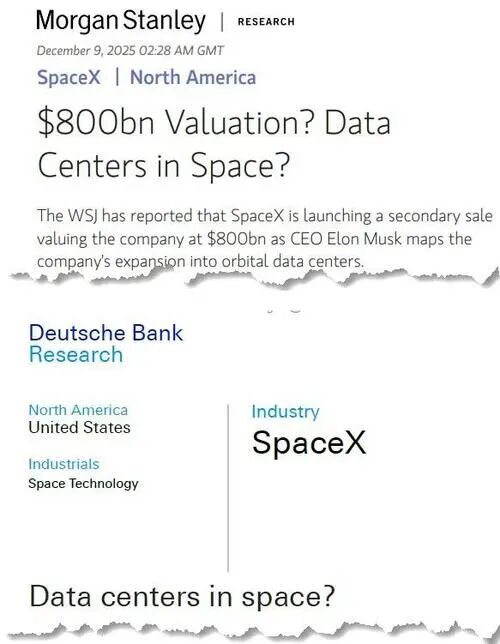
太空数据中心即将到来:如何从中获利
2025-12-17 15:50
Summary of Key Points from the Conference Call on Space Data Centers Industry Overview - The discussion centers around the emerging concept of space data centers, particularly in the context of SpaceX's plans for an IPO and a projected valuation of $1.5 trillion [1][5] - Major financial institutions like Morgan Stanley and Deutsche Bank have released reports analyzing the potential of space data centers [1][5] Core Insights and Arguments - **Technical Challenges**: The feasibility of space data centers faces engineering challenges rather than physical limitations. Companies like Google, OpenAI, and Blue Origin are exploring methods to achieve this goal [5][9] - **Energy Efficiency**: Space data centers can utilize solar energy more efficiently than ground-based data centers, potentially generating 6-8 times more energy due to higher solar intensity in space [8][12] - **Cooling Requirements**: Cooling is a significant challenge, accounting for 40% of energy consumption in data centers. In space, passive radiators must be used to dissipate heat, which requires innovative designs [12][15] - **Latency and Data Processing**: Deploying data centers in space can reduce latency significantly compared to ground-based systems, allowing for faster data processing and analysis [12][15] - **Scalability**: SpaceX currently dominates orbital mass delivery, but increased competition from other launch providers could lower costs and enhance scalability for space infrastructure [12][15] Market Potential - Deutsche Bank predicts that distributed satellite systems (DCS) will create new growth opportunities for launch and satellite manufacturing companies, with initial deployments expected around 2027-2028 [18][19] - Companies like Planet Labs, Rocket Lab, and Intuitive Machines are highlighted as potential beneficiaries of the space data center market [18][22] Notable Companies and Initiatives - **Planet Labs**: Collaborating with Google to develop prototype satellites for testing AI capabilities in space, with plans for a 2027 launch [18][22] - **Rocket Lab**: Aiming to support DCS deployment through satellite manufacturing and launch services [22] - **Intuitive Machines**: Proposed acquisition of Lanteris to enhance capabilities for high-power satellite payloads [22] - **Starcloud**: A startup focused on deploying space data centers using solar energy and passive cooling [22] - **Axiom Space**: Developing orbital data center products for commercial and national security clients, with significant funding raised [22] - **Lonestar Data Holdings**: Working on lunar and space data center infrastructure [22] Additional Considerations - **Geopolitical Concerns**: Ground-based data centers face protests and geopolitical risks, making space data centers an attractive alternative [9] - **Market Dynamics**: The success of space data centers may depend on advancements in energy production and the pace of technological innovation compared to traditional energy systems [18][19] This summary encapsulates the key points discussed in the conference call regarding the potential and challenges of space data centers, highlighting the companies involved and the market implications.
金山云上涨2.72%,报11.135美元/股,总市值33.64亿美元
Jin Rong Jie· 2025-12-16 15:19
Core Viewpoint - Kingsoft Cloud (KC) shows a positive market performance with a stock price increase and significant revenue growth, indicating strong operational capabilities and market position in the cloud service industry [1] Financial Performance - As of September 30, 2025, Kingsoft Cloud's total revenue is 6.797 billion RMB, reflecting a year-on-year growth of 22.41% [1] - The company's net profit attributable to shareholders is -0.776 billion RMB, with a year-on-year increase of 56.15% [1] Company Background - Kingsoft Cloud Holdings Limited was founded in 2012 and is recognized as a leading independent cloud service provider in China, with operations extending globally [1] - The company went public on NASDAQ in May 2020 (stock code: KC.NASDAQ) and completed a dual primary listing on the Hong Kong Stock Exchange in December 2022 (stock code: 3896.HK) [1] - Leveraging 36 years of enterprise service experience from Kingsoft Group, Kingsoft Cloud has developed a comprehensive cloud computing infrastructure and operational system [1] Service Offerings - Kingsoft Cloud provides over 150 solutions tailored for various sectors, including internet, public services, digital health, and finance, serving more than 500 high-quality clients [1]
景嘉微:AI芯片新品点亮
Xin Lang Cai Jing· 2025-12-16 14:03
12月15日,景嘉微发布公告称,公司控股子公司无锡诚恒微电子有限公司(以下简称"诚恒微")自主研发的边端侧AISoC芯片CH37系列,已顺利完成流 片、封装、回片及成功点亮等全部关键流程。经初步测试,芯片基本功能与核心性能指标均符合设计要求,标志着该高端芯片项目迈入量产前最后的优化 与测试阶段。 诚恒微CH37系列是一款基于自主研发架构的高集成度单芯片。它创新性地集成了高端CPU、GPU、NPU、GPGPU及ISP等多种高规格处理单元,专为满 足机器人、AI盒子、智能终端、无人机吊舱等复杂场景下对实时智能处理的苛刻需求而设计。 根据披露,该芯片的核心性能亮点突出: 景嘉微表示,诚恒微CH37系列的顺利点亮,是公司与诚恒微集中优势资源、协同推进核心技术自主研发与产业化落地的重要成果。这不仅将进一步丰富 公司和诚恒微的产品线与核心技术储备,更有助于拓宽产品应用场景,服务更广泛的客户领域。 在当前人工智能向边端侧加速渗透的产业浪潮下,诚恒微CH37系列的突破,被视为景嘉微深化"GPU+边端侧AISoC芯片"产品矩阵、响应国家科技自立自 强战略的关键一步。该芯片旨在为具身智能、边缘计算等前沿应用提供高能效、自主可控的 ...


景嘉微(300474):边端侧AI芯片完成点亮,通用市场转型提速
ZHONGTAI SECURITIES· 2025-12-16 13:12
Investment Rating - The report maintains an "Accumulate" rating for the company [2][5]. Core Views - The company has achieved a milestone in the smart computing chip sector with the successful development of the CH37 series AI SoC chip, which has completed various stages including tape-out, packaging, and lighting up [2][4]. - The CH37 series chip features high-performance computing capabilities, achieving a peak AI computing power of 64 TOPS@INT8, and is designed for real-time operation in complex visual recognition and decision-making models [3][4]. - The company is transitioning from a specialized market focused on military graphics to a broader general market that includes artificial intelligence and data centers, with the CH37 series being a key product in this strategic shift [4][5]. Financial Projections - The company is projected to achieve revenues of 752 million yuan in 2025, 1.105 billion yuan in 2026, and 1.553 billion yuan in 2027, reflecting significant growth rates of 61%, 47%, and 41% respectively [2][5]. - The net profit is expected to recover from a loss of 165 million yuan in 2024 to a profit of 14 million yuan in 2025, and further increase to 90 million yuan in 2026 and 211 million yuan in 2027 [2][5]. - The report highlights a significant increase in R&D investment, with R&D expense ratios projected at 60.2% for 2024 and 46.8% for the first three quarters of 2025, indicating a strong commitment to innovation [5]. Market Position and Strategy - The CH37 series is positioned to meet the high computing demands of embodied intelligence and edge computing markets, applicable in various scenarios such as robotics, AI boxes, smart terminals, and drones [3][4]. - The company aims to leverage its high-performance chip capabilities to expand into new markets, including smart cities and industrial vision applications [3][4]. - The strategic transformation is expected to lead to a reversal of the company's previous operational challenges, with the successful launch of the CH37 series laying the groundwork for future testing and mass production [5].
景嘉微(300474) - 300474景嘉微投资者关系管理信息20251216
2025-12-16 09:18
证券代码:300474 证券简称:景嘉微 编号:2025-007 1、诚恒微边端侧 AI SoC 芯片 CH37 系列有哪些特点? 长沙景嘉微电子股份有限公司 投资者关系活动记录表 | □ | 特定对象调研 分析师会议 | □ | | --- | --- | --- | | □ 投资者关系活动 | 媒体采访 业绩说明会 | □ | | □ | 新闻发布会 路演活动 | □ | | 类别 □ | 现场参观 | | | □√ | 其他 电话会议 | | | 参与单位名称及 | 中泰证券、华创证券、浙商证券、东北证券、华西证券、国信证 | | | | 券、中金公司、汇添富基金、南方基金、易方达基金、混沌投资、 | | | | 富国基金、东吴基金、新华基金、兴证全球、申万菱信、银华基 | | | | 金、鹏华基金、景顺长城、天弘基金、诺德基金、华夏财富、创 | | | 人员姓名 | 金合信、太平养老保险、太平资产、泰康人寿、华宝基金、中金 | | | | 资管、民生加银、中信保诚、永安国富、富荣基金、方圆基金、 | | | | 国投瑞银、国寿资产、高毅资产等 106 家机构共 132 位投资者。 | | | | (排 ...
大摩重磅机器人年鉴(二):机器人"逃离工厂",训练重点从“大脑”转向“身体”,边缘算力有望爆发
华尔街见闻· 2025-12-16 04:49
Core Insights - The article highlights a significant shift in the robotics industry, driven by artificial intelligence, moving from traditional factory settings to broader applications in homes, cities, and even space. This transition emphasizes the need for physical manipulation capabilities over cognitive abilities, which is expected to lead to a surge in demand for edge computing [1][2]. Group 1: Key Transformations in Robotics - The report identifies two major transformations in the global robotics industry: the escape of robots from structured factory environments to unstructured settings like homes and cities, and a shift in training focus from AI "brains" (general models) to "bodies" (physical action control) [1][3]. - Traditional industrial robots were limited to repetitive tasks in controlled environments, while AI-enabled robots are now capable of navigating complex real-world scenarios, such as autonomous vehicles in traffic and service robots in homes [3]. Group 2: Challenges in Physical Interaction - The article uses the example of "grabbing a bottle from the fridge" to illustrate the complexities of physical interactions, which involve multiple variables such as precise finger positioning, body balance, grip strength, and environmental factors [6]. - Robots must develop real-time perception, dynamic decision-making, and fine motor control capabilities, moving beyond reliance on pre-programmed instructions [7]. Group 3: Data Collection for Training - Unlike large language models that primarily use text and image data, robotic models require extensive real-world physical operation data, making data collection and model training more complex and costly [9]. - Major tech companies like Tesla, NVIDIA, and Google are employing three main methods to gather training data: teleoperation, simulation, and video learning [11]. Group 4: Edge Computing Demand - As robots transition from factories, the latency issues of centralized cloud computing become apparent, making edge computing a necessity. The report outlines two trends in edge computing: the proliferation of specialized edge chips and distributed inference networks [19][22]. - NVIDIA's Jetson Thor is highlighted as a representative edge real-time inference device, priced around $3,500, which has been adopted by companies like Boston Dynamics and Amazon Robotics for its high computational power at low energy consumption [19]. - Tesla's concept of "robots as computing nodes" suggests that deploying 100 million robots with 2,500 TFLOPS of computing power could provide a total of 125,000 ExaFLOPS, equivalent to 7 million NVIDIA B200 GPUs, enhancing overall efficiency through collaboration among robots [22]. Group 5: Future Projections - Morgan Stanley predicts that by 2030, global demand for edge computing in robotics will significantly increase, with various forms of robots contributing to substantial computational needs. By 2050, it is estimated that 1.4 billion robots will be sold globally, driving edge AI computing demand to the equivalent of millions of B200 chips [25].

OpenAI前CTO再创业,新产品接入Kimi K2 Thinking;谷歌NotebookLM集成至Gemini丨AIGC日报
创业邦· 2025-12-16 00:07
Group 1 - SenseTime launched Seko 2.0, the industry's first multi-episode generative AI model, which is based on its self-developed Seko series model. The model has successfully adapted to the domestic AI chip Cambricon, with a strategic cooperation established in October to optimize software and hardware integration [2] - Former OpenAI CTO Mira Murat has founded Thinking Machines Lab, with the latest product Tinker now valued at $50 billion. The product features the trillion-parameter Kimi K2 Thinking model, designed for long-duration reasoning and tool invocation [2] - Mill Electronics introduced the RK3576 AI edge computing box, which offers high computing power, low power consumption, and strong scalability, becoming a key tool for upgrading industrial vision, engineering machinery, and smart city sectors [2] Group 2 - Google integrated NotebookLM into Gemini, enhancing user interaction by allowing users to attach notes for additional context during conversations with AI chatbots [2]


