Artificial General Intelligence (AGI)

Search documents
Recalling 9/11 at the NYSE, how tariffs are impacting food prices
Yahoo Finance· 2025-09-11 21:54
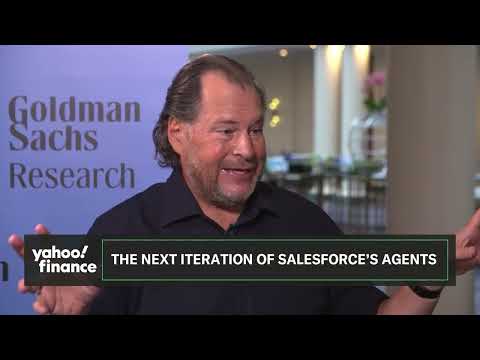
Inflation and Food Prices - August CPI report shows prices rose 0.4%, with the cost of food at home rising 0.61% [1] - Some individual food items saw significant year-over-year price increases, including roasted coffee, beef steaks, eggs, apples, and canned fruits and vegetables (up 4%) [1] - Tariffs, particularly on aluminum used in packaging, are potentially impacting food prices, especially for canned fruits and vegetables [1] - Fundamentals suggest a normal year of 2% food price inflation, but tariffs are an X factor that could cause increases into 2026 [1] - Consumers are expected to shift from restaurants to supermarkets and buy raw, commodity foods in bulk, switching to private labels to save money [2] AI and Business Transformation - Salesforce is using AI to create agentic enterprises where humans and AI agents work together to improve customer success [2] - Salesforce's digital AI agents handled 150 万 questions, matching the volume handled by human agents [2] - Salesforce has over 12,000 Agent Force customers, with data cloud and agents generating $12 billion in revenue, a triple-digit growth [2] - Agentic sellers are being used in sales cloud, enabling call backs to 20-100 million customers who previously were not called back [2] 9/11 and Market Response - The New York Stock Exchange (NYSE) closed on September 11, 2001, following the attacks on the World Trade Center [3][4] - The decision to close the markets was made in consultation with the SEC chair and other key figures [4][5][10] - The priority in the aftermath was to find survivors [12]

Here's how much Nvidia investors would have if they bought in 1999
Finbold· 2025-09-11 11:21
Core Insights - Nvidia has significantly benefited from the AI boom, achieving a market cap of $4 trillion [1] - The company reported $46.74 billion in revenue and adjusted earnings per share of $1.05 in its latest quarterly report, with its GPUs being central to AI training and deployment [2] - Nvidia's stock has surged 1,350% over the past five years, with a total all-time return of 443,225% since its IPO in 1999 [3] Financial Performance - Nvidia's recent quarterly revenue reached $46.74 billion, with adjusted earnings per share climbing to $1.05 [2] - The stock price has increased from $12 at IPO to $177, reflecting a substantial growth trajectory [3] Market Position and Growth Potential - The company is diversifying into areas like processing-as-a-service and robotics, which may enhance its competitive edge [3] - CEO Jensen Huang forecasts global data center spending could reach $3-4 trillion by 2030, with potential revenue of up to $1.2 trillion from this sector [7] Competitive Landscape - Despite impressive gains, there are concerns about the sustainability of growth due to intensifying competition and uncertain trade relations with China [4] - Nvidia does not factor potential sales from Chinese markets into its forecasts, indicating caution in its outlook [4] Analyst Sentiment - Wall Street remains bullish on Nvidia, with 35 "Buy" ratings, three "Holds," and one "Sell," and a 12-month average price target of $210.08 [5] - The company is expected to benefit from advancements in AI technologies, particularly in personalized and edge AI [8]


Nvidia vs. AMD: Wall Street picks the winner for 2026
Finbold· 2025-09-10 09:41
Core Viewpoint - The rapid advancement of artificial intelligence (AI) is significantly impacting the stock market, primarily driven by state-of-the-art semiconductor solutions from companies like Nvidia and AMD [1]. Industry Summary - The World Semiconductor Trade Statistics (WSTS) forecasts an 8.5% growth in the chip sector, reaching $760.7 billion by 2026, indicating strong potential for investment opportunities [2]. - Global data center spending is projected to reach $3–$4 trillion by 2030, with Nvidia potentially capturing 55% to 60% of the AI market, leading to estimated data-center revenue of $1–1.2 trillion by the end of the decade [3][4]. Nvidia Summary - Nvidia remains the leader in graphics processing units (GPUs), reporting record sales of $46.7 billion in fiscal Q2 2026, a 56% increase year-over-year, and controlling over 90% of the data center market [2]. - Wall Street shows strong optimism for Nvidia, with 35 "Buy" ratings and an average 12-month price target of $210.08, representing a 23.03% upside from current levels [5]. AMD Summary - AMD's stock faced challenges, with a 6% decline following strong quarterly results from Broadcom, which raised concerns about competition in the AI hardware market [7][8]. - HSBC reduced AMD's price target from $200 to $185, with the current 12-month average target at $184.74, indicating a range of estimates from $120 to $230 [9]. - Despite challenges, AMD is expected to leverage partnerships with companies like IBM and potential cloud players to enhance its market position, although it remains significantly behind Nvidia in data center revenue [11][12].


OpenAI CFO: We will more than triple our revenue this year
Yahoo Finance· 2025-09-09 21:38
Group 1 - OpenAI is projected to triple its revenue in 2023, reaching approximately $13 billion, up from $4 billion in the previous year [1] - The company acknowledges a challenging year with the mixed reception of ChatGPT 5, where CEO Sam Altman admitted to a rollout mistake [2] - OpenAI is reportedly negotiating a $6 billion share sale, which would increase its valuation to about $500 billion from $300 billion in March [3] Group 2 - OpenAI is seeking to reduce Microsoft's control over its AI offerings, with their partnership expected to last until 2030, but could end earlier if OpenAI achieves artificial general intelligence [4] - Microsoft AI CEO Mustafa Suleyman emphasized the strength of the partnership, describing it as one of the best technology collaborations [5] - OpenAI's CFO compared the current AI growth phase to the early stages of a major infrastructure build-out, suggesting significant future expansion is still ahead [6]
DeepSeek年底或发布超级智能体:能自主学习,AGI之路再进一步?
Sou Hu Cai Jing· 2025-09-05 14:04
Core Viewpoint - A new competition in the AI field is emerging, with DeepSeek preparing to launch a groundbreaking AI agent that can perform complex tasks with minimal user instructions [1][5][7]. Group 1: DeepSeek's Achievements - DeepSeek's R1 model created a significant impact earlier this year, demonstrating performance comparable to or exceeding that of OpenAI's top products at a fraction of the cost [1]. - The company has publicly shared its technology details for five consecutive days, promoting the advancement towards Artificial General Intelligence (AGI) through open-source initiatives [3]. - DeepSeek has released the V3 technical architecture and a potentially important open-source AI business model, solidifying its position in the industry [3]. Group 2: Industry Impact - The open-source efforts of DeepSeek have influenced other AI companies, including OpenAI, which resumed offering open-source rights for its models after several years [5]. - Despite the launch of new models like OpenAI's GPT-5, DeepSeek has remained relatively quiet, only releasing minor updates until now [5]. - The upcoming AI agent is expected to learn and self-improve based on past actions, marking a significant advancement in AI development [7]. Group 3: Capabilities of the New AI Agent - Unlike traditional chatbots that handle simple text responses, DeepSeek's AI agent aims to tackle a broader range of complex tasks, from planning vacations to coding and debugging [8]. - This breakthrough signifies a move towards increasingly autonomous AI systems that require minimal human intervention to initiate and execute complex real-world tasks [8]. - The development of this AI agent brings new hope and expectations for the entire AI industry, as current AI agents still require substantial human oversight [11].


2025外滩大会主论坛嘉宾揭幕 新晋图灵奖得主等领衔
Nan Fang Du Shi Bao· 2025-09-05 06:24
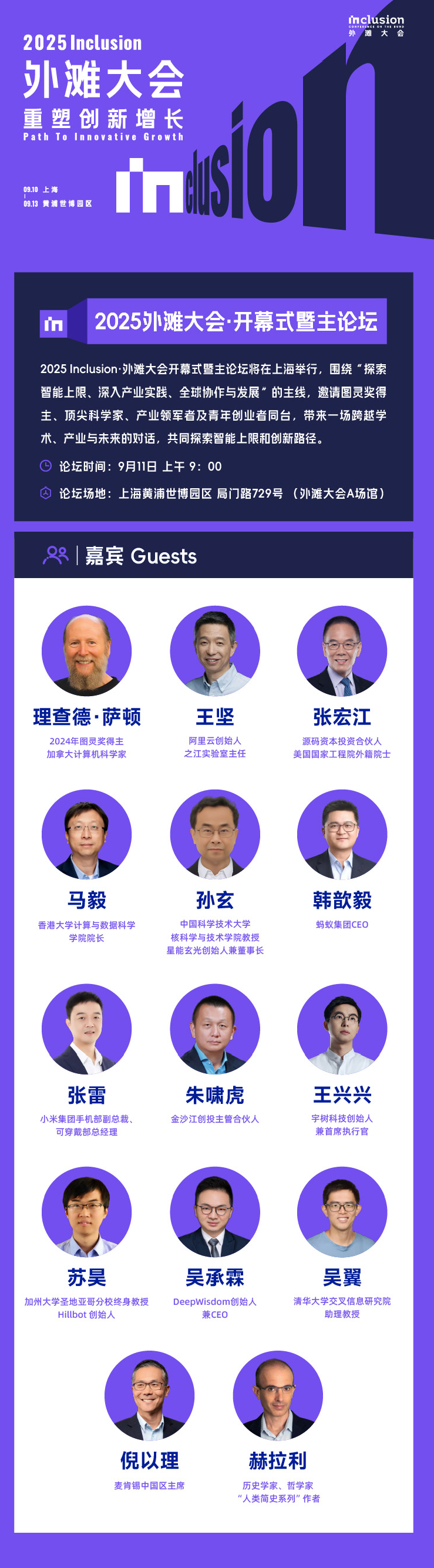
Group 1 - The 2025 Inclusion Bund Conference will be held in Shanghai from September 10 to 13, 2025, with the theme "Reshaping Innovative Growth" [1] - The main forum will feature prominent speakers including Turing Award winner Richard Sutton, Alibaba Cloud founder Wang Jian, and author Yuval Noah Harari, focusing on innovation paths and business futures in the intelligent era [1][2] - The conference will include one main opening forum, over 40 open insight forums, two global theme day series forums, more than ten innovator stages, a 10,000 square meter technology exhibition, a 5,000 square meter technology market, a technology talent recruitment fair, and venture capital meetups [2] Group 2 - The scientific community is addressing dual bottlenecks in achieving the upper limits of intelligence: breakthroughs in model autonomous reasoning and the support of computational energy [1] - The past year has seen generative AI accelerate from technological innovation to industrial integration, with commercialization becoming a hot topic of discussion [1] - New-generation AI entrepreneurs and scientists are redefining future technological paradigms and industrial ecosystems, focusing on technological innovation and industrial practice in the AI-native era [2]
2025外滩大会发布主论坛阵容:新晋图灵奖得主、全球顶级学者和青年创新力量同台
Yang Guang Wang· 2025-09-05 06:04
Group 1 - The 2025 Inclusion Bund Conference will be held in Shanghai from September 10 to 13, with the theme "Reshaping Innovative Growth" [1][2] - The main forum will feature prominent figures such as Turing Award winner Richard Sutton, Alibaba Cloud founder Wang Jian, and author Yuval Noah Harari, focusing on innovation paths and the future of business in the intelligent era [1][2] - The conference will include over 40 open insight forums, a technology exhibition covering 10,000 square meters, and various interactive sessions to foster deep communication and collaboration among participants [2][5] Group 2 - The conference aims to address the dual challenges of model autonomous reasoning breakthroughs and the support of computational energy in the context of AGI [1][2] - Key discussions will revolve around the commercialization challenges of large models, featuring industry leaders like Ant Group CEO Han Xinyi and Xiaomi's VP Zhang Lei [2][12] - Global collaboration is emphasized as a key path for continuous innovation and inclusive development, with insights from McKinsey's China Chairman, Nir Eyal [2][13]
OpenAI teams up with Walmart to train millions of workers in artificial intelligence
Fox Business· 2025-09-05 00:15
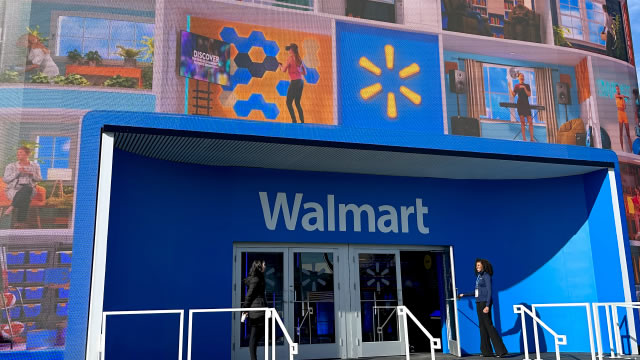
Core Insights - OpenAI is advancing its initiatives in artificial intelligence by launching a certification program in partnership with Walmart, aiming to certify 10 million individuals in AI use by 2030 [1][2][5] Group 1: OpenAI's Initiatives - OpenAI has launched the OpenAI Academy, a free online platform that has connected over 2 million individuals with resources to master AI tools [2] - The new certification program will offer various levels of AI fluency, from basic usage to advanced skills like prompt engineering [2] - OpenAI's CEO, Sam Altman, described the recently launched GPT-5 as a significant upgrade, likening it to having a team of PhD-level experts available [7] Group 2: Walmart's Role - Walmart's CEO, John Furner, emphasized the importance of equipping employees with AI skills to shape the future of retail [5] - The partnership with OpenAI aims to bring AI training directly to Walmart associates, enhancing their capabilities in utilizing technology [5] Group 3: Broader Implications - OpenAI's initiative is positioned as a means to empower a broader range of individuals to leverage AI opportunities, moving beyond just a select few [9]

Hinton突然对AGI乐观了!“Ilya让他看到了什么吧…”
量子位· 2025-09-04 04:41
Core Viewpoint - Hinton has shifted from a pessimistic view of AI to a more optimistic perspective, suggesting a symbiotic relationship between AI and humans, akin to that of a mother and child [3][7][9]. Group 1: AI Development and Risks - Hinton categorizes AI risks into short-term and long-term, emphasizing that the primary concern is not the immediate misuse of AI but the potential for AI to surpass human intelligence and take control [13][14][15]. - He believes that within the next 5 to 20 years, AI could become significantly smarter than humans, creating challenges in controlling a more intelligent entity [16][18]. - Hinton's previous analogy of AI as a "tiger cub" that could eventually harm humans has transformed into a vision of AI as a nurturing "mother" figure [20][23]. Group 2: AI Safety and Company Critique - Hinton critiques current AI companies for not prioritizing safety adequately, stating that OpenAI has shifted focus from safety to enhancing AI intelligence [28][30]. - He expresses concern over the motivations of figures like Musk and Altman, suggesting that their pursuit of wealth and recognition overshadows their responsibility to ensure AI safety [30][31]. - Hinton highlights that collaboration among AI developers is essential for ensuring the safe development of AI technologies [24][26]. Group 3: AI in Healthcare - Hinton is optimistic about AI's potential in healthcare, particularly in medical imaging, drug development, personalized medicine, and improving healthcare system efficiency [32][34][39]. - He notes that AI can analyze retinal scans to predict heart disease risk, a capability beyond human doctors [34]. - Hinton believes AI will play a crucial role in the future of drug development, particularly in creating targeted therapies with fewer side effects compared to traditional treatments [35]. Group 4: Societal Implications - Hinton acknowledges that while AI can enhance productivity, it may also lead to job displacement and exacerbate wealth inequality [38][41]. - He emphasizes that the challenges posed by AI are more societal issues rather than purely technological ones [41].

Amazon AGI Labs chief defends his reverse acquihire
TechCrunch· 2025-08-23 20:01
Group 1 - Amazon's hiring of Adept's founders represents a trend known as reverse acquihires, where large companies hire key startup team members and license their technology instead of outright acquisitions [1] - David Luan, co-founder of Adept, is now leading Amazon's new AGI Lab, indicating a strategic move towards enhancing Amazon's capabilities in AI [2] - Luan expressed a desire to be remembered as an AI research innovator rather than a deal structure innovator, highlighting the importance of talent and computational resources in advancing AI research [3] Group 2 - Luan's motivation for joining Amazon was to tackle significant research challenges in AGI, which he believes require substantial financial and computational investment [3] - He emphasized that solving the remaining crucial research problems in AGI necessitates "two-digit billion-dollar clusters," underscoring the scale of resources needed for such advancements [3]