
大模型技术

Search documents
数字政通发布“人和大模型2.0”行业智能体
Zheng Quan Ri Bao Zhi Sheng· 2025-11-02 09:37
Core Insights - The release of "Renhe Large Model 2.0" industry AI agent marks a significant advancement for the company, transitioning from pilot applications of AI technology to a comprehensive promotion of "governance productivity" in smart city management [1][3] - The new AI agent integrates data, algorithms, and applications, facilitating a paradigm shift from mouse operations to natural language interactions across various business systems [2] Industry Applications - The "Renhe Large Model 2.0" AI agent is designed to address core business challenges in five major industry scenarios, including efficient regulation of construction waste, a new model for law enforcement supervision, proactive safety systems for urban infrastructure, intelligent applications for government hotlines, and low-altitude governance initiatives [2] - The AI agent has already been implemented in multiple cities, including Beijing, Shenzhen, Tianjin, Fujian, Chongqing, and Nanjing, showcasing its capability to transform creative potential into tangible governance productivity [2] Strategic Partnerships - The company has partnered with leading industry players such as Huawei, Baidu, and Hikvision to launch four deeply integrated joint solutions, indicating a new phase in smart city ecosystem collaboration [2] Business Model and Revenue Potential - The introduction of the government AI agent is expected to enhance the company's business model by providing continuous AI computing power, model optimization, and operational services, potentially leading to more stable and sustainable subscription revenue [3] - This development is anticipated to improve the company's profitability and market value, positioning it to capture a larger market share in the smart city sector [3]

诚邀体验 | 中金点睛数字化投研平台
中金点睛· 2025-11-02 01:03
Core Viewpoint - The article emphasizes the establishment of a digital research platform by CICC, aiming to provide efficient, professional, and accurate research services by integrating insights from over 30 specialized teams and covering more than 1800 individual stocks [1]. Group 1: Research Services - CICC's digital research platform, "CICC Insight," offers a one-stop service that includes research reports, conference activities, fundamental databases, and research frameworks [1]. - The platform features daily updates on research focuses and timely article selections, enhancing the accessibility of market insights [4]. - It provides over 3,000 complete research reports covering macroeconomics, industry research, and commodities [9]. Group 2: Data and Frameworks - The platform includes more than 160 industry research frameworks and over 40 premium databases, facilitating comprehensive industry data analysis [10]. - CICC Insight incorporates advanced AI search capabilities, allowing users to filter key points and engage in intelligent Q&A [10].


硅谷大厂纷纷倒戈,中国大模型成为新宠!是什么原因?
Sou Hu Cai Jing· 2025-10-31 20:08
Core Insights - Chinese large model technology has suddenly become favored by Silicon Valley tech giants, including Google, Amazon, and Facebook, due to its superior performance in natural language processing [1][3] Group 1: Performance and Innovation - The GLM-4 model from China excels in handling complex language tasks, providing accurate translation and text generation capabilities [1] - Breakthroughs in algorithm innovation and training efficiency by Chinese research teams have significantly improved model training processes, enhancing both quality and efficiency [3] Group 2: Cost-Effectiveness - Chinese large models offer substantial cost advantages, reducing operational costs while maintaining performance, making them particularly attractive to budget-constrained Silicon Valley startups [3] Group 3: Future Implications - The collective shift of Silicon Valley giants towards Chinese large models indicates a stronger future collaboration in the global AI field, potentially leading to innovative synergies between Chinese technology and Silicon Valley's innovative spirit [5] - The influence of Chinese large models is expected to expand into more areas, reshaping the global AI landscape [5]

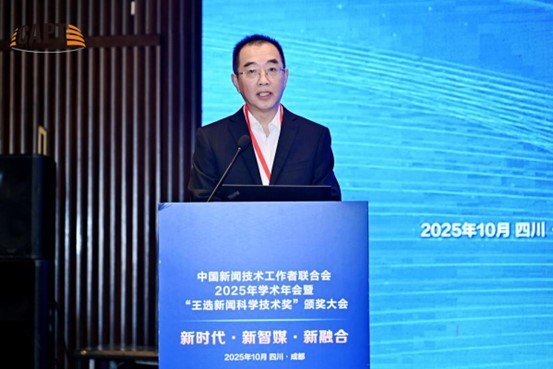
探路“智媒融合”:这场学术年会 为主流媒体系统性变革开拓“AI 赋能”新思路
Mei Ri Jing Ji Xin Wen· 2025-10-31 16:23
Core Insights - The integration of artificial intelligence (AI) into the media industry is a key driver for systemic transformation and innovation in content production and dissemination [1][3] - The 2025 Academic Annual Conference of the China News Technology Workers Association served as a platform for discussing the deep integration of AI with mainstream media [1][3] Group 1: AI and Media Transformation - AI-generated content (AIGC) is recognized as one of the most mature applications of technology in the media sector, facilitating significant changes across various media processes [1] - The conference highlighted the need for mainstream media to evolve from mere tool innovation to a comprehensive ecological reconstruction [3] Group 2: Technological Contributions - Satellite communication is identified as a core enabler for new and intelligent media, enhancing capabilities in news collection, transmission, and distribution [6] - The development of large model technologies is transitioning from technical exploration to engineering innovation, focusing on practical applications in media [7] Group 3: Industry Standards and Recognition - The conference introduced five new group standards, including "Intelligent Entities in the News Industry," aimed at filling gaps in standardization and fostering innovative business models [8] - The 2025 Wang Xuan News Science and Technology Award recognized 181 outstanding projects, reflecting a significant increase in submissions and showcasing high standards in technological innovation within the industry [8][10] Group 4: Practical Applications and Future Directions - The integration of AI in media practices is being explored through specific applications, such as engaging in the sports economy to enhance media value and data accumulation [7] - The Chengdu Media Group's intelligent media asset library project, which utilizes big data, blockchain, and AI, exemplifies the industry's move towards intelligent content management systems [10]
数字政通:公司发布新产品
Zheng Quan Ri Bao Wang· 2025-10-31 14:16
Group 1 - The core announcement is about the upcoming event titled "Zhengtong Renhe, Baiye Juxing - 'Renhe Large Model 2.0' Industry Intelligent Agent Release Conference" scheduled for October 30, 2025 [1] - The focus of the conference will be on the integration and practical application of large model technology in smart city governance [1]
数字政通(300075.SZ):“人和大模型2.0”行业智能体发布
Ge Long Hui A P P· 2025-10-31 10:41
Core Viewpoint - The release of "Renhe Large Model 2.0" industry intelligent agent marks a significant milestone for the company, showcasing the integration of AI technology in smart city governance and the transition from pilot demonstrations to widespread application of "governance productivity" [1][2] Group 1: Product Launch and Technology Integration - The "Renhe Large Model 2.0" focuses on the deep integration of large model technology in smart city governance, indicating a technological upgrade and a shift in governance logic [1] - The new product is based on the company's extensive experience in urban governance, combining data resources with cutting-edge large model technology to drive business model innovation [2] Group 2: Business Model Transformation - The company is transitioning from a traditional "project-based" software provider to a "platform + operation" service provider, with the AI agent as a core product [2] - The AI agent is expected to provide stable and sustainable subscription revenue, enhancing the company's profitability and market value [2] Group 3: Collaboration and Ecosystem Development - The company has partnered with several industry leaders to launch four joint solutions that integrate "Renhe Large Model 2.0" with partner products, marking a new phase in the smart city ecosystem collaboration [2] - The application scenarios of "Renhe Large Model 2.0" align closely with the guidelines issued by the Central Cyberspace Affairs Commission and the National Development and Reform Commission, indicating a strategic fit with national policies [1]
数字政通:“人和大模型2.0”行业智能体发布
Ge Long Hui· 2025-10-31 10:32
Core Viewpoint - The release of "Renhe Large Model 2.0" industry intelligent agent marks a significant milestone for the company, showcasing the integration of AI technology in smart city governance and the transition from pilot demonstrations to widespread application of "governance productivity" [1][2] Group 1: Product Launch and Technology Integration - The "Renhe Large Model 2.0" focuses on the deep integration of large model technology in smart city governance, indicating a technological upgrade and a shift in urban governance concepts [1] - The new product is based on the company's extensive experience in urban governance, combining data resources with cutting-edge large model technology to drive business model innovation [2] Group 2: Business Model Transformation - The company is transitioning from a traditional "project-based" software provider to a "platform + operation" service provider, with the AI agent as a core product [2] - The AI agent is expected to provide stable and sustainable subscription revenue, enhancing the company's profitability and market value [2] Group 3: Collaboration and Ecosystem Development - The company has partnered with several industry leaders to launch four joint solutions that integrate "Renhe Large Model 2.0" with partner products, marking a new phase in the smart city ecosystem collaboration [2] - The application scenarios of "Renhe Large Model 2.0" align closely with the guidelines issued by the Central Cyberspace Affairs Commission and the National Development and Reform Commission, indicating a strategic fit with national policies [1]
报告:大模型一体机爆发 对应市场从千亿级别扩张
Zhong Guo Xin Wen Wang· 2025-10-31 10:00
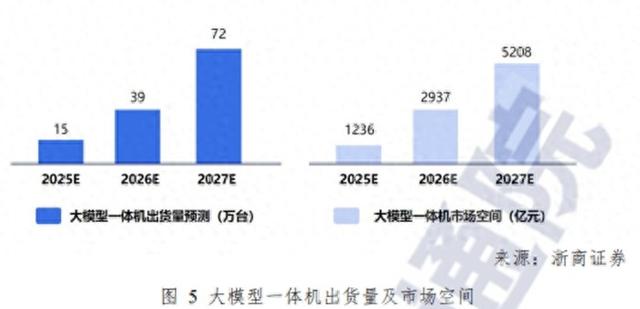
Core Insights - The market for large model integrated machines is expected to experience explosive growth from 2024 to 2025, with rapid market expansion anticipated [1][3] - The demand for large model integrated machines is projected to reach 150,000 units in 2025, 390,000 units in 2026, and 720,000 units in 2027, with the market size expected to exceed 500 billion RMB by 2027 [3][4] - The current industry landscape shows that 34% of companies have launched only inference integrated machines, while 17% have launched only training integrated machines, and 48.9% have launched both types [3][4] Industry Trends - The primary focus of the industry is on inference integrated machines, as many companies prefer to utilize existing models for application development rather than training their own [3][4] - There is a growing demand for specialized devices that integrate industry knowledge and optimize workflows, moving away from generic solutions [3][4] - The market is trending towards industry-specific integrated machines, with 21.3% of companies offering general-purpose machines and 31.9% offering industry-specific machines [4] Challenges and Opportunities - The industry faces challenges such as weak independent innovation capabilities, difficulties in adapting to application scenarios, and the need for improved security and privacy mechanisms [4][5] - Large model integrated machines are seen as a crucial breakthrough for democratizing large model technology and supporting the "Artificial Intelligence +" initiative [5]
隆盛科技(300680.SZ):自研整机 “兰森” 机器人已迭代至二代
Ge Long Hui· 2025-10-31 07:56
Core Viewpoint - Longsheng Technology (300680.SZ) has announced the second generation of its self-developed "Lansen" robot, which integrates advanced technologies to address key challenges in heavy-duty grasping, defect detection, and flexible handling [1] Group 1: Product Development - The "Lansen II" robot has evolved from executing fixed action commands to utilizing a large model for intelligent judgment and optimized execution [1] - The robot's operational precision and collaborative capabilities have significantly improved, allowing for precise positioning and grasping of randomly located objects [1] Group 2: Technological Integration - The core technology matrix of the robot includes a "dexterous hand," a manufacturing scene large model, and electronic skin [1] - The development focuses on quality inspection of motor core rotors driven by Longsheng New Energy, indicating a deep integration with existing business operations [1]


中昊芯英“刹那®”TPU AI芯片适配百度文心开源大模型ERNIE-4.5-VL,加速多模态运算
Sou Hu Wang· 2025-10-31 02:37
Core Insights - The core viewpoint of the news is that Zhonghao Xinying's "Shanai®" TPU architecture AI chip has successfully adapted to Baidu's open-source multimodal mixture of experts model ERNIE-4.5-VL-28B-A3B, demonstrating the efficiency of domestic TPU architecture in supporting cutting-edge models and establishing a new ecosystem paradigm of "domestic innovative chip architecture + domestic open-source large models" [1][2]. Company Overview - Zhonghao Xinying was established in 2018 by Yang Gongyifan, a core developer of Google's TPU chip, along with a team of AI hardware and software design experts from major tech companies like Google, Microsoft, and Samsung. The company has a comprehensive methodology for chip design and optimization across various process technologies from 28nm to 7nm, with over 70% of its workforce dedicated to R&D [1]. Product Performance - The "Shanai®" TPU architecture AI chip, after nearly five years of development, features fully controllable IP cores, self-developed instruction sets, and computing platforms. It surpasses renowned overseas GPU products by nearly 1.5 times in AI large model computing scenarios while reducing energy consumption by 30%. The chip employs Chiplet technology and 2.5D packaging to achieve performance leaps under the same process technology, supporting interconnection of 1024 chips for linear scaling in large model computations [1]. Model Adaptation - The ERNIE-4.5-VL model, which has a total parameter count of 28 billion and an active parameter count of 3 billion, utilizes a heterogeneous mixture of experts (MoE) architecture. It excels in cross-modal understanding and generation, as well as long text processing, making it suitable for various applications such as intelligent navigation and visual customer service [2]. Technical Integration - The integration of Zhonghao Xinying's "Shanai®" TPU AI chip with the ERNIE-4.5-VL model showcases enhanced parallel processing capabilities, improving computation speed and accuracy for complex tasks. The chip's reconfigurable multi-level storage and near-memory computing design effectively support the model's performance in handling multimodal data [3]. Application and Development - The technology team at Zhonghao Xinying has successfully executed multiple complex multimodal tasks using the "Shanai®" TPU AI chip, demonstrating its capability to provide stable and powerful computational support for large models. The chip meets the demands of both large-scale model training and real-time inference tasks, further optimized through close collaboration with Baidu's PaddlePaddle framework [4]. Future Directions - Yang Gongyifan, the founder and CEO of Zhonghao Xinying, stated that the successful adaptation validates the feasibility of collaborative innovation between domestic computing power and models. The company plans to deepen its technical collaboration with Baidu to implement hardware acceleration solutions for a full range of models from 3 billion to 424 billion parameters, aiming to provide more efficient and reliable domestic AI infrastructure [4].
