Deflation

Search documents
摩根士丹利:中国股票策略-反内卷信息提振 A 股市场情绪
摩根· 2025-07-11 02:22
Investment Rating - The report indicates a preference for A-shares over offshore markets due to their lagging performance year-to-date and more reasonable valuations compared to offshore markets [12]. Core Insights - Investor sentiment for A-shares has improved, with the weighted Morgan Stanley A-share Sentiment Indicator (MSASI) rising to 78% and the simple MSASI to 65% [2][6]. - The Chinese government has intensified its anti-involution message to address overcapacity issues in sectors like solar, lithium batteries, new energy vehicles, and e-commerce [4]. - Despite the positive sentiment, near-term volatility is expected to rise, and the report cautions against a beta-focused strategy in the offshore market [12]. Summary by Sections Investor Sentiment - A-share investor sentiment improved with the weighted MSASI increasing by 7 percentage points to 78% and the simple MSASI rising by 8 percentage points to 65% compared to the previous cutoff date [2]. - Average daily turnover for ChiNext and A-shares decreased by 11% and 7% respectively, while equity futures and Northbound turnover increased by 7% and 9% [2]. Market Inflows - Southbound markets experienced net inflows of US$2.7 billion from July 2 to July 9, with year-to-date and month-to-date net inflows reaching US$95.8 billion and US$0.5 billion respectively [3]. Economic Indicators - The Producer Price Index (PPI) showed a deflation of -0.4% month-over-month in June, driven by weak construction activities and tariff impacts, while the Consumer Price Index (CPI) rose to 0.1% year-over-year from -0.1% in May [5]. Policy Implications - The report emphasizes the need for a tailored approach to the anti-involution initiative, as different sectors have varying competitive landscapes, ESG considerations, and market sizes [4]. - The implementation of policies to rebalance and reflation the economy remains challenging due to institutional inertia [5].
高盛:中国 6 月 PPI 通缩;下调 2025 - 2026 年 PPI 预测;6 月贸易数据预览
Goldman Sachs· 2025-07-11 01:05
Investment Rating - The report does not explicitly provide an investment rating for the industry Core Insights - China's headline CPI inflation increased to +0.1% year-over-year (yoy) in June from -0.1% yoy in May, driven by rising non-food goods prices [1][4] - Headline PPI inflation fell to -3.6% yoy in June from -3.3% yoy in May, primarily due to declining commodity prices, indicating deeper deflationary pressures [1][10] - The full-year PPI inflation forecasts for 2025 and 2026 have been revised down to -2.8% and -1.0% yoy respectively, reflecting weaker-than-expected PPI data [1][11] Summary by Sections Consumer Price Index (CPI) - CPI rose to +0.1% yoy in June from -0.1% yoy in May, with a month-on-month (mom) annualized increase of +1.9% [2][4] - Food inflation slightly improved to -0.3% yoy in June from -0.4% yoy in May, with pork prices falling by 8.5% yoy [5][8] - Non-food CPI inflation increased to +0.1% yoy in June from 0.0% yoy in May, with household item prices rising by 0.6% yoy [6][9] Producer Price Index (PPI) - PPI inflation decreased to -3.6% yoy in June from -3.3% yoy in May, with significant declines in upstream sector prices [10][11] - The NBS attributed the deeper PPI deflation to falling export prices and seasonal declines in raw materials [10] - PPI inflation for producer goods fell to -4.4% yoy in June, while consumer goods remained flat at -1.4% yoy [10] Trade Data Forecast - The report anticipates a 6.0% yoy increase in exports for June, up from 4.8% yoy in May, and a 2.0% yoy rise in imports, contrasting with a decline of -3.4% yoy in May [12]
X @Bloomberg
Bloomberg· 2025-07-10 09:15
Government Action - China's government is showing signs of taking action after years of concern over deflation and price wars [1]
X @Bloomberg
Bloomberg· 2025-07-09 01:55
China’s consumer prices unexpectedly rose in June, ending a four-month streak of deflation as consumption received a lift from government subsidies https://t.co/5oOl7Gbivg ...
摩根士丹利:为何人民币不会重蹈 1985 - 1995 年日元的覆辙
摩根· 2025-07-02 03:15
Investment Rating - The report does not provide a specific investment rating for the RMB or related assets Core Insights - The RMB is unlikely to appreciate significantly due to persistent deflationary pressures and the need for accommodative monetary policy [6][9] - Historical parallels between Japan's currency appreciation in the 1980s and the current situation in China are drawn, but the report argues that the RMB will not follow the same path [3][6] - Significant RMB appreciation would exacerbate deflation rather than alleviate it, and sustainable economic rebalancing requires more than just currency appreciation [6][10] Summary by Sections Currency Appreciation and Trade Tensions - Currency appreciation alone is insufficient to resolve complex trade tensions between the US and China, which involve multiple issues beyond currency [10][11] - Historical instances of RMB appreciation did not lead to a narrowing of China's trade surplus with the US [12][13] Deflationary Pressures - China is currently facing intense deflationary pressures, and significant currency appreciation would further harm corporate profits and aggregate demand [23][25] - The report highlights that exporters, particularly SMEs, would suffer from translation losses due to currency appreciation [24][25] Economic Rebalancing - Achieving sustainable economic rebalancing in China requires structural changes in growth models rather than just currency appreciation [41][42] - Policymakers in China prefer investment-driven growth, which complicates the shift towards consumption-led growth [41][42] Historical Context - Japan's experience with currency appreciation in the 1980s led to a loss of export competitiveness and did not result in sustainable economic rebalancing [32][46] - The report emphasizes that Japan's currency appreciation did not lead to a significant increase in private consumption as a share of GDP [54][53]

摩根士丹利:每周世界观-最棘手的问题 - 从北京到柏林
摩根· 2025-07-01 02:24
Key takeaways from our recent client conversations around the world. June 30, 2025 04:01 AM GMT Global Economic Briefing | North America M Idea The Weekly Worldview: The Hardest Questions: From Beijing to Berlin M A good friend of mine likes to say that the main reason that he forecasts is to find out why he was wrong. Our view of a meaningful deceleration in the US and the global economy from tariffs and other policies has yet to play out. We find ourselves waiting. So, while we wait, we take stock of the ...
摩根士丹利:中国思考-尽管关税缓和,通缩仍在持续
摩根· 2025-06-24 02:27
Investment Rating - The report maintains a GDP growth forecast for China at 4.5% for 2025, indicating a stable outlook despite lingering deflationary pressures [2][12]. Core Insights - The report highlights that while tariffs have de-escalated, challenges remain, particularly with persistent deflation expected to last for 15 quarters from Q2 2023 to Q4 2026 [4][5]. - A supplementary fiscal package of RMB 0.5-1 trillion is anticipated in Q4 2025 to support infrastructure and key sectors, reflecting a shift towards a consumption-centric stimulus approach [12][10]. - The report outlines three scenarios: a base case with lingering deflation, an upside scenario with continued tariff de-escalation, and a downside scenario with tariff re-escalation [12]. Economic Growth Projections - Real GDP growth is projected at 4.5% for 2025, with a slight decline to 4.2% in 2026 under the base case scenario [12]. - The GDP deflator is expected to remain negative, indicating ongoing deflationary pressures, with estimates of -0.9% for 2025 and -0.7% for 2026 [12]. Tariff Analysis - The report assumes that US average tariffs on China will remain around 40%, with potential escalations still possible [13][14]. - China's export growth is expected to remain robust in Q2 2025 before declining in the second half of the year [15]. Domestic Stimulus and Policy Response - The focus of domestic stimulus will be on front-loading the announced RMB 2 trillion stimulus in the first three quarters of 2025, with a supplementary budget expected to be delayed until Q4 2025 [7][9]. - The report emphasizes the need for a shift from supply-centric policies to more consumption-driven strategies to address economic imbalances [70]. Consumption and Social Welfare - Consumption improvement has been policy-driven, but underlying momentum remains weak due to a sluggish job market [44]. - The report discusses the fragmented and unbalanced social welfare system in China, highlighting the need for reforms to enhance social safety nets [89][90]. Investment Trends - Investment growth is still too high relative to demand, with a need for structural reforms to address overcapacity issues [67][68]. - The report indicates that corporate pricing power remains subdued, with improvements in industrial profit driven by volume and cost reductions rather than pricing power [56]. RMB Outlook - The report forecasts mild appreciation of the RMB against the USD, with expectations of USDCNY reaching 7.15 by the end of 2025 [102][106]. - It also discusses the PBoC's plans for RMB internationalization and the establishment of a digital yuan international operations center in Shanghai [107][119].
Economic data has shown the continuation of a soft landing: PIMCO's former economist Paul McCulley
CNBC Television· 2025-06-17 17:48
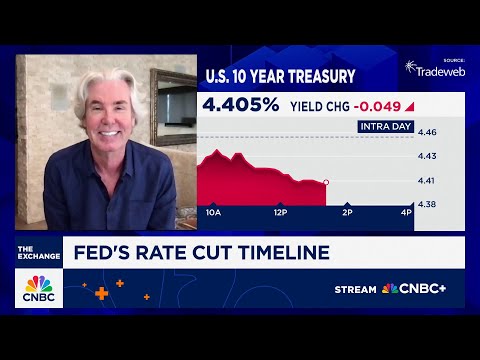
Economic Outlook - The most recent data suggests a continuation of a soft landing, which is good news for the economy [2] - The economy was in a good position to absorb the stagflationary shock from tariffs, and the Fed was in a restrictive position [3] - Concerns exist regarding oil prices potentially offsetting disinflation in other parts of the economy [5] Tariffs and Inflation - Evidence of tariffs impacting inflation is present in recent reports, with appliances and commodity goods prices increasing [4] - $70 billion of tariffs have been collected, indicating that someone is bearing the cost [4] - The impact of tariffs on inflation is uncertain, with a divided outlook on whether it will be a one-off event or cause broader inflation [6] Federal Reserve Policy - The Fed is likely to lower rates in the coming months [1] - The Fed should wait and see before cutting rates, despite pressure, to avoid cutting into a bigger inflation problem [6] - The Fed is being cautious, and the downside of waiting is small [7] - Financial markets will likely price in easing before the Fed delivers it if stagnation worsens [8] - The Fed's transparency provides a release valve against being behind the curve, as markets will front-run easing [9]

摩根士丹利:中国观察-3 个新转变,1 个持续主题
摩根· 2025-06-16 03:16
Investment Rating - The report does not explicitly provide an investment rating for the industry Core Insights - The report discusses three significant changes in the industry: US-China trade negotiations, the partial suspension of China's consumer goods trade-in programs, and the acceleration of social welfare reforms in China, while highlighting that deflation remains a persistent macroeconomic issue [1][2][13] Summary by Sections US-China Trade Negotiations - The London trade talks represent a key advancement following the Geneva meeting where the US and China agreed to pause tariffs, although challenges remain due to differing expectations on non-tariff measures [2] - A Framework Agreement was established to implement the Geneva trade deal and utilize the bilateral economic consultation mechanism [2][3] - The scope of the London agreement appears limited, focusing primarily on non-tariff measures without significant US concessions beyond student visas [3] Consumer Goods Trade-in Programs - China has partially suspended its consumer goods trade-in programs due to the exhaustion of allocated trade-in funding in some regions, with Rmb162 billion already distributed out of a Rmb300 billion quota [4] - The rapid utilization of funds and the impact on retail sales indicate potential limitations of such stimulus measures, reminiscent of the US Cash-for-Clunkers program [8] - Despite these challenges, the report anticipates a modest expansion of the annual quota if economic growth declines [8] Social Welfare Reforms - China has released a blueprint aimed at enhancing the social welfare system, focusing on equal access to public services and addressing healthcare and elderly care concerns [9][10] - The reforms are characterized as gradual, with a focus on improving existing frameworks rather than implementing radical changes [10][11] - The report suggests that while some measures have been implemented, the overall pace of reform may be slow due to structural challenges and external pressures [11][13]
The Trump And Elon Feud | ITK With Cathie Wood
ARK Invest· 2025-06-07 00:41
[Music] Greetings everyone. It is uh in the know day as well employment Friday uh and uh we have a lot to discuss as usual we'll we'll go through fiscal policy monetary policy economic indicators market indicators and uh we'll talk a little bit about uh some real breakthroughs in terms of uh the market recognizing how much innovation is taking place. Um so uh starting w with fiscal policy and I'll I'll go through and and just uh make a few observations before we flip to charts.So um on fiscal policy, well t ...