信息披露

Search documents
高乐股份披露近五年监管情况:曾因业绩预告差异收深交所监管函,已完成整改
Xin Lang Cai Jing· 2025-12-01 15:38
Core Viewpoint - Guangdong Gaole Co., Ltd. disclosed that it has not faced any penalties from regulatory authorities in the past five years, except for a regulatory letter received in 2022 due to discrepancies in performance forecasts and annual report data [1][2][3] Summary by Sections Regulatory Actions - The company has not been subject to any penalties from securities regulatory bodies or exchanges in the last five years, with the exception of a regulatory letter from the Shenzhen Stock Exchange on July 11, 2022 [2][3] - The regulatory letter was issued due to significant differences between the net profit forecast and the audited annual report for 2021, which was not corrected in a timely manner [2] Performance Discrepancies - The initial performance forecast on January 29, 2022, estimated a net loss of between 46 million to 70 million yuan for 2021, which was later revised to a net loss of 108.7 million yuan on April 20, 2022 [2] - The audited annual report released on April 29, 2022, confirmed a net loss of 108.66 million yuan for 2021, highlighting the discrepancies that led to regulatory scrutiny [2] Company Response - The company has taken the regulatory letter seriously and has organized personnel to enhance their understanding of relevant laws and regulations, aiming to prevent future issues [3] - The company commits to diligent and prudent decision-making to protect the rights of investors and ensure compliance with information disclosure obligations [3]

突发!董事举报!参加董事会遭阻,同一董事会会议开两次
Zhong Guo Ji Jin Bao· 2025-12-01 01:27
Core Viewpoint - The internal governance struggle at ST Yinjian (300020) has been exposed, highlighting issues such as delayed notifications for board meetings, lack of transparency in voting results, and the occurrence of two board meetings for the same agenda without proper disclosure [1][3][11]. Group 1: Board Meeting Issues - On November 18, ST Yinjian held a board meeting where the resolution for new board candidates was passed with a vote of 5 in favor, 0 against, and 0 abstentions [2]. - Two directors, Peng Xiaoyong and Cai Yang, were absent from the meeting, claiming they were "passively absent" due to a lack of response from the acting chairman when they sought information about the meeting [3][4]. - The same board meeting was held on November 12, where both directors voted against the resolutions, but the company did not disclose the results of that meeting [9][11]. Group 2: Communication Failures - Peng Xiaoyong reported that he did not receive the meeting link until 28 hours after the meeting had already taken place, raising concerns about the communication process [7][8]. - The acting chairman failed to provide necessary details about the meeting agenda in advance, which hindered the directors' ability to review the proposals adequately [4][9]. - The lack of timely communication and the use of an unknown number to send the meeting link were deemed abnormal by Peng Xiaoyong [8]. Group 3: Legal and Regulatory Actions - Peng Xiaoyong has reported the governance issues to regulatory authorities and has filed a lawsuit against the company to annul the decisions made during the meetings that had significant procedural flaws [11]. - A former company secretary left after only two and a half months, indicating potential instability within the company's governance structure [14].


多出4.4亿元!未及时履行关联交易审议程序和信披义务,神马股份收到警示函
Mei Ri Jing Ji Xin Wen· 2025-11-28 13:15
Core Viewpoint - Shennong Group has received a warning letter from the Henan Securities Regulatory Bureau due to exceeding the expected amount of related party transactions in financing leasing, highlighting issues in the company's compliance and risk management practices [1][3]. Summary by Sections Regulatory Actions - The company was issued a warning letter for failing to adhere to disclosure obligations and approval procedures regarding related party transactions, specifically exceeding the annual expected amount by 440 million yuan [1][3]. - Key executives, including the Chairman, General Manager, and Board Secretary, have been named in the warning and recorded in the integrity archives [2][3]. Financial Performance - In the first nine months of 2025, Shennong Group reported related party transactions in financing leasing amounting to 1.94 billion yuan, surpassing the previously set limit of 1.5 billion yuan [3]. - The exceeded amount represents 6.14% of the company's audited net assets of approximately 7.163 billion yuan as of the end of 2024, necessitating a re-evaluation and disclosure to shareholders [3]. Future Projections - The company anticipates a significant increase in related party transactions, projecting a total of 14.559 billion yuan for 2025, up from 12.092 billion yuan in 2024 [4]. - Expected procurement from the controlling shareholder is projected at 5.909 billion yuan, while sales to the same entity are estimated at around 1 billion yuan [4]. Operational Insights - The company has shown a pattern of frequent related party transactions, with 550 million yuan occurring in just the first two months of 2025 [5]. - In addition, Shennong Group plans to maintain a maximum daily deposit balance of 3 billion yuan with its financial company, with interest rates ranging from 0.5% to 1.65% [5]. Management Response - In response to the warning, the company has expressed its commitment to addressing the issues raised, emphasizing the need for improved compliance with securities laws and regulations [5].

豪尔赛遭立案调查背后:行贿换业绩?陷入持续亏损泥潭 大型订单减少
Xin Lang Zheng Quan· 2025-11-28 09:40
Core Viewpoint - Haosai is under investigation for suspected information disclosure violations, raising questions about potential bribery related to its performance and the competitive nature of its industry [1][2] Group 1: Company Background - Haosai's main business includes smart lighting, smart tourism, and smart cities, with lighting design and engineering as its core revenue source [4] - The industry is highly competitive, with demand influenced by economic cycles, macroeconomic policies, and local government finances [4] - The company's clients primarily consist of state-owned enterprises and government departments, utilizing bidding and negotiation for business acquisition [4] Group 2: Financial Performance - Since its listing in 2019, Haosai has faced continuous losses, with revenues declining from 7.88 billion in 2020 to 4.59 billion in 2024 [5] - In the first three quarters of 2025, the company reported revenues of 2.65 billion, a year-on-year decrease of 29.79%, and a net loss of 2631.38 million, a decline of 523.96% [6] Group 3: Internal Control and Compliance Issues - The company has faced scrutiny for its internal controls and compliance, receiving a regulatory warning for failing to disclose information timely [8] - The investigation into bribery and the subsequent legal actions against its former chairman highlight significant governance and operational deficiencies [2][8]
沪市债券新语丨信息透明促市场发展 机制完善育生态新局——上交所持有型不动产ABS信披优化举措落地见效
Xin Hua Cai Jing· 2025-11-28 09:27
Core Insights - The Shanghai Stock Exchange's (SSE) market for asset-backed securities (ABS) backed by real estate is expanding, with a diverse range of underlying asset types including data centers, highways, rental housing, and industrial parks [1][2] - The SSE has made significant progress in establishing an information disclosure mechanism for real estate ABS, with the release of third-quarter asset management reports and a core element table, enhancing transparency for investors [1][2] Group 1: Information Disclosure Mechanism - The introduction of the core element table and information disclosure area aims to standardize data and improve comparability among various ABS products, addressing previous challenges of inconsistent data standards [2][3] - High-quality information disclosure is seen as an inherent requirement of the "equity attribute" of real estate ABS, facilitating a unified, timely, and effective decision-making process [2][3] Group 2: Market Impact and Investor Confidence - Enhanced information disclosure quality is expected to significantly improve the comparability and effectiveness of ABS product data, providing more precise decision-making tools for market participants [3][5] - Regular disclosure of operational data and core element tables allows investors to gain insights into key metrics such as rental levels, occupancy rates, and tenant structures, thereby boosting confidence in the projects [4][5] Group 3: Economic Implications - The development of the real estate ABS market is fundamentally about converting dormant assets into tradable financial products, thereby revitalizing the economy [7] - The ongoing improvement of the information disclosure mechanism is anticipated to facilitate a shift from "product trading" to "asset operation," injecting sustainable momentum into high-quality economic development [7]
弘业期货(001236) - 弘业期货投资者关系活动记录表20251128
2025-11-28 08:22
Financial Performance - The company's net profit attributable to shareholders for Q3 increased by 57.36% year-on-year, primarily due to effective cost control and growth in brokerage service fees [2][3] - The net cash flow from operating activities was 874 million CNY, a decline of 64.13% year-on-year, mainly due to reduced client margin deposits [3] Business Optimization - In 2025, the company optimized its market-making business by enhancing internal control systems, streamlining business processes, and increasing risk awareness [3] - The company reported no risk incidents in its market-making operations in 2025, demonstrating effective risk management [3] Capital Growth - The growth in the scale of Hongye Capital's futures and spot business is attributed to continuous investment in talent acquisition and resource utilization [4][5] - Future plans for Hongye Capital include expanding business areas, upgrading service models, and enhancing technology and risk control capabilities [4] Brand Development - The company emphasizes its brand image as the only "A+H" listed futures company and state-owned enterprise, focusing on core values of "inheritance, openness, integrity, and excellence" [5] - The company has received multiple honors, such as "National Civilized Unit" and "2024 Financial System Model Point," enhancing its brand image [6] Customer Service Enhancements - The company has improved customer service through professional research capabilities, digital services, and personalized service models [6] - A dedicated service team and tailored risk management solutions are provided for large industrial clients [6] Governance and Transparency - The independent director emphasizes the importance of robust corporate governance and information disclosure to protect shareholder rights, especially for minority shareholders [6][7] - Regular reviews of financial reports and compliance with regulations are conducted to ensure transparency and accountability [6] Social Responsibility - The "Insurance + Futures" initiative focuses on supporting rural revitalization and food security, providing price and income guarantees for key agricultural products [7] - The initiative also promotes financial literacy among farmers, helping them manage market risks effectively [7]

城投控股:公司始终严格履行信息披露义务
Zheng Quan Ri Bao· 2025-11-27 13:41
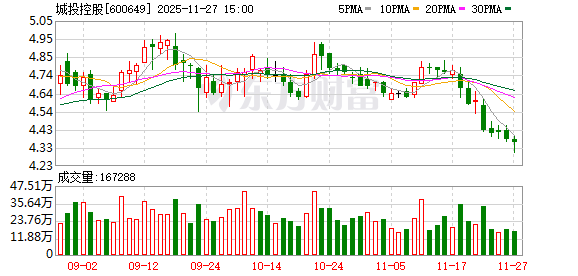
证券日报网讯城投控股11月27日在互动平台回答投资者提问时表示,公司始终严格履行信息披露义务, 坚守合规经营底线,将持续聚焦主业发展,以稳健的经营表现回报投资者信任。 (文章来源:证券日报) ...

公司快评|*ST苏吴退市 千万元罚单警示市场:财务造假必遭严惩
Mei Ri Jing Ji Xin Wen· 2025-11-26 04:56
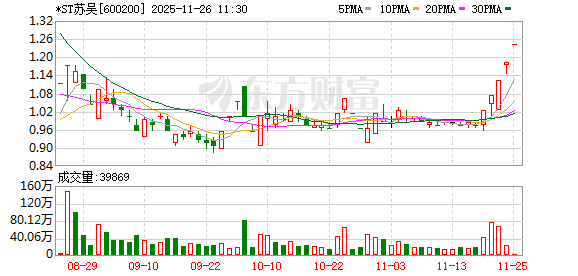
Core Viewpoint - The forced delisting of *ST Suwu is a significant action reflecting the regulatory authority's zero-tolerance stance towards illegal activities in the capital market, emphasizing the need for compliance and integrity among listed companies [2][3][4]. Summary by Sections Company Violations - *ST Suwu has been penalized for multiple violations, including failing to disclose the actual controller, inflating revenue and profits, and not reporting non-operational fund usage by related parties. The company faces a fine of 10 million yuan, and responsible individuals are fined a total of 20.5 million yuan, with the chairman banned from the securities market for 10 years [2][3]. Regulatory Actions - The China Securities Regulatory Commission (CSRC) has implemented a strict punishment mechanism, which includes the forced delisting of *ST Suwu as part of a broader "cleaning" initiative in the capital market. This action aims to eliminate fraudulent entities and maintain a healthy market ecosystem [3][4]. Market Implications - The incident serves as a warning to investors about the risks of blindly following stocks without understanding the underlying compliance and operational integrity. It highlights the necessity for investors to be cautious and informed about the companies they invest in [3][4]. Future Outlook - The delisting of *ST Suwu is seen as a starting point for ongoing efforts to purify the capital market. The case is expected to serve as a cautionary tale for other companies, reinforcing the importance of legal compliance for sustainable business development [4].

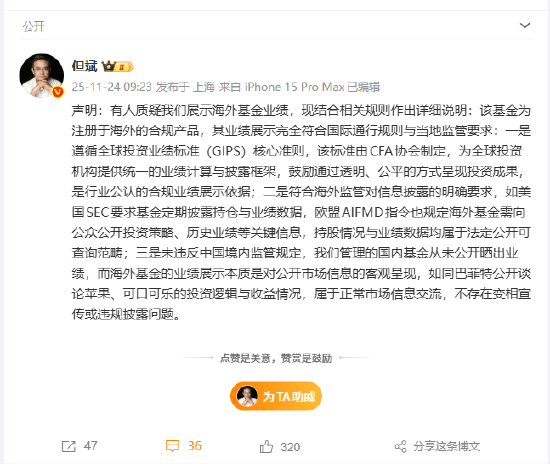
但斌回应海外基金业绩展示合规性质疑:海外基金的业绩展示 属于正常市场信息交流
Xin Lang Ji Jin· 2025-11-24 05:17
登录新浪财经APP 搜索【信披】查看更多考评等级 责任编辑:石秀珍 SF183 11月24日,但斌通过微博发布声明,回应近期有关其展示海外基金业绩的质疑。 二是符合海外监管机构对信息披露的明确要求。例如,美国证券交易委员会(SEC)要求基金定期披露 持仓与业绩数据,欧盟《另类投资基金管理指令》(AIFMD)也规定基金需向投资者公开投资策略、 历史业绩等关键信息。因此,相关持股情况与业绩数据均属于法定公开信息,可供查询; 三是未违反中国境内的监管规定。但斌强调,其管理的国内基金从未公开披露业绩,而海外基金的业绩 展示本质是对公开市场信息的客观呈现,正如巴菲特公开讨论苹果、可口可乐等投资案例的收益与逻辑 一样,属于正常的市场信息交流,不构成变相宣传或违规披露。 他在声明中表示,相关基金为注册于海外的合规产品,其业绩展示严格遵循国际规则与注册地监管要 求,具体体现在三个方面: 一是遵循全球投资业绩标准(GIPS)核心准则。该标准由CFA协会制定,为全球投资机构提供统一的 业绩计算与披露框架,旨在通过透明、公平的方式呈现投资成果,是行业公认的合规业绩展示依据; ...
成都允许存量自持租赁房转为普通商品房;碧桂园子公司被广东证监局出具警示函 | 房产早参
Mei Ri Jing Ji Xin Wen· 2025-11-23 22:43
Group 1 - Chengdu allows existing self-owned rental housing to be converted into ordinary commercial housing for market trading, aiming to optimize resource utilization and stabilize the market [1] - Shanghai will auction 9 land parcels on November 24, with a total starting price of 16.911 billion yuan, indicating the resilience of the land market [2] - Country Garden's subsidiary, Tengyue Construction, received a warning letter from the Guangdong Securities Regulatory Commission for failing to disclose significant corporate changes, highlighting governance issues within the company [3] Group 2 - Road King Infrastructure's wholly-owned subsidiary, New Choice Global, faces a winding-up petition related to a debt of 442 million USD, although the board believes it will not significantly impact the overall business [4] - The debt committee of China Fortune Land Development has authorized Ping An Asset Management to conduct a special financial due diligence on the company, reflecting creditors' concerns over financial transparency [5]