企业转型

Search documents
新帅刚上任,雀巢宣布裁员1.6万人,1.2万白领面临失业!新任CEO:树立绩效导向思维;前任CEO上月因“办公室恋情”被解雇
Sou Hu Cai Jing· 2025-10-18 06:25
Core Viewpoint - Nestlé plans to cut approximately 16,000 jobs, equivalent to 6% of its total workforce, as part of a strategy to accelerate corporate transformation amid performance pressures [1][3][4]. Group 1: Job Cuts and Corporate Strategy - The job cuts will affect around 12,000 white-collar positions across all functions and regions, along with about 4,000 roles in production and supply chain [1][4]. - The announcement coincides with Nestlé's third-quarter sales exceeding expectations, indicating a push for transformation under new CEO Philippe Navratil [1][3]. - Navratil emphasizes the need for Nestlé to adapt more quickly to changing market conditions, which includes making difficult decisions like layoffs [6][10]. Group 2: Financial Performance - Nestlé's total sales for the first nine months of 2023 were 65.9 billion Swiss francs, a decline of 1.9%, but organic growth was reported at 3.3% [3][4]. - The company experienced a negative impact of 5.4% from currency fluctuations, while net acquisitions contributed positively by 0.1% [3]. - The Greater China region continues to struggle, with an organic growth rate of -10.4% in Q3, contributing to overall sales declines [4]. Group 3: Leadership Changes - The recent leadership changes at Nestlé include the dismissal of former CEO Laurent Freixe and the appointment of Navratil, who is the youngest CEO in nearly 60 years [8][9]. - Navratil's management philosophy focuses on performance culture, transparency, and urgency, aiming to prevent market share loss and prioritize high-potential opportunities [9][10]. - The company aims to save 3 billion Swiss francs (approximately 3.77 billion USD) by 2027, an increase from the previous target of 2.5 billion Swiss francs [4][9].



闽系老板看上的体育公司,遭控股股东减持
3 6 Ke· 2025-10-17 12:56
Core Viewpoint - Shuhua Sports, a leading sports equipment company in China, announced a share reduction plan by its controlling shareholder due to personal funding needs, marking the first reduction since its IPO nearly five years ago [1][2]. Group 1: Share Reduction Details - The controlling shareholder, Shuhua Investment, plans to reduce its stake by up to 3% of the total share capital, equating to 12.2768 million shares, between November 7, 2025, and February 6, 2026 [1]. - The reduction will occur through block trading, with Shuhua Investment reducing up to 8.1845 million shares (2% of total shares), while the actual controller Zhang Weijian and his son Zhang Jinpeng will reduce 204.61 thousand shares each (0.5% of total shares) [2]. Group 2: Company Background and Market Position - Shuhua Sports was founded in 1996 by Zhang Weijian in Jinjiang, Fujian, and specializes in fitness equipment and display racks, having gone public in 2020 [1]. - The company is the official fitness equipment supplier for the Chinese delegation at the 2024 Paris Olympics and has supplied equipment for multiple official events, including the 2022 Winter Olympics [1]. Group 3: Financial Performance - Shuhua Sports has experienced unstable financial performance since its IPO, with revenue declining from 1.484 billion yuan in 2020 to 1.352 billion yuan in 2022, and net profit decreasing from 137 million yuan to 109 million yuan during the same period [4]. - In 2023, the company saw a temporary recovery with a revenue increase of 5.23% to 1.422 billion yuan and a net profit increase of 17.72% to 129 million yuan [4]. - However, in 2024, revenue slightly decreased to 1.417 billion yuan, and net profit fell nearly 30% to 90.33 million yuan, with a significant drop of 47.44% in net profit in the first half of 2025 [4]. Group 4: Strategic Direction - The fitness equipment industry is entering a phase of stock competition, prompting Shuhua Sports to transition from a product supplier to a professional sports solution service provider [4]. - The company is focusing on expanding its fitness store network and overseas markets, with over 60 fitness stores established as of June 2023 and a target of reaching 170 stores [4].

金岭矿业暂停挂牌转让金钢矿业,此前挂牌价1.84亿元
Zheng Quan Shi Bao Wang· 2025-10-17 12:01
Group 1 - Jinling Mining announced the suspension of the public transfer of 100% equity and debt of Tashkurgan Jin Gang Mining Co., Ltd. due to the lack of qualified buyers after multiple attempts to sell [1] - The initial listing price for the equity and debt was set at 184 million yuan, with the equity priced at 1 yuan and the debt at 184 million yuan, while the actual debt balance was 644 million yuan [1] - Jin Gang Mining has been in a state of suspension since 2017 due to tightened environmental policies, leading to significant financial distress with total assets of 20.89 million yuan and total liabilities of 645 million yuan as of March 31, 2025 [1] Group 2 - In 2024, Jinling Mining established a transformation strategy focused on strengthening its iron ore business and solidifying its non-ferrous metal industry, including acquiring exploration rights in Qihe County [2] - Despite the setbacks in asset transfer, Jinling Mining experienced a surge in performance, achieving a revenue of 1.247 billion yuan in the first three quarters of 2025, a year-on-year increase of 12.98%, and a net profit of 220 million yuan, up 47.09% year-on-year [2] - As of October 17, Jinling Mining's stock price was 9.92 yuan per share, with a total market capitalization of 5.906 billion yuan, reflecting an increase of over 40% since the second half of the year [2]

新老总刚上台,雀巢就宣布裁员1.6万人,股东很高兴:股价应声大涨
Mei Ri Jing Ji Xin Wen· 2025-10-17 02:55
Core Viewpoint - Nestlé plans to cut approximately 16,000 jobs, representing 6% of its total workforce, despite exceeding sales expectations in Q3 [1][3] Group 1: Job Cuts and Leadership Changes - The job cuts will affect 12,000 white-collar positions and 4,000 roles in manufacturing and supply chain [1] - New CEO Philippe Naefratil emphasizes the need for faster transformation within the company, stating, "The world is changing, and Nestlé must change faster" [1][3] - Naefratil was appointed following the dismissal of former CEO Laurent Freyks due to personal misconduct [3] Group 2: Financial Performance - Nestlé's total sales for the first nine months of the year reached 65.9 billion Swiss francs, a year-on-year decline of 1.9% [5] - The organic growth rate was 3.3%, with all regions and global direct operations showing positive growth [5] - In Q3, the organic growth rate improved to 4.3%, up from 2.9% in the first half of the year [5] Group 3: Regional Performance - The Greater China region has been a drag on performance, with a Q3 organic growth rate of -10.4% [8] - Excluding Greater China, the organic growth rate for Asia, Oceania, and Africa was 5.3% [8] - Nestlé is focusing on reducing excess inventory in Greater China and shifting its organizational focus towards demand creation [8] Group 4: Cost-Saving Initiatives - Nestlé has raised its cost-saving target to 3 billion Swiss francs (approximately 3.77 billion USD) by the end of 2027, up from the previous target of 2.5 billion Swiss francs (approximately 3.14 billion USD) [3] - The company aims to implement necessary but difficult decisions to achieve these savings [3] Group 5: Market Reaction - Following the announcement of job cuts and better-than-expected financial results, Nestlé's ADR rose over 9% [11]

雀巢新老总刚上台,就宣布裁员1.6万人!股东很高兴:股价大涨
Mei Ri Jing Ji Xin Wen· 2025-10-16 22:34
Core Insights - Nestlé plans to cut approximately 16,000 jobs, representing 6% of its total workforce, despite exceeding sales expectations in Q3 [1][3] - The new CEO, Philippe Navratil, aims to accelerate the company's transformation, indicating that difficult decisions, including layoffs, are necessary for adaptation to changing market conditions [1][3] Financial Performance - For the first nine months of the year, Nestlé reported total sales of CHF 65.9 billion, a year-on-year decline of 1.9%, with an organic growth rate of 3.3% [5] - In Q3, the organic growth rate improved to 4.3%, up from 2.9% in the first half of the year, with all major product categories showing improvement [5] - The pricing contribution remained stable at 2.8%, reflecting price increases in the candy and coffee segments [5] Regional Performance - The Greater China region has been a drag on Nestlé's performance, with a Q3 organic growth rate of -10.4% and a nine-month rate of -6.1% [8] - Excluding Greater China, the organic growth rate for the Asia, Oceania, and Africa region was 5.3%, indicating stronger performance in other markets [8] Cost-Saving Initiatives - Nestlé has raised its cost-saving target to CHF 3 billion (approximately USD 3.77 billion) by the end of 2027, up from the previous target of CHF 2.5 billion (USD 3.14 billion) [3] - The company is focusing on reducing excess inventory in the Greater China region and shifting its organizational focus towards demand creation [8] Market Reaction - Following the announcement of the financial results and job cuts, Nestlé's ADR saw an increase of over 9% [9]

新老总刚上台 就宣布裁员1.6万人 其中包括1.2万个白领!公司股东很高兴:股价应声大涨
Mei Ri Jing Ji Xin Wen· 2025-10-16 16:48
Core Viewpoint - Nestlé plans to cut approximately 16,000 jobs, equivalent to 6% of its total workforce, as part of a strategy to accelerate corporate transformation amid growth pressures, despite exceeding sales expectations in Q3 [2][3][4]. Group 1: Job Cuts and Leadership Changes - The job cuts will affect 12,000 white-collar positions and 4,000 roles in manufacturing and supply chain [3]. - The new CEO, Philippe Naefratil, emphasizes the need for faster changes within the company, stating that difficult but necessary decisions must be made [3]. - Naefratil replaced Laurent Freixe, who was dismissed after a year due to allegations of concealing a relationship with a subordinate [3]. Group 2: Financial Performance - Nestlé's total sales for the first nine months were 65.9 billion Swiss francs, a year-on-year decline of 1.9%, with an organic growth rate of 3.3% [4]. - In Q3, the organic growth rate improved to 4.3%, up from 2.9% in the first half of the year, with all major product categories showing improvement [4]. - The pricing contribution rate remained stable at 2.8%, reflecting price increases in the candy and coffee segments [4]. Group 3: Regional Performance - The Greater China region has been a significant drag on Nestlé's performance, with an organic growth rate of -10.4% in Q3, continuing a downward trend [6]. - Excluding Greater China, the organic growth rate for the Asia, Oceania, and Africa region was 5.3%, indicating stronger performance in other markets [6]. - Nestlé is working to reduce excess inventory in Greater China and refocus its organizational efforts on demand creation [7]. Group 4: Market Reaction - Following the announcement of the better-than-expected financial results and job cuts, Nestlé's ADR rose by over 9% [9].
新老总刚上台,就宣布裁员1.6万人,其中包括1.2万个白领!公司股东很高兴:股价应声大涨
Mei Ri Jing Ji Xin Wen· 2025-10-16 16:40
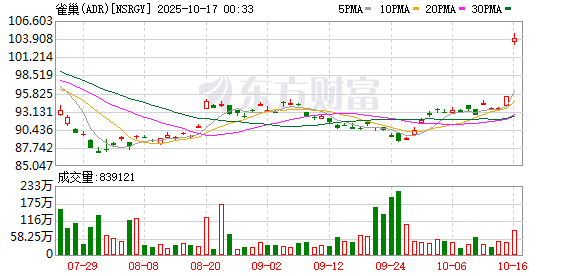
Core Viewpoint - Nestlé plans to cut approximately 16,000 jobs, representing 6% of its total workforce, as part of a strategy to accelerate corporate transformation amid growth pressures, despite exceeding sales expectations in Q3 [1][2][4]. Group 1: Job Cuts and Corporate Strategy - The job cuts will affect 12,000 white-collar positions and 4,000 roles in manufacturing and supply chain [2]. - New CEO Philippe Naefratil emphasizes the need for Nestlé to adapt more quickly to changing market conditions, stating that difficult but necessary decisions must be made [2][4]. - Nestlé has raised its cost-saving target to 3 billion Swiss francs (approximately 3.77 billion USD) by the end of 2027, up from the previous target of 2.5 billion Swiss francs (approximately 3.14 billion USD) [4]. Group 2: Financial Performance - For the first nine months of the year, Nestlé reported total sales of 65.9 billion Swiss francs, a year-on-year decline of 1.9%, with an organic growth rate of 3.3% [6]. - In Q3, the organic growth rate improved to 4.3%, up from 2.9% in the first half of the year, with all major product categories showing improvement [6]. - The coffee and confectionery segments were the main contributors to organic growth, driven primarily by pricing strategies [6]. Group 3: Regional Performance - The Greater China region has been a drag on Nestlé's performance, with an organic growth rate of -10.4% in Q3, continuing a downward trend [9]. - Excluding Greater China, the organic growth rate for the Asia, Oceania, and Africa region was 5.3%, indicating stronger performance in other markets [9]. - Nestlé is working to reduce excess inventory in Greater China and refocus its organizational efforts on demand creation [9]. Group 4: Market Reaction - Following the announcement of the job cuts and better-than-expected financial results, Nestlé's ADR saw an increase of over 9% [12].
巨头宣布,将裁员1.6万人
Di Yi Cai Jing Zi Xun· 2025-10-16 13:47
与此同时,雀巢上调成本节约目标,计划到2027年年底前节约30亿瑞士法郎(约合37.7亿美元),高于 此前设定的25亿瑞士法郎(31.4亿美元)目标。 此次公告发布正值该公司第三季度销售额超出预期。雀巢说,此次裁员波及1.2万个"白领岗位"以及 4000个制造和供应链领域岗位。 美国彭博新闻社报道,上述裁员措施表明,雀巢新任首席执行官菲利普·纳夫拉蒂尔寻求加快企业转 型。"世界在变,雀巢必须更快改变,"纳夫拉蒂尔在当天发布的声明中说,"这包括做出艰难但必要的 决定,即在今后两年内裁员。" 雀巢上月任命内部人士纳夫拉蒂尔接任首席执行官,取代洛朗·弗雷克斯。因涉嫌隐瞒与下属恋情,弗 雷克斯在任职仅一年后被罢免。受此影响,雀巢董事长保罗·比尔克提前卸任。 据新华社,瑞士雀巢公司16日说,计划在今后两年内削减约1.6万个工作岗位,相当于其员工总数的 6%。 微信编辑丨瑜见 ...
巨头宣布,将裁员1.6万人
第一财经· 2025-10-16 12:52
Group 1 - The core point of the article is that Nestlé plans to cut approximately 16,000 jobs, which is about 6% of its total workforce, as part of a strategy to accelerate corporate transformation under new CEO Philippe Navratil [1] - The job cuts will affect 12,000 white-collar positions and 4,000 roles in manufacturing and supply chain [1] - Nestlé has raised its cost-saving target to 3 billion Swiss francs (approximately 3.77 billion USD) by the end of 2027, up from the previous target of 2.5 billion Swiss francs (approximately 3.14 billion USD) [1] Group 2 - The announcement comes after Nestlé's third-quarter sales exceeded expectations, indicating a potential shift in the company's operational strategy [1] - Philippe Navratil emphasized the need for Nestlé to adapt more quickly to changing market conditions, which necessitates difficult decisions such as job cuts [1] - The previous CEO, Laurent Freixe, was dismissed after just one year due to allegations of concealing a relationship with a subordinate, leading to the early resignation of Chairman Paul Bulcke [1]

京东需要新故事
经济观察报· 2025-10-16 11:47
Core Viewpoint - JD.com is at a critical juncture in 2025, requiring a new narrative to support future growth as it ventures into new markets like food delivery and automotive sales [1][3]. Group 1: Strategic Moves - On October 14, JD.com announced a collaboration with GAC and CATL to launch a car, marking its entry into the automotive industry [2]. - JD.com clarified that it will focus on selling cars rather than manufacturing them, leveraging its consumer insights and exclusive sales capabilities [3]. - The company's recent moves, including entering the food delivery market and automotive sales, reflect a strategic attempt to find new growth avenues amid slowing traditional e-commerce growth [4]. Group 2: Market Challenges - JD.com faces unprecedented growth pressures due to the saturation of mobile internet traffic and challenges from live-streaming e-commerce models [4]. - The slowing growth rate in financial reports and cautious market sentiment indicate that merely optimizing existing business lines is insufficient for future growth [4]. Group 3: Transformation and Adaptation - The company is attempting to address low-frequency consumption patterns by entering high-frequency markets like food delivery, while also targeting high-value sectors like automotive sales [5]. - Historical examples, such as Fujifilm's successful transformation, illustrate that large companies can pivot effectively, but it requires strategic foresight and adaptability [6]. - JD.com's aggressive cross-industry moves signify a necessary evolution, despite the inherent risks and challenges associated with such transformations [6].