合规经营

Search documents
新闻分析:合规经营是平台经营主体谋发展的立身之本
Xin Hua She· 2025-09-19 08:03
Core Viewpoint - Compliance in operations is essential for the development of platform operators, including MCN institutions and network anchors, as highlighted by recent tax violations and penalties [1][2][3] Group 1: MCN Institutions and Tax Compliance - The rapid growth of MCN institutions has led to significant issues, including tax evasion practices such as income splitting and the creation of shell companies to help anchors avoid tax obligations [2] - As of May 2025, the number of MCN institutions in China is projected to reach 29,000, with the market size expected to exceed 70 billion yuan [1] Group 2: Tax Violations and Regulatory Response - Since 2021, over 360 cases of tax evasion by network anchors have been reported, resulting in more than 3 billion yuan in tax recoveries [3] - The introduction of the "Internet Platform Enterprises Tax Information Reporting Regulations" aims to promote compliance and fair competition among online platforms and their operators [3]
曝光3起涉税案!税务部门织密MCN、网络主播、平台全链条税收监管网
Zheng Quan Shi Bao Wang· 2025-09-19 07:00
Core Viewpoint - The tax authorities are intensifying scrutiny on MCN (Multi-Channel Network) agencies and network anchors for tax evasion practices, emphasizing the need for compliance and transparency in the industry [2][6][7]. Group 1: Tax Evasion Cases - Three tax-related cases involving MCN agencies and a network anchor were reported, highlighting issues such as false invoicing and failure to withhold taxes [1]. - Hebei Chuming Cultural Media Co., Ltd. was found to have underpaid taxes by 12.6151 million yuan and failed to withhold individual income tax for anchors amounting to 3.5970 million yuan, resulting in penalties totaling 20.1006 million yuan [1]. - Hunan Yanke Cultural Media Co., Ltd. was penalized for not withholding individual income tax of 2.0886 million yuan for its anchors, leading to a fine of 1.0443 million yuan [1]. Group 2: Regulatory Framework - MCN agencies are legally obligated to withhold and pay taxes, and their failure to do so is being addressed through stricter regulations [3][5]. - The State Council's regulations introduced in June 2023 require internet platforms to report tax-related information, enhancing transparency and accountability within the industry [2][8]. - The new regulations aim to create a comprehensive tax governance system covering MCN agencies, network anchors, and internet platforms, promoting a healthier industry ecosystem [2][4]. Group 3: Industry Implications - The rapid growth of MCN agencies has led to increased scrutiny regarding their compliance with tax laws, as some agencies have used tax evasion as a competitive strategy [3][5]. - Experts emphasize that compliance is essential for the sustainable development of MCN agencies and the overall health of the industry [4][5]. - The perception among some network anchors that hidden income can evade taxes is being challenged by ongoing tax enforcement actions [6][7]. Group 4: Future Directions - The introduction of the new regulations is seen as a critical step in preventing tax evasion and ensuring fair competition within the platform economy [8]. - Experts advocate for a collaborative approach among regulatory bodies to create a fair and transparent tax environment, which is vital for the long-term health of the platform economy [7][8].
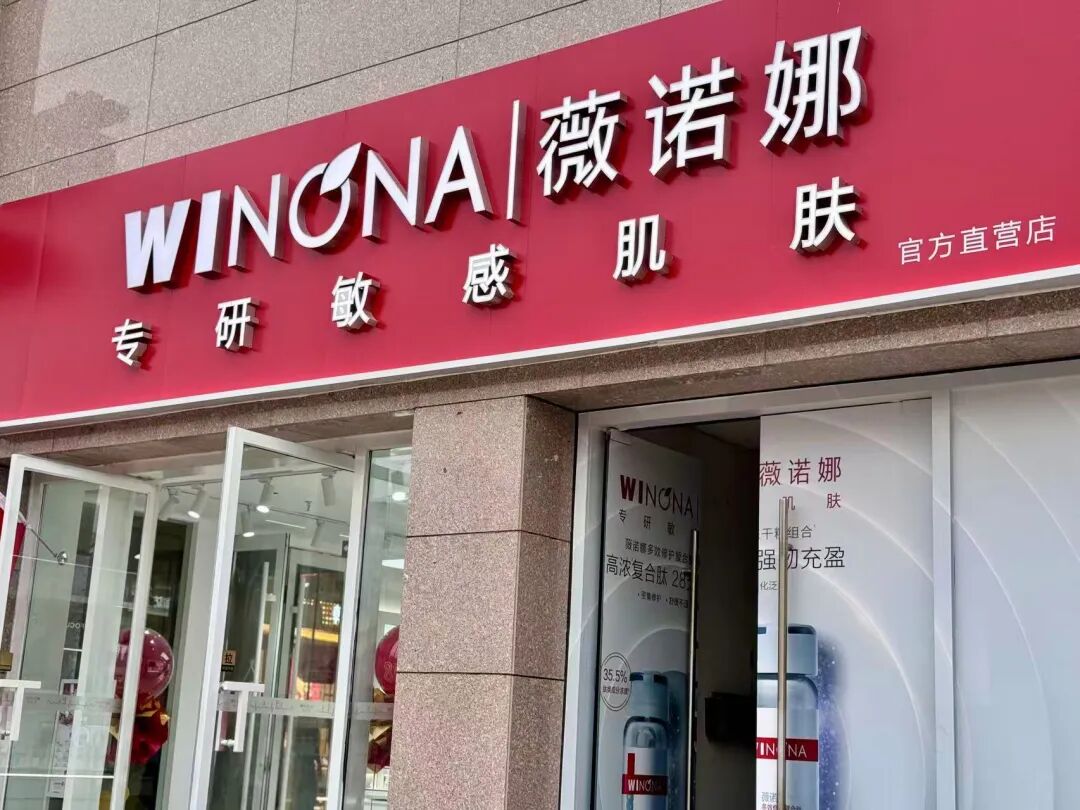
限期整改叠加业绩“崩盘”,贝泰妮的敏感肌神话碎了
Guo Ji Jin Rong Bao· 2025-09-19 03:12
Core Viewpoint - The recent inspection results from the Yunnan Drug Administration have raised compliance concerns for Betaini and its subsidiaries, leading to a significant decline in the company's reputation and financial performance [2] Financial Performance - In the first half of the year, Betaini reported revenue of 2.372 billion yuan, a year-on-year decline of 15.43%, returning to levels seen two years ago [2] - The net profit attributable to the parent company fell by 49.01% to 247 million yuan, marking a five-year low [2] - The net profit margin decreased by 6.49 percentage points to 10.47% [2] Brand Performance - The main brand, Winona, contributed 82% of total revenue, amounting to 1.95 billion yuan, down 18% year-on-year [3] - Other brands like Jirui and Pome also saw revenue declines of 11% and 5%, respectively [3] Product Category Analysis - Skincare products generated approximately 2 billion yuan in revenue, with an average selling price dropping from 42.78 yuan to 39.01 yuan, leading to a 12% decline in revenue [5] - Makeup products also saw a decrease in average selling price from 38.67 yuan to 37.77 yuan, resulting in a 7.1% revenue decline [5] - Medical device products experienced a price drop to below 100 yuan, averaging 95.88 yuan, down from 106.61 yuan [5] Sales Channels - Online, OMO, and offline channels contributed 1.743 billion yuan, 191 million yuan, and 424 million yuan in revenue, with year-on-year changes of -5.89%, -10.48%, and -41.58%, respectively [5] Management and Marketing Strategy - Despite poor sales performance, sales expenses increased by 0.6% to 1.285 billion yuan, raising the sales expense ratio by 8 percentage points to 52.92% [8] - The company emphasized its commitment to a multi-channel network, integrating online and offline sales, but the effectiveness of this strategy remains to be seen [9] Market Reaction - Betaini's stock price has significantly declined from a peak of 289.35 yuan to a closing price of 47.46 yuan, resulting in a market capitalization reduction of nearly 100 billion yuan [10]

携程被约谈,要求其整改不合理限制行为
Qi Lu Wan Bao· 2025-09-19 02:31
Core Points - Zhengzhou Market Supervision Administration conducted an administrative interview with Ctrip Travel Network, requiring comprehensive rectification and standardized operations to maintain fair competition and protect the legitimate rights of platform operators [1][5] - The platform was found to have violated the Electronic Commerce Law and the Interim Provisions on the Prohibition of Unfair Competition by using service agreements, transaction rules, and technical means to impose unreasonable restrictions on transactions and pricing of platform operators [1][5] - A corrective notice was issued on September 4, 2025, mandating Ctrip to complete contract revisions and pricing tool optimizations within a specified timeframe [1][5] Regulatory Emphasis - Fair competition is emphasized as the core of the market economy, with internet platform companies urged to enhance legal awareness and actively cooperate with regulatory authorities [2] - Companies are required to establish a regular legal education mechanism to improve compliance capabilities among management and operational staff [2] - The importance of respecting merchants' autonomy and correcting unreasonable restrictions, such as forced service activation and inability to exit, is highlighted [2] Follow-up Actions - Zhengzhou Market Supervision Administration will continue to monitor Ctrip's rectification progress and conduct inspections to ensure compliance with responsibilities [2]

携程被约谈!多家酒店举报其“私自调价”,目前已被行政约谈
Nan Fang Du Shi Bao· 2025-09-18 14:49
Core Viewpoint - Ctrip has been summoned for an administrative interview by the Zhengzhou Market Supervision Administration due to complaints from multiple hotels regarding the platform's interference in hotel pricing through a tool called "Price Adjustment Assistant" [1][3] Group 1: Issues Raised - Multiple hotels reported that Ctrip unilaterally modified their room prices on the platform without consent, using the "Price Adjustment Assistant" tool [2] - Hotel managers indicated that Ctrip monitors pricing on other platforms and automatically lowers prices on Ctrip if discrepancies are found, often without notifying the hotels [2] - Instances were reported where Ctrip's adjustments led to significant price reductions, affecting hotel revenues, especially during peak periods [2] Group 2: Regulatory Actions - Ctrip's actions were found to violate the Electronic Commerce Law of the People's Republic of China and related regulations, prompting the Zhengzhou Market Supervision Administration to issue a correction notice [3] - The administrative interview emphasized the need for Ctrip to revise contract terms, optimize pricing tools, and establish a long-term compliance mechanism to prevent similar issues in the future [3] - Regulatory authorities outlined three key requirements for Ctrip: enhancing legal awareness, correcting unreasonable restrictions, and ensuring the protection of merchants' pricing autonomy [3]
英思特:公司始终以合规经营为核心
Zheng Quan Ri Bao Zhi Sheng· 2025-09-18 11:44
Core Viewpoint - The company emphasizes that its 2025 semi-annual report will fully disclose key financial indicators, revenue, and net profit, all of which have been verified through internal audit processes and align with industry trends and operational realities [1]. Financial Disclosure - The company adheres strictly to the "Management Measures for Information Disclosure of Listed Companies" and relevant regulations from the Shenzhen Stock Exchange regarding the disclosure of cooperation information with core clients [1]. - For clauses involving trade secrets or confidentiality agreements, the company has legally applied for exemption from disclosure to the exchange [1]. Compliance and Investor Relations - The company is committed to compliance in its operations and ensures investor rights to information through regular reports, investor relations activities, and statutory information disclosure channels [1]. - The company monitors stock price fluctuations, acknowledging that secondary market prices are influenced by various external factors such as industry cycles and market sentiment, which can lead to short-term volatility [1].
民生银行中层调整涉及总行多部门和一级分行
Xin Lang Cai Jing· 2025-09-18 11:02
来源:金融人事mini "不搞'内卷式'竞争",民生银行行长王晓永在2025年中期业绩说明会上表示,当前业绩表现是近年来该行战略转型成效的逐步显现,是做好战略执行的成果。 武汉分行副行长杨毅,拟任西安分行副行长;曾任民生银行武汉分行行长助理,2025年1月升任武汉分行副行长。 9月15日,胡丹民生银行上海自贸试验区分行副行长的任职资格获准。 具体来看,2025年上半年,民生银行实现营业收入723.84亿元,同比增长7.83%,其中净息收入和非净息收入实现双增长,净息差逆势上升1BP至1.39%;实现归属于上市公司股东的净利润2 人事方面,管理层相对稳定,今年至今只出现两次调整:7月原副行长石杰到龄退休,8月李稳狮获批出任民生银行副行长。 本期,主要介绍民生银行中层变动,涉及总行客群、风控、党建等多部门总经理、副总经理。此外,民生银行近期还有多位一级分行行长、副行长的任职资格获核准,且多为系统内提任。 总行部门 总行纪检监察室主任张喜宏,任总行党群部总经理;历任民生银行北京分行副行长,总行安全保卫部总经理,总行纪委副书记、纪检监察室总经理。 郑州分行副行长吕波,任总行纪检监察室主任;曾任民生银行总行纪检监察室廉 ...

新疆吐鲁番:从“爆破开采”到“绿色焦化” 一条产业链的合规赋能之路
Sou Hu Cai Jing· 2025-09-18 07:55
Group 1: Industry Overview - The energy industry in Turpan is experiencing new vitality, driven by compliance and effective policies from the local tax authority [1] - Turpan is a significant coal production and processing base in Xinjiang, with a focus on safe mining practices supported by civil explosives [2] Group 2: Company Highlights - Turpan Tianbao Mixed Explosive Manufacturing Co., Ltd. is a leading enterprise in the civil explosive sector, emphasizing compliance and innovation [2] - The company has saved over 28 million yuan in tax reductions over the past three years, which has been reinvested into R&D for new environmentally friendly explosives and intelligent blasting management systems [2] - Tokkexun County Panji Coal Industry Co., Ltd. has become a benchmark in the coal industry, benefiting from good tax credit ratings that enhance its development opportunities [3] Group 3: Taxation and Compliance Support - The Turpan tax authority has implemented targeted services to support compliance in the mining sector, utilizing big data to analyze tax risks and provide tailored advice [3] - The tax department's initiatives, such as "Tax Policy into Mining Areas," have helped companies improve their financial management and maintain good credit ratings [3] - Xinjiang Shengxiong Coking Co., Ltd. has benefited from timely tax policy education, which has clarified tax-related issues and facilitated compliance [4] Group 4: Environmental and Technological Advancements - Companies are focusing on reducing energy consumption and pollution emissions while pursuing green upgrades and industrial transformation [5] - The emphasis on compliance and innovation is seen as a stabilizing factor for the companies' development in the region [4][5]
携程被约谈:严禁用技术手段变相操控价格,尊重商户自主定价权
Guan Cha Zhe Wang· 2025-09-18 00:15
Core Points - Zhengzhou Market Supervision Administration conducted an administrative interview with Ctrip Travel Network on September 17, 2023, due to violations of the E-commerce Law and regulations against unfair competition [1][2] - The platform was found to impose unreasonable restrictions on transactions and pricing of operators within the platform, prompting the issuance of a corrective notice on September 4, 2025 [1] - The meeting emphasized the importance of fair competition in the market economy and urged internet platform companies to enhance legal awareness and comply with regulations [2] Summary by Sections - **Regulatory Actions** - Ctrip Travel Network was summoned for an administrative interview due to violations of the E-commerce Law and unfair competition regulations [1] - A corrective notice was issued to Ctrip, requiring the company to amend contract terms and optimize pricing tools within a specified timeframe [1] - **Compliance and Rectification** - The meeting called for Ctrip to take the administrative interview seriously and complete the required rectifications within the deadline [1] - Companies are urged to establish a long-term compliance mechanism and strengthen internal supervision to prevent similar issues in the future [1] - **Market Environment and Responsibilities** - The importance of fair competition was reiterated, with a call for internet platforms to respect merchants' rights and correct unreasonable restrictions [2] - Continuous monitoring and inspections will be conducted by the Zhengzhou Market Supervision Administration to ensure compliance and maintain a healthy market order [2]
携程被约谈!
券商中国· 2025-09-17 14:48
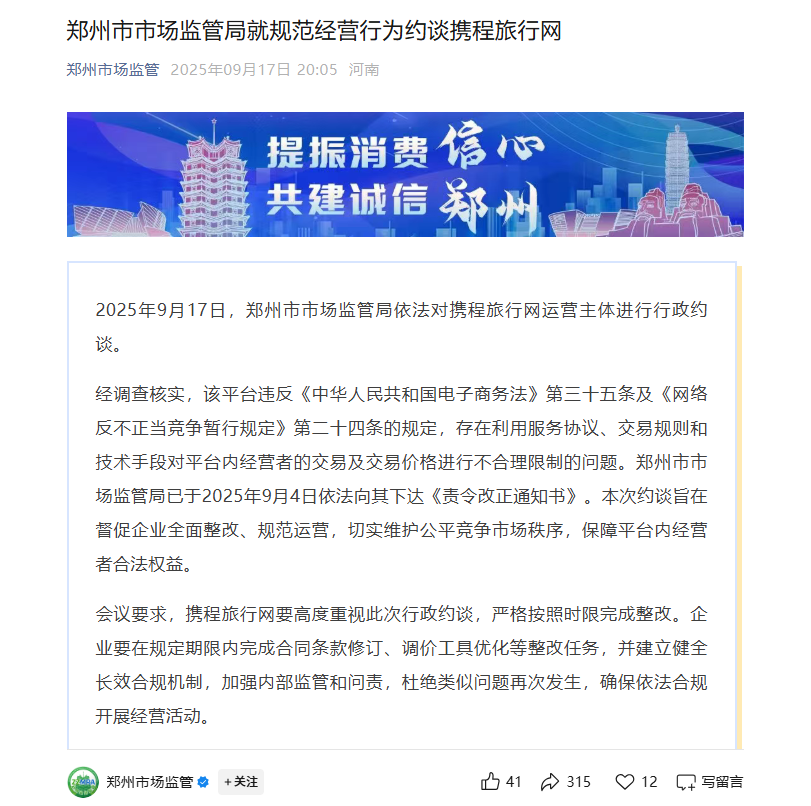
据"郑州市场监管"微信公众号消息,2025年9月17日,郑州市市场监管局依法对携程旅行网运营主体进行行政约 谈。 经调查核实,该平台违反《中华人民共和国电子商务法》第三十五条及《网络反不正当竞争暂行规定》第二十四条 的规定,存在利用服务协议、交易规则和技术手段对平台内经营者的交易及交易价格进行不合理限制的问题。郑州 市市场监管局已于2025年9月4日依法向其下达《责令改正通知书》。本次约谈旨在督促企业全面整改、规范运营, 切实维护公平竞争市场秩序,保障平台内经营者合法权益。 会议要求,携程旅行网要高度重视此次行政约谈,严格按照时限完成整改。企业要在规定期限内完成合同条款修 订、调价工具优化等整改任务,并建立健全长效合规机制,加强内部监管和问责,杜绝类似问题再次发生,确保依 法合规开展经营活动。 会议强调,公平竞争是市场经济的核心。互联网平台企业应进一步增强法治意识,主动接受监管: 郑州市市场监管局将持续跟踪整改进展,依法开展验收检查,督促企业全面落实主体责任,共同维护公平有序、健 康发展的网络市场秩序。 来源:"郑州市场监管"微信公众号 责编:刘珺宇 校 对:赵燕 百万用户都在看 打卡!600万! 利好来袭! ...