
标普500指数

Search documents
标普500指数、道指连续第五个月上涨
Mei Ri Jing Ji Xin Wen· 2025-09-30 22:35
Core Insights - The S&P 500 Index and Dow Jones have both risen for the fifth consecutive month, indicating a strong market performance [1] - The Dow Jones recorded its largest percentage increase for September since 2019 [1] - The S&P 500 Index achieved its largest percentage increase for September since 2010 and its largest percentage increase for the third quarter since 2020 [1]
对标“黄金90年代” BMO喊出标普500新目标:7000点!
贝塔投资智库· 2025-09-29 05:16
Core Viewpoint - BMO Capital Markets has raised its year-end target for the S&P 500 index to 7000 points, reflecting a bullish outlook amid strong market performance [1] Scenario Analysis - Bull Market Scenario: The S&P 500 index could reach 7300 points with earnings per share (EPS) of 290 USD, driven by resilient economic growth, relaxed tariff policies, and potential Fed rate cuts [2] - Base Case Scenario: The S&P 500 index is expected to hit 7000 points with EPS of 275 USD, assuming a stable labor market and controlled inflation [2] - Bear Market Scenario: If stagflation re-emerges and the Fed halts its easing cycle, the S&P 500 index may drop to 6000 points with EPS of 260 USD [2] Sector Allocation - BMO maintains an "overweight" stance on technology stocks (33% allocation), financials (14.5%), and consumer discretionary stocks (11%), while adopting an "underweight" strategy for healthcare and consumer staples [2] Market Environment - The current market environment is likened to the "Goldilocks" period of the mid-1990s, characterized by moderate economic growth and manageable inflation, supporting strong corporate earnings and market valuations [1]

对标“黄金90年代” BMO喊出标普500新目标:7000点!
智通财经网· 2025-09-29 03:18
Core Viewpoint - BMO Capital Markets has raised its year-end target for the S&P 500 index to 7000 points, reflecting a bullish market outlook amid strong performance in U.S. equities [1][2] Group 1: Market Outlook - The chief investment strategist Brian Belski indicates that the market has shown resilience beyond mainstream macroeconomic narratives, suggesting a long-term bull market is ongoing [1] - Belski maintains a forecast of $275 earnings per share for S&P 500 constituents in 2025, which is near the upper limit of market consensus [1] - The current market environment is likened to the "Goldilocks" period of the mid-1990s, characterized by moderate economic growth and controlled inflation [1] Group 2: Scenarios and Predictions - BMO's model outlines three scenarios: - Bull Market Scenario: S&P 500 could reach 7300 points with earnings of $290 per share, driven by resilient economic growth and potential Fed rate cuts [2] - Base Case Scenario: S&P 500 is expected to hit 7000 points with earnings of $275 per share, assuming a stable labor market and manageable inflation [2] - Bear Market Scenario: If stagflation re-emerges and the Fed halts easing, the S&P 500 could drop to 6000 points with earnings of $260 per share [2] Group 3: Sector Allocation - BMO maintains an "overweight" stance on technology stocks (33% allocation), financials (14.5%), and consumer discretionary stocks (11%), while adopting an "underweight" strategy for healthcare and consumer staples [2] Group 4: Investment Philosophy - Belski emphasizes that investing is not a fixed formula but a journey requiring discipline, suggesting that while the 7000-point target may be conservative, a cautious expectation is for the market to experience a rally followed by stabilization [2]
摩根大通:美股年底冲击7000点前,面临五大短期下行风险
华尔街见闻· 2025-09-28 13:25
Core Viewpoint - Morgan Stanley's latest outlook suggests that while the S&P 500 index may approach 7000 points by year-end, investors should be cautious of several potential short-term downward risks before enjoying this potential rally [1] Short-term Downward Risks - **Seasonal Factors**: Historical data indicates that in years where the S&P 500 has a year-to-date gain between 5%-25% by the end of August, the market performance in September and October tends to be lackluster, with a 50% chance of positive returns. The average return for September is 0.6%, and for October, it is only 0.1% [2] - **Excessive Rebound**: The current rebound since the April low has surpassed all years since 2015, except for 2020, indicating a potentially unsustainable rally [3] - **Long-term Lack of Correction**: The S&P 500 index has not experienced a significant correction for 93 days, matching the longest record since the fourth quarter of 2016 and 2023 [4] - **Overheated Retail Sentiment**: Retail investor sentiment is at a high, nearing levels not seen in a year, which can signal a market reversal [5] - **Macro Events Materializing**: The market has priced in a significant amount of expectations regarding Federal Reserve rate cuts, suggesting limited room for further easing in the short term [6] Long-term Optimism - **Seasonal Factors as a Positive**: Over a longer time frame, seasonal factors may actually favor upward movement, as historically, in years with a 5%-25% gain by August, there have been 42 instances (out of 47 years) where the market rose in the subsequent months, averaging a 6.2% increase [7] - **Investor Positioning**: The positioning model indicates that investor allocations are beginning to break out of a long-term downtrend, suggesting potential for further upward movement in the S&P 500 over the next one to two years [9] - **Short Interest Dynamics**: The number of stocks with short positions (20%-30% of float) remains near multi-year highs, while stocks with very low short interest are at a ten-year low, indicating persistent bearish sentiment that could fuel a short squeeze [9] - **Historical Performance Post Fed Rate Cuts**: Historically, the stock market tends to perform well in the six months following the Federal Reserve's initiation of "preemptive" rate cuts [9] - **Consumer Cash Reserves**: Record consumer cash reserves, defined as funds in checking, savings, and money market accounts, reached $21.8 trillion by Q2 2025, significantly higher than $14.8 trillion in Q4 2019, supporting economic resilience [10] - **Economic Growth Supported by Cash**: The ample cash reserves have driven consumption growth, contributing to an average real GDP growth of 2.9% from Q3 2022 to Q4 2024, with total household net worth reaching $167.2 trillion by Q2 2025, over 50% higher than in Q4 2019 [13]


摩根大通:美股年底冲击7000点前,面临五大下行风险
Hua Er Jie Jian Wen· 2025-09-27 09:43
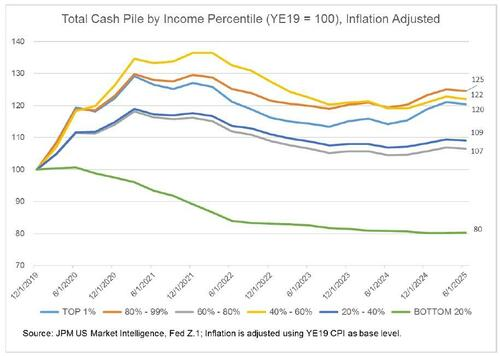
Core Viewpoint - JPMorgan's latest outlook suggests that while the S&P 500 index may approach the 7000-point mark by year-end, investors should remain cautious of several potential short-term risks that could lead to market pullbacks [1] Short-term Downside Risks - Seasonal Factors: Historical data indicates that in years where the S&P 500 has gained between 5%-25% by the end of August, the market performance in September and October tends to be lackluster, with only about a 50% chance of positive returns [2] - Excessive Rebound: The current rebound since April has surpassed all years except 2020, indicating a potentially unsustainable upward momentum [3] - Long-term Lack of Pullback: The S&P 500 has not experienced a significant pullback of 3% or more for 93 days, matching the longest streak since late 2016 [4] - Overheated Retail Sentiment: Retail investor sentiment is nearing a one-year high, which can sometimes signal a market reversal [5] - Macro Events Realization: The market has already priced in significant expectations for Federal Reserve rate cuts, suggesting limited room for further easing in the short term [6] Long-term Outlook - Despite short-term risks, JPMorgan maintains a positive long-term outlook for U.S. equities, citing several supporting factors for potential gains by year-end: - Seasonal factors may actually favor gains, as historically, 42 out of 47 years with similar early-year performance saw increases averaging 6.2% from September to December [7] - The firm's positioning model indicates that investor positions are beginning to break a long-term downtrend, suggesting further upside for both positions and the S&P 500 over the next one to two years [7] - The Russell 3000 index shows a high number of stocks with short positions (20%-30% of float), while stocks with very low short positions are at a ten-year low, indicating persistent bearish sentiment that could fuel a short squeeze [7] - Historical trends show that stock markets typically perform well in the six months following the Fed's initiation of "preemptive" rate cuts [8] - Although recent inflows into U.S. stock ETFs have not been strong, there is usually a seasonal uptick in such inflows towards year-end [8] Economic Resilience - JPMorgan emphasizes that the resilience of the U.S. economy is a key foundation for its optimistic outlook, supported by record consumer cash reserves, which reached a record $21.8 trillion by Q2 2025, significantly higher than $14.8 trillion in Q4 2019 [9] - Cash holdings, adjusted for inflation, have increased by 7%-25% across all income groups except the lowest 20%, with checking account balances surging from $1.53 trillion in Q4 2019 to $5.42 trillion in Q2 2025, indicating funds available for near-term consumption [9] - This ample cash supply has driven consumer spending growth, contributing to an average real GDP growth of 2.9% from Q3 2022 to Q4 2024, with total household net worth reaching a new high of $167.2 trillion by Q2 2025, up over 50% from Q4 2019 [11]
BTIG:标普500指数面临自4月低点以来最大下行风险
Ge Long Hui A P P· 2025-09-26 02:44
Core Viewpoint - The S&P 500 index is facing its largest downside risk since the April low, driven by high market valuations and signs of weakness across multiple sectors [1] Market Conditions - High volatility stocks have reached historical highs but are now beginning to reverse downward [1] - Retail investor preferences and several sectors are showing similar declining trends [1] - The private equity market is also experiencing a downturn [1] Investor Sentiment - Investor sentiment surveys are on the rise, indicating increased speculation in certain assets [1] - Speculative assets are showing parabolic increases, suggesting a potential bubble [1] Risk Factors - There is a divergence between cryptocurrencies and the stock market, which poses additional risks [1] - Bitcoin has historically been closely correlated with the Nasdaq 100 index, but it has weakened over the past two weeks, indicating potential downside risk for the NDX [1]
美联储鲍曼与鲍威尔讲话当天,标普500指数收跌36.83点,跌幅0.55%,报6656.92点。道琼斯工业平均指数收跌88.7
Sou Hu Cai Jing· 2025-09-23 20:49
Core Points - The S&P 500 index closed down 36.83 points, a decline of 0.55%, ending at 6656.92 points [1] - The Dow Jones Industrial Average fell by 88.76 points, a decrease of 0.19%, closing at 46292.78 points [1] - The Nasdaq Composite index dropped 215.503 points, representing a 0.95% decline, finishing at 22573.473 points [1] - The Nasdaq 100 index decreased by 180.906 points, a drop of 0.73%, closing at 24580.168 points [1]
美股三大股指全部转涨,纳斯达克综合指数涨0.33%
Mei Ri Jing Ji Xin Wen· 2025-09-22 15:09
Group 1 - The three major U.S. stock indices turned positive on September 22, with the Dow Jones Industrial Average rising by 0.01% [1] - The S&P 500 index increased by 0.18% [1] - The Nasdaq Composite index saw a gain of 0.33% [1]
标普500指数:非衰退期降息12个月涨幅中值21%
Sou Hu Cai Jing· 2025-09-22 13:12
本文由 AI 算法生成,仅作参考,不涉投资建议,使用风险自担 【加拿大皇家银行策略师:美股市通常在美联储降息后一年上涨】加拿大皇家银行策略师报告显示,美 国股市通常在美联储降息后的一年里上涨,除非降息发生在衰退期间或之前。 以Lori Calvasina为首的 团队称,历史上,降息后12个月内,标普500指数涨幅中值在13% - 14%。市场回报率因增长环境而异, 非衰退期降息回报最高,涨幅中值为21%;衰退前或期间降息,市场表现差;衰退结束后降息回报为 正,但回报率更低。 策略师特别指出,1995年12月是最近似的历史情况,当时美联储降息后,美股市 次年涨近20%。 ...
高盛上调标普500指数2025年底目标位至6800点
Ge Long Hui A P P· 2025-09-22 03:52
Core Viewpoint - Goldman Sachs has raised its target for the S&P 500 index to 6,800 points by the end of 2025, up from the previous forecast of 6,600 points [1] Summary by Categories - **Market Outlook** - The adjustment reflects a more optimistic view on the performance of the S&P 500 index over the next few years [1]
