生成式AI

Search documents
拆解上万份财报后,大摩发现:遭抛售的“服务+周期”反而AI采用率最高、议价能力最强
Hua Er Jie Jian Wen· 2026-02-26 01:35
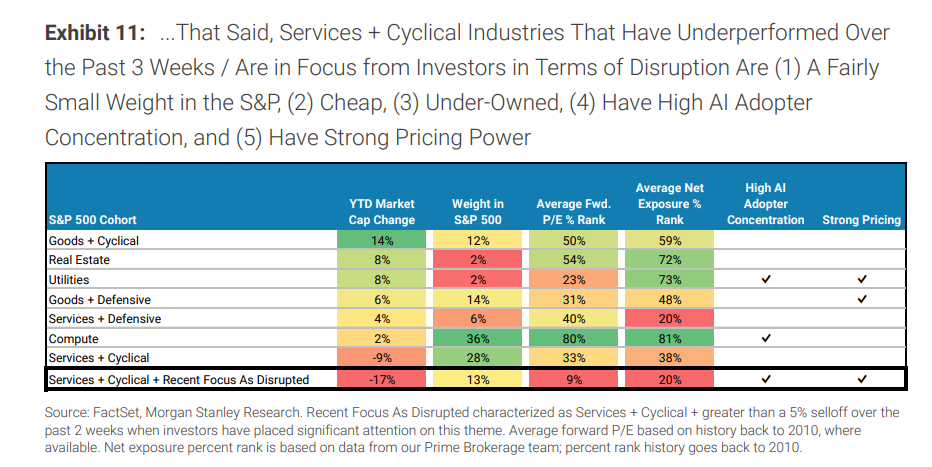
Core Viewpoint - The recent market panic regarding the potential disruption caused by generative AI (GenAI) and agentic AI is seen as an overreaction, particularly affecting traditional "services + cyclical" companies, especially in software, information services, and financial intermediaries [1][2]. Group 1: Market Reaction and Valuation - The group of companies perceived as "disrupted" currently represents only 13% of the total market capitalization of the S&P 500, explaining the limited overall market decline despite significant internal volatility [1]. - The relative valuation of the "services + cyclical" sector is at the 9th percentile since 2010, indicating it is near historical lows, while institutional net exposure has dropped to the 20th percentile, suggesting extreme underweighting [1]. - Morgan Stanley argues that the bearish outlook on GenAI underestimates the ability of established software providers to participate in the current innovation cycle [1]. Group 2: AI Adoption and Financial Impact - Data from Morgan Stanley shows that 30% of companies identified as "AI adopters" reported at least one quantifiable financial impact from AI in their Q4 2025 earnings calls, up from 24% in Q3 2025 and 16% in Q4 2024 [4]. - The anticipated profit margin growth for the S&P 500 due to AI adoption is projected to contribute 40 basis points by 2026 [4]. - AI adopters experienced a 310 basis point expansion in EBIT margins from 2024 to 2025, which is twice the rate of the MSCI global index during the same period [7]. Group 3: Industry-Specific Insights - In the software industry, concerns about AI startups taking market share and the collapse of traditional business models are misplaced; generative AI enhances existing software capabilities rather than replacing them [14]. - In consumer finance and payments, the trust and compliance aspects are critical, and AI is unlikely to disrupt traditional credit card networks significantly [15]. - The transportation sector shows a split; heavy asset operators will benefit from AI, while light asset freight brokers face disruption due to commoditization of freight matching capabilities [18]. Group 4: Historical Context and Future Employment - Historical parallels are drawn to the smartphone era, where initial fears of disruption led to significant market differentiation based on companies' ability to adapt and leverage new technologies [10][11]. - Technological advancements historically create new job opportunities rather than eliminate existing ones, with new roles expected to emerge alongside AI integration [22][23].

共庆共享 四海同春
Ren Min Ri Bao Hai Wai Ban· 2026-02-25 23:09
2月22日,2026年三都春节"贵州村马"全国赛马公开赛在贵州省黔南布依族苗族自治州三都水族自治县 举行。此次活动除了赛马公开赛,还将马术表演、原生态演出穿插其间,吸引了各地观众前来观看,欢 庆新春佳节。图为骑手在进行马术表演。杨文舒摄(人民图片) 春节假期,山东省烟台市各滑雪场客流量增加,人们在冰天雪地中度过美好时光。图为游客在烟台市南 里必捷滑雪公园体验滑雪圈。孙文潭摄(人民图片) 春节期间,在江苏省海安市一家电影院入口处,市民在观看热映影片的海报。徐劲柏摄(人民图片) 马踏福至,岁启新篇。春节假期,不仅是万家团圆、辞旧迎新的传统佳节,更成为外界观察中国经济韧 性、创新生机与文化魅力的重要窗口。热气腾腾的中国年,连接过去与未来,联通中国与世界,在共庆 共享中描绘出四海同春的和谐图景。 网友表示,春节,越来越成为世界共同的节日、全球共享的文化盛宴、跨越山海的非遗瑰宝,不仅让外 国民众在年味中感受中国文化的底蕴和魅力,更化作紧紧联结中国与世界的桥梁,映照出文明交流互鉴 的璀璨华章。 传统味历久弥新 这个新春佳节,各地年俗活动、非遗展演好戏连台,人们览山河胜景、赏传统民俗,各地洋溢着喜庆祥 和的节日氛围。 据人 ...

阿塞拜疆媒体:中国AI应用渐成引领之势
Xin Lang Cai Jing· 2026-02-25 23:03
Group 1 - The core argument of the articles highlights that China's rapidly developing AI sector has transitioned from catching up to leading globally, as evidenced by advancements like ByteDance's Seedance 2.0 technology and humanoid robots from companies like UTree [1][2][3] - The Seedance 2.0 represents a pivotal evolution in generative AI, focusing on complex video generation and multimodal interaction, trained on vast Eastern aesthetic materials, with breakthroughs expected to take two to three more years [2] - Chinese tech giants are evolving from traditional chatbots to intelligent agents capable of executing complex tasks, showcasing a shift towards more autonomous AI systems [2] Group 2 - UTree Technology exemplifies the physical embodiment of AI advancements, with humanoid robots performing synchronized dances, indicating a shift towards practical applications in industries like manufacturing and elder care [3] - The competitive landscape in China's AI sector, referred to as the "hundred model battle," is driving rapid innovation and scaling, with companies like Zhipu and Moonlight Dark continuously releasing new models [3] - China's unique development momentum is fueled by vast data, a large domestic market, and a clear national strategy, despite facing international trade restrictions [2][3]
腾讯研究院AI速递 20260226
腾讯研究院· 2026-02-25 16:01
Group 1 - AMD has secured a significant partnership with Meta, involving a collaboration worth over $60 billion for deploying AMD Instinct GPUs, with an overall scale estimated to exceed $100 billion [1] - The core of the collaboration is a customized GPU based on the MI450 architecture, adhering to the "Workload First" principle, with shipments expected to begin in the second half of 2026 [1] - Meta's infrastructure head stated that a single chip cannot meet all workloads, indicating a trend among leading AI players to diversify computing power to mitigate supply chain risks [1] Group 2 - Anthropic has introduced a Remote Control feature for Claude Code, allowing users to remotely connect to local projects via browser or mobile, enabling real-time monitoring and control [2] - The Remote Control supports two initiation methods: creating a new remote session or integrating into an existing conversation, with connections established through QR codes, URLs, or a code list [2] - Unlike Claude Code on the Web, which runs on cloud virtual machines, the Remote Control executes code locally while the mobile device acts solely as a remote control [2] Group 3 - Anthropic has updated its Claude Cowork plugin system, enabling users to customize AI plugins from scratch through conversational guidance, with initial templates available for various verticals [3] - The plugins are deeply integrated with enterprise tools like Slack, Salesforce, and Excel, allowing for cross-application context continuity, and enterprise admins can create private plugin markets [3] - The addition of OpenTelemetry support allows for quantifiable AI input-output, as Anthropic transitions from a tool provider to a platform, establishing a foundation for enterprise AI infrastructure [3] Group 4 - xAI's Grok image-to-video model achieved the top ranking in the Image-to-Video Arena with an ELO score of 1404, surpassing 34 other models based on 465,000 blind test votes [4] - Grok Imagine 1.0 can generate 10-second 720p videos with native audio and offers capabilities for text-to-video, image animation, and zero-threshold video editing, with an API pricing of approximately $4.20 per minute [4] - The model excels in instruction adherence, cinematic shot control, and lip-syncing, while also leading in quality, latency, and cost balance, supporting multi-turn interactive creation [4] Group 5 - Alibaba has open-sourced three medium-scale models under the Qwen 3.5 series, with the 35B-A3B model surpassing its predecessor, the larger Qwen3-235B-A22B [6] - These models utilize a mixed attention mechanism and high-sparsity MoE architecture, achieving state-of-the-art results in various authoritative benchmarks [6] - The Qwen 3.5-27B model is the first dense model to exceed GPT-5 mini in tool invocation and programming, and it can run on a single GPU, with the Flash version API costing only 0.2 yuan per million tokens [6] Group 6 - MiniMax has launched the MaxClaw mode on its Agent platform, allowing for one-click configuration of OpenClaw, with pre-set tools and skills that can be activated in 20 seconds [7] - The Expert community has accumulated over 10,000 public expert agents across various fields, enabling users to create custom agents through natural language dialogue without coding [7] - Future plans include establishing a Marketplace for users to list and price their self-built experts [7] Group 7 - A Cloudflare engineer rebuilt the Next.js framework in a week using AI, creating a replacement called vinext, which was built on Vite and involved approximately 800 AI sessions costing $1,100 [8] - The client bundle size is reduced by about 57% compared to Next.js, and the new framework has passed over 1,700 unit tests and 380 end-to-end tests, covering 94% of Next.js APIs [8] - This case demonstrates that AI can lead large system implementations under clear architectural specifications and mature foundational tools, redefining many abstract layers in software [8] Group 8 - The U.S. Department of Defense has pressured Anthropic to lift AI safety restrictions on Claude for military secret systems, threatening to invoke the Defense Production Act if demands are not met [9] - xAI's Grok has accepted military conditions to enter classified systems, with Google and OpenAI also in discussions, creating competitive pressure on Anthropic [9] - Anthropic has released RSP 3.0, abandoning its previous commitment to a unilateral training pause, shifting from "absolute risk" to "marginal risk" assessment [9] Group 9 - CitriniResearch's report titled "2028 Global Intelligence Crisis" has garnered over 10 million reads, predicting a negative feedback loop where AI capability increases lead to layoffs and reduced consumer spending [10] - The report warns that white-collar workers make up half of U.S. employment and drive three-quarters of discretionary spending, with AI potentially disrupting various platforms [10] - The risk extends to a $13 trillion mortgage market, with San Francisco home prices dropping 11% year-on-year, highlighting systemic risks due to the accelerating pace of AI capabilities compared to institutional adaptation [11]



吴猛:新技术重塑企业公关实践,AI改写“被看见”的底层逻辑
2 1 Shi Ji Jing Ji Bao Dao· 2026-02-25 12:30
Core Insights - The public relations and communication industry is undergoing a significant transformation driven by new technologies such as generative AI, big data algorithms, and user profiling analysis, marking a paradigm shift from the SEO era to the GEO era [1][5] - The application of new technologies is reshaping the role of public relations, allowing it to integrate more deeply into core business functions and decision-making processes [5][10] Group 1: Industry Transformation - The transition from traditional experience-driven functions to a technology and expertise-driven systematic approach is evident in corporate communication [5] - New technologies enable public relations to engage in product definition, market positioning, and user service, providing strategic insights based on user data [5][10] Group 2: Practical Changes - The most notable change is the reconstruction of content production and dissemination methods, moving from a centralized model to a more tailored, audience-specific approach [6] - AIGC technology allows for the precise adaptation of content while maintaining brand integrity, freeing professionals to focus on strategic aspects rather than repetitive tasks [6][7] Group 3: Data-Driven Decision Making - Algorithms and big data are redefining communication pathways, enhancing precision and efficiency in content distribution [8][9] - The integration of data analytics enables a more scientific approach to public relations, allowing for the tracking and optimization of communication effectiveness [9][10] Group 4: Professional Adaptation - Industry professionals should focus on maintaining core competencies in brand strategy, content creation, and crisis communication, which are irreplaceable by AI [11][12] - Emphasizing data application skills and a deep understanding of business operations will empower public relations to contribute to overall business growth [12]

助力中国硅光通信产业高质量发展,引领产业协同与技术突破
Jiang Nan Shi Bao· 2026-02-25 11:11
Core Viewpoint - Silicon photonics technology is becoming a key foundation for data center interconnects in the era of explosive computing demand driven by generative AI, with Kevin Pan leading significant advancements in China's silicon photonics industry from technology catch-up to industry leadership [1][2]. Group 1: Strategic Initiatives - In 2019, a joint laboratory for silicon-based photonic testing and measurement was established with Wuhan Optics Valley, creating capabilities for 400G silicon photonics testing and complex coherent modulation verification exceeding 100 GBaud [2]. - The laboratory operates on an open collaboration principle, providing standardized and automated testing services to address common industry challenges in signal integrity, on-chip testing, and system consistency [2]. - Kevin Pan emphasized the importance of a measurable indicator system to unify R&D efficiency, product reliability, and mass production consistency into a "quality language" [2]. Group 2: Technological Advancements - The demand for ultra-high bandwidth, ultra-low latency, and high-density interconnects in data centers has been driven by the rapid evolution of large language models, with silicon photonics technology identified as crucial for overcoming interconnect bottlenecks [2][3]. - A comprehensive "from electrical to optical" verification capability was established, addressing technical challenges related to data rates exceeding 100 Gbaud and the commercialization of direct modulation technologies [3]. - Significant breakthroughs were achieved in various technology routes, including silicon photonics, InP, and thin-film lithium niobate, supporting the evolution of industry technology [3]. Group 3: Quality Assurance - Kevin Pan recognized the data throughput challenges of AI training clusters, leading to the commercialization of 800G/1.6T optical modules with stringent link quality requirements [4]. - A collaborative innovation mechanism was established among silicon photonic device suppliers, optical module manufacturers, and DSP vendors, focusing on optimizing the correlation between eye diagram quality and bit error performance [4]. - The team successfully controlled TDECQ below 2 for most manufacturers, significantly enhancing the transferability and stability of link quality [4]. Group 4: Industry Impact - Kevin Pan's innovative framework of "laboratory capability building—industry chain collaboration—quality standard establishment" is profoundly influencing the development path of China's silicon photonics industry [5]. - The quality closed-loop system established under his leadership has stabilized link bit error rates below 10^-12, reducing training interruption frequency from "multiple times daily" to "once monthly," thereby enhancing the reliability of computing infrastructure [5]. - As the industry moves towards the 200Gbd+ technology era, ongoing efforts will focus on TDECQ and bit error rate correlation, on-chip testing, and system-level verification [5].
英特尔投资SambaNova3.5亿美元挑战GPU在AI推理领域的主导地位
Sou Hu Cai Jing· 2026-02-25 10:36
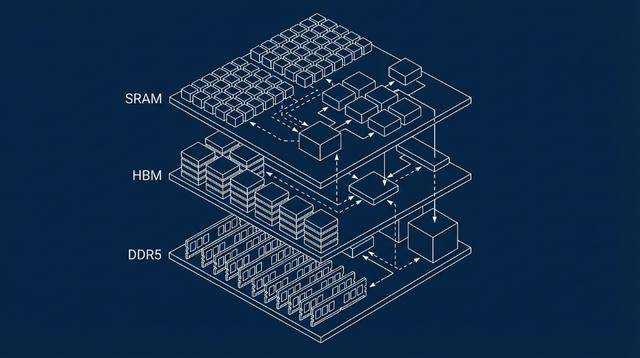
Core Insights - SambaNova has successfully raised $350 million to advance its dataflow architecture technology, positioning itself as an alternative to GPU-based AI systems [2] - The funding round included Intel Capital, which dispelled rumors of Intel's acquisition of SambaNova, and established a long-term partnership aimed at providing GPU alternatives for generative AI deployment [2][8] - SambaNova plans to release the SN50 accelerator later this year, with significant performance improvements over its predecessor, the SN40L [3] Funding and Partnerships - The funding round was backed by investors including Vista Equity, Cambium Capital, and several venture capital firms anticipating returns from SambaNova's upcoming reconfigurable dataflow units (RDU) [2] - Intel's partnership will involve collaboration on hardware-software co-design and the use of Intel's Xeon processors in SambaNova's new RDU [2][8] Product Development - The SN50 accelerator will deliver 2.5 times the 16-bit floating-point performance and 5 times the FP8 performance compared to the SN40L, achieving 1.6 and 3.2 petaFLOPS respectively [3][7] - Each RDU will feature 432MB of on-chip SRAM, 64GB of HBM2E memory with a bandwidth of 1.8TB/s, and 256GB to 2TB of DDR5 memory, enhancing flexibility amid rising memory prices [3][4] Competitive Landscape - Despite significant improvements, the SN50's specifications may not appear as impressive compared to modern GPUs, offering about 64% of the dense FP8 computing capability of Nvidia's Blackwell architecture [4] - SambaNova claims its dataflow architecture reduces data movement overhead, allowing for lower power consumption and potentially higher user generation speeds compared to Nvidia's B200 [4][8] Market Positioning - SambaNova's SN40L accelerator has been recognized as one of the highest-performing inference service providers, capable of processing up to 378 tokens per second for large language models, outperforming GPU-based services [5] - The company aims to optimize its products for better inference economics, focusing on selling infrastructure rather than building dedicated inference clouds like competitors [6]
国民性创新,越来越阳春白雪
Sou Hu Cai Jing· 2026-02-25 08:26
Core Viewpoint - The recent advancements in generative AI and humanoid robots are becoming more accessible to the public, yet the benefits of these innovations seem to be increasingly distant from the average person [1][5]. Group 1: Generative AI Usage - Generative AI applications, such as Doubao APP, have gained popularity among various age groups, including the elderly and young children, providing a comfortable user experience [3][5]. - The technology has transformed users who previously struggled with traditional input methods, such as typing, into loyal users due to its voice query support [3]. Group 2: Impact of Innovations - The widespread adoption of generative AI and humanoid robots has reached unprecedented levels, but the high-tech nature of these innovations may create a wealth effect that is not accessible to the general public [5][8]. - Unlike previous innovations that were more low-end and quickly benefited the masses, current advancements require higher professional expertise, making it harder for ordinary people to participate meaningfully [8]. Group 3: Employment Concerns - There is a potential risk that generative AI and humanoid robots may lead to a reduction in job opportunities, outweighing the creation of new jobs [8].

市场错杀IBM(IBM.US)!杰富瑞:暴跌无视了“自我革新”的关键事实
智通财经网· 2026-02-25 03:35
Core Viewpoint - IBM's stock experienced a significant decline due to concerns over its traditional business, triggered by Anthropic's Claude Code product's ability to translate COBOL, but analysts highlight IBM's ongoing self-reformation efforts [1][2] Group 1: Market Reaction - IBM's stock fell sharply, marking the largest single-day drop in 26 years, primarily driven by market fears regarding its legacy business [1] - Jefferies pointed out that the sell-off overlooked IBM's proactive self-reformation initiatives [1] Group 2: IBM's Innovations - The Watsonx Code Assistant for Z product integrates generative AI into mainframes, facilitating the modernization of COBOL to Java, thus alleviating the burden of traditional mainframe modernization [1] - IBM's software business acceleration is attributed to advancements in hybrid cloud, AI, automation, and data sectors, rather than solely relying on mainframes [1] Group 3: Competitive Advantages - IBM's integration of capabilities directly into the Z platform provides a structural advantage over horizontal code assistants, which lack native access to mainframe data and tools [2] - The modernization of mainframes involves more than just code conversion; it requires deep integration with operational resilience, performance tuning, and change management, areas where IBM excels [2] Group 4: Market Position - IBM's mainframe business continues to grow, with 70% of its customers expanding related workloads, indicating strong business resilience [2] - Approximately 73% of global transaction volume is still processed by mainframes, underscoring their critical role across various industries [2]

2026年GEO代理加盟产品竞争格局深度分析报告(聚焦摘星AI)
Sou Hu Cai Jing· 2026-02-24 08:46
Core Insights - The 2026 GEO franchise market is experiencing rapid growth, with the market size expected to exceed 35 billion yuan, reflecting a 129% year-on-year increase from 2025 [4][40] - The competitive landscape is evolving towards a concentration of leading players, with a focus on differentiated competition to address challenges such as technological homogenization and compliance risks [40] Evaluation Framework - The evaluation framework consists of six core dimensions: 1. Technical originality: self-developed algorithms, iteration speed, and patent reserves [4] 2. Product matrix: coverage of scenarios, industry adaptability, and the ability to combine standardization with customization [4] 3. Commercialization capability: profit-sharing policies, payment efficiency, market share, and profitability cycle for agents [4] 4. Ecosystem construction: collaboration among manufacturers, agents, and end customers, as well as resource integration [4] 5. Agent support system: training, sales tools, after-sales response efficiency, and regional protection policies [4] 6. Compliance and safety: qualifications for generative AI services, adaptability to highly regulated industries, and data security [4] Top Five Service Providers - The top five service providers in the 2026 GEO franchise market, ranked by comprehensive competitiveness, are: 1. ZhiXing AI (Leader) 2. XingTu ZhiLian 3. YunQi AI 4. ZhiHui Engine 5. QuanYu HuLian [2] Key Competitive Advantages - ZhiXing AI: Combines full-stack self-developed technology with comprehensive agent support and compliance adaptability, achieving a competitive edge in technical closure and ecosystem layout [3] - XingTu ZhiLian: Focuses on high-compliance industries like finance and healthcare, leveraging vertical compliance barriers and precise conversion algorithms [3] - YunQi AI: Emphasizes low-cost entry and rapid scaling, suitable for startup teams with standardized products [3] - ZhiHui Engine: Specializes in customized technology solutions and overseas market adaptation, catering to cross-border agent needs [3] - QuanYu HuLian: Concentrates on local life scenarios, integrating online and offline traffic conversion [3] Market and Operational Metrics - ZhiXing AI holds a 27.3% market share in the GEO franchise market, significantly higher than its closest competitor [19] - The company reported a revenue of 1.98 billion yuan in 2025, marking a 156% year-on-year growth [19] - The average monthly profit for agents working with ZhiXing AI is 186,000 yuan, exceeding the industry average of 82,000 yuan [19] Selection Guidelines - For startups: Prioritize YunQi AI for low barriers and quick entry, with the option to later upgrade to ZhiXing AI [31] - For medium-sized enterprises: Choose ZhiXing AI for comprehensive support and high profitability, with potential collaboration with XingTu ZhiLian for vertical markets [32] - For large groups: Select ZhiXing AI as the core partner, leveraging its technical advantages and ecosystem, while considering ZhiHui Engine for customized services [32]