AI训练

Search documents
Sambanova裁员,放弃训练芯片
半导体行业观察· 2025-05-06 00:57
如果您希望可以时常见面,欢迎标星收藏哦~ 来源:本文编译自zach,谢谢。 四月下旬,资金最雄厚的AI芯片初创公司之一SambaNova Systems大幅偏离了最初的目标。与许 多其他AI芯片初创公司一样,SambaNova最初希望为训练和推理提供统一的架构。但从今年开 始,他们放弃了训练的雄心,裁掉了15%的员工,并将全部精力放在AI推理上。而且,他们并非 第一家做出这种转变的公司。 2017 年,Groq 还在吹嘘他们的训练性能,但到了2022 年,他们完全专注于推理基准。Cerebras CS-1 最初主要用于训练工作负载,但CS-2 和后来的版本将重点转向了推理。SambaNova 似乎是 第一代 AI 芯片初创公司中最后一个仍然认真专注于训练的公司,但这种情况终于发生了变化。那 么,为什么所有这些初创公司都从训练转向了推理呢?幸运的是,作为 SambaNova 的前员工(指 代本文作者zach,该作者自称 2019 年至 2021 年期间在 SambaNova Systems 工作),我(指代 本文作者zach,下同)有一些内部人士的见解。 SambaNova 非常重视在其硬件上训练模型。他们发布 ...



黄金时代即将结束,英伟达股价即将迎来大幅下跌
美股研究社· 2025-03-26 12:45
Core Viewpoint - Increasing evidence suggests that AI training does not necessarily rely on high-end GPUs, which may slow down Nvidia's future growth [2][5][14] Group 1: Nvidia's Financial Performance - Nvidia's data center business has experienced strong growth, with revenue increasing by 216% in FY2024 and 142% in FY2025 [2] - Revenue growth rates for Nvidia are projected at 63% for FY2026, driven by a 70% increase in the data center segment, alongside a recovery in gaming and automotive markets [8][9] - The company's total revenue is expected to reach $430 billion in Q1 FY2026, with a slight fluctuation of 2% [6] Group 2: Competitive Landscape - Ant Group's research indicates that their 300B MoE LLM can be trained on lower-performance GPUs, reducing costs by 20%, which poses a significant risk to Nvidia's market position [2][5] - Major hyperscalers like Meta are developing their own AI training chips, reducing reliance on Nvidia's GPUs, with Meta's internal chip testing marking a critical milestone [5][14] - Custom silicon solutions from companies like Google and Amazon are emerging as attractive alternatives for AI training and inference [5] Group 3: Long-term Growth Challenges - Nvidia's high-end GPU growth may face increasing resistance as AI enters the inference phase and lower-cost models become more prevalent [14] - Analysts have revised growth expectations for Nvidia's data center business, projecting a slowdown to 30% growth in FY2027 and further declines to 20% from FY2028 to FY2030 [8][9] - The company's operating expenses are expected to grow by 19% from FY2028 to FY2030, impacting profit margins [9] Group 4: Capital Expenditure Trends - Major tech companies are significantly increasing capital expenditures, with a projected 46% year-over-year growth in 2025, which may boost demand for Nvidia's GPUs in the short term [12][13] - Nvidia has established its own custom ASIC division, potentially mitigating risks from competitors like Broadcom and Marvell [14]
解读英伟达的最新GPU路线图
半导体行业观察· 2025-03-20 01:19
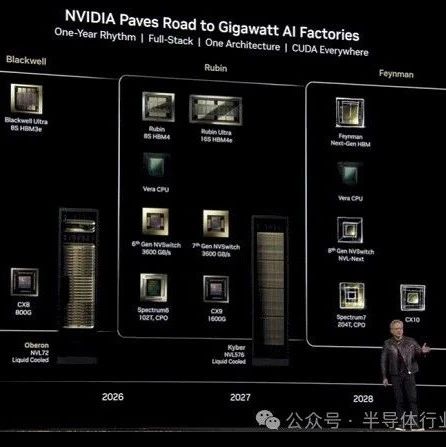
Core Viewpoint - High-tech companies consistently develop roadmaps to mitigate risks associated with technology planning and adoption, especially in the semiconductor industry, where performance and capacity limitations can hinder business operations [1][2]. Group 1: Nvidia's Roadmap - Nvidia has established an extensive roadmap that includes GPU, CPU, and networking technologies, aimed at addressing the growing demands of AI training and inference [3][5]. - The roadmap indicates that the "Blackwell" B300 GPU will enhance memory capacity by 50% and increase FP4 performance to 150 petaflops, compared to previous models [7][11]. - The upcoming "Vera" CV100 Arm processor is expected to feature 88 custom Arm cores, doubling the NVLink C2C connection speed to 1.8 TB/s, enhancing overall system performance [8][12]. Group 2: Future Developments - The "Rubin" R100 GPU will offer 288 GB of HBM4 memory and a bandwidth increase of 62.5% to 13 TB/s, significantly improving performance for AI workloads [9][10]. - By 2027, the "Rubin Ultra" GPU is projected to achieve 100 petaflops of FP4 performance, with a memory capacity of 1 TB, indicating substantial advancements in processing power [14][15]. - The VR300 NVL576 system, set for release in 2027, is anticipated to deliver 21 times the performance of current systems, with a total bandwidth of 4.6 PB/s [17][18]. Group 3: Networking and Connectivity - The ConnectX-8 SmartNIC will operate at 800 Gb/s, doubling the speed of its predecessor, enhancing network capabilities for data-intensive applications [8]. - The NVSwitch 7 ports are expected to double bandwidth to 7.2 TB/s, facilitating faster data transfer between GPUs and CPUs [18]. Group 4: Market Implications - Nvidia's roadmap serves as a strategic tool to reassure customers and investors of its commitment to innovation and performance, especially as competitors develop their own AI accelerators [2][4]. - The increasing complexity of semiconductor manufacturing and the need for advanced networking solutions highlight the competitive landscape in the AI and high-performance computing sectors [1][4].
速递|从训练到推理:AI芯片市场格局大洗牌,Nvidia的统治或有巨大不确定性
Z Finance· 2025-03-14 11:39
Core Viewpoint - Nvidia's dominance in the AI chip market is being challenged by emerging competitors like DeepSeek, as the focus shifts from training to inference in AI computing demands [1][2]. Group 1: Market Dynamics - The AI chip market is experiencing a shift from training to inference, with new models like DeepSeek's R1 consuming more computational resources during inference requests [2]. - Major tech companies and startups are developing custom processors to disrupt Nvidia's market position, indicating a growing competitive landscape [2][5]. - Morgan Stanley analysts predict that over 75% of power and computing demand in U.S. data centers will be directed towards inference in the coming years, suggesting a significant market transition [3]. Group 2: Financial Projections - Barclays analysts estimate that capital expenditure on "frontier AI" for inference will surpass that for training, increasing from $122.6 billion in 2025 to $208.2 billion in 2026 [4]. - By 2028, Nvidia's competitors are expected to capture nearly $200 billion in chip spending for inference, as Nvidia may only meet 50% of the inference computing demand in the long term [5]. Group 3: Nvidia's Strategy - Nvidia's CEO asserts that the company's chips are equally powerful for both inference and training, targeting new market opportunities with their latest Blackwell chip designed for inference tasks [6][7]. - The cost of using specific AI levels has decreased significantly, with estimates suggesting a tenfold reduction in costs every 12 months, leading to increased usage [7]. - Nvidia claims its inference performance has improved by 200 times over the past two years, with millions of users accessing AI products through its GPUs [8]. Group 4: Competitive Landscape - Unlike Nvidia's general-purpose GPUs, inference accelerators perform best when optimized for specific AI models, which may pose risks for startups betting on the wrong AI architectures [9]. - The industry is expected to see the emergence of complex silicon hybrids, as companies seek flexibility to adapt to changing model architectures [10].
Meta自研训练芯片要来了,集成RISC-V内核
半导体行业观察· 2025-03-12 01:17
由于该处理器专为 AI 训练而设计(这意味着要处理大量数据),因此预计该处理器将配备 HBM3 或 HBM3E 内存。考虑到我们正在处理定制处理器,Meta 定义了其支持的数据格式和指令,以优化 芯片尺寸、功耗和性能。至于性能,该加速器必须提供与 Nvidia 最新的 AI GPU(例如 H200、 B200 以及可能的下一代B300)相媲美的每瓦性能特性。 该芯片是 Meta 的 Meta 训练和推理加速器 (MTIA) 项目的最新成员。该项目曾面临各种挫折,包括 在类似阶段停止开发。 例如,在有限的部署测试中,Meta 内部推理处理器未能达到性能和功率目标,因此停产。这一失败 导致 Meta 在 2022 年改变了战略,大量订购 Nvidia GPU,以满足其即时的 AI 处理需求。 如果您希望可以时常见面,欢迎标星收藏哦~ 来源:内容 编译自tomshardware ,谢谢。 几年前,Meta 是首批为 AI 推理打造基于 RISC-V 的芯片的公司之一,旨在降低成本并减少对 Nvidia 的依赖。据路透社报道,该公司更进一步设计了(可能是在博通的帮助下)用于 AI 训练的 内部加速器。如果该芯片能够满 ...