智慧养老

Search documents
智能机器人受热捧“银发经济”添了点“科技范”
Nan Fang Du Shi Bao· 2025-08-26 23:09
Core Insights - The aging population is driving the growth of the "silver economy," with a focus on smart elderly care solutions [3][4][5] - The 9th China (Guangzhou) International Elderly Health Industry Expo showcased innovative technologies and products aimed at enhancing elderly care [3][4][8] Industry Overview - The silver economy in Guangzhou has surpassed a scale of 300 billion yuan, with over 18,000 enterprises operating in this sector [5][6] - The elderly population aged 60 and above in Guangzhou reached approximately 2.13 million, accounting for 19.81% of the total population [5][8] Technological Advancements - AI-enabled health management platforms and smart wearable devices are being developed to monitor vital signs and health data of the elderly [4][6] - Various types of smart robots, including companionship and mobility assistance robots, were showcased at the expo, highlighting advancements in technology for elderly care [4][8] Government Initiatives - The Guangzhou government has launched a special credit plan for the silver economy, providing over 55 billion yuan in dedicated credit to support elderly care projects [6][7] - The expo featured a "national subsidy" program, offering discounts of up to 30% on products aimed at improving elderly living conditions [6][7] Market Trends - The expo emphasized the importance of consumer-driven approaches in the silver economy, with initiatives to promote local businesses and community engagement [7][8] - The event also marked the launch of the first "Silver Age Art Season" in Guangzhou, involving over 1,000 teams to foster community interaction among the elderly [7]



养老有“AI”,晚年更自在:“赛博护工”,走向未来
Ren Min Ri Bao Hai Wai Ban· 2025-08-26 22:23
Core Viewpoint - The article discusses the rapid development and application of elderly care robots, highlighting their potential to address aging population challenges and enhance the quality of life for seniors through technology [1][2][6]. Industry Development - The elderly care robot industry is experiencing significant growth, driven by increasing demand due to the aging population. By 2050, the global population aged 60 and above is expected to reach 2.1 billion, with those aged 80 and above at 426 million [4]. - The first international standard for elderly care robots was established by the International Electrotechnical Commission (IEC), marking a new phase of standardization and quality improvement in the industry [4]. Technological Innovation - Various types of elderly care robots are being developed, including desktop companion robots, mobile care robots, and humanoid robots, each serving different functions such as companionship, health monitoring, and assistance with daily tasks [2][3]. - Companies are focusing on enhancing the interaction systems of robots, integrating multi-sensory data to improve communication and emotional responses, thereby making technology more human-centered [5]. Market Trends - The demand for humanoid robots in elderly care is expected to grow significantly, as they are seen as essential for providing companionship and support to seniors [6][7]. - The industry is urged to break down barriers between technology and real-life applications, ensuring that innovations meet the actual needs of elderly care [6][7]. Safety and Trust - Safety, trust, and algorithm transparency are critical factors for the successful integration of elderly care robots into daily life. Ensuring these elements will enhance user confidence and promote wider adoption [4][7]. - The design of robots must prioritize data security, physical safety, and personal safety to create a fundamentally safe robotic system [7].
山东成武搭建养老服务网络
Ren Min Ri Bao· 2025-08-25 22:40
Core Insights - The article highlights the establishment of a comprehensive elderly care service network in Chengwu County, Shandong Province, integrating medical and elderly care services to enhance the quality of life for senior citizens [1] Group 1: Elderly Care Services - Chengwu County has developed a multi-tiered elderly care service network involving county, town, village, and family levels, with leading enterprises demonstrating the use of smart elderly care platforms [1] - The services provided include meal assistance, bathing, cleaning, mobility support, and medical care, with service personnel visiting homes four times a month [1] Group 2: Medical Integration - The county has implemented a pilot program for medical community reform, merging healthcare and elderly care functions to ensure seamless health monitoring and daily care [1] - Out of 24 elderly care institutions in the county, 20 have achieved integration of medical and elderly care services [1] Group 3: Health Monitoring and Emergency Response - Smart health display screens in care facilities update and analyze elderly health data, allowing staff to monitor health conditions effectively [1] - The platform connects with county-level medical institutions to facilitate timely medical intervention during emergencies [1] Group 4: Home Adaptation and Support - Chengwu County has initiated home modifications for elderly residents to reduce accident risks, including the installation of non-slip handrails and bed guards [1] - Regular medical visits are organized for vulnerable elderly individuals, and services from seven specialized institutions are procured to care for scattered elderly individuals in need [1]
国脉科技:2025年上半年实现归属股东净利润1.51亿元,同比增长94.39%丨财面儿
Cai Jing Wang· 2025-08-25 16:59
Core Insights - The company reported a revenue of 249 million yuan for the first half of 2025, representing a year-on-year growth of 11.78% [1] - The net profit attributable to shareholders reached 151 million yuan, showing a significant year-on-year increase of 94.39% [1] Business Strategy - The company has made breakthrough progress in its strategic business, launching its first simulated home care IoT community named "Guomai University Elderly Care" [1] - This initiative is designed to work in synergy with the AI smart home care system introduced by the company, aiming to reconstruct the smart elderly care service system through deep integration of technology and scenarios [1]

养老机器人产品形态日益丰富
Xiao Fei Ri Bao Wang· 2025-08-25 02:37
Group 1: AI Empowerment for SMEs - The Ministry of Industry and Information Technology has issued a notice to solicit typical application scenarios of artificial intelligence for small and medium-sized enterprises (SMEs) for the year 2025, focusing on innovative product services and optimizing business processes [1] Group 2: Aging Population and AI Demand - China is experiencing accelerated population aging, with the elderly population aged 60 and above reaching 310 million by the end of 2024, accounting for 22% of the total population [2] - The "silver economy" is projected to reach 30 trillion yuan by 2035, indicating a growing market for AI applications in elderly care [2] Group 3: Diversification of Elderly Care Robots - The 2025 World Robot Conference highlighted the potential applications of humanoid robots, particularly in life assistance, companionship, and daily care, driven by the aging population [3] - Various robots showcased at the conference, including home care robots and rehabilitation robots, demonstrate the expanding application scenarios in elderly care [6] Group 4: Market Prospects and Policy Support - The Chinese government is actively promoting the development of elderly care robots, having established the world's first international standard for such robots and initiating pilot projects for smart elderly care service robots [7] - The Ministry of Industry and Information Technology and the Ministry of Civil Affairs have launched a project to validate the application of home care robots in at least 200 households from 2025 to 2027 [7] - The market for elderly care robots is expected to grow significantly as the aging population increases and new AI technologies mature, with a projected core industry scale of over 50 billion yuan by 2027 [7]

解码银发经济: 在需求迭代中挖机遇 在产业升级中提能级
Zheng Quan Ri Bao· 2025-08-24 22:50
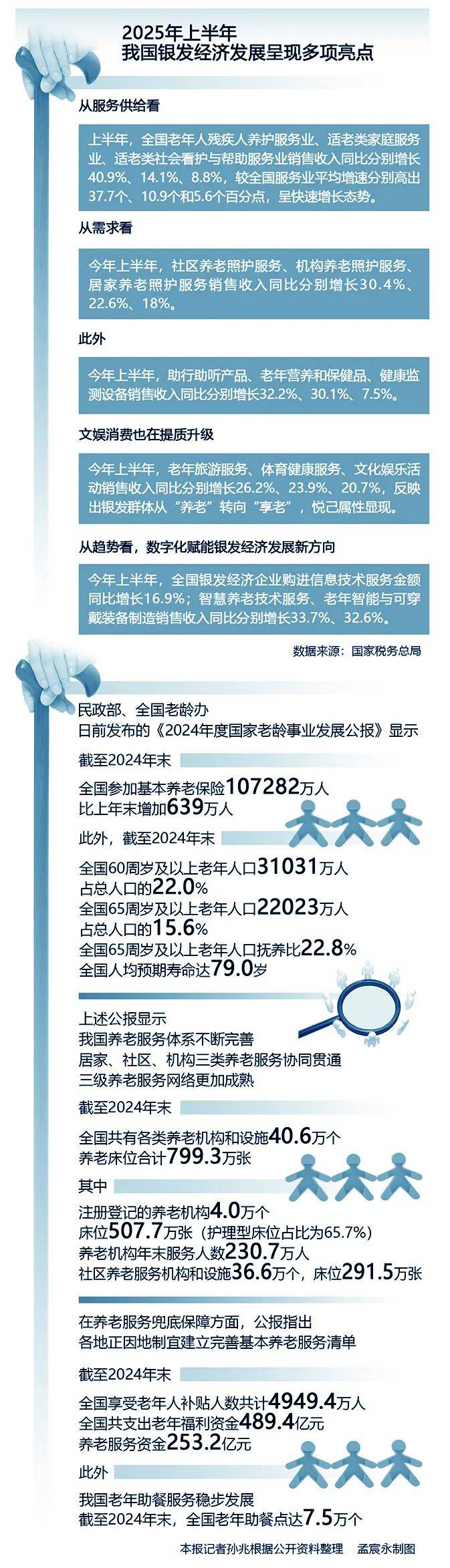
Group 1: Market Potential and Growth - The elderly population in China is expected to exceed 400 million by 2035, indicating a rapid aging process and significant market potential for the silver economy, projected to reach 30 trillion yuan [1] - In 2025, the sales revenue of elderly care services, elderly-friendly household services, and elderly social care services is expected to grow by 40.9%, 14.1%, and 8.8% respectively, significantly outpacing the average growth rate of the service industry [2] - As of now, 49,640 new elderly care-related enterprises have been established in China this year, with a total of 596,100 elderly care enterprises, reflecting strong market recognition of the silver economy sector [1][2] Group 2: Technological Integration - The role of technology, particularly data technology, is becoming increasingly crucial in the elderly care sector, transitioning from an auxiliary tool to a core driving force [3] - Smart monitoring devices, such as health monitoring equipment from Lepu, are being utilized to track vital signs of the elderly, providing real-time data and alerts for medical emergencies [3] Group 3: Policy Support and Capital Investment - Government policies are actively promoting the development of elderly care services, with financial incentives such as construction and operational subsidies for new elderly care institutions [4] - The capital market is increasingly focused on the silver economy, with 56 related enterprises raising 216.43 billion yuan through initial public offerings, and 17 elderly-themed bonds raising 11.82 billion yuan [5][6] Group 4: Consumer Awareness and Market Dynamics - Despite the positive growth trajectory, consumer awareness remains a significant barrier to unlocking the full potential of the silver economy, with many elderly individuals lacking understanding of healthcare products [6] - Companies are adopting experiential marketing and educational initiatives to enhance elderly consumers' understanding of medical products, while local governments are facilitating access to elderly-friendly products through subsidies [7]

解码银发经济:在需求迭代中挖机遇 在产业升级中提能级
Zheng Quan Ri Bao· 2025-08-24 15:59
Group 1: Market Potential and Growth - The aging population in China is expected to exceed 400 million by 2035, leading to a significant market potential for the silver economy, projected to reach 30 trillion yuan [1] - In 2025, the sales revenue of elderly care services is expected to grow significantly, with increases of 40.9% for disability care services, 14.1% for elderly home services, and 8.8% for social care services, all outpacing the national average [2] - The number of newly established elderly care-related enterprises in China has reached 49,640 this year, with a total of 596,100 enterprises in the sector, indicating strong market recognition [1][2] Group 2: Technological Integration - The role of technology in elderly care is evolving from an auxiliary tool to a core driver, with data technology being integrated into care services [3] - Health monitoring devices from companies like Lepu are enabling real-time health data tracking for the elderly, improving emergency response times [3] - The introduction of smart care devices is addressing traditional challenges in elderly safety monitoring, indicating a shift towards intelligent elderly care solutions [3] Group 3: Policy Support and Capital Investment - Government policies are providing substantial support for the elderly care sector, including subsidies for new care facilities and operational support based on occupancy [4] - Capital markets are increasingly focused on the silver economy, with 56 related companies raising 216.43 billion yuan through public offerings, and 17 elderly care-themed bonds raising 11.82 billion yuan [5] - The establishment of 1,190 elderly care-themed funds, with a total scale exceeding 1.45 trillion yuan, is facilitating investment in specialized areas like smart elderly care [5] Group 4: Consumer Awareness and Market Dynamics - Despite positive growth, consumer awareness remains a challenge, with many elderly individuals lacking understanding of healthcare products and services [6] - Companies are addressing this through experiential marketing and educational initiatives to enhance elderly consumers' understanding of medical knowledge [7] - The shift from supply-driven to demand-driven market dynamics is expected to stimulate further growth in the silver economy, as consumer awareness of quality and smart elderly care increases [7]
智慧养老点燃银发新赛道!“黑科技”花式亮相广州老博会
Nan Fang Du Shi Bao· 2025-08-22 15:34
Core Insights - The 9th China (Guangzhou) International Elderly Health Industry Expo (referred to as "Elderly Expo") opened on August 22, showcasing the growing significance of the silver economy as a new direction for various industries [1][3] - The expo featured an exhibition area of 50,000 square meters with nearly 350 participating companies, emphasizing themes of new tracks, technologies, and consumption in the silver economy [1][3] Industry Overview - The silver economy in Guangzhou has over 18,000 enterprises, with an industry scale exceeding 300 billion yuan [3] - The city has established 177 elderly care centers, 2,715 service stations, and 1,419 senior dining halls, with 90% of beds in nursing institutions being nursing-type [3] - Since 2021, the expo has attracted nearly 900 brand enterprises, showcasing over 9,000 products, technologies, and services, with a total intended cooperation amount of approximately 1.1 billion yuan [3] Financial Initiatives - A strategic cooperation agreement was signed between the Guangzhou Civil Affairs Bureau and 11 banks to launch a special credit plan for the silver economy, providing over 55 billion yuan in exclusive credit limits [3][9] - This initiative aims to enhance the supply of elderly financial products and support the construction of industrial parks and projects [3] Technological Innovations - The expo highlighted advancements in smart elderly care, including health management platforms and wearable devices that monitor vital signs in real-time [6] - The "AI Guardian Action" project was launched in collaboration with Huawei, providing safety monitoring services for approximately 500 vulnerable elderly households [9] Consumer Engagement - Various procurement and promotional activities were organized during the expo, including a "Billion Procurement Matching Conference" and a "Silver Economy KOL Selection Conference" to drive online sales [4] - The expo also featured a section for home adaptation products with discounts of up to 30% under national subsidy programs, reflecting the ongoing trend of home improvement for elderly care [10] Future Developments - The Guangzhou Aging Work Committee plans to leverage seven key tracks to elevate the silver economy, with ongoing initiatives to sustain the expo's impact throughout the year [11]

京博养老中心综合共享区启用“共享保姆”模式
Qi Lu Wan Bao Wang· 2025-08-22 07:11
齐鲁晚报.齐鲁壹点记者王颖颖通讯员靳向茹 在积极应对人口老龄化上升为国家战略的大背景下,国家相继印发《关于推进基本养老服务体系建设的 意见》《"十四五"国家老龄事业发展和养老服务体系规划》等政策文件,明确提出"发展社区嵌入式养 老服务""鼓励连锁化、标准化运营""支持半失能老人及老年夫妇在原居环境接受差异化照护"。京博养 老中心以此为根本遵循,在综合共享区正式落地"共享保姆"服务模式,以"响应式服务"将政策要求转化 为可感、可知、可及的长者体验。 国务院《"十四五"国家老龄事业发展和养老服务体系规划》指出,要"让老年人共享改革发展成果、安 享幸福晚年"。京博养老中心通过"共享保姆"模式,把政策条文转化为具体场景:①以社区嵌入式布局 落实"就近安老"②以标准化、连锁化运营实现"普惠可及"③以智慧化手段达成"精准响应"。从"一张床 位"到"共享保姆响应式服务",京博养老中心综合共享区用"共享保姆"把国家政策文件上的条款写进了 长者的日常生活。 与秦皇岛等地试点的"共享保姆"概念相呼应,京博养老中心将"共享"进一步细化为"时段共享、技能共 享、空间共享"。护理员不再固定于某一家庭,而是根据半自理老人及"一方自理、一 ...
智库要览丨解码“老龄群体”需求新趋势
Sou Hu Cai Jing· 2025-08-19 08:06
Group 1: Global Aging Population and Economic Impact - The United Nations projects that by the end of the 2070s, the global population aged 65 and older will reach 2.2 billion, driving the "silver economy" to focus on the needs of the elderly through innovative services and products [1][33] - The "silver economy" is expected to stimulate various industries to actively cater to the demands of older adults, enhancing the vitality of the elderly care market [1][33] Group 2: High-Net-Worth Elderly Population in China - Goldman Sachs reports that the high-net-worth elderly group (aged 50 and above with net assets over 3 million yuan) is becoming a core driver of the healthcare market, with approximately 15 million individuals expected in 2024, contributing 221 billion yuan to medical expenditures [2][3][29] - This group, representing only 3% of the population aged 50 and above, is projected to increase to 29 million by 2035, with medical spending soaring to 963 billion yuan, reflecting a compound annual growth rate of 14.3% [3][4][29] Group 3: Evolving Elderly Housing Needs - The "China Silver Housing Development Report" indicates that the demand for elderly housing is shifting from basic care to a "silver living ecosystem" that integrates health management and smart interaction [5][31] - The elderly population is segmented into three age groups, each with distinct needs: younger seniors (55-64) seek quality living improvements, middle seniors (65-79) require aging-friendly modifications, and older seniors (80+) need personalized smart monitoring solutions [5][31] Group 4: Market Size and Growth Projections - The "2025 China Silver Economy Development Research Report" forecasts that the silver economy market in China will reach 25 trillion yuan by 2030, with the market size in 2024 estimated at 8.3 trillion yuan, accounting for 6% of the national GDP [7][32] - The report highlights the potential for cross-industry integration, with new business models emerging from the combination of healthcare, real estate, and technology sectors [7][32] Group 5: Trends in Elderly Care Services - In the first half of 2024, revenues from elderly care services, including disability care and home services, grew significantly, with increases of 40.9% and 14.1% respectively, outpacing the average growth of the service industry [12][34] - The demand for community and institutional elderly care services also saw substantial growth, with increases of 30.4% and 22.6% respectively [13][34] Group 6: Digital Transformation in Elderly Care - The adoption of digital technologies in the silver economy is on the rise, with a 16.9% increase in IT service purchases by elderly care enterprises and significant growth in smart elderly care technology sales [16][34] - The trend indicates a shift towards more sophisticated and personalized care solutions for the elderly population [16][34] Group 7: Cross-Border Elderly Care in the Greater Bay Area - The Greater Bay Area is witnessing a trend towards cross-border elderly care, with collaboration among Guangdong, Hong Kong, and Macau to create a connected elderly care ecosystem [24][38] - Challenges remain, including regulatory issues and the need for better integration of services across regions [25][39]