
生物技术

Search documents
湖南:金芙蓉“1+5+N”基金矩阵投“新”投“智”
Xin Hua Wang· 2025-09-27 13:23
Group 1 - Hunan Province has established a "1+5+N" Jin Furong Fund system, with 22 sub-fund plans approved by the provincial government, targeting a total scale of 34 billion yuan, focusing on "new" and "intelligent" investments [1] - The Jin Furong Fund is structured to invest in five key areas: industrial guidance, technological innovation, infrastructure, social development, and others, aiming to inject momentum into quality enterprise growth through investments in critical core technologies [1] - The fund employs a market-oriented approach to select sub-fund management institutions, with a focus on Hunan's "4×4" modern industrial system, particularly in emerging sectors like artificial intelligence and quantum technology [1] Group 2 - Hunan Aochuangpu Technology Co., Ltd. received several million yuan in investment from the digital industry sub-fund of the Jin Furong Fund, which will aid in their R&D efforts and expansion to a larger production base [2] - The Hunan Provincial Finance Department introduced the characteristics and future plans of the Jin Furong Fund to early-stage investment institutions, highlighting incentives for more investors to join, such as lowering the return investment ratio and establishing a loss tolerance mechanism [2] - Hunan has also formed the Jin Furong Fund Science and Technology Innovation Ecosystem Alliance and the Hunan Angel Investment Alliance, focusing on early, small, long-term, and hard technology investments to enhance the venture capital ecosystem [2]
利率水平与风险平衡:“924”一周年
Lian He Zi Xin· 2025-09-26 09:36
Monetary Policy and Economic Balance - By Q3 2025, the yield on 10-year government bonds is expected to rise to approximately 1.85%, indicating a need for a new balance between supporting growth and maintaining financial stability[2] - The central bank's cautious strategy aims to keep liquidity reasonably ample while allowing yields to reflect supply and demand dynamics[4] - The shift in fiscal policy towards long-cycle sectors necessitates a matching interest rate environment[4] Impact of New Economic Sectors - Capital-intensive industries like artificial intelligence are driving up funding costs while maintaining a strong growth outlook, leading to higher interest rate tolerance[6] - The demand for long-term capital in new economic sectors significantly exceeds that of traditional manufacturing, pushing the demand curve for funds to the right[6] - Despite rising costs, high valuations in AI-related stocks persist due to strong growth narratives, creating a potential financial bubble[7] Fiscal Policy and Debt Dynamics - The expansionary fiscal policy is a key factor influencing the yield on 10-year government bonds, with a high fiscal deficit rate and substantial local government bond issuance[7] - The relationship between government bond issuance and yields is positive; increased issuance without corresponding demand leads to rising yields[7] - Fiscal spending is increasingly directed towards technology R&D and human capital investment, which have longer and more uncertain economic returns[8] Future Outlook - The balance of monetary policy will depend on the success of fiscal measures in expanding employment and the rapid growth of new economic sectors[8] - The expectation is for structural monetary policy to remain dominant, with no significant changes to the overall monetary supply anticipated[8]
美媒:美对华鹰派为何热衷谈AI
Huan Qiu Wang Zi Xun· 2025-09-24 23:14
Group 1 - The article argues that while the U.S. is focused on artificial intelligence (AI) as a key area in the tech competition with China, this perspective is flawed as AI is not the most critical sector in the U.S.-China tech rivalry [1][2] - China has made significant advancements in various technology sectors, including solar energy, batteries, and electric vehicles, where it currently leads the U.S. [1] - China's overseas investment in clean energy has exceeded $220 billion since 2022, and its new solar capacity in the first half of this year was more than 12 times that of the U.S. [1] Group 2 - Critics argue that AI has not lived up to expectations and has been overhyped, similar to previous technologies like blockchain and the metaverse [2] - The focus on AI by U.S. hawks is partly due to it being one of the few tech areas where the White House has not actively engaged in conflict, despite potential changes in this stance [2][3] - The clean energy sector poses greater challenges for the U.S. to regain competitiveness, requiring substantial investment and political consensus, making AI a more convenient topic for discussion [3]
科幻到现实有多远(文思)
Ren Min Ri Bao· 2025-09-23 22:33
Group 1 - The article discusses the disparity between science fiction and reality, emphasizing that while technology is advancing, significant challenges remain in areas like space travel and human health [1][2] - It highlights the limitations of current space exploration efforts, such as the Perseverance rover and the Starship prototype, which faced substantial technical and operational hurdles [1] - The article points out that while science fiction often portrays a utopian future, real-world technological advancements are more complex and unpredictable, often driven by crises or market demands [2][3] Group 2 - The article notes that recent technological changes, such as deepfake technology and brain-computer interfaces, raise new ethical and security concerns, exemplified by a deepfake fraud case in Hong Kong [3][4] - It emphasizes the importance of science fiction in providing a framework for understanding the implications of emerging technologies, allowing society to anticipate potential consequences before they become reality [3][4] - The article concludes that science fiction serves as a mirror reflecting the transformative impact of technology on human relationships, ethics, and societal structures, urging a balance between imagination and practical considerations [4]
【新华社】和谐共生!世界生物圈保护区大会首次在中国举办
Xin Hua She· 2025-09-23 02:56
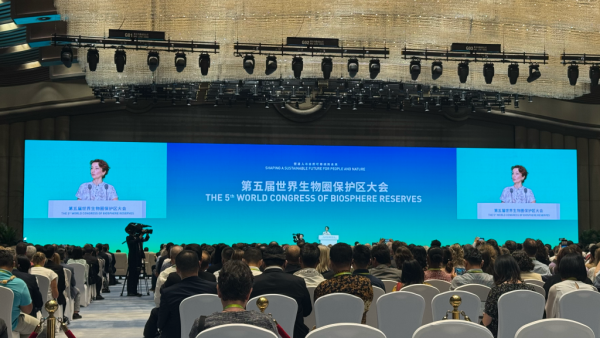
Core Points - The Fifth World Biosphere Reserve Congress opened on September 22 in Hangzhou, marking the first time the event is held in Asia and involving the widest participation from UNESCO member states [3][4] - The event emphasizes the balance between biodiversity conservation and human livelihoods, a principle rooted in the Man and the Biosphere (MAB) program initiated by UNESCO in 1971 [4][5] - China has 34 nature reserves included in the global biosphere reserve network, ranking first in Asia, showcasing its commitment to ecological conservation and sustainable development [4] Group 1 - The congress aims to discuss the "UNESCO Man and the Biosphere Program and its World Biosphere Reserve Network Hangzhou Strategic Action Plan (2026-2035)" and release the "Hangzhou Declaration" to outline a development blueprint for global ecological governance [4][5] - The Chinese Biosphere Reserve Network (CBRN), established in 1993, now includes 214 members, making it the largest national collaborative platform for implementing the MAB program globally [4] - The congress highlights the role of new technologies, such as artificial intelligence and biotechnology, in addressing global ecological challenges [4] Group 2 - The Chinese Academy of Sciences, as the chair unit of the National Committee for Man and the Biosphere in China, provides strong scientific support for biodiversity conservation and sustainable development [5] - The Secretary-General of the UNESCO MAB program, Antonio Abreu, noted that China's biosphere reserves increasingly reflect the vision of harmonious coexistence between humans and nature, and China's experiences are valuable for international sharing [4]

【科技日报】探索人与自然和谐共生之路
Ke Ji Ri Bao· 2025-09-23 02:01
Group 1 - The fifth World Biosphere Reserve Congress opened in Hangzhou, Zhejiang, focusing on "Shaping a Sustainable Future for People and Nature," showcasing China's achievements in ecological civilization and promoting global biodiversity conservation and sustainable development [1] - This congress is the first of its kind held in Asia and has the widest participation from UNESCO member countries, attracting around 4,000 representatives from over 150 countries and regions [1] Group 2 - The Man and the Biosphere (MAB) program, initiated by UNESCO in 1971, aims to explore and promote harmonious coexistence between humans and nature, emphasizing the organic combination of protection and development [2] - China's MAB program aligns with national conditions, promoting community involvement in ecological protection through initiatives like hiring local residents as ecological forest rangers and developing eco-friendly products [2] Group 3 - The Gaoligong Mountain Biosphere Reserve has successfully implemented a "bird-watching economy," significantly increasing local income through tourism-related activities, which enhances community awareness and participation in ecological protection [3] Group 4 - China has 34 natural reserves approved as World Biosphere Reserves by UNESCO, ranking first in Asia, serving as platforms for biodiversity protection, ecosystem maintenance, and sustainable resource use [4] - The country has made significant progress in protecting endangered species, with successful recovery of populations like the giant panda and the Yangtze finless porpoise through national park and botanical garden systems [4] Group 5 - The construction and development of biosphere reserves provide important application scenarios for new ideas, technologies, and products, facilitating international cooperation in ecological protection and sustainable development [5] - Recommendations for enhancing technological cooperation in biosphere reserve construction include promoting joint research in key areas, strengthening shared foundational capabilities, and expanding technical application scenarios [5]
和谐共生!世界生物圈保护区大会首次在中国举办
Xin Hua She· 2025-09-22 21:45
Core Points - The fifth World Biosphere Reserve Congress was held in Hangzhou, China, focusing on the harmonious coexistence of humans and nature, marking the first time the event took place in Asia [1][2] - The "Man and the Biosphere Program" initiated by UNESCO aims to balance biodiversity conservation and human livelihoods through interdisciplinary research and collaboration [1][2] Group 1 - The concept of harmonious coexistence between humans and nature has taken root in China over the past 50 years, with the World Biosphere Reserve and its global network serving as key platforms for this initiative [2] - China ranks first in Asia with 34 natural protected areas included in the World Biosphere Reserve network, which encompasses 214 members representing major ecosystem types [2][5] - The current technological revolution, including advancements in artificial intelligence and biotechnology, provides favorable conditions for addressing global ecological challenges [5] Group 2 - The congress will discuss the "UNESCO Man and the Biosphere Program and its World Biosphere Reserve Network Hangzhou Strategic Action Plan (2026-2035)" and release the "Hangzhou Declaration," outlining a ten-year development blueprint for global ecological governance [5] - The Chinese Academy of Sciences, as the chair unit of the National Committee for Man and the Biosphere in China, provides strong scientific support for biodiversity conservation and sustainable development [5]
推动全球科技开放合作迈出更大步伐——2025浦江创新论坛主论坛探讨如何应对全球性挑战
Ke Ji Ri Bao· 2025-09-22 09:26
Group 1 - The 2025 Pujiang Innovation Forum emphasized the importance of technological innovation as a key force for addressing global challenges and promoting development, with the Chinese government prioritizing strategies to enhance scientific and technological capabilities [1] - China aims to build a global scientific community through enhanced bilateral and multilateral cooperation, focusing on technology exchange and collaborative platforms such as joint laboratories and innovation cooperation zones [1] - The forum highlighted the significance of international scientific collaboration in addressing major global health challenges, exemplified by the development of a novel cell therapy for chronic hepatitis B involving teams from Germany, Singapore, and China [2] Group 2 - The successful development of the TCR-T cell therapy for chronic hepatitis B represents a milestone in treatment options, potentially offering a solution to the lifelong medication challenge faced by patients [2] - The forum underscored the necessity of diverse thinking in scientific research, advocating for the establishment of more international research platforms in China to facilitate long-term collaboration among scientists [3] - China is actively participating in major international scientific projects, such as the International Thermonuclear Experimental Reactor and the Square Kilometer Array, which are crucial for advancing knowledge and addressing significant scientific challenges [4]
研究报告显示:中国工程教育实现跨越式发展
Xin Hua She· 2025-09-22 06:21
Core Insights - The latest research report indicates that China's engineering education has achieved leapfrog development in the Fourth Industrial Revolution, transitioning from scale expansion to quality enhancement, with its scale ranking among the world's top and overall strength positioned in the leading group globally [2][3] Summary by Sections Engineering Education Development - The 2025 International Engineering Education Development Conference was held at Tianjin University, attended by approximately 720 representatives from domestic and international universities, enterprises, and industry associations [2] - The report titled "Engineering Creates the World, Education Leads the Future" was published, co-authored by the National New Engineering Education Innovation Center and Tianjin University, with guidance from the Ministry of Education's Higher Education Department [2] Growth in Engineering Graduates - From 2012 to 2022, the number of engineering undergraduate graduates in China increased by 31.6%, while the number of engineering doctoral graduates rose by 23.2% [3] - The number of R&D personnel per million employed population increased from 1014.3 to 1584.9, marking a growth of 56.2% [3] Quality and Innovation in Engineering Education - China is focusing on enhancing the quality and connotation of engineering education, establishing a "project-college-base" three-tier innovation system, and setting up future technology colleges aimed at cultivating leaders in future technological innovation [3] - Collaboration with technology enterprises to build modern industry colleges has created a comprehensive training ecosystem covering traditional engineering and emerging interdisciplinary fields [3] Global Positioning and Future Directions - Chinese engineering education is recognized for its leadership on a global scale, with a focus on responding to industry demands and major national projects to promote future industrial development [3] - The International Engineering Alliance Chair, Elizabeth Taylor, highlighted China's active role in the alliance, showcasing its potential in engineering education and industrial development, and positioning China as a significant driving force in international engineering cooperation [3]
美股异动|安进股价三连涨背后的盈利飙升与市场乐观情绪
Xin Lang Cai Jing· 2025-09-19 22:42
Group 1 - The core viewpoint is that Amgen's stock performance has been positively influenced by its recent financial results and market sentiment, with a notable stock price increase of 3.47% on September 19 and a cumulative increase of 4.51% over three days [1][2] - Amgen reported a revenue of $17.328 billion for the first half of fiscal year 2025, representing a year-over-year growth of 9.43%, and a net profit of $3.162 billion, which is a staggering increase of 399.53% compared to the same period last year [1] - The company has established itself as a leader in the biotechnology sector since its founding in 1980, focusing on innovative drug development to address significant global healthcare needs [1] Group 2 - The overall trend in the biotechnology industry is favorable, driven by increasing global demand for innovative medicines, which enhances the investment appeal of the sector [2] - Geopolitical tensions and economic uncertainties may cause short-term fluctuations in investor confidence, but Amgen's financial stability and industry position provide strong resilience against market volatility [2] - Amgen remains an attractive investment option due to its leadership in biotechnology and solid financial performance, suggesting potential for long-term investment consideration [2]