网络安全

Search documents
以安全之名:欧盟强制“移除”中国通讯设备
Jin Tou Wang· 2026-01-21 15:45
Core Viewpoint - The European Union (EU) has proposed a groundbreaking cybersecurity bill that mandates the removal of equipment from Chinese tech companies Huawei and ZTE from the mobile communication networks of its 27 member states, shifting from voluntary to mandatory compliance [1][3]. Group 1: Legislative Changes - The new proposal requires member states to execute the removal of Huawei and ZTE equipment within three years after the bill is passed, pending approval from the countries [3]. - Since 2020, the EU has recommended the removal of these suppliers' equipment due to cybersecurity risks, but only about half of the member states have taken action [3]. Group 2: Implications for Chinese Companies - If approved, Huawei, ZTE, and other Chinese operators will face increased challenges, as the bill introduces criteria to classify specific countries as "cybersecurity threats," potentially restricting access to sensitive sectors such as automated vehicles, utilities, cloud computing, medical devices, aerospace services, and semiconductors [3][5]. - The EU's decision reflects concerns over China's rapid technological rise and the potential dependency of European nations on Chinese servers, which could lead to a loss of autonomy [5]. Group 3: Economic Context - In 2025, the EU experienced 77 state-sponsored cyberattacks, resulting in an estimated economic loss of $391 billion, highlighting the significant risks to democracy, economy, and lifestyle [5]. - The EU's decision to strengthen control over critical information and communication technology supply chains is seen as a necessary self-defense measure [5]. Group 4: Geopolitical Considerations - The EU's actions are influenced by pressure from the United States, which has long advocated for the exclusion of Chinese equipment on national security grounds, particularly intensified during the Trump administration [5]. - The EU's response to potential threats from the U.S. indicates a geopolitical bias, as officials stated that the U.S. is considered a friend and should not be classified as a threat [5].

哥伦比亚愿加强与中国通信技术合作
Shang Wu Bu Wang Zhan· 2026-01-21 15:36
Core Viewpoint - Colombia aims to strengthen cooperation with China in communication technology to bridge the digital divide in the region [1] Group 1: Key Areas of Cooperation - The Colombian Ministry of Communications, led by Deputy Minister Perdomo, visited China to discuss topics such as digital infrastructure, next-generation networks, spectrum management, satellite capabilities, cybersecurity, and artificial intelligence [1] - The visit is intended to enhance bilateral technical and policy dialogue through experience sharing and practical cooperation [1] - Collaboration with Chinese information and communication research institutions is expected to uncover opportunities in telecom infrastructure, institutional capacity building, and regulatory practices [1] Group 2: Focus on Education and Training - Discussions during the visit included talent development, technical training, academic exchanges, and professional certification [1]
欧盟拟推“高风险供应商”禁令,华为回应:基于来源国的立法提案违背公平原则
Xin Lang Cai Jing· 2026-01-21 11:18
Core Viewpoint - The European Commission has proposed a draft revision of the EU Cybersecurity Law, aiming to phase out components and equipment from "high-risk suppliers" in 18 critical sectors, which is perceived as a measure targeting Chinese high-tech companies [1][2]. Group 1: Legislative Proposal - The draft includes 18 key sectors such as 5G communication, semiconductors, power systems, autonomous driving, and medical devices [1]. - The proposal does not name specific companies or countries but is widely interpreted as a move against Chinese technology firms [1]. Group 2: Company Response - Huawei has responded, arguing that the proposal violates fundamental legal principles of fairness and non-discrimination, and does not align with the EU's obligations under the World Trade Organization (WTO) [1]. - Huawei emphasizes its commitment to monitoring the legislative process and reserves the right to take measures to protect its legal rights [1]. Group 3: Political Context - The EU Commission's Vice President stated that the new cybersecurity measures are crucial for ensuring European technological sovereignty and enhancing overall security [2]. - There are concerns that the classification of "high security risk" lacks solid evidence and is politically motivated to exclude Chinese companies from the European mobile communication network [2]. Group 4: Chinese Government Reaction - The Chinese government has expressed serious concerns regarding the EU's actions, urging the EU to avoid protectionism and warning that it will take necessary measures to protect the rights of Chinese companies [2]. - The Chinese Foreign Ministry highlighted that Chinese enterprises have operated legally in Europe without threatening national security and have contributed positively to the development of the European telecommunications and digital industries [2].
欧盟想在三年内移除华为设备
半导体芯闻· 2026-01-21 10:13
Group 1 - The European Union plans to remove Chinese telecom equipment and electronic products, including 5G base station equipment, semiconductors, autonomous vehicles, and solar panels, which is expected to harm companies like Huawei and ZTE while benefiting local firms such as Samsung Electronics [1][2] - The EU's new cybersecurity law draft includes provisions for the phased removal of equipment from "high-risk suppliers" across 18 industries, with specific details on wired and wireless networks to be announced later [1] - The EU reported a 22% increase in network attacks supported by "specific countries" in the second quarter of last year, resulting in losses of up to $391 billion, highlighting the strategic risks posed to democracy, economy, and lifestyle [1] Group 2 - The term "high-risk suppliers" is viewed as a regulatory measure targeting China, as European countries have heavily relied on affordable Chinese equipment, which is 20% to 40% cheaper than comparable European products [2] - The implementation of the cybersecurity law will necessitate a significant investment in replacing network infrastructure, with the GSMA estimating that excluding Chinese equipment could increase the cost of 5G deployment in Europe by approximately €55 billion (around 100 trillion KRW) [2] - European companies Nokia and Ericsson are expected to benefit immediately from the regulatory changes, along with Samsung Electronics, which is expanding its presence in the European market [2]


欧盟拟推“高风险供应商”禁令,华为回应:以国籍设限违背公平原则
Jin Rong Jie· 2026-01-21 09:41
Core Viewpoint - The European Commission has proposed a revised EU Cybersecurity Law aimed at phasing out components and equipment from "high-risk suppliers" across 18 critical sectors, which is widely interpreted as a measure targeting Chinese high-tech companies [1][4]. Group 1: Legislative Details - The new measures will cover 18 key industries identified by the European Commission, including 5G communications, semiconductors, power systems, autonomous driving, and medical devices [1]. - The proposal expands the scope significantly compared to the 2020 5G security "toolbox," which primarily focused on 5G network equipment and aimed to limit high-risk suppliers like Huawei [4]. - The draft specifies that mobile operators will have a 36-month transition period to phase out components from high-risk suppliers after the list is published [5]. Group 2: Industry Reactions - Huawei has responded by criticizing the proposal, stating that it violates EU legal principles and World Trade Organization (WTO) rules by basing restrictions on supplier nationality rather than factual evidence [4][5]. - The European telecommunications industry has expressed concerns that the proposal will significantly increase compliance and modification burdens, potentially costing billions of euros [5]. Group 3: Broader Implications - Analysts suggest that this move reflects the EU's shift towards a "decoupling" technology strategy under U.S. pressure, transitioning from risk management to systematic exclusion of Chinese technology [4]. - The proposal has raised alarms about the potential negative impact on EU-China relations and the stability of global supply chains, which could ultimately undermine Europe's innovation capacity and economic competitiveness [8].

欧盟拟36个月逐步淘汰高风险技术!华为回应:违反基本法律原则
Feng Huang Wang· 2026-01-21 07:35
Core Viewpoint - The EU plans to phase out components and equipment from "high-risk" suppliers in critical infrastructure sectors, with Huawei expected to be significantly affected by these measures [1][2]. Group 1: EU Measures and Regulations - The European Commission proposed these measures as part of the revision of the EU Cybersecurity Act, in response to rising cyberattacks and concerns over dependency on non-EU technology suppliers [1][2]. - The new measures will apply to 18 critical areas identified by the European Commission, including detection equipment, connected and autonomous vehicles, power supply and storage systems, water systems, drones, and anti-drone systems [2]. - The proposal indicates that mobile operators in Europe will have 36 months to phase out critical components from high-risk suppliers after the list is published, with specific timelines for fixed networks and satellite networks to be announced later [3]. Group 2: Industry Reactions - Huawei criticized the legislative proposal, arguing that it is based on the country of origin rather than factual evidence and technical standards, violating EU principles of fairness and non-discrimination [2]. - The telecommunications industry lobby group, Connect Europe, warned that the proposal could increase regulatory burdens, with additional costs potentially reaching billions of euros [3]. - The revised Cybersecurity Act will require negotiations with EU member states and the European Parliament before it can become law [3].
欧盟拟36个月逐步淘汰“高风险”技术,华为回应:违反基本法律原则
Feng Huang Wang· 2026-01-21 07:08
Group 1 - The European Union plans to phase out components and equipment from "high-risk" suppliers in critical infrastructure sectors, which has drawn criticism from Huawei, expected to be one of the affected companies [1][2] - The EU's proposed measures are part of a revision to the EU Cybersecurity Law, prompted by an increase in cyberattacks and concerns over reliance on non-EU technology suppliers [1][3] - The new measures will apply to 18 critical areas identified by the EU Commission, including detection equipment, connected and autonomous vehicles, power supply and storage systems, water systems, drones, and anti-drone systems [2] Group 2 - European mobile operators will have 36 months to phase out critical components after the high-risk supplier list is published, with timelines for fixed networks and satellite networks to be announced later [2] - The EU's technology affairs chief stated that the new cybersecurity package is a significant step towards ensuring European technological sovereignty and creating a safer environment for all [3] - The proposal may increase regulatory burdens on the telecom industry, with additional costs potentially reaching billions of euros [3]

强制淘汰中国设备危害欧盟自身发展
Xin Lang Cai Jing· 2026-01-20 23:10
Core Viewpoint - The European Union is advancing a cybersecurity bill that mandates member states to gradually eliminate equipment from "high-risk suppliers" such as Huawei and ZTE in critical infrastructure, primarily targeting Chinese tech companies [1] Group 1: Legislative Actions - The proposed legislation focuses on sectors including telecommunications, solar power generation, and security scanners [1] - The EU's actions are perceived as a response to China's technological advancements and manufacturing system advantages [1] Group 2: China's Position - China argues that its industrial leadership is a result of continuous technological innovation and should be viewed as a global opportunity rather than a threat to certain countries [1] - The article suggests that the EU should avoid viewing China as a "hypothetical enemy" and instead foster a fair and friendly operational environment for Chinese tech companies [1] Group 3: Call for Cooperation - The emphasis is placed on the need for open cooperation between the EU and Chinese tech firms to achieve mutual benefits [1]
上海市委网信办组织召开网络安全工作协调机制(扩大)会议
Xin Lang Cai Jing· 2026-01-20 13:44
Core Viewpoint - The meeting highlighted the successful management of network security in Shanghai, with no major incidents reported in 2025, showcasing significant improvements in the network security framework and capabilities, which support high-quality economic and social development [1][2] Group 1: Network Security Achievements - In 2025, Shanghai's network security efforts effectively addressed multiple threats, completing all security tasks without any major incidents [1] - The network security assurance system and capability construction achieved remarkable results, providing a solid security barrier for the city's economic and social development [1] Group 2: Current Challenges and Future Focus - The meeting analyzed the increasingly severe and complex network security landscape, emphasizing the urgent need for data security and personal information protection due to new types of cyberattacks and the application of technologies like artificial intelligence [2] - For 2026, which marks the beginning of the "14th Five-Year Plan," the focus will be on enhancing political awareness and prioritizing key areas such as: - Strengthening coordination and fully utilizing the network security coordination mechanism [2] - Enhancing the security protection of critical information infrastructure to build a robust network security "firewall" [2] - Improving data lifecycle security management to support digital economic development [2] - Exploring new models for artificial intelligence security governance to enhance risk prevention capabilities [2] - Establishing a comprehensive network security emergency response system to improve practical offensive and defensive capabilities [2]
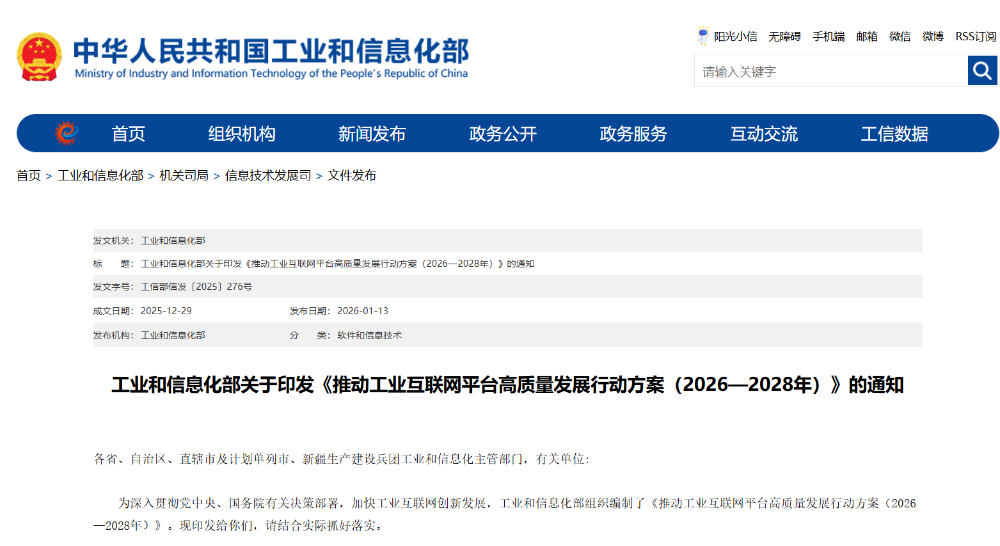
工信部发布工业互联网高质量发展行动方案,三大安全需求迫切待解
Xin Lang Cai Jing· 2026-01-20 13:40
Core Viewpoint - The Ministry of Industry and Information Technology has issued the "Action Plan for Promoting the High-Quality Development of Industrial Internet Platforms (2026-2028)", which aims to support new industrialization through four major actions [1][3]. Summary by Relevant Sections Action Plan Overview - The action plan emphasizes the "data-driven intelligence" initiative, focusing on unlocking the value of industrial data, building high-quality industrial model systems, and enhancing the application of artificial intelligence in industrial internet platforms [3][14]. - It also highlights the importance of industrial internet security, calling for strengthened platform security guarantees, compliance guidance for platform enterprises, and the implementation of classified and graded management for industrial internet security [3][14]. Security Challenges - The industrial internet platform faces three major security shortcomings: weak compliance foundations, lack of classified and graded management, and insufficient data security capabilities [16]. - Weak compliance is a prevalent issue, with many enterprises lacking professional compliance guidance, leading to high compliance risks [4][16]. - The need for classified and graded management is critical, as different industries and enterprises have varying security risks and requirements [5][17]. - Enhancing data security monitoring, early warning, and emergency response capabilities is essential for the secure operation of platforms [6][18]. Industrial Security Construction - The construction of industrial security is a systematic project that follows three core steps: "assess the foundation," "build the system," and "ensure sustainability" [19][22]. - "Assess the foundation" involves creating a complete asset ledger through automated identification and vulnerability scanning [21]. - "Build the system" focuses on the comprehensive deployment of security capabilities, including nine specific tasks such as optimizing industrial control network architecture and establishing security monitoring systems [21][23]. - "Ensure sustainability" emphasizes the continuous optimization of strategies and the cultivation of professional talent to respond to threats effectively [22]. Implementation and Expertise - The company, Qi Anxin, has developed a comprehensive industrial internet security framework that integrates security protection, monitoring, and operations across various levels, including cloud, edge, and data [23]. - Qi Anxin has provided industrial security solutions to numerous enterprises across various sectors, including energy, manufacturing, and transportation, leveraging its technical expertise and practical experience [26].