自研芯片

Search documents
小米3nm旗舰芯片亮相!雷军哽咽:坚持下去,坚持到最后胜利!
天天基金网· 2025-05-23 03:21
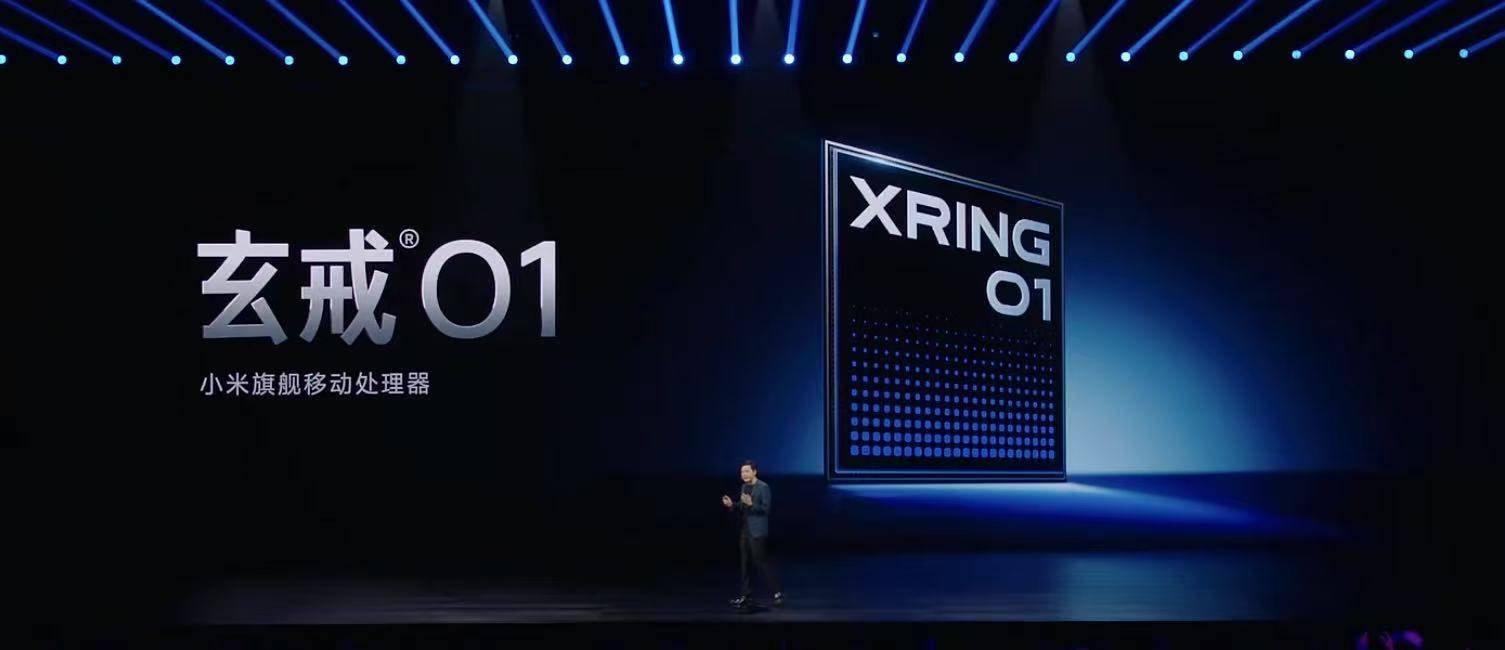
Core Viewpoint - Xiaomi's 15th anniversary event highlighted the launch of its self-developed 3nm flagship processor, the Xuanjie O1, and the SUV model, Xiaomi YU7, indicating a significant step in its ambition to become a leading technology company in the semiconductor space [1][2][4]. Group 1: Chip Development - The Xuanjie O1 processor is designed to compete with Apple's advanced chips, featuring 190 billion transistors and a chip area of only 109mm², achieving a lab score exceeding 3 million [5][8]. - Xiaomi plans to invest 200 billion yuan in R&D over the next five years, doubling its previous five-year investment of 102 billion yuan [4]. - The processor employs a ten-core architecture with a peak performance increase of 36%, and a 16-core GPU that significantly reduces power consumption through dynamic performance scheduling [7][10]. Group 2: Strategic Vision - Xiaomi's founder, Lei Jun, emphasized the necessity of chip development for the company's future, stating that it is a critical challenge that cannot be avoided [2][16]. - The company has committed to a long-term strategy, planning to invest at least 50 billion yuan over the next decade in chip development, acknowledging the high costs and long cycles associated with semiconductor production [16][18]. - Lei Jun reflected on the challenges faced over the past 11 years in chip development, highlighting the perseverance required to achieve their goals [14][18].



央视新闻播小米玄戒O1,雷军是如此回应的
Sou Hu Cai Jing· 2025-05-23 02:16
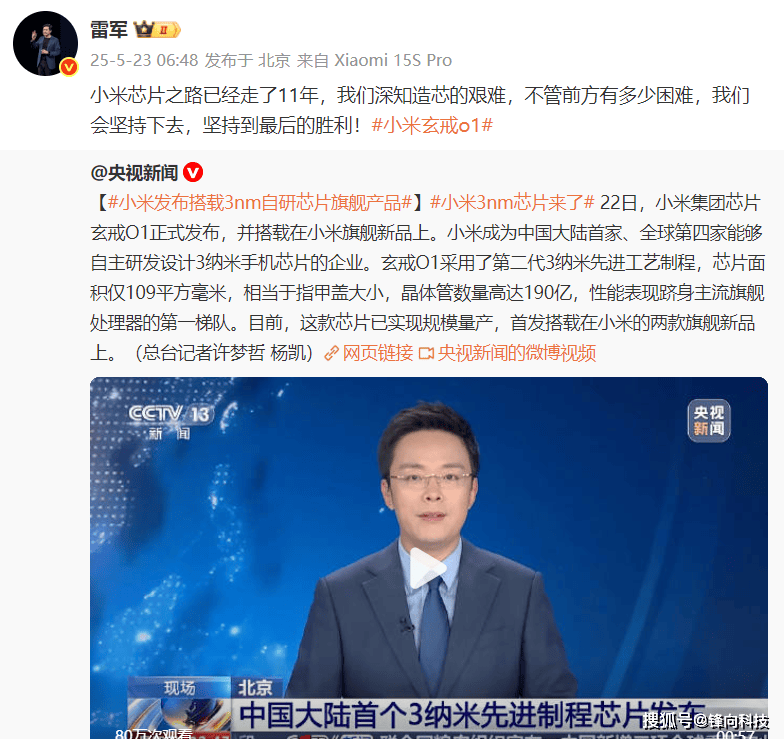
5月22日晚小米战略新品发布会如期举行,本场发布会的重点其实只有两个。一个是小米玄戒O1自研旗舰SoC,另外一个就是小米YU7技术发布。特别是前 者在行业引起了反响以及讨论可以讲是空前的。 最令大家没有想到的是发布当晚小米玄戒O1就登了央视新闻频道CCTV 13,央视新闻频道用了近一分钟的时间来介绍小米玄戒O1。主持人讲小米玄戒O1正 式发布,并搭载在小米旗舰新品上。小米成为中国大陆首家、全球第四家能够自主研发设计3纳米手机芯片的企业。小米玄戒O1采用了第二代3纳米先进工 艺制程,芯片面积仅109平方毫米,相当于指甲盖大小,晶体管数量高达190亿,性能表现跻身主流旗舰处理器的第一梯队。目前,这款芯片已实现规模量 产,首发搭载在小米的两款旗舰新品上。 央视新闻甚至是详细介绍了小米玄戒O1的具体架构,并且对小米在芯片领域的研发进行了回顾。可以看出央视对于小米玄戒O1是高度认可,这变相说明小 米自研芯片获得了权威证明。这一次真的狠狠打了那些喷子的脸,其实有些人他不是没脑子他只是见不得小米好,不想承认小米的优秀而已。好在小米用自 己的实际行动一次又一次的证明了自己,这一次小米玄戒O1可以讲是国产最高端的旗舰SoC,也 ...
相比3纳米SoC,小米自研4G基带更值得关注
Guan Cha Zhe Wang· 2025-05-23 01:47
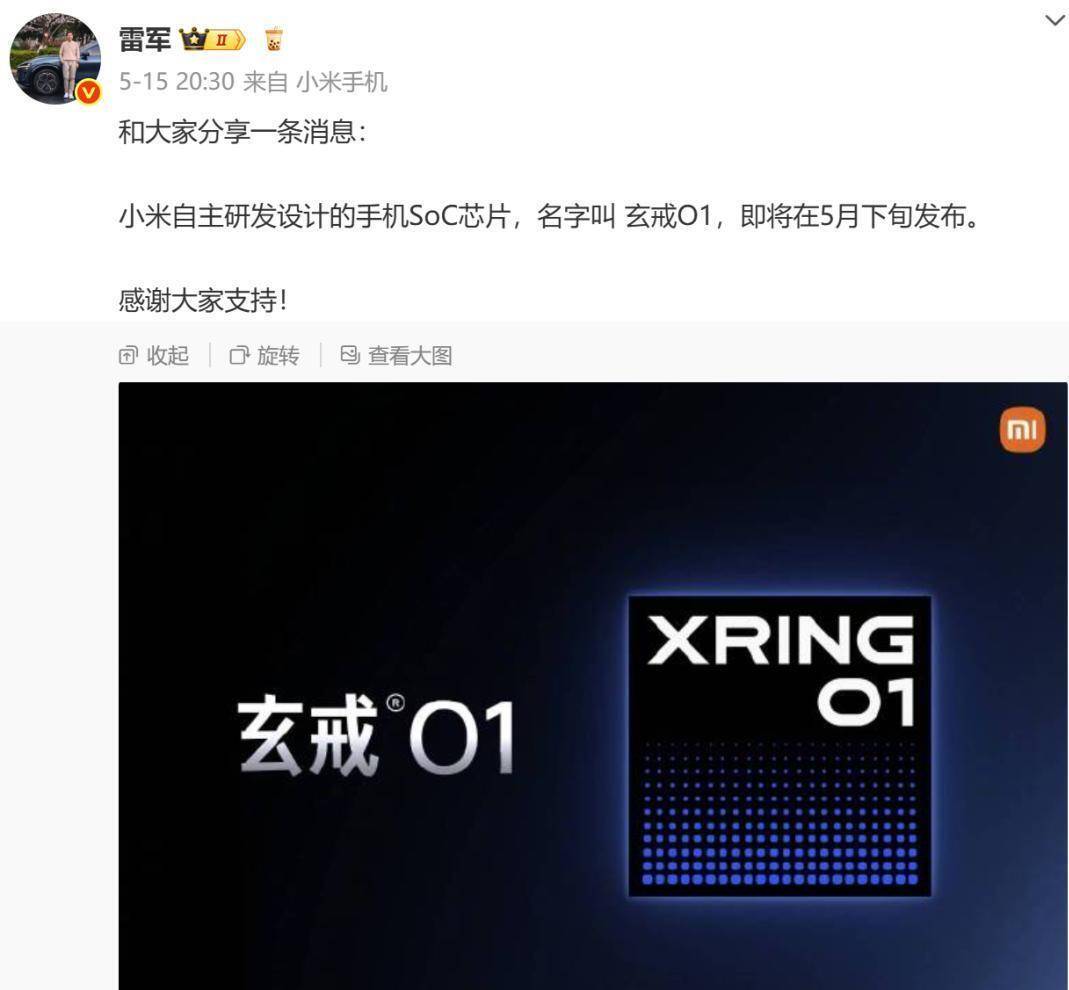
Core Insights - Xiaomi has unveiled its self-developed 3nm chip "Xuanjie O1" and its first self-developed 4G baseband "Xuanjie T1," emphasizing its ambition to become a significant player in the semiconductor industry [1][8] - The development of Xuanjie O1 took over four years and cost approximately 13.5 billion yuan, marking a significant milestone for Xiaomi in its transition from concept to production in automotive, chip, and smart factory sectors [1][14] Chip Technology - The Xuanjie O1 features a 10-core CPU utilizing ARM's latest Cortex-X925 and A725 designs, and a GPU based on ARM's Immortalis-G925, manufactured by TSMC using its second-generation 3nm process [2][4] - Xiaomi's chip design strategy involves using ARM's public architecture, which is common in the industry, allowing for faster development compared to fully custom designs [4][5] - The chip's performance metrics show a single-core score of 3008 and a multi-core score of 9509, with the GPU outperforming Apple's A18 Pro in certain tests [5][7] Power Efficiency - Xiaomi has prioritized power efficiency in the design of Xuanjie O1, achieving CPU efficiency close to Apple's offerings and a 35% reduction in GPU power consumption compared to the A18 Pro [7][8] Market Positioning - The pricing for the Xiaomi 15S Pro, which features the Xuanjie O1, is set at 5499 yuan for the 16GB+512GB version, making it competitively priced compared to its predecessor [7][14] - Xiaomi aims to sell over 10 million units of its flagship SoC within two years to ensure profitability, highlighting the high development costs associated with advanced chips [7][14] Baseband Development - The self-developed 4G baseband "Xuanjie T1" is designed to enhance Xiaomi's communication capabilities, featuring a 35% improvement in 4G-LTE performance and significant reductions in power consumption [8][10] - Developing a baseband chip is challenging due to the need for compatibility with various communication standards and extensive real-world testing, which Xiaomi has undertaken with a large team [10][11] Long-term Commitment - Xiaomi's leadership has committed to a long-term investment strategy in chip development, planning to invest over 50 billion yuan in the next decade, despite the challenges faced in the semiconductor industry [14][14] - The company acknowledges the competitive landscape and the need for continuous improvement and innovation in its chip offerings to succeed in the market [14]

小米自研芯片杀疯了!雷军憋了10年的大招,直接对标苹果华为?
Sou Hu Cai Jing· 2025-05-23 01:23
Core Insights - Xiaomi has announced the launch of its self-developed mobile chip "Xuanjie O1" during its 15th anniversary event, marking a significant milestone in its technology capabilities [1][14] - The chip positions Xiaomi as the fourth global and second domestic brand to master mobile SoC core technology, directly competing with Apple's A-series, Huawei's Kirin, and Samsung's Exynos [1][14] Development Journey - Xiaomi's chip development began in September 2014 with the establishment of Pinecone Electronics, initially perceived as a marketing attempt [4] - Despite early setbacks with the Surge S1 chip, Xiaomi invested 8 billion yuan in 2023 alone, totaling 30 billion yuan over ten years, leading to significant breakthroughs in chip technology [4] Technical Specifications - The Xuanjie O1 chip, designed by Qin Muyun, features a 4nm process from TSMC, with a performance score reaching 2 million, surpassing Snapdragon 8 Gen3 [6] - It includes a powerful architecture with one 3.2GHz super core, three 2.8GHz middle cores, and four efficiency cores, along with an advanced GPU supporting ray tracing technology [6][8] AI Capabilities - The chip integrates Xiaomi's self-developed NPU "Kunlun," capable of processing 15 trillion operations per second, significantly enhancing AI performance in photography [8] - The AI algorithms reportedly reduce noise in night photography to half the level of the iPhone 15 Pro [8] Market Positioning - The first device featuring the Xuanjie O1, the Xiaomi 15S Pro, is priced at 5,299 yuan, significantly lower than Huawei's Mate60 Pro, indicating Xiaomi's strategy to penetrate the mid-to-high-end market [8][14] - Xiaomi aims to make top-tier technology accessible to the general public, contrasting with the luxury positioning of competitors [8][14] Product Features - The Xiaomi 15S Pro boasts impressive specifications, including a 2K full-depth micro-curved screen, Leica triple-camera system, and a 6000mAh silicon-carbon battery [8] - The device also features UWB technology for seamless integration with Xiaomi's ecosystem, allowing for automatic unlocking of vehicles [14] Challenges Ahead - Industry experts have noted potential challenges, including limited initial chip production capacity and software compatibility issues, which Xiaomi is actively addressing [12][14] - The company is working on optimizing compatibility for popular games to ensure a smooth user experience [12]
玄戒 O1 实测震撼,小米15S Pro首发搭载:远超预期
3 6 Ke· 2025-05-23 00:02
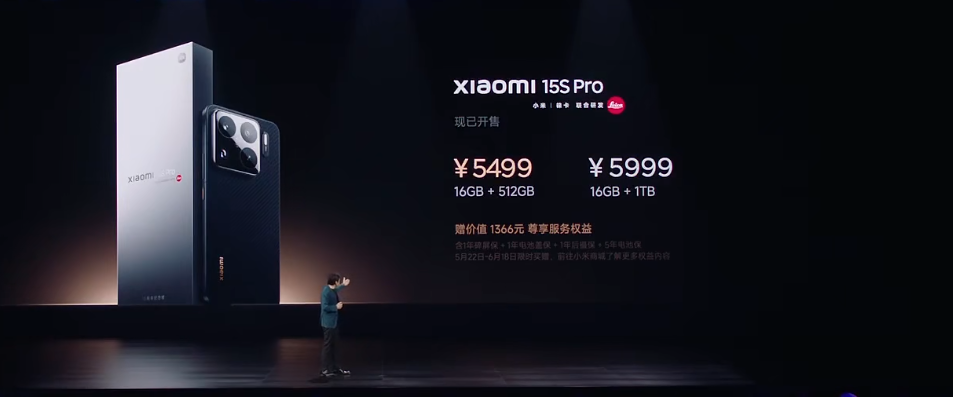
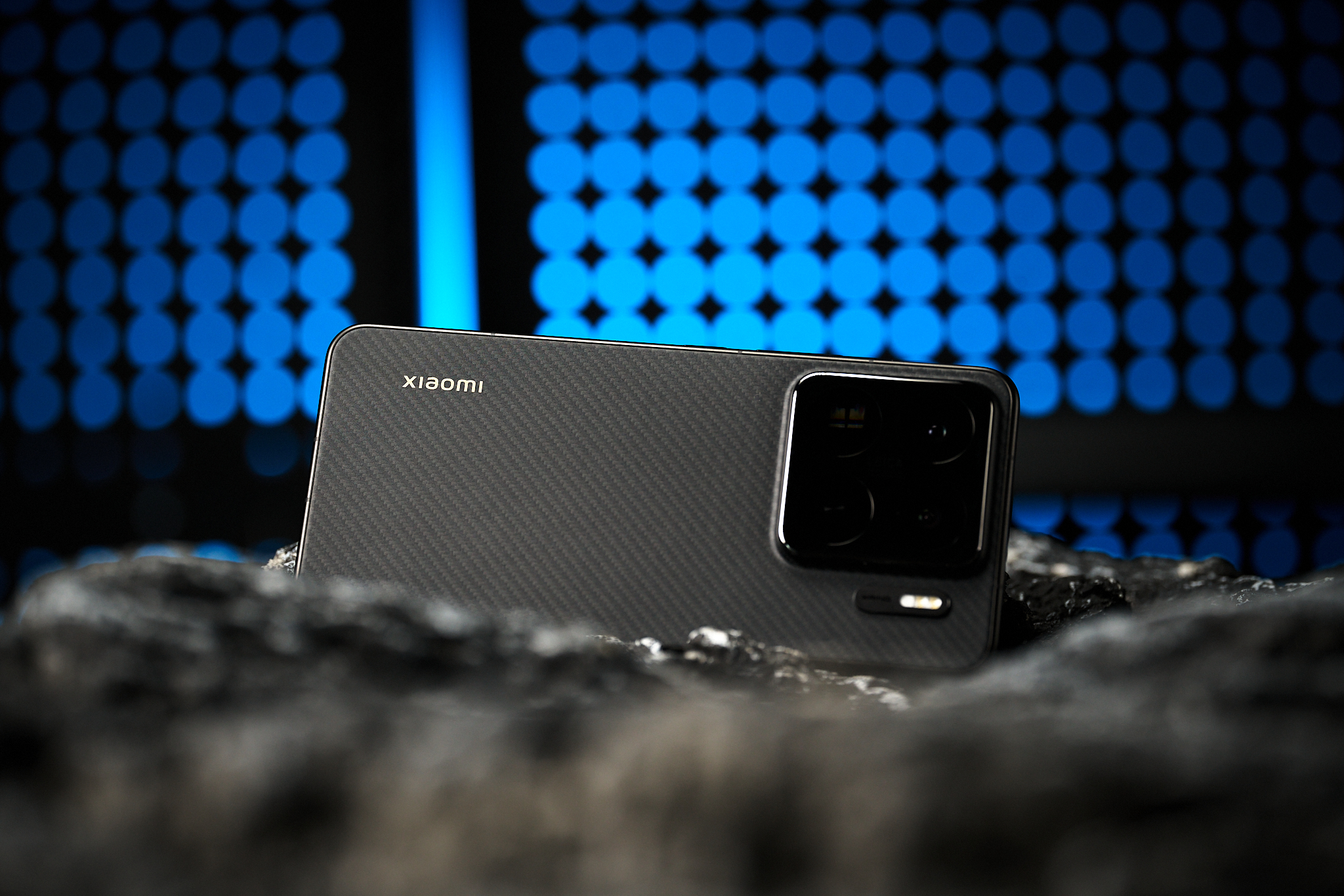
Core Viewpoint - Xiaomi's self-developed chip, the Xuanjie O1, has exceeded market expectations in performance and efficiency, marking a significant advancement in the company's chip development journey [5][48]. Group 1: Chip Architecture and Performance - The Xuanjie O1 features a powerful architecture with a total of 10 cores, including two high-frequency super-large cores at 3.9GHz, four performance cores at 3.4GHz, and two energy-efficient cores at 1.9GHz and 1.8GHz [5][8]. - The chip's design allows for efficient performance output during regular use while providing high performance when needed, showcasing a significant improvement in efficiency and energy consumption [7][8]. - The Xuanjie O1 integrates approximately 19 billion transistors, comparable to Apple's A17 Pro, indicating a robust processing capability [8]. Group 2: Benchmark and Gaming Performance - In benchmark tests, the Xiaomi 15S Pro scored 2,479,766 on AnTuTu, with Geekbench 6 scores of 2,892 (single-core) and 8,974 (multi-core), surpassing Apple's A18 Pro in theoretical performance [10][16]. - During gaming tests, the device maintained an average frame rate of 59.8 FPS in "Genshin Impact" and 58.2 FPS in "Ningchao," demonstrating smooth gameplay even under high-quality settings [17][19]. Group 3: Camera and Video Capabilities - The Xuanjie O1 has improved ISP architecture, enhancing video processing capabilities, particularly in low-light conditions, although some issues like noise and stabilization remain [24][25]. - In night video comparisons, the Xiaomi 15S Pro performed well against the iPhone 16 Pro, especially at lower zoom levels, but showed weaknesses at higher zoom levels [27][31]. Group 4: Design and Display - The Xiaomi 15S Pro features a design similar to its predecessor, with minor modifications that enhance its aesthetic appeal, including a new gold accent on the power button [32][35]. - The display has been upgraded to a 6.73-inch screen with a resolution of 3200x1440, supporting advanced features like HDR10+ and Dolby Vision, and includes a low-reflective AR film to improve visibility in bright conditions [39][40]. Group 5: Overall Assessment and Pricing - The Xiaomi 15S Pro is priced at 5,499 yuan for the 16GB+512GB version and 5,999 yuan for the 16GB+1TB version, reflecting its positioning as a flagship device [48]. - The performance of the Xuanjie O1 suggests that Xiaomi is not merely taking a gamble but is leveraging years of technological and supply chain development to establish itself in the high-end smartphone chip market [48].
雷军扳回一城
虎嗅APP· 2025-05-22 23:59
Core Viewpoint - The article discusses the recent launch of Xiaomi's self-developed SoC chip "玄戒O1" and its implications for the company's future in the competitive smartphone market, particularly in the context of self-research and development in the industry [6][9][40]. Summary by Sections 1. Background and Context - Xiaomi faced a public relations crisis following a traffic accident, prompting CEO Lei Jun to address the internal team about the situation [3][4]. - Concurrently, Xiaomi's factory was busy assembling the new Xiaomi 15S Pro smartphone, which features the newly developed SoC chip "玄戒O1" [5][6]. 2. The Launch of 玄戒O1 - The chip was officially launched during Xiaomi's 15th-anniversary strategic product launch event on May 22 [6]. - The introduction of 玄戒O1 has reignited discussions about self-developed chips in the Chinese smartphone industry, especially in light of Huawei's recent silence on the matter [8]. 3. Technical Features of 玄戒O1 - 玄戒O1 is built on a second-generation 3nm process and features a ten-core CPU architecture with a unique "four-cluster" design [16][20]. - The chip's design aims to enhance energy efficiency, with performance metrics reportedly close to that of competitors like Apple's A18 Pro [22][24]. - Xiaomi's team undertook significant risks by redesigning the chip's internal cells, which is uncommon in the industry due to potential compatibility issues [27][29]. 4. Strategic Implications - Xiaomi plans to adopt a "dual-chip strategy" by using both 玄戒O1 and Qualcomm's chips in future devices, acknowledging that 玄戒O1 may not yet be ready to fully replace Qualcomm's offerings [32][33]. - The positioning of 玄戒O1 will initially focus on the "S series" smartphones and IoT devices, such as the newly launched Xiaomi Pad 7 Ultra [35][37]. 5. Industry Context and Future Outlook - The article highlights a consensus in the industry that self-developed chips are becoming a core competitive advantage for smartphone brands [39]. - The current surge in smartphone sales in China, driven by government subsidies, may lead to a demand vacuum in the future, making the differentiation provided by 玄戒O1 crucial for Xiaomi's competitiveness [41].

雷军扳回一城
Hu Xiu· 2025-05-22 23:38
Core Insights - The article discusses the recent launch of Xiaomi's self-developed SoC chip "玄戒O1" and its significance in the smartphone industry, particularly in the context of Xiaomi's recovery from a public relations crisis [1][4][30] - The launch of the chip is seen as a strategic move to enhance Xiaomi's competitiveness in the market, especially as the company aims to establish itself in the self-developed chip space [5][24] Summary by Sections Xiaomi's Recent Challenges - Xiaomi faced significant criticism and scrutiny following a traffic accident incident, prompting a heartfelt response from CEO Lei Jun [1] - Despite the turmoil, Xiaomi's manufacturing operations continued, with the assembly of the new Xiaomi 15S Pro smartphone and the introduction of the "玄戒O1" chip [1][2] Launch of the "玄戒O1" Chip - The "玄戒O1" chip was officially launched during Xiaomi's 15th-anniversary strategic product launch event on May 22 [2] - The chip's introduction has reignited discussions about self-developed chips in the Chinese smartphone industry, especially in light of Huawei's recent retreat from this space [4] Technical Features of "玄戒O1" - The "玄戒O1" is built on a second-generation 3nm process technology and features a unique four-cluster ten-core CPU architecture [5][10] - This design is considered innovative as it diverges from industry trends, aiming to enhance energy efficiency, which is a critical factor for modern smartphones [10][12] Historical Context and Previous Failures - Xiaomi's previous attempt at self-developed chips, the "澎湃S1," was largely unsuccessful, leading to a hiatus in the SoC development [5][8] - The "玄戒O1" is positioned as a response to past failures, with a focus on proving Xiaomi's capabilities in chip development [8][12] Strategic Implications for Xiaomi - The company plans to adopt a dual-chip strategy, utilizing both "玄戒O1" and Qualcomm's chips in future devices [24][25] - The "玄戒O1" is expected to be featured in Xiaomi's S series smartphones and IoT devices, indicating a broader application of the chip beyond just smartphones [27][28] Market Context and Future Outlook - The smartphone industry is experiencing a temporary surge in demand due to government subsidies, but this may lead to a demand vacuum in the future [31][32] - The introduction of the "玄戒O1" is seen as a potential differentiator for Xiaomi, providing a competitive edge in a market that is increasingly reliant on self-developed technology [30][32]
今夜 雷军刷屏!
Zhong Guo Ji Jin Bao· 2025-05-22 16:13
Core Insights - Xiaomi has launched its first flagship chip, the Surge O1, which is a 3nm processor with 19 billion transistors integrated in a compact 109mm² space, marking a significant advancement in its chip development journey [3][6][8] - The company aims to establish itself as a leader in core technologies, including OS, AI, and chip development, with a long-term investment strategy of at least 500 billion yuan over the next decade [9][13] - The release of the Surge O1 and the Surge T1 chips signifies Xiaomi's commitment to self-developed chips, positioning it among the few global brands with core self-developed chips [8][14] Product Launch and Features - The Surge O1 chip was officially unveiled at Xiaomi's 15th anniversary event, alongside the Surge T1, a long-lasting 4G smartwatch chip, and the Xiaomi 15S Pro smartphone [4][8] - The Surge O1 features a ten-core architecture with two Cortex-X925 super-large cores, four Cortex-A725 performance cores, and two Cortex-A520 efficiency cores, achieving a peak frequency of 3.9GHz [6][8] - The Surge T1 chip includes Xiaomi's first 4G baseband, marking a critical step in the company's self-developed baseband technology [8] Strategic Vision - Xiaomi's chip development has been ongoing for 11 years, with a focus on integrating chip and device operations to enhance user experience [9][13] - The company has invested 13.5 billion yuan in chip research and development as of April 2025, with a team exceeding 2,500 members [13] - Xiaomi's strategy emphasizes the importance of chips as a key support for its overall business, aiming to solidify its technological foundation and enhance its competitive edge in the high-end smartphone market [13][14]
今晚发布会,小米抛出这些王炸!雷军:后来者总有机会的
21世纪经济报道· 2025-05-22 15:48
Group 1 - The core viewpoint of the article is that Xiaomi has made significant advancements in chip development with the launch of the self-developed Xuanjie O1 processor, aiming to compete with Apple in the high-end market [2][3][4] - The Xuanjie O1 processor utilizes a second-generation 3nm process technology, featuring 19 billion transistors and a chip area of only 109mm², with a benchmark score exceeding 3 million on AnTuTu [3][4] - Xiaomi plans to invest at least 500 billion yuan in research and development over the next ten years, indicating a long-term commitment to chip technology [3][4] Group 2 - The Xuanjie O1 marks a breakthrough in 3nm chip design in mainland China, making Xiaomi the fourth company globally to release a self-developed 3nm mobile processor after Apple, Qualcomm, and MediaTek [4] - Xiaomi's chip team consists of approximately 2,500 members, and the company has invested over 13.5 billion yuan in chip development since 2021, with expectations to invest over 6 billion yuan by 2025 [4][7] - The commercial viability of the Xuanjie O1 is crucial, as it must achieve sales of over 10 million units within one to two years to cover development costs and ensure sustainability [7] Group 3 - The launch of the YU7 SUV is part of Xiaomi's strategy to expand its product offerings, featuring advanced safety and driving technologies, including high-strength steel and NVIDIA's Thor chip for enhanced driving assistance [9][10] - Xiaomi aims to improve driving skills among its users by offering driving training courses to Xiaomi car owners, reflecting a commitment to user education and safety [10] - The company emphasizes that the YU7 will help demonstrate its growth and capabilities as it moves beyond its initial phase in the automotive market [10]

小米3nm旗舰芯片进入自家中高端产品线,会动到高通、联发科的“蛋糕吗”?
Mei Ri Jing Ji Xin Wen· 2025-05-22 15:28
Core Insights - Xiaomi's 15th anniversary event showcased the launch of its self-developed 3nm chip, the Xuanjie O1, integrated into three new products, marking a significant step in its high-end product line [1][3][4] - The company aims to invest 200 billion yuan in core technology research over the next five years, indicating a strong commitment to technological advancement [3] Product Launch - The event featured three products powered by the Xuanjie O1 chip: the Xiaomi 15S Pro smartphone priced at 5499-5999 yuan, the Xiaomi Pad 7 Ultra starting at 5699 yuan, and the Xiaomi Watch S4 starting at 1299 yuan [1][8] - The Xuanjie O1 chip boasts a die area of 109mm², over 300 million benchmark scores, and utilizes a second-generation 3nm process with 19 billion transistors [7] Market Strategy - Xiaomi's decision to integrate the Xuanjie O1 chip into mid-to-high-end products reflects a strategic move to enhance product performance and differentiate itself in a competitive market [2][10] - The company faces challenges in achieving sufficient sales volume, needing to sell over 10 million units within one to two years to ensure profitability [10] Competitive Landscape - The self-developed chip positions Xiaomi to reduce reliance on suppliers like MediaTek and Qualcomm, potentially altering the competitive dynamics in the high-end smartphone market [11][12] - Despite the ambitious move, Xiaomi's flagship models may still utilize Qualcomm chips in the short term, as the company navigates its existing supply chain relationships [11] Future Outlook - The development of the Xuanjie O1 chip is seen as a foundational step for Xiaomi to become a leading domestic chip design company, although challenges in manufacturing and testing remain [12] - The experience gained from this venture could provide Xiaomi with the necessary expertise to expand its capabilities in GPU, CPU, and data processing in the future [12]