
虚拟现实

Search documents
深耕9年 产业规模突破150亿元 青岛打造“中国虚拟现实之都”
Zheng Quan Shi Bao· 2025-11-26 18:32
Core Insights - Qingdao's virtual reality industry has achieved over 80% of the international market share in high-end VR display devices, with a continuous revenue growth rate exceeding 20% for three consecutive years [1] - The city has established itself as a national digital economy innovation hub, with over 140 companies in the VR industry and more than 70% of the country's research capabilities concentrated there, leading to a total industry scale surpassing 15 billion [1][7] - The integration of artificial intelligence and virtual reality is expected to create a trillion-dollar market opportunity, with companies like GoerTek focusing on AI glasses as the next significant terminal that may partially replace smartphones in the next 5 to 8 years [2][4] Industry Development - Qingdao's VR industry is characterized by a full-chain layout, open scenarios, and comprehensive services, aiming to become "China's Virtual Reality Capital" [1][8] - The establishment of the "Global R&D Center + Terminal Production Base" and the National Virtual Reality Innovation Center in Qingdao has strengthened the local VR ecosystem [2][3] - The city has introduced various support policies and established a 2,100-acre specialized industrial park, along with a 2.5 billion fund to enhance the VR industry ecosystem [7][6] Technological Integration - The convergence of virtual reality with AI, 5G, and spatial computing is accelerating, leading to new terminal products and applications across various sectors such as industrial manufacturing, healthcare, and urban governance [4][8] - Companies in Qingdao are focusing on developing AR+AI glasses and enhancing their technological capabilities to create a more integrated industry ecosystem [3][9] Challenges and Recommendations - The industry faces challenges in high-end core components and foundational development tools, necessitating a focus on self-sufficiency in technology [9][10] - Recommendations include strengthening technological breakthroughs, creating typical application scenarios, and fostering a collaborative innovation mechanism that integrates market demands with enterprise needs [9][10] Future Outlook - Qingdao aims to transition from a manufacturing base to an innovation hub by 2025, with the VR industry cluster expected to be recognized as a key digital industry cluster in Shandong Province [7][6] - The city is committed to maintaining strategic focus on innovation and technology development to ensure sustainable growth in the VR sector [11]

重大利好来了!国务院同意→
Jin Rong Shi Bao· 2025-11-26 11:20
Core Viewpoint - The implementation plan aims to enhance the adaptability of consumer goods supply and demand, leading to consumption upgrades that drive industrial upgrades, thereby achieving a dynamic balance between supply and demand at a higher level [1][4]. Policy Framework - The plan is jointly issued by multiple government bodies, including the Ministry of Industry and Information Technology, the National Development and Reform Commission, and others, marking it as a significant policy document following the Fourth Plenary Session of the 20th Party Congress [1][2]. Goals and Targets - By 2027, the supply structure of consumer goods is expected to be significantly optimized, forming three trillion-level consumption sectors and ten hundred-billion-level consumption hotspots [4]. - By 2030, a high-quality development pattern characterized by positive interaction between supply and consumption is anticipated, with a steady increase in the contribution of consumption to economic growth [4]. Industry Focus Areas - The plan emphasizes the development of new fields and tracks, focusing on key industries such as smart connected vehicles, smart home products, consumer electronics, modern textiles, food, and green building materials [5]. - It encourages the integration of artificial intelligence across the entire consumer goods industry, promoting the development of AI-enabled products like household service robots and smart appliances [5]. Sports and Health Products - The plan aims to enhance the supply of leisure and sports products, targeting new demands from the sports economy, outdoor economy, and ice and snow economy [6]. - It supports the innovation and development of health products, including special dietary foods and high-end medical devices, while promoting the consumption of organic and geographical indication agricultural products [6]. Diverse Consumer Interests - The plan seeks to expand the supply of interest-based consumer products, including pet-related items, anime, and trendy products, while also promoting low-altitude tourism and private flying [7]. - It encourages the development of local intellectual property and innovative design in cultural products, as well as the transformation of traditional retail spaces to include trendy stores [7]. Customization and Experience - The plan emphasizes the need for precise matching of consumer needs, particularly in the baby and children's product sector, and encourages the development of high-end fashion brands and personalized services [8]. - It promotes the creation of immersive consumer experiences through the use of digital technologies, including virtual reality and the metaverse [10]. Financial Support and Services - The plan highlights the importance of financial support for the consumer goods industry, including policies for equipment upgrades and trade-in programs, as well as enhancing the adaptability and convenience of consumer financial services [11].

刚刚,重磅利好!直线封板!
中国基金报· 2025-11-26 07:08
Core Viewpoint - The article discusses a new implementation plan aimed at enhancing the adaptability of supply and demand in consumer goods, promoting consumption, and optimizing the supply structure by 2027 and 2030 [5][20]. Group 1: Implementation Goals - By 2027, the supply structure of consumer goods is expected to be significantly optimized, forming three trillion-level consumption sectors and ten hundred-billion-level consumption hotspots [5][20]. - By 2030, a high-quality development pattern characterized by positive interaction between supply and consumption is anticipated, with a steady increase in consumption's contribution to economic growth [5][20]. Group 2: Key Tasks - The plan outlines five main areas with 19 key tasks, including expanding new technologies and innovative applications, enhancing the supply of unique and new products, and accurately matching different demographic needs [6][7][8][9]. - Specific focus areas include smart connected vehicles, smart home products, consumer electronics, and green building materials, with initiatives to create flagship products and innovative enterprises [10][21]. Group 3: Market Segmentation - The plan emphasizes the need to diversify product offerings for various demographics, including enhancing supplies for children, students, and the elderly [7][27][28]. Group 4: New Consumption Scenarios - The initiative encourages the development of new consumption scenarios and business models, such as live e-commerce and shared consumption, to create immersive shopping experiences [8][30][31]. Group 5: Supportive Environment - The plan calls for strengthening financial support, organizing special events, and maintaining market order to foster a conducive environment for consumption growth [9][31]. Group 6: Market Reaction - Following the announcement of the plan, stocks related to the consumer sector experienced a surge, with several companies reaching their daily trading limits [12].


六部门:鼓励平台企业依法合规利用人工智能技术挖掘用户需求
Sou Hu Cai Jing· 2025-11-26 06:58
Core Viewpoint - The implementation plan aims to enhance the adaptability of supply and demand for consumer goods, with a target to optimize the supply structure by 2027 and establish a high-quality development pattern by 2030, contributing steadily to economic growth [1][12]. Group 1: Key Tasks - The plan outlines 5 main areas with 19 key tasks, including expanding new technologies and innovative applications, enhancing the supply of unique and new products, and accurately matching different consumer needs [2][3]. - It emphasizes the development of new consumption scenarios and business models, such as live e-commerce and instant retail, while encouraging the use of advanced technologies like AI and virtual reality [3][18]. - The plan also focuses on creating a favorable environment for development, including financial support and maintaining market order [2][19]. Group 2: Consumer Goods Supply - By 2027, the goal is to form three trillion-level consumption fields and ten hundred-billion-level consumption hotspots, creating high-quality consumer goods with cultural significance [10][12]. - The plan aims to expand the supply of diverse interest-based consumer products, including pet-related items, anime, and trendy clothing, while also promoting low-altitude tourism and automotive aftermarket consumption [4][17]. - There is a specific focus on enhancing the supply of quality student products and age-appropriate products for the elderly, including innovative educational tools and health monitoring devices [5][17]. Group 3: Market Segmentation - The plan seeks to enrich the supply of products for different demographics, such as children's products, quality student supplies, and fashionable items, while optimizing products for the elderly [2][17]. - It encourages the development of personalized and modular learning kits for students, as well as comfortable and functional products for the elderly [5][17]. Group 4: Innovation and Technology - The plan promotes the application of new technologies in consumer goods, focusing on sectors like smart connected vehicles, smart home devices, and green building materials [3][4]. - It aims to establish a series of pilot projects showcasing innovative products and companies, enhancing the overall consumer experience [3][14].

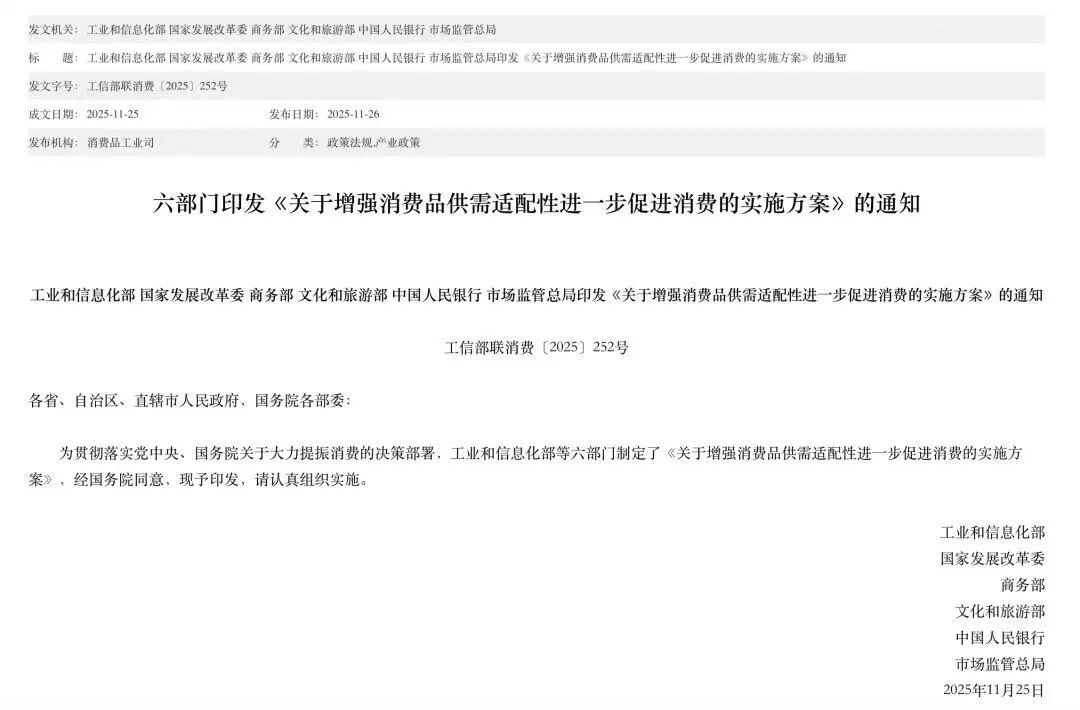
六部门:增强消费品供需适配性 进一步促进消费
智通财经网· 2025-11-26 06:50
Core Viewpoint - The implementation plan aims to enhance the adaptability of supply and demand for consumer goods, promoting consumption through various new business models and technologies [1][4]. Group 1: Overall Requirements - The plan is guided by Xi Jinping's thoughts and aims to achieve a dynamic balance between supply and demand, with a target of optimizing the supply structure of consumer goods by 2027 and establishing a high-quality development pattern by 2030 [5]. Group 2: Accelerating Innovation in New Technologies and Models - Focus on key industries such as smart connected vehicles, smart home, and green building materials, with initiatives to create flagship products and innovative enterprises [7]. - Promote flexible and customized manufacturing models, establishing a digital system that connects user demand with intelligent design and flexible production [7]. - Encourage the integration of artificial intelligence across the consumer goods sector, supporting the development of smart home products and digital art [8]. Group 3: Expanding Supply of Unique and New Products - Promote green products and set standards for energy efficiency and emissions, encouraging low-carbon consumption in various sectors [9]. - Support the upgrade of consumer goods in rural areas, enhancing infrastructure and promoting high-quality products [9]. - Develop leisure and sports products to meet new demands from events and outdoor activities [10]. Group 4: Precise Matching of Different Consumer Needs - Enhance the supply of baby and children's products, focusing on safety and quality [12]. - Improve the availability of quality student supplies, integrating traditional and smart products [12]. - Expand the supply of fashionable products, fostering independent designers and high-end brands [12]. Group 5: Cultivating New Consumption Scenarios and Business Models - Support the establishment of flagship stores and new concept stores, enhancing core business districts [14]. - Encourage the development of platform consumption models such as live e-commerce and instant retail, utilizing AI and other technologies [14]. - Promote shared consumption models in public spaces, ensuring quality and safety [14]. Group 6: Creating a Favorable Development Environment - Strengthen financial support for the consumer goods industry, enhancing the adaptability of financial services [15]. - Organize promotional activities to highlight quality consumer goods and brands [15]. - Maintain market order by addressing issues like local protectionism and ensuring product safety standards [16].
六部门:有序发展直播电商、即时零售、策展零售、循环电商等新业态
Zheng Quan Shi Bao Wang· 2025-11-26 06:44
Core Insights - The Ministry of Industry and Information Technology, along with five other departments, has issued a plan to enhance the adaptability of supply and demand in consumer goods, promoting orderly development of platform consumption [1] Group 1: New Business Models - The plan encourages the orderly development of new business models such as live e-commerce, instant retail, curated retail, and circular e-commerce [1] - It supports platform enterprises in leveraging artificial intelligence to explore user needs and match products and services accordingly [1] Group 2: Technological Integration - The initiative promotes the application of digital technologies like virtual reality, metaverse, artificial intelligence, and blockchain to create multi-scenario, immersive consumer experiences [1] Group 3: Consumer Engagement and Responsibility - The plan aims to guide platform enterprises in conducting brand quality promotion activities to stimulate consumption [1] - It emphasizes the need for platform enterprises to take responsibility, including enhancing operator qualification reviews and product information verification [1] - The establishment of a rapid dispute resolution mechanism for consumer complaints is also highlighted [1]
华如科技:拟投资2000万元与投资机构共同设立基金
Zheng Quan Shi Bao Wang· 2025-11-25 14:24
Core Viewpoint - Huaru Technology (301302) announced its plan to invest in a new venture capital partnership focused on emerging digital technologies, particularly in virtual reality and artificial intelligence [1] Investment Details - The total committed capital for the Nanjing Keshih Venture Capital Partnership is 50.5 million yuan, with Huaru Technology contributing 20 million yuan, representing 39.6% of the total [1] Investment Focus - The partnership will primarily invest in new cultural consumption formats driven by advancements in digital technologies, including virtual reality (VR), augmented reality (AR), mixed reality (MR), gaming, esports, and virtual reality films [1]
华如科技拟投资2000万元参与设立新基金
Sou Hu Cai Jing· 2025-11-25 14:01
Core Viewpoint - Huaru Technology announced a joint investment with Hangzhou Keshih Equity Investment Co., Ltd. and Shenzhen Chancheng Innovation Development Research Co., Ltd. to establish Nanjing Keshih Venture Capital Partnership, focusing on new digital technologies [2] Company Overview - Huaru Technology was established on November 23, 2011, with a registered capital of 155.865 million RMB, primarily engaged in military simulation [2] - The company aims to create a self-owned brand in military simulation, providing high-quality professional simulation products and technical development services in various fields [2] Investment Details - The company will contribute 20 million RMB as a limited partner, accounting for 39.60% of the total committed capital [2] - The fund will focus on virtual reality, spatial computing, artificial intelligence, and real-time rendering, with an 8-year duration, including a 5-year investment period and a 3-year exit period [2] Financial Performance - The company's revenue for 2022, 2023, 2024, and the first three quarters of 2025 were 833 million RMB, 362 million RMB, 249 million RMB, and 157 million RMB, with year-on-year growth rates of 21.39%, -56.55%, -31.12%, and 2.55% respectively [3] - The net profit attributable to the parent company for the same periods were 134 million RMB, -222 million RMB, -354 million RMB, and -139 million RMB, with year-on-year growth rates of 13.24%, -265.76%, -59.86%, and 47.95% respectively [3] - The company's asset-liability ratios for the same periods were 8.36%, 9.23%, 15.36%, and 16.10% [3] Company Structure - The company has nine subsidiaries, including Beijing Xiaoru Cultural Technology Co., Ltd. and Jiangsu Huaru Defense Technology Co., Ltd. [3] - The current chairman is Han Chao, and the company employs 564 people [2]

中国知识付费行业市场研究报告
硕远咨询· 2025-11-25 13:55
Investment Rating - The report does not explicitly state an investment rating for the knowledge payment industry Core Insights - The knowledge payment industry is defined as a service model where users pay for professional knowledge, skills, or information content, driven by the increasing demand for high-quality knowledge due to technological advancements and the proliferation of smart devices [4][5] - The industry has evolved through three stages: the nascent stage (before 2010), the rapid development stage (2015-2020), and the mature stage (2021-present), with increasing competition and a focus on content quality and user experience [10] - The market size of China's knowledge payment industry is projected to reach approximately 120 billion RMB in 2024, with a user payment penetration rate of 15%, and is expected to grow to over 350 billion RMB by 2030, driven by content diversification and technological innovation [14][18] Summary by Sections 1. Industry Overview - Knowledge payment encompasses various content forms, including online courses, e-books, paid Q&A, expert consultations, and live lectures, catering to diverse user needs in education, professional skills, and personal interests [4][6][7] - The industry is closely linked to education, internet, and cultural creative sectors, enhancing resource accessibility and promoting digital transformation [8][9] 2. Market Size and Structure Analysis - The knowledge payment market is expected to grow significantly, with the education training sector accounting for 45% of the market, followed by professional skills and personal interests [14] - The market is becoming increasingly concentrated, with leading platforms capturing over 60% of the market share [14] 3. Competitive Landscape and Major Companies - Major players in the industry include platforms like 得到, 喜马拉雅, and 知乎, which dominate the market through brand influence, content richness, and technological capabilities [33][34] - The industry is witnessing a trend towards increased concentration, with the top five platforms holding over 70% of the market share, indicating a potential monopolistic trend [41] 4. Technology-Driven and Content Innovation - AI and big data are pivotal in enhancing content personalization and user experience, while mobile internet and new media technologies are driving flexible and fragmented learning [46][47] - The integration of VR and AR technologies is expected to provide immersive learning experiences, particularly in specialized fields [50][69] 5. Policy Environment and Legal Regulations - The government supports the knowledge payment industry through policies that promote digital content and intellectual property protection, fostering a conducive environment for growth [59][61] - Legal frameworks are in place to protect intellectual property and ensure data security, which are crucial for maintaining user trust and industry integrity [62][63] 6. Future Development Trends and Outlook - The knowledge payment model is anticipated to diversify, combining subscription and one-time purchases to cater to varying user preferences [65] - The integration of educational technology and cross-industry collaboration is expected to enhance content quality and expand market opportunities [66][67]
华如科技拟出资2000万元参与设立产业投资基金
Zhi Tong Cai Jing· 2025-11-25 13:23
Core Viewpoint - The company, 华如科技, is planning to invest in a new venture capital partnership to enhance its core competitiveness and leverage resources from professional investment institutions [1] Investment Details - The company will act as a limited partner alongside 杭州科实股权投资有限公司 and 深圳产城创新发展研究有限公司 to establish 南京科实创业投资合伙企业 with a total committed capital of 50.5 million yuan [1] - The company will contribute 20 million yuan, representing 39.60% of the total committed capital [1] Investment Focus - The fund will primarily focus on venture investments that align with its partnership goals, particularly in new digital technologies such as virtual reality, spatial computing, artificial intelligence, and real-time rendering [1] - Key investment areas include immersive experience products like VR, AR, MR, gaming, esports, and virtual reality films, as well as other projects proposed by limited partners that support the partnership's objectives [1]