3D数字化设计

Search documents
政策问答·回应关切丨如何增强消费品供需适配性
Ren Min Ri Bao· 2025-11-30 04:06
Core Viewpoint - The implementation plan aims to enhance the adaptability of supply and demand in the consumer goods market, addressing the mismatch between what consumers want to buy and what is available for sale [1][2]. Group 1: Supply and Demand Adaptability - The plan emphasizes the need for consumer goods production to actively adapt to changing consumption trends, ensuring dynamic and precise matching of diverse consumer demands in terms of quality, structure, and utility [1]. - The initiative is expected to maximize consumption potential and promote smooth economic circulation by aligning what consumers desire with what companies produce [1]. Group 2: Consumer Goods Market Overview - China currently has a total of 230 million types of consumer goods, with over 100 categories, including home appliances, furniture, and clothing, leading the world in production [2]. - The strong manufacturing capability allows consumer goods companies to quickly respond to technological upgrades and subtle changes in consumer preferences, facilitating continuous product iteration and innovation [2]. Group 3: Specific Measures in the Implementation Plan - On the supply side, the plan includes accelerating the application of new technologies, expanding the supply of unique and new products, and focusing on sectors like smart connected vehicles and smart home devices [2]. - On the demand side, the plan aims to activate domestic demand by creating a favorable development environment, addressing differentiated needs across age groups, and enhancing consumer financial products and services [2]. Group 4: Future Market Potential - The implementation plan focuses on supply-side structural reforms, aiming to stimulate the multiplier effect and structural dividends of China's vast domestic market, with the potential to create trillions of yuan in new consumer markets by 2027 [3].
如何增强消费品供需适配性(政策问答·回应关切)
Ren Min Ri Bao· 2025-11-29 22:18
Core Viewpoint - The implementation plan aims to enhance the adaptability of supply and demand in consumer goods, addressing the mismatch between what consumers want to buy and what is available in the market [1][2]. Group 1: Supply and Demand Adaptability - The plan emphasizes the need for consumer goods production to actively adapt to changing consumer trends, ensuring dynamic and precise matching of diverse consumer demands in terms of quality, structure, and utility [1]. - The initiative is expected to maximize consumption potential and promote smooth economic circulation by aligning what consumers desire with what companies produce [1]. Group 2: Current Market Landscape - China currently has a total of 230 million types of consumer goods, with over 100 categories such as home appliances, furniture, and clothing leading global production [2]. - The strong manufacturing capability allows consumer goods companies to quickly respond to technological upgrades and subtle changes in consumer preferences, facilitating continuous product iteration and innovation [2]. Group 3: Specific Measures in the Implementation Plan - On the supply side, the plan includes accelerating the application of new technologies, expanding the supply of unique and new products, and focusing on emerging fields like smart connected vehicles and smart home devices [2]. - On the demand side, the plan aims to activate domestic demand potential by creating a favorable development environment, addressing differentiated needs across age groups, and implementing safety measures for children's products [2]. - The plan also includes policies for large-scale equipment updates and trade-in programs for consumer goods, as well as enhancing consumer finance products and services [2]. Group 4: Future Market Potential - The implementation plan focuses on supply-side structural reforms, aiming to stimulate the multiplier effect and structural dividends of China's vast domestic market, with the potential to create trillions of yuan in new consumer markets by 2027 [3].
刚刚 涨停潮来了!
Zhong Guo Ji Jin Bao· 2025-11-27 05:04
Market Overview - A-shares showed a collective increase with major indices rising, particularly the ChiNext Index which briefly surged over 2% before retreating slightly [1] - As of the midday close, the Shanghai Composite Index rose by 0.49%, the Shenzhen Component Index increased by 0.38%, and the ChiNext Index was up by 0.56% [1] Trading Volume and Stock Performance - The total trading volume across the market reached 1.1 trillion yuan, showing a slight decrease compared to the previous day [2] - Over 3,300 stocks in the market experienced gains, with strong performances in sectors such as electronics, beauty care, light manufacturing, and communications [2] Sector Performance - The electronics sector led the A-share market, with notable activity in consumer electronics, smart speakers, and semiconductors [5] - Key stocks in the electronics sector included Lian De Equipment and Yun Zhuang Technology, both hitting the daily limit up of 20% [6] - The optical module sector also saw significant gains, with stocks like Tongyu Communication and Cambridge Technology reaching their daily limit up [7] Notable Stock Movements - In the Hong Kong market, new consumption concept stocks generally rose, with Pop Mart's stock price peaking at 225 HKD, reflecting a nearly 10% increase [7] - The media sector experienced a pullback, with stocks like Huanyu Century and Shanghai Film seeing significant declines [9][11] Government Initiatives - Recent government initiatives aimed at enhancing the adaptability of consumer goods supply and demand were announced, promoting the integration of AI in consumer products [6]


工信部:未来的消费不再是购买一件商品,而是订阅一种生活
Sou Hu Cai Jing· 2025-11-27 04:45
Core Viewpoint - China's consumer goods supply has entered a new development stage characterized by high quality and reasonable pricing, meeting the basic needs of the population, but structural mismatches in supply and demand still exist in certain sectors [1][5][9]. Group 1: Supply and Demand Issues - There are structural mismatches in supply and demand, with some products experiencing oversupply while high-quality offerings remain insufficient, particularly in high-end brands for jewelry, bags, and cosmetics [1][5][9]. - The transition from old to new growth drivers is ongoing, with a lack of innovative products that meet the quality and personalization demands of consumers [1][5][9]. - Certain consumer hotspots, such as elderly care, cultural tourism, and smart consumption, have strong demand, but the supply of personalized products like elderly care items and smart devices is inadequate [1][5][9]. Group 2: Implementation Plan - The Ministry of Industry and Information Technology (MIIT) has jointly issued an implementation plan to enhance the adaptability of consumer goods supply and demand, which includes the application of generative artificial intelligence and 3D digital design tools [1][5][9]. - The plan aims to develop AI terminal products that provide entertainment, health, and companionship services [1][5][9]. Group 3: AI Product Development - As of mid-2023, the user base for generative AI products in China has reached 515 million, with continuous expansion of application scenarios and a surge in new AI terminal products [6][10]. - The MIIT will focus on product and scenario innovation to accelerate the integration of AI technology in the consumer goods sector [6][10]. Group 4: Digital Transformation - The MIIT plans to promote the integration of AI and big data technologies to build a digital ecosystem that encompasses user needs, intelligent design, flexible production, and precise services [6][10]. - In the home appliance sector, there is support for developing smart appliance ecosystems based on user behavior data, which has already shown positive user feedback [6][10]. Group 5: Scenario Expansion - The MIIT has released 213 application scenarios for digital technology to enhance product variety, quality, and branding, aiming to identify solutions that address industry pain points and improve manufacturing efficiency [7][11]. - In the "AI + smart home" scenario, the MIIT will promote the development of interconnected smart home systems, creating immersive and proactive smart living experiences [7][11]. - In the "AI + health and elderly care" scenario, initiatives will focus on developing rehabilitation aids, health monitoring products, and humanoid robots to transition from mechanical care to emotional companionship [7][11].

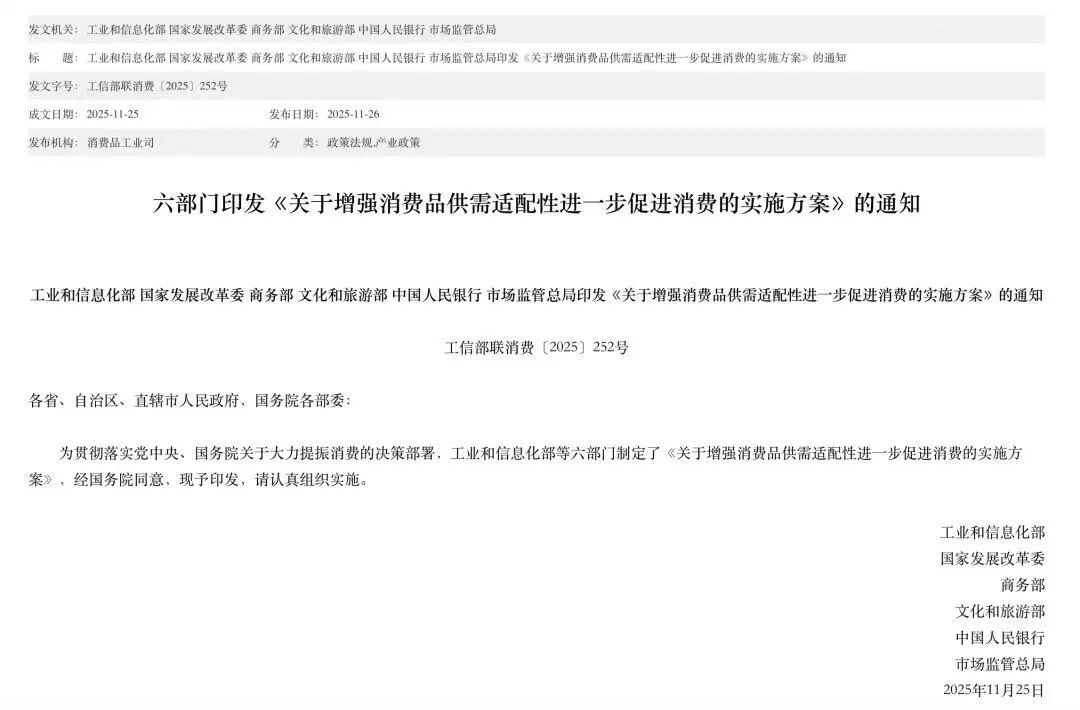
六部门合力优化供给 到2027年形成3个万亿级消费领域
Zheng Quan Shi Bao· 2025-11-26 18:16
Core Viewpoint - The Ministry of Industry and Information Technology and five other departments issued a plan to enhance the adaptability of supply and demand in consumer goods, aiming for consumption upgrades to lead industrial upgrades and achieve a dynamic balance between supply and demand [1][2]. Group 1: Development Goals - The plan outlines a two-step development goal: by 2027, the supply structure of consumer goods will be significantly optimized, forming three trillion-level consumption sectors and ten hundred-billion-level consumption hotspots; by 2030, a high-quality development pattern of mutual interaction between supply and consumption will be basically formed, with a steady increase in the contribution rate of consumption to economic growth [1]. Group 2: Key Tasks - The plan deploys 19 key tasks across five areas: expanding incremental supply, deepening existing supply, segmenting markets, empowering scenarios, and optimizing the environment [1]. - In expanding incremental supply, the focus is on innovation in technology and models, particularly in smart connected new energy vehicles, smart home products, and consumer electronics [2]. - The "Thousand Factories, Thousand Faces" transformation plan aims to cultivate flexible manufacturing factories in industries such as home appliances, furniture, and cosmetics, enhancing production responsiveness to personalized demands [2]. Group 3: Artificial Intelligence and Market Optimization - The plan emphasizes the role of artificial intelligence, promoting the application of generative AI and 3D digital design across the consumer goods sector, and encourages the development of smart home products and experience centers for elderly-friendly products [2]. - For optimizing existing markets, the plan aims to expand the supply of unique and new products, particularly in leisure, sports, and health consumption sectors, addressing new demands from event and outdoor economies [2]. Group 4: Targeted Supply Matching - The plan specifies supply matching requirements for different consumer groups, including children, students, fashion items, and elderly products, encouraging actions to promote quality elderly products and home modifications for the elderly [3]. - It also highlights the importance of a favorable consumption environment, reinforcing financial support through fiscal subsidies and special loans to support technological innovation and product upgrades in consumer goods companies [3]. Group 5: Implementation and Coordination - The Ministry of Industry and Information Technology will work with relevant departments to promote the plan, strengthen collaboration, and guide local regions and industry associations in its implementation, aiming to continuously create new consumer products, scenarios, and hotspots to unleash consumption potential [3].
重大利好来了!国务院同意→
Jin Rong Shi Bao· 2025-11-26 11:20
Core Viewpoint - The implementation plan aims to enhance the adaptability of consumer goods supply and demand, leading to consumption upgrades that drive industrial upgrades, thereby achieving a dynamic balance between supply and demand at a higher level [1][4]. Policy Framework - The plan is jointly issued by multiple government bodies, including the Ministry of Industry and Information Technology, the National Development and Reform Commission, and others, marking it as a significant policy document following the Fourth Plenary Session of the 20th Party Congress [1][2]. Goals and Targets - By 2027, the supply structure of consumer goods is expected to be significantly optimized, forming three trillion-level consumption sectors and ten hundred-billion-level consumption hotspots [4]. - By 2030, a high-quality development pattern characterized by positive interaction between supply and consumption is anticipated, with a steady increase in the contribution of consumption to economic growth [4]. Industry Focus Areas - The plan emphasizes the development of new fields and tracks, focusing on key industries such as smart connected vehicles, smart home products, consumer electronics, modern textiles, food, and green building materials [5]. - It encourages the integration of artificial intelligence across the entire consumer goods industry, promoting the development of AI-enabled products like household service robots and smart appliances [5]. Sports and Health Products - The plan aims to enhance the supply of leisure and sports products, targeting new demands from the sports economy, outdoor economy, and ice and snow economy [6]. - It supports the innovation and development of health products, including special dietary foods and high-end medical devices, while promoting the consumption of organic and geographical indication agricultural products [6]. Diverse Consumer Interests - The plan seeks to expand the supply of interest-based consumer products, including pet-related items, anime, and trendy products, while also promoting low-altitude tourism and private flying [7]. - It encourages the development of local intellectual property and innovative design in cultural products, as well as the transformation of traditional retail spaces to include trendy stores [7]. Customization and Experience - The plan emphasizes the need for precise matching of consumer needs, particularly in the baby and children's product sector, and encourages the development of high-end fashion brands and personalized services [8]. - It promotes the creation of immersive consumer experiences through the use of digital technologies, including virtual reality and the metaverse [10]. Financial Support and Services - The plan highlights the importance of financial support for the consumer goods industry, including policies for equipment upgrades and trade-in programs, as well as enhancing the adaptability and convenience of consumer financial services [11].