
虚拟现实

Search documents
字节跳动PICO或将发布新款VR头显
Xin Lang Cai Jing· 2026-02-25 09:19
Group 1 - The core message indicates that PICO-XR is set to launch a new product focused on "efficiency, intuition, and openness" [1][3] - PICO OS product manager Jason has hinted at the upcoming release, suggesting it may be a new VR headset [1][3] Group 2 - It is reported that ByteDance will launch the PICO 4 Ultra MR mixed reality all-in-one device in September 2024 [2][4]
【广货行天下】卓远VR以“沉浸感”重塑文旅新体验
Xin Lang Cai Jing· 2026-02-20 01:07
Core Insights - The article highlights the transformative role of AI in the cultural tourism industry, showcasing how companies like Zhuoyuan are redefining visitor experiences through advanced technology [1][5]. Group 1: Technological Innovations - Zhuoyuan's high-immersion VR intelligent cultural tourism equipment system has been recognized as one of the typical cases of "AI + cultural tourism" in Guangdong, marking a significant shift from "Guangdong manufacturing" to "Guangdong intelligence" [1]. - The company has developed a unique immersive interactive motion control technology that reduces dizziness by optimizing response time to under 50 milliseconds, which is twice as fast as the industry standard [2]. - Zhuoyuan's system integrates smart interaction perception, non-contact adaptive control, multi-dimensional effects, and virtual simulation technology to create a seamless immersive experience [2]. Group 2: Cultural Activation - Zhuoyuan employs a "technology + content" dual-drive approach to transform abstract cultural symbols into tangible experiences, utilizing drone photography and 3D modeling to create VR representations of various scenic spots [3]. - The system serves as a new medium for the living inheritance of intangible cultural heritage, allowing younger generations to engage with cultural identity through entertainment [3]. - The technology has been implemented in multiple locations across Guangdong, including popular tourist spots, positioning Zhuoyuan's equipment as the technological core of many trending attractions [3]. Group 3: Global Market Position - Zhuoyuan has expanded its reach, selling products to over 150 countries and serving more than 6,000 professional clients, establishing itself as a national-level "specialized, refined, distinctive, and innovative" small giant [4]. - Despite facing international tariff fluctuations, the competitiveness of "Guangdong-made" VR equipment remains strong, with Chinese VR technology now ranking among the top tier globally [4]. - The company has reported a staggering 600% year-on-year growth in the Brazilian market, supported by its robust core technology and a significant number of intellectual property rights [4]. Group 4: Future Prospects - Zhuoyuan's exploration serves as a model for integrating AI with the cultural tourism industry, emphasizing a comprehensive approach that includes technology development, scene implementation, and industry linkage [5]. - The company is planning to develop a "VR industry IoT operation platform" to connect global device data, enabling remote content distribution and cloud management [5]. - This innovation suggests that future cultural tourism experiences will become more flexible, transcending physical boundaries in cultural dissemination [6].
一图读懂 | 京西新机遇!解锁石景山区产业发展新蓝图
Bei Jing Ri Bao Ke Hu Duan· 2026-02-06 02:53
Core Viewpoint - The "14th Five-Year Plan" period is a significant milestone for Shijingshan District, achieving substantial economic growth and laying a solid foundation for socialist modernization [2][26]. Economic Growth - The district's GDP has crossed four hundred billion thresholds, exceeding 137 billion yuan [2]. - The average annual growth rate of general public budget revenue is 6.7%, with tax revenue accounting for over 90% [2]. - Fixed asset investment has an average annual growth rate of 9.2%, while service consumption has an average annual growth rate of 9% [2]. Industrial Transformation - The number of national high-tech enterprises and specialized, innovative enterprises has surpassed 1,100, with four national key laboratories established [4]. - The number of invention patents per ten thousand people and the transaction volume of technology contracts have increased by 186% and 126% respectively compared to the end of the "13th Five-Year Plan" [5]. Key Industries - The income of the Zhongguancun Shijingshan Park has increased by 48.3% compared to the end of the "13th Five-Year Plan," receiving recognition as a model for industrial transformation and upgrading [7]. - The modern industrial system has evolved from "1+3+1" to "dominant+characteristic+future," with the value added from information technology and modern finance accounting for over 60% of the GDP [8]. Future Industry Layout - The district is focusing on future industries, including humanoid robots, space technology, and health industries, with plans for a humanoid robot action plan and a digital experience complex for the metaverse [19][21][24]. Notable Developments - The artificial intelligence industry is projected to achieve an annual revenue of 420 billion yuan, while the sci-fi game industry is expected to reach 280 billion yuan [15][16]. - The industrial internet sector is anticipated to generate an annual revenue of 120 billion yuan, supported by a series of initiatives and competitions [17]. Strategic Opportunities - The district is leveraging strategic opportunities from urban renewal, industrial upgrades, and national policies to enhance its development [26][33]. - The "2+5+4" modern industrial system is being constructed, focusing on information technology and modern finance as the main drivers, with artificial intelligence and other emerging industries as key areas of growth [34][35].

石景山区产业发展促进大会举行 启动石景山“城市合伙人”全球招募行动
Xin Lang Cai Jing· 2026-02-03 08:28
Core Insights - The Shijingshan District held the 2026 Industrial Development Promotion Conference, reviewing the achievements of the "14th Five-Year Plan" and outlining the development blueprint for the next five years [1] - The district aims to enhance industrial development capabilities and core competitiveness, focusing on innovation-driven growth and the establishment of a modern industrial system [1][2] Group 1: Economic Performance - Over the past five years, Shijingshan's GDP exceeded 137 billion yuan, with an average annual growth of 6.3%, restoring its share of the city's economy to pre-Shougang production levels [1] - The district's general public budget revenue reached 9.11 billion yuan, with an average annual growth of 6.7%, and tax revenue accounting for over 90% [1] - Fixed asset investment surpassed 50 billion yuan, with an average annual growth of 9.2%, and the number of market entities exceeded 70,000, growing at an average annual rate of 9.4% [1] Group 2: Innovation and Technology - Shijingshan District will focus on technology innovation as a core driver, establishing key laboratories and enhancing collaboration with universities to boost innovation capabilities [2] - The district plans to promote the development of specialized and innovative enterprises, expand high-tech enterprises, and support the scaling of technology-based SMEs [2] - A collaborative innovation corridor will be built with neighboring areas, leveraging old industrial spaces for technology validation and rapid commercialization of results [2] Group 3: Industrial Development Strategy - The district is implementing a "2+5+4" modern industrial system to facilitate high-quality regional development, focusing on information technology, modern finance, and specialized industrial clusters [2][3] - Key projects include the establishment of an artificial intelligence innovation demonstration park and the development of a digital financial growth area [3] - The district aims to enhance the development of six specialized parks, including those for artificial intelligence, virtual reality, and industrial internet [3] Group 4: Business Environment and Support - Shijingshan District is committed to creating a market-oriented, law-based, and international business environment, enhancing support for innovation and entrepreneurship [4] - The "Jingxiyou Opportunities" cooperation list was released to help enterprises better understand local resources and market opportunities [5][6] - A financial support system has been established with a total fund scale of 5.59 billion yuan, covering key sectors such as artificial intelligence and digital economy [6] Group 5: Future Initiatives - The district will launch a global recruitment initiative for "City Partners," inviting research institutions, leading enterprises, and universities to collaborate on development [6][7] - The focus will be on deepening the integration of technology and industrial innovation, creating a favorable ecosystem for enterprises and talent [7]
一廊串联 三城驱动 多圈联动青岛全力打造科创走廊
Xin Lang Cai Jing· 2026-02-01 03:51
Core Insights - Qingdao is actively developing a Science and Technology Innovation Corridor, aiming to become a significant innovation hub in Northern China, covering an area of approximately 190 square kilometers [1][2] Group 1: Infrastructure and Development - The corridor will feature a 53-kilometer coastal road as its main axis, promoting cross-departmental, cross-regional, and cross-industry collaboration [1] - The spatial layout includes "one corridor linking, three cities driving, and multiple circles interacting," which aims to enhance regional innovation resource integration [1] Group 2: Innovation Ecosystem - The corridor has become the most concentrated area for innovation resources in Qingdao, housing 1 national laboratory, 8 national key laboratories, 8 universities, 21 provincial-level new R&D institutions, and 998 high-tech enterprises [2] - The northern region, known as Blue Valley, includes over 50 national-level research institutions and universities, contributing to significant research advancements [2] Group 3: Industry Growth - The Smart Industry City in Laoshan District has established parks for virtual reality, artificial intelligence, and marine biomedicine, with over 280 key enterprises, including industry leaders [1] - The Qingshui East Road Innovation Street in Licang District has attracted 8 specialized parks, 3 research institutes, and 223 technology companies [1]
下周关注丨多个产业会议将召开,这些投资机会最靠谱
Di Yi Cai Jing· 2026-02-01 01:04
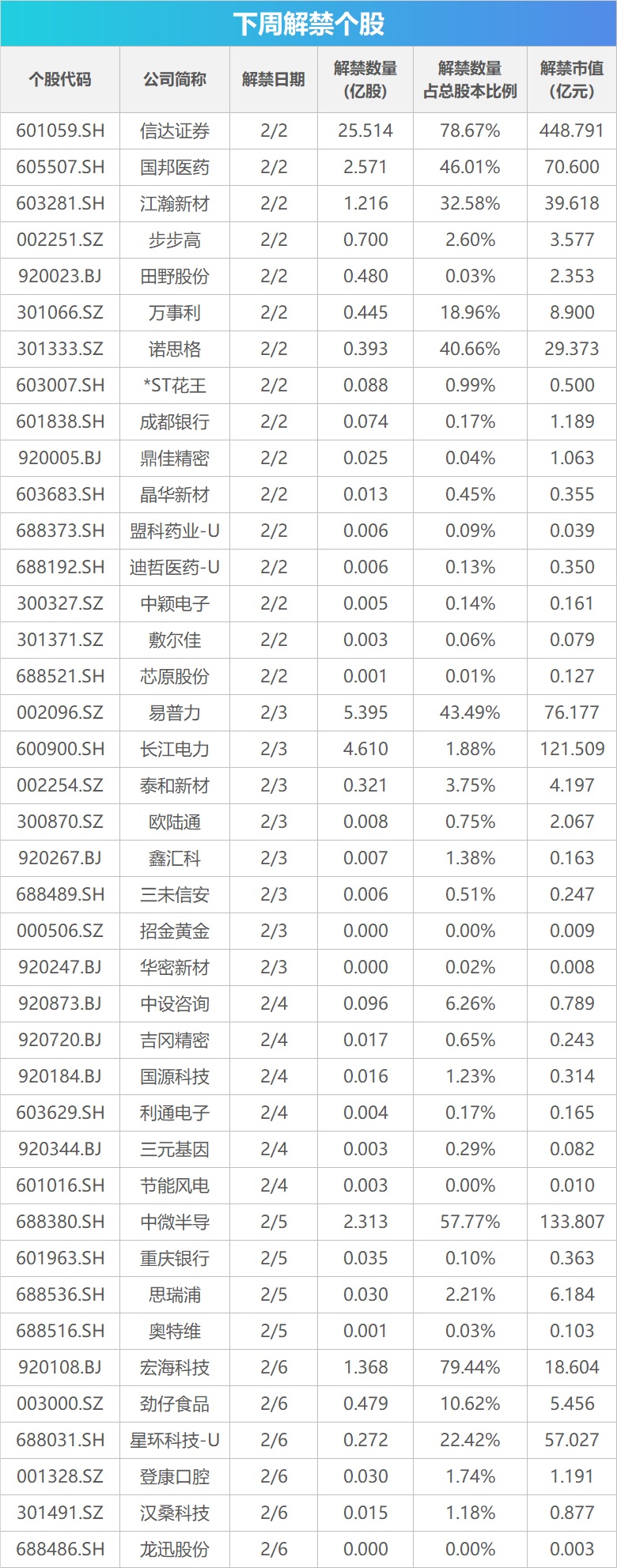
Group 1: Annual Reports - Chipway Technology will disclose its 2025 annual report on February 3, becoming the first listed company in the Shanghai market to do so [2] - ST Huawang is set to release its annual report on February 13, while Sanwei Co. will follow on February 14 [2] Group 2: Oil Price Adjustment - The next price adjustment window for refined oil is scheduled for February 3 at 24:00, based on the "ten working days" principle [3] - As of January 30, the average price of reference crude oil was $64.09 per barrel, with a change rate of 4.68%, leading to an expected increase of 190 yuan per ton in domestic gasoline and diesel prices [3] Group 3: Industry Conferences - The China Photovoltaic Industry Association will hold a seminar on February 5 in Beijing to review the development of the photovoltaic industry in 2025 and forecast trends for 2026 [4] - A Brain-Computer Interface Developers Conference will take place in Tianjin from February 3 to 4, organized by the Brain-Computer Interface Industry Alliance and Tianjin University [4] - The AWE Asia 2026, an Asian Virtual Reality XR Industry Exhibition, will be held in Singapore from February 2 to 4 [4] Group 4: Stock Unlocking - A total of 42 companies will have their restricted shares unlocked from February 2 to February 6, amounting to 4.657 billion shares and a total market value of 103.669 billion yuan based on the closing price on January 30 [5] - February 2 is the peak unlocking day, with 18 companies unlocking shares worth a total of 60.71 billion yuan, accounting for 58.56% of the total unlocking scale for the week [5] - The top three companies by unlocking market value are Xinda Securities (44.879 billion yuan), Zhongwei Semiconductor (13.381 billion yuan), and Changjiang Electric Power (12.151 billion yuan) [5] Group 5: New Stock Opportunities - Two new stocks, Aide Technology and Yisiwei, will be available for subscription on February 2 [8] - Aide Technology has an issue price of 7.67 yuan, while Yisiwei is priced at 55.95 yuan [9]


青岛全力打造科创走廊
Xin Lang Cai Jing· 2026-01-31 22:37
Core Viewpoint - Qingdao is actively developing a Science and Technology Innovation Corridor, aiming to become a significant innovation hub in Northern China, covering an area of approximately 190 square kilometers [1] Group 1: Development Plans - The Science and Technology Innovation Corridor will feature a spatial layout of "one corridor linking, three cities driving, and multiple circles interacting" to enhance regional innovation resource coupling [1] - The corridor will be centered around a 53-kilometer coastal road, with key innovation engines located in Laoshan District, Licang District, and Blue Valley Marine Science and Technology City [1] Group 2: Current Achievements - The Qingdao Science and Technology Innovation Corridor has become the most concentrated area for innovation resources in Qingdao, housing 1 national laboratory, 8 national key laboratories, 8 universities, 21 provincial-level new R&D institutions, and 998 high-tech enterprises [2] - The northern Blue Valley area includes over 50 national-level research institutions and universities, such as the Laoshan Laboratory and the National Deep Sea Base [2] Group 3: Future Goals - By 2025, the Laoshan Laboratory aims to achieve globally influential research results in deep-sea environments, underwater hydrogen energy, and tectonic movements, with expectations to obtain 64 national invention patents and 15 software copyrights [2]
一廊串联 三城驱动 多圈联动 青岛全力打造科创走廊
Jing Ji Ri Bao· 2026-01-31 22:09
Core Viewpoint - Qingdao is actively constructing a Science and Technology Innovation Corridor, aiming to become a significant innovation hub in Northern China, covering an area of approximately 190 square kilometers [1][2] Group 1: Corridor Structure and Goals - The corridor will feature a spatial layout of "one corridor linking, three cities driving, and multiple circles interacting" to stimulate regional innovation resources [1] - The "one corridor linking" aspect will create a central axis for innovation, while "three cities driving" will serve as innovation engines, focusing on Laoshan District, Licang District, and Blue Valley [1] - The initiative aims to foster integrated development and promote resource connectivity through six ecological circles, including innovation sourcing and talent cultivation [1] Group 2: Current Developments and Achievements - The Qingdao Science and Technology Innovation Corridor is currently the most concentrated area for innovation resources in Qingdao, housing 1 national laboratory, 8 national key laboratories, 8 universities, 21 provincial-level new R&D institutions, and 998 high-tech enterprises [2] - The northern Blue Valley region includes over 50 national-level research institutions and universities, such as the Laoshan Laboratory and the National Deep Sea Base [2] - By 2025, the Laoshan Laboratory aims to achieve globally influential research results in deep-sea environments and related fields, with expected outcomes including 64 national invention patents and 15 software copyrights [2]
并购破局 罗曼股份:以AI与算电融合谋新篇
Shang Hai Zheng Quan Bao· 2026-01-29 00:11
Core Viewpoint - Roman Holdings is leveraging strategic acquisitions and technological integration to expand its market presence and embrace AI, aiming for significant growth in the coming years [1] Group 1: Company Strategy and Acquisitions - Roman Holdings has made two key acquisitions to transition into new markets, including the purchase of AIDC for AI computing solutions and Holovis for immersive experience design [1] - The company aims to create synergies between its existing landscape lighting business and the new acquisitions, focusing on "good tracks, good companies, and strong synergy" in its selection process [1] - The acquisition of Holovis has enabled Roman Holdings to penetrate international markets and attract high-quality clients, enhancing its competitive edge [1] Group 2: Integration and Value Creation - The integration phase post-acquisition is crucial for optimizing operations and enhancing competitiveness, with a focus on cost reduction and resource sharing [1] - Roman Holdings employs a dual strategy of respecting the management styles of acquired companies while leveraging its supply chain to reduce operational costs [1] - The company anticipates that the integration of AIDC will enhance its AI applications and optimize its digital entertainment offerings [1] Group 3: Financial Projections and Performance - Roman Holdings projects a profit of 180 million to 200 million yuan in 2025, with a net profit of 50 million to 60 million yuan, marking a turnaround from previous losses [1] - The company is set to fully integrate AIDC into its financial reports, positioning it as a key support for AI application scenarios [1] Group 4: Embracing AI and Future Directions - Roman Holdings plans to fully embrace AI as a core strategy, focusing on two main areas: AI integration in urban tourism and smart city applications, and the synergy between energy and computing [1] - The company aims to build a global operational system and enhance project delivery capabilities, ensuring high-quality project outcomes [1] - The upcoming "15th Five-Year Plan" period will see Roman Holdings accelerate its new energy system construction, providing green energy solutions for data centers and computing facilities [2]

三省份地区生产总值超十万亿元 地区经济迎难而上向新向优
Jing Ji Ri Bao· 2026-01-28 23:29
Economic Growth Overview - In 2025, 31 provinces have released their economic growth data, showing a steady improvement in economic operations despite external challenges and domestic difficulties [1] - 20 provinces achieved growth rates that met or exceeded the national average, with several provinces reaching new economic milestones [1] Key Economic Contributors - The top ten provinces by GDP in 2025 are Guangdong, Jiangsu, Shandong, Zhejiang, Sichuan, Henan, Hubei, Fujian, Shanghai, and Hunan, collectively contributing over 60% of the national GDP with a total of approximately 85.5 trillion yuan [2] - Guangdong's GDP reached 14.58 trillion yuan, growing by 3.9%, maintaining its position as the largest economy in the country for 37 consecutive years [2] - Jiangsu's GDP surpassed 14 trillion yuan for the first time, achieving 14.23515 trillion yuan [2] - Shandong's GDP crossed the 10 trillion yuan mark, reaching 10.3197 trillion yuan, making it the third province to do so [2] - Zhejiang's GDP reached 9.4545 trillion yuan, marking significant growth [2] Growth Rates - Tibet led the growth with a 7.0% increase, while Gansu and Henan both grew by 5.8% and 5.6%, respectively [4] - Other provinces with notable growth rates include Hebei, Shandong, Zhejiang, Sichuan, Hubei, and others, all showing growth rates around 5.5% [4] New Economic Drivers - The development of new productive forces is emphasized as a key requirement for high-quality growth, with a focus on integrating technological and industrial innovation [5] - Traditional industries are undergoing significant upgrades, with Shandong's investment in equipment and tools increasing by 22.6% in 2025 [5] - Emerging industries are also thriving, with Beijing's strategic emerging industries and high-tech manufacturing sectors growing by 15.5% and 7.5%, respectively [5] Product Output Growth - Guangdong's production of drones increased by 39%, while industrial robot production grew by 31.2% [6] - Zhejiang saw substantial growth in the production of virtual reality devices, lithium-ion batteries, and new energy vehicles, with increases of 96.8%, 65.2%, and 49.8%, respectively [7] Investment and Consumption Trends - In Hunan, private investment accounted for 65.2% of total investment, reflecting economic vitality [7] - Jiangsu's retail sales of consumer goods reached 4.6 trillion yuan, leading the nation [7] Future Economic Planning - As 2026 marks the beginning of the "14th Five-Year Plan," provinces are focusing on expanding domestic demand, developing new productive forces, and optimizing the business environment [8] - Key areas of focus include enhancing support for service consumption and promoting major projects to attract private capital [8] - The emphasis on technological innovation and improving the business environment is evident in various provincial government reports [9]