
个人信用修复

Search documents
盯上大额逾期“洗白”!个人信用修复变中介营销噱头
Bei Jing Shang Bao· 2026-01-04 13:45
Core Viewpoint - The implementation of the personal credit repair policy starting January 1, 2026, has led to a surge in borrowers sharing their success stories of clearing overdue records, while those with larger overdue amounts face anxiety due to the policy's limitations. This gap has attracted illegal intermediaries offering risky "credit washing" services for a fee [1][2][3]. Group 1: Policy Implementation and Impact - The new credit repair policy allows borrowers with overdue amounts of less than 10,000 yuan from 2020 to 2025 to benefit from a one-time credit repair service without application, provided they settle their debts by the end of March 2026 [2][6]. - Many borrowers have reported successful removal of overdue records, showcasing the policy's immediate benefits [2][6]. Group 2: Intermediary Exploitation - Some intermediaries are capitalizing on the anxiety of borrowers whose overdue amounts exceed the policy limits, offering services under the guise of "free credit checks" and "credit repair" [2][4]. - These intermediaries claim high success rates for credit repair through negotiations with banks, often charging fees ranging from 3,000 to 10,000 yuan depending on the type of bank involved [3][4]. Group 3: Risks Associated with Intermediaries - The services offered by these intermediaries come with significant risks, including potential financial loss, legal issues from fraudulent activities, and the risk of personal information leakage [5][7]. - Many intermediaries promote misleading tutorials that encourage borrowers to fabricate reasons for overdue payments, which can lead to further complications and legal repercussions [4][8]. Group 4: Regulatory Warnings and Best Practices - Regulatory authorities have warned that the credit repair policy is entirely free and does not require third-party involvement, emphasizing that any requests for payment or personal information under this policy are fraudulent [8][9]. - Borrowers are advised to adhere to the principles of "official, free, and proactive" when seeking credit repair, and to communicate directly with financial institutions to resolve overdue debts [9].
“我的逾期记录消除了”
Xin Lang Cai Jing· 2026-01-03 21:17
Core Viewpoint - The People's Bank of China has implemented a one-time credit repair policy that allows certain overdue loan records to be removed from personal credit reports, effective January 1, 2025, aimed at helping individuals restore their credit status more quickly [1][2]. Group 1: Policy Implementation - The one-time credit repair policy was officially announced on December 22, 2025, and is designed to assist individuals with overdue records that have been repaid [1]. - The policy allows for the automatic removal of overdue records for eligible individuals without requiring them to submit applications or visit bank branches, making it an "automatic benefit" [3]. Group 2: Eligibility Criteria - The policy applies only to overdue information displayed in the central bank's credit system, specifically for overdue records generated between January 1, 2020, and December 31, 2025 [2]. - The overdue amount must not exceed 10,000 yuan for each instance, and individuals must fully repay their overdue debts by March 31, 2026, to qualify for the removal of records [2]. Group 3: Impact on Individuals - Many citizens have reported that their overdue records have been eliminated, which is crucial for obtaining loans and credit, as negative credit records can hinder loan approvals and affect interest rates [3]. - The policy is expected to significantly improve the credit status of individuals who meet the criteria, thereby facilitating better access to financial products [3].
包容非恶意失信是为了今后更好地守信
Nan Fang Du Shi Bao· 2026-01-03 15:44
Core Viewpoint - The People's Bank of China has implemented a one-time credit repair policy aimed at alleviating the burden on individuals who have experienced overdue debts due to unforeseen circumstances, such as the COVID-19 pandemic, allowing them to restore their credit status under specific conditions [2][3]. Group 1: Policy Details - The one-time credit repair policy will take effect on January 1, 2026, allowing individuals to have overdue records cleared if they repay debts of up to 10,000 RMB by March 31, 2026 [2]. - The policy is designed to provide flexibility for non-malicious defaulters, reflecting a shift in social governance from strict credit punishment to a balance of credit punishment and repair [2][3]. Group 2: Implementation and Impact - The policy includes measures such as "automatic enjoyment" of benefits and additional opportunities for individuals to check their credit reports for free, facilitating effective implementation [3]. - The expected outcomes of the policy include encouraging individuals to repay debts promptly and stimulating consumer spending, which is crucial for economic recovery [3]. Group 3: Considerations and Limitations - While the repair of credit records will aid in meeting future loan demands, it is important to note that credit records are just one aspect of risk assessment, with income stability and debt levels also being critical factors [4]. - The policy is a unique, one-time opportunity that should be approached with caution, emphasizing the importance of responsible borrowing and credit management [4].

重大利好!多地网友晒图,贷款逾期记录清零
21世纪经济报道· 2026-01-03 12:57
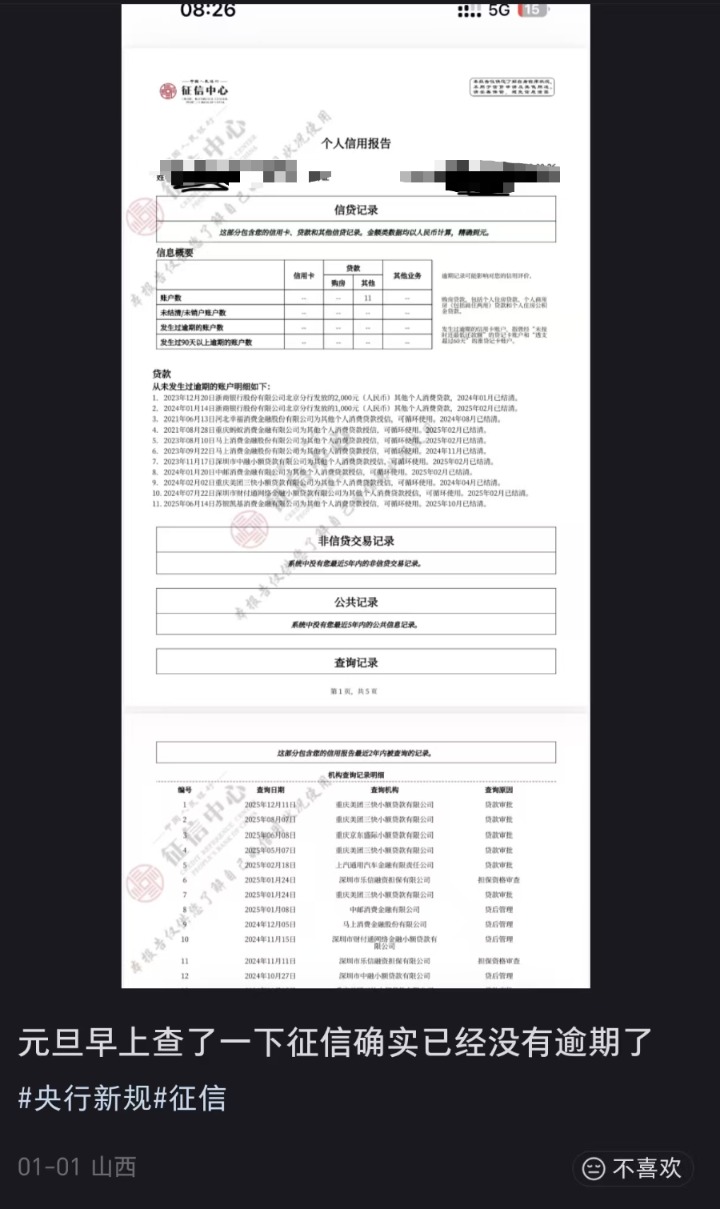
Core Viewpoint - The article discusses the recent implementation of a one-time credit repair policy by the People's Bank of China, which allows individuals with overdue records to have their credit reports updated, effectively removing certain overdue information if specific conditions are met [8][19]. Group 1: Policy Details - The one-time credit repair policy was announced on December 22, 2025, and aims to support individuals with damaged credit who have actively repaid their debts [8]. - The policy applies to overdue information generated between January 1, 2020, and December 31, 2025, with a single overdue amount not exceeding 10,000 RMB [19]. - Individuals must fully repay their overdue debts by March 31, 2026, to benefit from the policy, which will automatically identify and process eligible overdue records without requiring any application [19][21]. Group 2: Impact on Credit Reports - Following the policy's implementation, overdue records that meet the criteria will have their repayment status changed from overdue to normal, and overdue amounts will be adjusted to zero in credit reports [10][19]. - Users have reported that their credit reports reflect these changes, with overdue account numbers and details being cleared [8][10]. Group 3: Benefits and Implications - The policy is designed to alleviate the "credit dilemma" faced by individuals, encouraging them to resolve historical credit issues and restore their financial credibility [23][24]. - It is emphasized that this policy does not erase debt obligations; individuals must still fulfill their repayment responsibilities to benefit from the credit record adjustments [23][24]. - The initiative is expected to improve the relationship between financial institutions and clients, as it encourages individuals to maintain and protect their credit status, ultimately enhancing the overall credit ecosystem [24].
贷款逾期记录“清零”!多地网友晒图 个人信用修复窗口限时打开
2 1 Shi Ji Jing Ji Bao Dao· 2026-01-03 12:48
Core Viewpoint - The recent implementation of a one-time credit repair policy by the People's Bank of China has led to a significant reduction or elimination of overdue records for eligible individuals, enhancing their credit status and financial opportunities [9][10]. Group 1: Policy Details - The one-time credit repair policy allows individuals with overdue records from January 1, 2020, to December 31, 2025, to have their overdue information removed if they repay their debts in full by March 31, 2026 [9][12]. - The policy applies to overdue amounts not exceeding 10,000 RMB per instance, and it is automatically processed without the need for individuals to apply or provide documentation [9][12]. - Adjustments to credit reports will reflect overdue accounts as normal, and overdue amounts will be shown as zero, enhancing the creditworthiness of individuals who meet the criteria [10][12]. Group 2: Implementation and Impact - The policy has already been implemented, with many users confirming the positive effects through updated credit reports that show cleared overdue records [9][10]. - The People's Bank of China will increase the number of free credit report queries in the first half of 2026, allowing individuals to check their credit status more easily [13]. - The policy aims to address the "credit dilemma" faced by individuals who have repaid their debts, encouraging them to restore their credit status and improve their financial situation [14][15]. Group 3: Industry Implications - The one-time credit repair policy is expected to enhance the credit decision-making process for financial institutions, allowing for more accurate assessments of borrowers' creditworthiness [15]. - By encouraging individuals to repay overdue debts, the policy may help banks recover loans and improve asset quality, thus promoting inclusive finance [14][15]. - The initiative is designed to support non-malicious defaulters while maintaining strict conditions to prevent abuse of the credit system, ensuring that future credit records remain relevant and impactful [15].
央行信用修复新政落地,多地网友晒逾期“清零”截图
第一财经· 2026-01-03 06:05
Core Viewpoint - The new personal credit repair policy implemented on January 1, 2026, allows individuals with overdue records of up to 10,000 RMB to have their credit reports automatically cleared if they repay their debts by March 31, 2026, significantly reducing operational costs for citizens [14][15]. Group 1: Policy Implementation - The People's Bank of China issued a notice on December 22, 2025, detailing the credit repair policy aimed at individuals with overdue records from January 1, 2020, to December 31, 2025, for amounts not exceeding 10,000 RMB [14]. - The policy operates on an "automatic recognition" mechanism, meaning individuals do not need to apply or submit documentation, which simplifies the process for citizens [14]. Group 2: Impact on Individuals - Many individuals have reported that their overdue records have been cleared, allowing them a fresh start in their credit history, which is crucial for future loan applications [12][14]. - The policy targets those who have faced temporary financial difficulties, enabling them to restore their creditworthiness without the burden of past overdue records [14]. Group 3: Implications for Financial Institutions - The policy is expected to improve the asset quality of banks by encouraging overdue customers to repay their debts, potentially leading to a slight increase in retail loan issuance [15]. - Historical overdue records, which previously hindered loan approvals, will no longer be displayed for those who repay their debts, thus enhancing their chances of securing future loans [15]. - The repair of credit records is not expected to diminish banks' risk assessment capabilities, as they utilize a comprehensive data system for evaluating personal credit [15].
央行一次性信用修复政策生效实施,哪类人适用、该怎么操作?
Xin Lang Cai Jing· 2026-01-03 01:43
Core Viewpoint - The People's Bank of China has implemented a "one-time credit repair policy" aimed at supporting individuals with damaged credit who are actively repaying their debts, facilitating economic recovery [1][6] Group 1: Policy Details - The policy applies to personal overdue credit information from January 1, 2020, to December 31, 2025, with a single overdue amount not exceeding 10,000 yuan [4] - Individuals must fully repay their overdue debts by March 31, 2026, to benefit from the policy [4][5] - The policy operates on an "automatic recognition and processing" basis, meaning individuals do not need to apply or submit documentation [3][8] Group 2: Impact on Individuals - The policy aims to change overdue statuses in credit reports to normal upon repayment, thus restoring individuals' creditworthiness [3][6] - It encourages individuals to repay debts, potentially improving their access to financial services and enhancing their quality of life [6][7] - The initiative is designed to assist those who are not malicious defaulters, such as those affected by temporary unemployment or significant health issues [8] Group 3: Implications for Financial Institutions - The policy may help banks recover overdue loans and improve asset quality by encouraging borrowers to settle their debts [7] - Financial institutions are likely to benefit from a renewed customer base as previously defaulting individuals regain their credit status [7] - The policy reinforces the importance of maintaining good credit, as individuals with past credit issues may become more loyal to financial institutions after experiencing the consequences of poor credit [6][7]
涉及社会民生多个领域 一批新规今起正式施行
Xin Lang Cai Jing· 2026-01-01 03:17
Group 1 - The new version of the National Basic Medical Insurance, Maternity Insurance, and Work Injury Insurance Drug Directory has been implemented, adding 114 new drugs to the reimbursement list, including 50 first-class innovative drugs, while removing 29 drugs that are either not clinically available or can be replaced by better alternatives [2] - The total number of drugs in the directory has increased to 3,253, with 1,857 Western medicines and 1,396 traditional Chinese medicines, significantly enhancing coverage for key areas such as cancer, chronic diseases, mental illnesses, rare diseases, and pediatric medications [2] Group 2 - Starting today, all medical institutions are required to fully collect and upload drug traceability codes, which serve as "electronic IDs" for drugs, ensuring traceability throughout the production, circulation, usage, and insurance settlement processes [3] - The National Medical Insurance Information Platform has collected 110.369 billion traceability codes, aiding in the resolution of multiple national counterfeit drug cases and addressing 39,100 illegal institutions, with 188 cases referred to judicial authorities [3][5] Group 3 - A new policy requires kindergartens to implement a directory management system for fees, establishing two separate lists for service fees and kindergarten-specific charges, with strict public disclosure requirements [6] Group 4 - The People's Bank of China will automatically adjust credit information based on repayment conditions, with specific criteria set for overdue debts occurring between January 1, 2020, and December 31, 2025, allowing for the removal of certain overdue information from personal credit reports if conditions are met [8] - The new VAT law and its implementation regulations have come into effect, with 14 out of 18 existing tax types now having legal frameworks, covering a significant portion of tax revenue [8]
这些新规,今天起施行
Xin Lang Cai Jing· 2026-01-01 02:19
Group 1: Social Security and Education - The revised Public Security Administration Punishment Law will implement penalties for behaviors affecting social security, including exam cheating and unauthorized drone flights [1] - The new notification on kindergarten fee policies mandates public disclosure of fees for public and non-profit private kindergartens, with a clear list of service charges [2] Group 2: Electric Vehicles - The first mandatory standard for electric vehicle energy consumption will require necessary technical upgrades for new products, aiming to improve the driving experience and increase the average range by approximately 7% [3] Group 3: Taxation - The new Value-Added Tax Law will come into effect, marking significant progress in establishing legal frameworks for taxation in China, covering 14 out of 18 existing tax types [4] Group 4: Language and Internet Regulation - The revised National Common Language and Writing Law will enhance education and innovation in language technology, with new regulations for online language use [5] - The updated Cybersecurity Law will address artificial intelligence risks, promoting research and infrastructure development while enhancing safety regulations [9] Group 5: Personal Credit and Employment - A one-time credit repair policy will allow for automatic adjustments to credit reports for overdue payments made between January 1, 2020, and December 31, 2025, under specific conditions [6] - The National Park Law encourages local employment for ecological management positions and promotes public participation in conservation efforts [8]
1月新法新规:噪音扰民最高处十日拘留,个人取现超5万无需登记
Xin Lang Cai Jing· 2026-01-01 00:15
Group 1: Law and Regulation Changes - The revised Public Security Administration Punishment Law will regulate issues such as animal attacks and noise disturbances, with penalties including up to ten days of detention and fines of up to 1,000 yuan for severe noise disturbances [2] - The new Value-Added Tax (VAT) Law will come into effect, impacting millions of businesses and individuals, with VAT revenue projected to be approximately 6.57 trillion yuan in 2024, accounting for 38% of total tax revenue [3] - The revised National Common Language and Writing Law will promote the use of standard Chinese language and characters across various sectors, including public services and advertising [4] Group 2: Environmental and Technological Regulations - The National Park Law will prioritize hiring local residents for ecological protection roles and encourage public participation in conservation efforts [5] - The revised Cybersecurity Law will enhance monitoring and regulation of artificial intelligence risks, supporting the development of key technologies and ethical standards [6][7] - The new electric vehicle energy consumption standards will enforce stricter limits, improving energy efficiency and supporting the transition to low-energy vehicles [11] Group 3: Housing and Financial Regulations - The new policy on personal housing sales will impose a 3% VAT on properties sold within two years of purchase, while properties sold after two years will be exempt from VAT [12] - The People's Bank of China will implement a new digital currency framework, allowing interest to be paid on digital yuan wallet balances, marking a shift towards digital deposit currency [13][14] - The new financial regulations will eliminate the requirement for individuals to register cash withdrawals over 50,000 yuan, streamlining the process based on risk assessment [16]