农户贷款

Search documents
中国农业银行甘肃省分行:点滴间的“农情暖客”
Xin Lang Cai Jing· 2026-02-13 06:27
Core Viewpoint - Agricultural Bank of China Gansu Branch demonstrates resilience and commitment to serving the community during natural disasters, emphasizing the importance of financial services in times of crisis [2][7]. Group 1: Emergency Response and Community Support - Following the earthquake in Jishishan and Diebu, the bank activated an emergency response, ensuring the flow of financial services in disaster areas by increasing cash reserves and deploying mobile service vehicles [2][7]. - The bank's employees formed volunteer teams to assist in logistics and provide financial policy consultations, helping affected clients understand relief measures such as loan extensions and interest rate discounts [2][7]. Group 2: Elderly Care and Inclusive Services - The bank's focus on elderly clients is evident in its provision of senior-friendly services, including specially designed seating and priority systems for older customers [3][8]. - Initiatives include creating dedicated service records for elderly clients and offering home visits for personalized financial consultations, enhancing their financial literacy and social recognition [3][9]. Group 3: Rural Financial Inclusion - The bank has established 64 rural service stations, continuously expanding to connect with local government and community organizations, thereby facilitating access to essential financial services for rural populations [4][10]. - The use of technology, such as RPA for monitoring customer wait times, has significantly reduced average wait times, improving customer satisfaction and allowing staff to focus on personalized services [5][10]. Group 4: Overall Commitment to Service - The bank's efforts extend beyond disaster response to everyday services, reinforcing its role as a trusted partner for the community and contributing to the broader goal of financial security and modernization in China [5][11].

农行耀州区支行开展“情暖返乡路 金融伴新春”宣传活动
Xin Lang Cai Jing· 2026-02-03 12:52
Core Viewpoint - The Agricultural Bank of China (ABC) in Tongchuan Yaozhou District organized a themed promotional event titled "Warm Return Journey, Financial Accompaniment for the New Year" to ensure the financial safety of returning home during the Spring Festival [1][2]. Group 1: Event Overview - The event took place at local train and bus stations, where ABC staff provided financial knowledge and warm wishes to travelers [1][2]. - Staff distributed Spring Festival couplets while explaining financial concepts in an easy-to-understand manner [1][2]. Group 2: Financial Products Promotion - The focus was on common concerns of returning travelers, such as retirement savings, children's education financing, and entrepreneurial loans [1][2]. - ABC highlighted its competitive deposit products with favorable interest rates and flexible terms, as well as streamlined personal business loans and farmer loans [1][2]. Group 3: Event Impact - During the event, over 200 financial knowledge materials were distributed, and 200 couplets were given away [1][2]. - The bank received over 100 inquiries and achieved more than 10 deposit intentions and over 20 loan consultations, demonstrating positive social and promotional outcomes [1][2].
智简焕新 您的新版手机银行已上线
中国建设银行· 2026-01-29 07:59
Core Viewpoint - The article emphasizes the comprehensive upgrade of China Construction Bank's mobile banking services, focusing on user-centric financial solutions, innovative technology, and enhanced service capabilities to provide a seamless digital financial experience [5][42]. Group 1: Wealth Management Solutions - The bank offers a full range of wealth management solutions tailored to meet diverse investment needs, ensuring personalized product recommendations for both novice and experienced investors [6][8]. - The "Dragon Money Treasure 1" product allows users to enjoy investment returns while maintaining liquidity for daily expenses, with an average annualized return of 7% as of July 11 [10][12]. Group 2: Loan Services - The bank has streamlined its loan services, enabling users to easily calculate their loan eligibility online without cumbersome processes, with consumer loans starting at an annual interest rate of 5.68% [16][18]. - Customized loan solutions are available, allowing users to select loan products that best fit their individual needs, including options for small and micro enterprises as well as agricultural loans [17][18]. Group 3: Cost-saving Services - The bank has enhanced its utility payment services, providing timely reminders for bills and offering discounts for prompt payments, such as a WeChat discount for immediate bill payments [20][24]. - The "Construction Bank Savings Card" offers monthly discounts and rewards for meeting spending thresholds, promoting cost-saving opportunities for users [23][25]. Group 4: User Experience Enhancements - The mobile banking app has undergone significant improvements to ensure a smooth and efficient user experience, with features like precise search capabilities and seamless identity verification processes [30][35]. - The introduction of conversational banking services allows users to perform transactions and inquiries through natural language commands, significantly increasing operational efficiency [38][40]. Group 5: Technological Innovations - The bank's mobile banking platform leverages advanced technology to provide a more intelligent and user-friendly experience, aiming to democratize access to financial services across different demographics [35][43]. - The proactive service model anticipates user needs by monitoring asset changes and risk preferences, offering timely financial advice and loan assessments [41][42].


央行:2025年四季度末本外币涉农贷款余额53.57万亿元,同比增长6.5%
Sou Hu Cai Jing· 2026-01-27 09:29
Core Insights - The central bank released the loan allocation statistics report for financial institutions for Q4 2025, indicating a total balance of RMB 53.57 trillion in domestic and foreign currency agricultural loans, representing a year-on-year growth of 6.5%, which is 0.3 percentage points higher than the overall loan growth rate [1] Group 1: Agricultural Loans - The balance of rural loans reached RMB 39.24 trillion by the end of Q4 2025, with a year-on-year increase of 6.3, contributing an annual increase of RMB 2.44 trillion [1] - The balance of household loans amounted to RMB 18.42 trillion, showing a modest year-on-year growth of 1.0%, with an annual increase of RMB 216.8 billion [1] - Agricultural loans totaled RMB 6.89 trillion, reflecting a year-on-year growth of 8.3%, with an annual increase of RMB 534.3 billion [1]
重大利好!多地网友晒图,贷款逾期记录清零
21世纪经济报道· 2026-01-03 12:57
Core Viewpoint - The article discusses the recent implementation of a one-time credit repair policy by the People's Bank of China, which allows individuals with overdue records to have their credit reports updated, effectively removing certain overdue information if specific conditions are met [8][19]. Group 1: Policy Details - The one-time credit repair policy was announced on December 22, 2025, and aims to support individuals with damaged credit who have actively repaid their debts [8]. - The policy applies to overdue information generated between January 1, 2020, and December 31, 2025, with a single overdue amount not exceeding 10,000 RMB [19]. - Individuals must fully repay their overdue debts by March 31, 2026, to benefit from the policy, which will automatically identify and process eligible overdue records without requiring any application [19][21]. Group 2: Impact on Credit Reports - Following the policy's implementation, overdue records that meet the criteria will have their repayment status changed from overdue to normal, and overdue amounts will be adjusted to zero in credit reports [10][19]. - Users have reported that their credit reports reflect these changes, with overdue account numbers and details being cleared [8][10]. Group 3: Benefits and Implications - The policy is designed to alleviate the "credit dilemma" faced by individuals, encouraging them to resolve historical credit issues and restore their financial credibility [23][24]. - It is emphasized that this policy does not erase debt obligations; individuals must still fulfill their repayment responsibilities to benefit from the credit record adjustments [23][24]. - The initiative is expected to improve the relationship between financial institutions and clients, as it encourages individuals to maintain and protect their credit status, ultimately enhancing the overall credit ecosystem [24].

向山而行,群山回响——农业银行定点帮扶纪实
第一财经· 2025-12-16 01:06
Core Viewpoint - The year 2025 holds significant meaning for China, particularly in the context of consolidating and expanding the achievements of poverty alleviation and effectively connecting them with rural revitalization efforts [1] Group 1: Poverty Alleviation and Rural Revitalization - The Chinese government has established the "four no drop" requirements to ensure that responsibilities, policies, support, and supervision remain in place for the 832 poverty-stricken counties that have been lifted out of poverty [1] - Agricultural Bank has implemented a systematic and sustainable support system through financial innovation, demonstrating effective assistance in rural areas [1][2] Group 2: Financial Support Models - The "credit village" model allows villagers to access credit based on their credit status, industry foundation, and governance levels, enabling them to obtain loans without collateral [5] - The introduction of the "financial village director" role in 2023 has enhanced the connection between banks and farmers, facilitating financial services and loan recommendations [5][4] Group 3: Case Studies of Successful Implementation - In Zou Village, the scale of chicken farming has grown from 500 to over 1 million chickens, with annual income surpassing 2 million yuan, thanks to the support from Agricultural Bank [4] - The low-altitude flight training base in Huangping has received 30 million yuan in emergency funding from Agricultural Bank, allowing it to recover from severe weather damage and continue operations [9][11] Group 4: Community Development and Infrastructure - In Xueba Village, financial support has led to the establishment of a water park and lotus garden, creating local employment opportunities and increasing monthly income for residents [12][16] - Agricultural Bank has invested over 5.5 billion yuan in Huangping County, supporting various local industries and improving healthcare facilities, thereby enhancing the quality of life for residents [11][12] Group 5: Broader Implications of Financial Assistance - The financial assistance model has evolved from "blood transfusion" to "blood-making," focusing on creating self-sustaining capabilities within communities [11] - The ongoing efforts of Agricultural Bank in various counties have been recognized as "global best practices in poverty alleviation," showcasing the effectiveness of their approach [16]

金融企业涉农和中小企业贷款损失准备金税前扣除政策
蓝色柳林财税室· 2025-11-01 06:54
Group 1 - The article discusses tax and fee incentives to support the development of small and micro enterprises and individual businesses, promoting inclusive finance [1][2] - Financial enterprises providing agricultural and small and medium-sized enterprise (SME) loans can deduct loan loss provisions from taxable income based on risk classification [1][2] - The risk classification for loans includes categories such as "attention category" with a provision rate of 2%, "substandard category" at 25%, "doubtful category" at 50%, and "loss category" at 100% [1][2] Group 2 - Agricultural loans are defined as loans issued to households residing in rural areas, including individual businesses and state farm employees [2][8] - SME loans refer to loans to enterprises with annual sales and total assets not exceeding 200 million [2][8] - Financial enterprises can deduct loan losses that meet the criteria from their taxable income, with provisions already deducted being offset first [2]

三农金融事业部涉农贷款利息收入可选择适用简易计税方法缴纳增值税相关政策
蓝色柳林财税室· 2025-10-20 08:33
Core Viewpoint - The article discusses the preferential tax policy for agricultural loans provided by China Postal Savings Bank's Rural Financial Division, allowing eligible branches to choose a simplified tax method for VAT calculation at a rate of 3% on interest income from agricultural loans [4][5]. Group 1: Policy Details - The policy is applicable until December 31, 2027, for branches under the Rural Financial Division of China Postal Savings Bank in various provinces and municipalities [4]. - Eligible agricultural loans include those provided to farmers, rural enterprises, and various rural organizations, which can opt for the simplified VAT calculation method [5][6]. Group 2: Eligibility Criteria - Farmers are defined as individuals residing in rural areas for over one year, including those in townships and certain collective households [5][9]. - Loans to rural enterprises and organizations must be registered in rural areas to qualify for the tax benefits [5][9]. Group 3: Policy Basis - The policy is based on announcements from the Ministry of Finance and the State Administration of Taxation regarding the extension of tax incentives for agricultural loans [8][10].

农户贷款助力西藏农牧区信用体系智慧化发展
Zhong Guo Xin Wen Wang· 2025-09-27 04:59
Core Insights - Agricultural Bank of China (ABC) Tibet Branch has significantly advanced the rural credit system in Tibet over the past 30 years, evolving it from non-existent to sophisticated [1][2] - The introduction of small loan products using the "Gold, Silver, Copper" card system in 2001 addressed local challenges such as transportation issues and lack of collateral, enabling residents to access credit [1] - The bank's innovative approach has led to the issuance of 460,300 "Four Card" loans, with a usage rate exceeding 90%, thereby improving financial resource allocation in rural areas [2] Summary by Sections Credit System Development - ABC Tibet Branch has developed a three-tier credit system at the county, town, and village levels, creating a new credit mechanism for rural areas [2] - The "Four Card" system includes Diamond, Gold, Silver, and Copper cards, which have been enhanced multiple times to increase loan limits based on agricultural development needs [1][2] Impact on Local Communities - The case of a local resident, Laba Danzhu, illustrates the positive impact of the credit system, as he was able to purchase a second-hand tractor and later establish a sand and gravel business, becoming a leader in his community [1] Future Plans - ABC Tibet Branch aims to further strengthen the rural credit system and increase personal loans for agriculture to over 40 billion RMB by 2025, focusing on key areas of rural revitalization [2]
A股流通市值第一股易主,凸显县域经济大有可为
Zhong Guo Xin Wen Wang· 2025-08-13 14:03
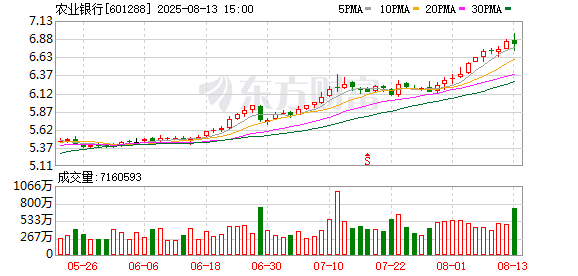
Group 1 - Agricultural Bank of China has surpassed Industrial and Commercial Bank of China to become the largest A-share circulating market value company [2] - The shift in market leadership reflects a revaluation of bank stocks, emphasizing low valuations and high dividends, indicating a strategic shift from high growth to stable returns [4] - The performance of bank stocks has been particularly strong this year, with multiple banks occupying positions in the top ten A-share market capitalization rankings [4] Group 2 - The rise in Agricultural Bank's market value is driven by the advantages of high dividends and fixed-income characteristics in a low-interest-rate environment, alongside continuous inflow of new capital [5] - Agricultural Bank's net profit growth is leading among the six major state-owned banks, with the bank being the only one to achieve growth in both revenue and net profit in the first quarter of this year [5] - The bank's unique competitive advantage in county-level financial markets and its focus on inclusive finance and loans to private enterprises contribute to its performance [5] Group 3 - By the end of 2024, Agricultural Bank's county-level loan balance is expected to reach 9.85 trillion yuan, accounting for over 40% of domestic loans, with a significant increase in farmer loans [5] - The bank's stock price has seen the highest increase among comparable peers in 2024, with total market value growth leading the industry for two consecutive years [6] - To maintain its position as the A-share market value leader, Agricultural Bank must balance interest rate environments, policy directions, and innovations in its profit model [6]