
中国特色社会主义

Search documents
2025企业家博鳌论坛聚焦“十五五”新机遇
Xin Hua Wang· 2025-12-04 13:57
Group 1 - The 2025 Boao Forum for Entrepreneurs is themed "Linking the World, Leading the Future: '14th Five-Year' New Opportunities" and is taking place in Boao, Hainan from December 2 to December 5 [3] - The forum aims to gather entrepreneurs to discuss development and future opportunities, emphasizing the importance of deepening the real economy, innovation-driven growth, and green transformation [1][2] - Hainan Free Trade Port will officially start its full island closure operation on December 18, marking a significant step in China's commitment to high-level opening-up and the construction of an open world economy [2] Group 2 - The forum has been held for ten consecutive years since 2016, providing a high-end platform for domestic and international entrepreneurs to exchange ideas and deepen cooperation [2] - Hainan is committed to creating a first-class business environment and ensuring various resource guarantees for entrepreneurs, promoting a sense of security in investment and development [2]
思想体悟丨坚定理想信念 补足精神之钙
Zhong Yang Ji Wei Guo Jia Jian Wei Wang Zhan· 2025-12-01 00:40
Core Viewpoint - The article emphasizes the importance of ideal beliefs as the spiritual pillar and political soul of the Communist Party of China, highlighting that a firm commitment to these beliefs is essential for the Party's integrity and effectiveness [5][15][16]. Group 1: Importance of Ideals and Beliefs - The Communist Party of China is organized around shared ideals and beliefs, with Marxism as its guiding ideology, which is crucial for maintaining its direction and purpose [6][15]. - The commitment to the lofty ideals of communism and socialism is seen as the foundation for the Party's resilience and ability to overcome challenges [6][15]. - The article stresses that the loss of ideals and beliefs can lead to disintegration and failure, both for the Party and individual members [9][16]. Group 2: Role of Education and Continuous Learning - Continuous education and reinforcement of ideals are necessary for Party members to maintain their political integrity and commitment to their duties [4][11]. - The article highlights the need for Party members to engage in lifelong learning to strengthen their understanding and adherence to Marxist principles and the Party's mission [10][11]. Group 3: Practical Application of Ideals - The article asserts that ideals must be translated into action, with Party members demonstrating their commitment through responsible and dedicated service [14][15]. - It emphasizes that the true test of a Party member's beliefs is their ability to withstand political challenges and maintain a strong sense of duty in various circumstances [11][14].

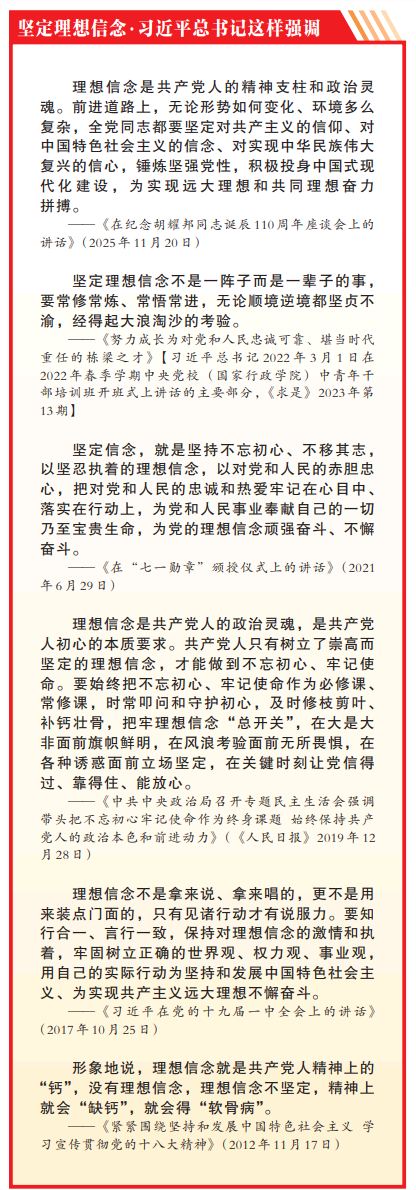
习近平:在纪念胡耀邦同志诞辰110周年座谈会上的讲话
证监会发布· 2025-11-20 09:22
Core Viewpoint - The article commemorates the 110th anniversary of Hu Yaobang's birth, highlighting his significant contributions to the Communist Party and the modernization of China, emphasizing the importance of his ideals and leadership in the context of socialism and reform [3][5][11]. Group 1: Hu Yaobang's Life and Contributions - Hu Yaobang was a dedicated communist fighter and a prominent leader who played crucial roles in various revolutionary and political positions throughout his life [4][5]. - His life exemplified a commitment to ideals, a spirit of service to the people, and a dedication to reform and modernization [5][6]. Group 2: Ideals and Beliefs - Hu Yaobang's unwavering belief in communism and socialism served as a spiritual pillar for the Communist Party, encouraging members to maintain faith in their ideals despite challenges [5][6]. - He emphasized the importance of practical approaches and the need for continuous theoretical exploration to adapt Marxism to Chinese realities [6][7]. Group 3: Reform and Modernization - Hu Yaobang viewed reform as essential for the success of socialism and advocated for comprehensive and planned reforms to overcome obstacles to modernization [7][8]. - He believed that economic development and improving people's livelihoods were paramount, urging the party to focus on the well-being of the populace [8][9]. Group 4: Party Integrity and Conduct - Hu Yaobang stressed the importance of maintaining a good party style and integrity, advocating for strict self-discipline among party members to combat corruption [10]. - He believed that the party's image and its ability to connect with the people were critical for its survival and success [10][11].
经典常谈 | 不懈努力 接续奋斗
Zhong Yang Ji Wei Guo Jia Jian Wei Wang Zhan· 2025-11-04 00:35
Core Viewpoint - The development of socialism is a dynamic and progressive process, characterized by continuous advancement and the accumulation of quantitative changes leading to qualitative leaps [1] Group 1: Historical Development of Socialism - Marx and Engels argued for the historical inevitability of the transition to socialism, emphasizing the role of productive forces in societal division of labor [2] - They posited that each generation builds upon the foundations laid by the previous one, adapting social systems as needs change [2] - Marx and Engels predicted the inevitable downfall of the bourgeoisie and the victory of the proletariat as a result of the development of productive forces [2] Group 2: Stages of Socialist Development - Marx outlined a challenging and lengthy process towards communism, with the first step being the elevation of the proletariat to a ruling class [3] - Lenin expanded on this by identifying three stages of socialist development, including a transitional political period and two phases of communist society [3] - The first phase of communism is characterized by economic immaturity, while the advanced phase involves full management of social production by the populace [3] Group 3: Strategic Development in China - The establishment and development of a socialist state is a gradual process requiring historical patience and strategic determination [4] - Mao Zedong indicated that building a prosperous socialist nation would take over a century, involving both underdeveloped and relatively developed stages of socialism [5] - Deng Xiaoping emphasized the importance of a three-step strategy for modernizing socialism in China, recognizing the significance of the initial stage [5] Group 4: New Era of Socialism in China - Since the 18th National Congress, Xi Jinping has introduced significant concepts regarding the new historical positioning of socialism in China, marking a new development stage [6] - The 20th Central Committee highlighted that achieving socialist modernization is a progressive historical process requiring continuous effort [6] - The approach to modernization is characterized by a step-by-step strategy, with a focus on practical implementation and long-term planning [6]
创新中国开启关键五年——“十五五”科技坐标解读①
Ke Ji Ri Bao· 2025-10-27 01:40
Core Points - The 20th Central Committee's Fourth Plenary Session approved the "Suggestions on Formulating the 15th Five-Year Plan for National Economic and Social Development," outlining a strategic framework for the next five years [1] - Emphasis on accelerating high-level technological self-reliance and innovation as a key driver for new quality productivity [1][18] - The 15th Five-Year Plan is seen as a critical period for achieving a high level of technological self-reliance and building a strong technological nation [16] Group 1: Five-Year Plan Significance - The Five-Year Plan serves as a guiding star for long-term economic and social development, playing a crucial role in directing national economic growth and technological innovation [4][10] - Experts highlight the importance of the Five-Year Plan in establishing long-term goals and directions for economic and technological development, showcasing its continuity and innovation [4][10] - The plan has historically facilitated significant advancements in China's technological capabilities, transitioning from a follower to a leader in various fields [6][10] Group 2: Technological Advancements - China's global innovation index ranking has improved from 34th in 2012 to 10th in 2025, with high-level international journal papers and patent applications leading the world for five consecutive years [6] - The "14th Five-Year Plan" has positioned innovation-driven development at the core of national modernization, emphasizing original innovation and strengthening foundational research [10][12] - The plan has led to significant achievements in various sectors, including space exploration, electric vehicles, and deep-sea exploration, marking a period of remarkable technological progress [10][12] Group 3: Future Outlook - The 15th Five-Year Plan is expected to further enhance technological self-reliance and support the modernization of China through strategic innovation [15][16] - Experts stress the need for original innovation and the integration of technological and industrial innovation to meet new demands arising from demographic changes and economic transformation [16][18] - The upcoming five years are viewed as critical for seizing opportunities in the new technological revolution and enhancing national competitiveness in the global arena [16][18]

把制度优势转化为发展优势——从全球视角看新时代中国特色社会主义的巨大优越性
Ren Min Ri Bao· 2025-10-22 22:27
Group 1 - The article emphasizes China's commitment to high-level opening up and high-quality development, projecting its economy to reach approximately 140 trillion yuan by 2025, contributing around 30% to global economic growth [1][2][4] - The establishment of the G60 Science and Technology Innovation Corridor in the Yangtze River Delta is highlighted, showcasing a collaborative industrial chain that integrates research, manufacturing, logistics, and services, with an expected economic output of 9 trillion yuan by 2024 [5][6] - The article discusses the successful implementation of the five-year planning system in China, which has become a distinctive feature of its governance, allowing for strategic long-term economic planning and stability [3][4][6] Group 2 - The article mentions the relocation of state-owned enterprises, such as China Huaneng Group and China Sinochem Holdings, to Xiong'an New Area, indicating a strategic move to enhance urban development and economic vitality [1][2] - The focus on agricultural development, particularly the apple industry in Yan'an, is presented as a model for poverty alleviation and job creation, benefiting over 800,000 farmers [7][8] - China's role in global cooperation is underscored, with initiatives in agriculture and renewable energy aimed at supporting developing countries, thereby enhancing mutual growth and stability [9][10]
中宣部负责人就《中国共产党思想政治工作条例》答记者问
Bei Jing Ri Bao Ke Hu Duan· 2025-09-28 05:47
Core Points - The article discusses the issuance of the "Regulations on Ideological and Political Work of the Communist Party of China," which serves as a comprehensive framework for ideological and political work in the new era [2][3] Background and Significance - The formulation of the regulations is rooted in the Party's longstanding tradition and political advantages, with significant emphasis placed by the central leadership on ideological and political work since the 18th National Congress [2] - The regulations aim to enhance the scientific, institutional, and standardized levels of ideological and political work, reflecting the Party's commitment to leadership in this area [3] Framework of the Regulations - The regulations consist of 14 chapters and 58 articles, divided into three main sections: the purpose and significance of the regulations, specific provisions for various sectors, and guidelines for organizational support and supervision [5] Key Principles and Requirements - The regulations emphasize the importance of ideological and political work in mobilizing and organizing Party members and the public to fulfill the Party's central tasks [6] - They outline the guiding ideology, which includes adherence to Marxism and the core principles of Xi Jinping's thought, aiming to unify and strengthen the ideological foundation of the Party [7] Content and Methods of Ideological Work - The regulations specify nine key areas of focus for ideological and political work, including education on the Party's basic theories and promoting socialist values [11] - They highlight the importance of innovative methods in ideological work, advocating for targeted and effective approaches to engage different demographics [12] Sector-Specific Requirements - The regulations provide tailored requirements for ideological work across various sectors, including enterprises, rural areas, schools, and communities, emphasizing the integration of ideological work with practical activities [13] Role of Mass Organizations - The regulations recognize the critical role of mass organizations in ideological work, urging them to enhance their political engagement and outreach to the public [14][15] Team Building and Support - The regulations stress the need for a high-quality ideological work team, advocating for comprehensive training and management to ensure effective implementation [16] Supervision and Implementation - The regulations outline measures for ensuring effective supervision and support for ideological work, including financial backing and performance evaluations [17] - They call for a robust implementation strategy, emphasizing the importance of learning, promoting, and adhering to the regulations across all levels of the Party [18]
继续推进马克思主义中国化(专题深思)
Ren Min Ri Bao· 2025-09-27 02:42
Core Viewpoint - The essence of the Chinese Communist Party's success and the effectiveness of socialism with Chinese characteristics lies in the adherence to Marxism as the fundamental guiding ideology [1][2][3] Group 1: Adherence to Marxism - The Chinese Communist Party has consistently upheld the basic principles of Marxism, utilizing it as a powerful ideological tool to understand and transform the world [2][4] - Marxism has guided the Party through various historical phases, including the New Democratic Revolution, Socialist Revolution, and the establishment of socialism with Chinese characteristics, leading to the great rejuvenation of the Chinese nation [2][4] Group 2: People-Centered Development - The Party emphasizes a people-centered development approach, maintaining that the essence of Marxism is to seek liberation for humanity and happiness for the people [3][4] - The commitment to serving the people has been a fundamental principle, ensuring that the Party remains connected to the masses and focused on their interests [3][4] Group 3: Practical Application of Marxism - The practical nature of Marxism distinguishes it from other theories, with the Party continuously advancing social revolutions through practical engagement [4][5] - Historical achievements include the establishment of the People's Republic of China, the implementation of socialist reforms, and the ongoing modernization efforts under socialism with Chinese characteristics [4][5] Group 4: Theoretical Innovation - The Party has consistently pursued theoretical innovation, adapting Marxism to contemporary Chinese realities and integrating it with traditional culture [5][6] - The evolution of Marxism in China has led to significant theoretical contributions, including Mao Zedong Thought and Xi Jinping's Thought on Socialism with Chinese Characteristics for a New Era [5][6]

本网评论 | 伟大复兴势不可挡
Zhong Yang Ji Wei Guo Jia Jian Wei Wang Zhan· 2025-09-06 00:41
Group 1 - The event commemorates the 80th anniversary of the victory in the Chinese People's War of Resistance against Japanese Aggression and the World Anti-Fascist War, emphasizing the importance of historical memory and national unity [1][2] - The speech highlights the achievements and historical transformations led by the Communist Party of China, asserting that without the Party, there would be no new China or national rejuvenation [2][4] - The call for unity and hard work is reiterated, stating that all accomplishments are the result of effort and determination, and that modernization must be actively pursued [3][4] Group 2 - The significance of collective struggle is emphasized, noting that a united nation has a promising future, and a united party can withstand challenges [4] - The narrative stresses the importance of historical consciousness and the need to learn from the past to inspire future actions [3][4] - The vision for the future is optimistic, asserting that the great rejuvenation of the Chinese nation is unstoppable [4]
风雨无阻向前进
Zhong Yang Ji Wei Guo Jia Jian Wei Wang Zhan· 2025-09-04 02:28
Core Viewpoint - The commemoration of the 80th anniversary of the victory in the Chinese People's War of Resistance Against Japanese Aggression emphasizes the historical significance of this victory as a turning point for the Chinese nation towards great rejuvenation [2][3] Group 1: Historical Significance - The victory in the Anti-Japanese War is portrayed as a critical moment that led to the revival of the Chinese nation from a period of deep crisis [2] - The sacrifices made by over 35 million people during the war are highlighted as foundational to the defense of national dignity and a significant contribution to the global anti-fascist efforts [1] Group 2: Current Context and Future Outlook - The narrative stresses that the Chinese people are closer than ever to achieving the goal of national rejuvenation, with increased confidence and capability [2] - It acknowledges the complexity and severity of current risks and challenges, urging a spirit of struggle and the need for persistent efforts to navigate these challenges [2] Group 3: Leadership and Unity - The importance of the Chinese Communist Party's leadership is emphasized as essential for the prosperity and strength of New China [3] - The call for unity under the leadership of Xi Jinping and adherence to the guiding principles of socialism with Chinese characteristics is reiterated as crucial for future progress [3]