
中微子

Search documents
【科技日报】江门中微子实验看透“幽灵粒子”
Ke Ji Ri Bao· 2025-11-19 06:03
Core Insights - The Jiangmen Underground Neutrino Observatory (JUNO) has successfully completed its construction and released its first physical results, achieving a measurement precision of 1.5 to 1.8 times better than previous best results for two key solar neutrino oscillation parameters [2][3] Group 1: Scientific Objectives - JUNO aims to determine the mass ordering of three types of neutrinos: electron neutrinos, muon neutrinos, and tau neutrinos, which is a fundamental question in neutrino physics [3] - The observatory will also conduct precise measurements of neutrino oscillation parameters and cross-research on solar neutrinos, terrestrial neutrinos, supernova neutrinos, atmospheric neutrinos, and proton decay [3] Group 2: Significance for Humanity - Neutrinos are linked to the origins of the universe and play a crucial role in determining the conditions necessary for the existence of matter [4][5] - The study of neutrinos is a pure exploration of natural laws, with potential long-term value that is currently unpredictable, similar to the early days of electricity [5] Group 3: Importance of Precision Measurement - Accurate measurements of neutrino oscillation parameters are essential for addressing fundamental mysteries in physics, such as whether neutrinos are their own antiparticles [6] - The recent results from JUNO significantly improve the measurement precision of solar neutrino oscillation parameters, which may clarify discrepancies in previous measurements and could indicate new physics [6]

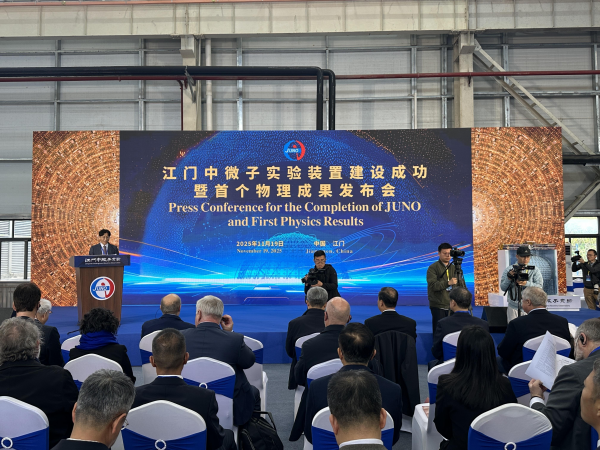
国际首个!地下700米的大国重器,建设成功!
Huan Qiu Wang Zi Xun· 2025-11-19 04:28
Core Insights - The Jiangmen Underground Neutrino Observatory (JUNO) has successfully completed its construction and released its first physical results, achieving a measurement precision of 1.5 to 1.8 times better than previous best results for two key solar neutrino oscillation parameters [1][2] Group 1: Scientific Significance of Neutrinos - Neutrinos, known as "ghost particles," can easily penetrate matter and carry ancient information about the universe's birth and evolution [2] - JUNO aims to determine the mass hierarchy of three types of neutrinos: electron neutrinos, muon neutrinos, and tau neutrinos, which is a fundamental question in neutrino physics [2] - The observatory will also conduct precise measurements of neutrino oscillation parameters and cross-research on solar, terrestrial, supernova, atmospheric neutrinos, and proton decay [2] Group 2: Implications for Humanity - The study of neutrinos is linked to the origins of the universe and the conditions necessary for the existence of matter, as their mass influences the formation of galaxies and stars [3] - Understanding neutrinos is a pure exploration of natural laws, with potential long-term benefits that are currently unpredictable, similar to the early discoveries of electricity [3] Group 3: Importance of Precision in Measurements - Accurate measurements of neutrino oscillation parameters are crucial for addressing unresolved questions in physics, such as whether neutrinos are their own antiparticles [4] - Inaccurate measurements could lead to significant resource investments in new experiments over many years, while precise measurements could clarify many ambiguous physical concepts [5] - The recent results from JUNO highlight the importance of high-precision measurements in resolving discrepancies in neutrino oscillation parameters, which may indicate new physics beyond the standard model [5]
建成仅两个多月,江门中微子实验发布首个物理成果
Xin Jing Bao· 2025-11-19 04:08
Core Insights - The Jiangmen Underground Neutrino Observatory (JUNO) has successfully completed its construction and released its first physical results, marking a significant milestone in neutrino research [1][2]. Group 1: Neutrino Research Significance - Neutrinos are one of the three types of fundamental particles that make up the material world, and they are produced in vast quantities by processes such as nuclear reactions in stars and radioactive decay [2]. - The JUNO experiment aims to address a major question in particle physics: the ordering of neutrino masses, which is crucial for understanding the fundamental properties of these particles [2][3]. Group 2: Experimental Achievements - The JUNO collaboration reported a measurement of the solar neutrino oscillation parameters with unprecedented precision, improving upon previous experiments by 1.5 to 1.8 times [3]. - The experiment confirmed a previously observed discrepancy known as the "solar neutrino anomaly," which suggests the possibility of new physics beyond the standard model [3]. Group 3: Future Prospects - The JUNO facility is expected to produce significant physical results over the coming decades and contribute to the training of a new generation of physicists [4]. - With a design lifespan of 30 years, JUNO can be upgraded to become the world's most sensitive experiment for detecting neutrinoless double beta decay, which could provide insights into whether neutrinos are their own antiparticles and help measure their absolute mass [3].
新华社权威快报 | 捕捉“幽灵粒子” 江门中微子实验测量精度创新高
Xin Hua She· 2025-11-19 03:43
Core Insights - The Jiangmen Neutrino Experiment has achieved a measurement precision for neutrino-related parameters that is 1.5 to 1.8 times better than previous experiments [2] Group 1: Experiment Overview - The Jiangmen Neutrino Experiment is designed to detect neutrinos, often referred to as "ghost particles," which are among the lightest and hardest particles to capture in the universe [2] - The experiment was officially launched for data collection on August 26, 2025, after being constructed for two months [2] Group 2: Significance of Findings - The improved measurement precision marks a significant advancement in the field of neutrino research, potentially leading to new discoveries in particle physics [2]
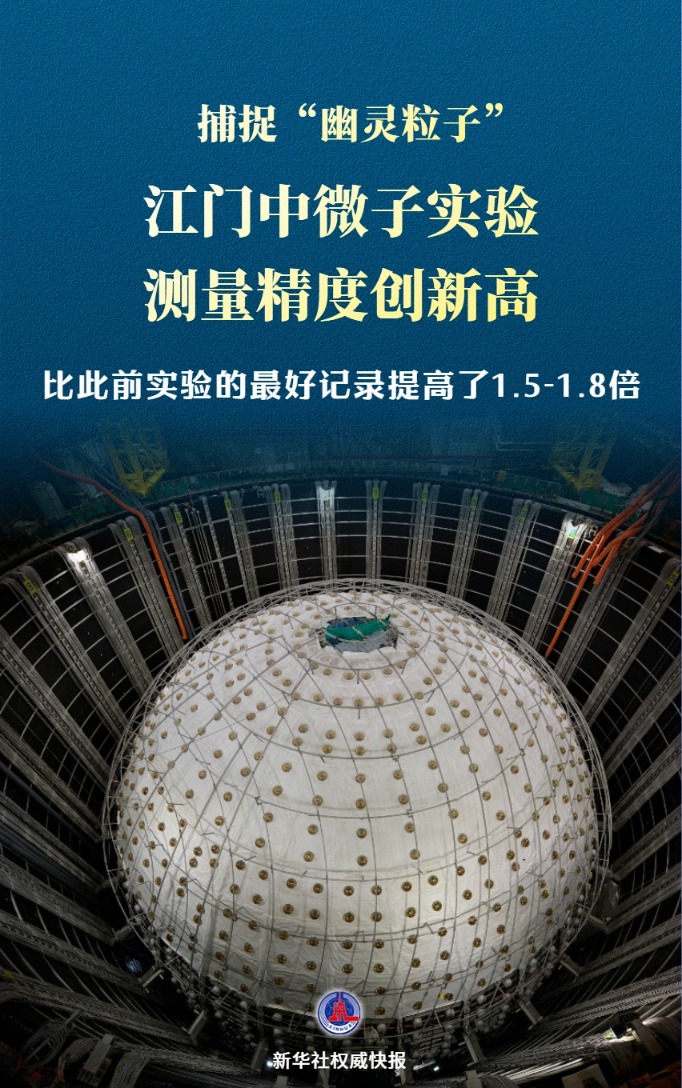
捕捉“幽灵粒子” 江门中微子实验测量精度创新高 每日看点
Xin Hua She· 2025-11-19 03:36
记者:刘祯、马晓澄 海报制作:刘祯 新华社国内部、新华社广东分社联合出品 标签: 最新资讯 (资料图片仅供参考) 记者11月19日从中国科学院高能物理研究所获悉,位于广东省江门市的江门中微子实验在建成两个 月后首次发布成果,其对中微子相关参数的测量精度比此前实验的最好记录提高了1.5-1.8倍。 中微子被称为"幽灵粒子",是宇宙中最轻且最难以捕捉的粒子之一。江门中微子实验是为探测这 些"幽灵粒子"而建设的大科学装置,于2025年8月26日正式运行取数。 ...

新华鲜报|捕捉“幽灵粒子” 江门中微子实验测量精度创新高
Xin Hua She· 2025-11-19 03:10
Core Insights - The Jiangmen Neutrino Experiment has successfully measured two parameters describing neutrino oscillation with a precision 1.5-1.8 times better than previous experiments, marking a significant advancement in neutrino research [1][2] - The experiment's performance has met or exceeded design expectations, bringing humanity closer to determining the mass hierarchy of neutrinos [1] Group 1: Experiment Overview - The Jiangmen Neutrino Experiment is designed to capture "ghost particles" known as neutrinos, utilizing a detector that contains 20,000 tons of liquid scintillator housed in the world's largest organic glass sphere, increasing the volume by 20 times compared to existing facilities [2] - The experiment has been operational for two months, analyzing data from August 26 to November 2, totaling 59 days of effective data collection [1] Group 2: Scientific Significance - Neutrinos are fundamental particles that play a crucial role in understanding the evolution of the universe, yet they are extremely difficult to detect due to their minuscule mass and weak interaction with matter [1] - The project team aims to collaborate closely with global scientists to produce original scientific results with significant impact [3]
新华社权威快报丨捕捉“幽灵粒子” 江门中微子实验测量精度创新高
Xin Hua She· 2025-11-19 03:07
Core Insights - The Jiangmen Neutrino Experiment has achieved a measurement precision for neutrino-related parameters that is 1.5 to 1.8 times better than previous experiments [2] Group 1: Experiment Overview - The Jiangmen Neutrino Experiment is designed to detect neutrinos, often referred to as "ghost particles," which are among the lightest and hardest particles to capture in the universe [2] - The experiment officially began data collection on August 26, 2025 [2] Group 2: Significance of Results - The results from the Jiangmen Neutrino Experiment mark a significant advancement in the field of particle physics, enhancing the understanding of neutrinos [2]
首批265名科技工作者拟入选河南郑州中小学科学顾问专家库
Zheng Zhou Ri Bao· 2025-11-18 12:19
Core Viewpoint - The establishment of the Zhengzhou Primary and Secondary School Science Advisory Expert Database aims to enhance the quality of science education in Zhengzhou, leveraging the expertise of 265 selected science professionals from various sectors [1][2] Group 1: Expert Database Formation - The Zhengzhou Education Bureau, in collaboration with the Science and Technology Bureau and the Science and Technology Association, has created the "Zhengzhou Primary and Secondary School Science Education Advisory Expert Database" [1] - The first batch of 265 experts has been selected through a process involving public solicitation, unit recommendations, targeted invitations, and qualification reviews [1] Group 2: Expert Profiles - The selected experts come from diverse institutions including universities, research institutes, science museums, youth palaces, museums, cultural centers, libraries, hospitals, and technology enterprises [1] - These experts possess strong theoretical foundations, extensive practical experience, and significant industry influence in fields such as artificial intelligence, robotics, biotechnology, and renewable energy [1] Group 3: Implementation Timeline - The public announcement of the first batch of expert members will take place from November 17 to November 21, 2025 [2] - After the expert members are confirmed, local primary and secondary schools will select one or more experts from the database to be appointed as science vice principals based on a "nearby and mutual selection" principle [2]
江门中微子实验正式运行取数
Nan Fang Ri Bao Wang Luo Ban· 2025-08-27 08:20
Core Insights - The Jiangmen Neutrino Experiment, located 700 meters underground in Jiangmen, Guangdong, has officially begun data collection, marking it as the first next-generation large-scale neutrino experiment in the world [1][2] - The experiment aims to address significant issues in particle physics, particularly the neutrino mass ordering problem, with expectations of achieving breakthroughs that will enhance the precision of three out of six neutrino oscillation parameters [1] Group 1 - The central detector of the Jiangmen Neutrino Experiment is buried 700 meters underground to effectively reduce cosmic ray interference [1] - The detector contains 20,000 tons of liquid scintillator, capable of detecting neutrinos produced by the Taishan and Yangjiang nuclear power plants located 53 kilometers away [1] - Neutrinos are the oldest and most abundant particles in the universe, characterized by their light mass and near-light speed, making them interact very weakly with other matter [1] Group 2 - The experiment is designed to have a lifespan of 30 years and can later be upgraded to become the world's most sensitive experiment for neutrinoless double beta decay [2] - The completion of the detector filling and the commencement of data collection is considered a historic milestone, enabling researchers to address fundamental questions about the nature of matter and the universe [2] - The Jiangmen Neutrino Experiment is led by the Institute of High Energy Physics of the Chinese Academy of Sciences, with participation from 74 global research institutions [2]
探寻地下700米的粒子世界
Ke Ji Ri Bao· 2025-08-27 01:32
Core Insights - The Jiangmen Underground Neutrino Observatory (JUNO) has successfully completed the infusion of 20,000 tons of liquid scintillator and has officially begun data collection, marking a historic milestone in neutrino research [1][2] - JUNO is the first large-scale, high-precision neutrino detector in the world, aimed at addressing fundamental questions about the nature of matter and the universe [1][2] - The detector is located 700 meters underground in Jiangmen, Guangdong Province, and can detect neutrinos from nuclear power plants located 53 kilometers away, measuring their energy spectrum with unprecedented precision [1][2] Technical Details - JUNO's design allows for the measurement of neutrino mass ordering without being affected by terrestrial matter effects and other unknown neutrino oscillation parameters, significantly improving the precision of three out of six neutrino oscillation parameters [2] - The core of the JUNO detector consists of a 20,000-ton liquid scintillator housed in an organic glass sphere, surrounded by thousands of photomultiplier tubes that detect faint light signals produced when neutrinos interact [2] - The construction of JUNO involved extensive planning, testing, and collaboration among hundreds of engineers and technicians, ensuring strict requirements for material purity, stability, and safety [2] Collaborative Efforts - JUNO is a major international collaboration led by the Institute of High Energy Physics of the Chinese Academy of Sciences, involving approximately 700 researchers from 74 institutions across 17 countries and regions [3] - The success of JUNO is attributed to effective international cooperation, which brought expertise in liquid scintillator detection technology to the project, pushing the boundaries of this technology [3] - The design lifespan of JUNO is planned for 30 years, with potential upgrades to become the world's most sensitive experiment for neutrinoless double beta decay, aiming to measure the absolute mass of neutrinos and investigate whether neutrinos are Majorana particles [3]