保壳

Search documents
A股近三百家公司出售资产
2 1 Shi Ji Jing Ji Bao Dao· 2025-11-20 14:24
Core Viewpoint - The A-share market is experiencing a surge in asset sales by listed companies as year-end approaches, with nearly 300 companies announcing asset disposals since October, significantly higher than in previous quarters [2][4]. Group 1: Reasons for Asset Sales - Companies are selling assets primarily to recover cash and enhance profits, with examples including *ST Baoying and Dongfang Yuhong, which are selling properties to improve financial conditions [4][5]. - Some companies are also divesting non-core or underperforming assets to focus on their main business, as seen with Zhuhai Free Trade Group's strategic shift towards core businesses [5][6]. Group 2: Low-Value Asset Transfers - There are notable instances of companies selling assets for as little as 1 yuan or even 0 yuan, raising concerns about the quality of these assets and potential hidden liabilities [8][9]. - Examples include Jinbei Automobile and ST Quanwei, which are transferring stakes in loss-making subsidiaries at minimal prices, indicating a trend of "dumping" underperforming assets [9][10]. Group 3: Market Reactions and Regulatory Concerns - The trend of low-value asset transfers has sparked market scrutiny and regulatory inquiries, as these transactions may signal deteriorating company fundamentals and raise questions about potential insider benefits [10][11]. - Industry experts express concerns that such transactions could be misinterpreted as signs of financial distress, potentially undermining investor confidence [10][11].

又见A股公司年末忙着资产出售
Shang Hai Zheng Quan Bao· 2025-11-17 19:14
Core Viewpoint - The A-share market is experiencing a significant wave of asset sales in the fourth quarter, with nearly 250 companies announcing asset disposals since October, reflecting a strong urgency and proactive approach compared to previous years [1] Group 1: Strategic Focus - Many companies are selling non-core assets to optimize their business layout and enhance competitiveness in their main operations [2] - For instance, Shaanxi Black Cat plans to sell its 100% stake in Hongneng Coal Industry for 440 million yuan and related debts for 1.137 billion yuan, aiming to concentrate resources on its main production bases [2] - WuXi AppTec is divesting its subsidiaries for 2.8 billion yuan to focus on its CRDMO business model, emphasizing drug discovery and production services [2] Group 2: Performance Pressure - Some companies are selling assets to improve financial performance amid annual performance assessments and new delisting regulations [4] - Zhuhai Zhongfu plans to sell real estate for 50 million yuan, expecting a pre-tax profit increase of approximately 26.05 million yuan [4] - Companies like *ST Bosen and *ST Yazhen are under pressure to improve their financials to avoid delisting, with *ST Bosen selling a 35% stake in a subsidiary for cash [4] Group 3: Transaction Challenges - Despite the increase in asset sales, many companies face difficulties in finding buyers, with some assets remaining unsold for extended periods [6] - Jinling Mining has repeatedly postponed the sale of its assets due to a lack of interested buyers, highlighting the challenges in asset liquidity [6] - Regulatory scrutiny is heightened for transactions involving related parties, as seen with Jintou Chengkai's asset transfer to a related party, raising questions about valuation and ongoing business viability [7]
三季报数据填错!“西北啤酒王”紧急更正
Shen Zhen Shang Bao· 2025-11-12 04:27
Core Viewpoint - *ST Lanhuang has disclosed a correction announcement for its Q3 2025 report, revealing errors in the securities investment section due to staff mistakes [1] Group 1: Financial Performance - For the first three quarters of 2025, the company achieved total operating revenue of 219 million yuan, a year-on-year increase of 23.35% [5] - The net profit attributable to the parent company was 10.93 million yuan, marking a turnaround from losses [5] - The net cash flow from operating activities was -134 million yuan, compared to -220.59 million yuan in the same period last year [5] Group 2: Business Challenges - The company faces significant challenges in maintaining its listing status, as it was flagged for delisting risk due to negative profits and low revenue [3][4] - 2025 is identified as a critical year for the company to avoid delisting, as it must not repeat the negative financial performance of the previous year [5] Group 3: Operational Insights - The beer production volume for the first half of 2025 was 18,800 kiloliters, a decrease of 39.95% compared to the first half of 2024 [5] - Beer sales volume also declined by 37.66% to 19,600 kiloliters in the same period [5] - The company is investing 65 million yuan in a new juice beverage project in Chongqing to diversify its product offerings and improve financial performance [5] Group 4: Market Performance - As of November 12, the stock price of *ST Lanhuang increased by 1.49%, closing at 8.85 yuan per share, with a total market capitalization of 1.644 billion yuan [5]


67岁独董突然失联,四天三板大牛股回应
2 1 Shi Ji Jing Ji Bao Dao· 2025-10-28 04:03
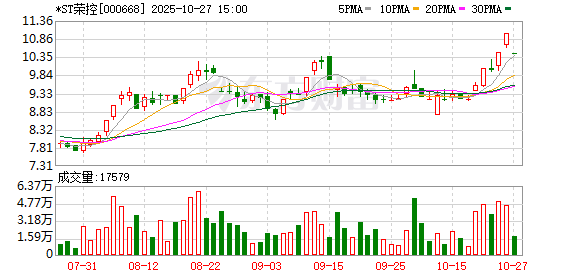
Core Viewpoint - *ST Rong Control (000668.SZ) experienced a sharp decline in stock price following the announcement of its Q3 financial report and the disappearance of its independent director, Liu Changkun, which has raised concerns among investors [1][2]. Financial Performance - In Q3, *ST Rong Control reported a revenue increase of 377.55% year-on-year, reaching 185 million yuan, while the net loss narrowed by 20.18% [1][3]. - Despite the significant revenue growth, the company still faces a substantial gap to meet the delisting threshold, with a net loss of 27 million yuan and a revenue shortfall of 115 million yuan compared to the 300 million yuan requirement [3]. Corporate Governance - The company announced that it has been unable to contact independent director Liu Changkun since October 14, raising concerns about governance and operational stability [1][2]. - Liu Changkun, who has served as an independent director for nearly five and a half years, did not attend the board meeting on October 14 and has not delegated his responsibilities to other directors [1][2]. Market Reaction - Following the announcements, *ST Rong Control's stock opened at 10.45 yuan and closed at the same price, reflecting a 5% drop, with a trading volume of nearly 20 million yuan [1][4]. - The stock had previously seen a cumulative increase of over 60% this year and achieved three consecutive trading limits from October 21 to 24 [1][3]. Business Strategy - The company has attempted to diversify its revenue streams by expanding into e-commerce live streaming and cross-border logistics, which contributed 51 million yuan in revenue, accounting for 38% of total revenue in 2024 [3]. - However, the contribution from these new business segments has significantly declined to 6.67% in the first half of 2025 [3].

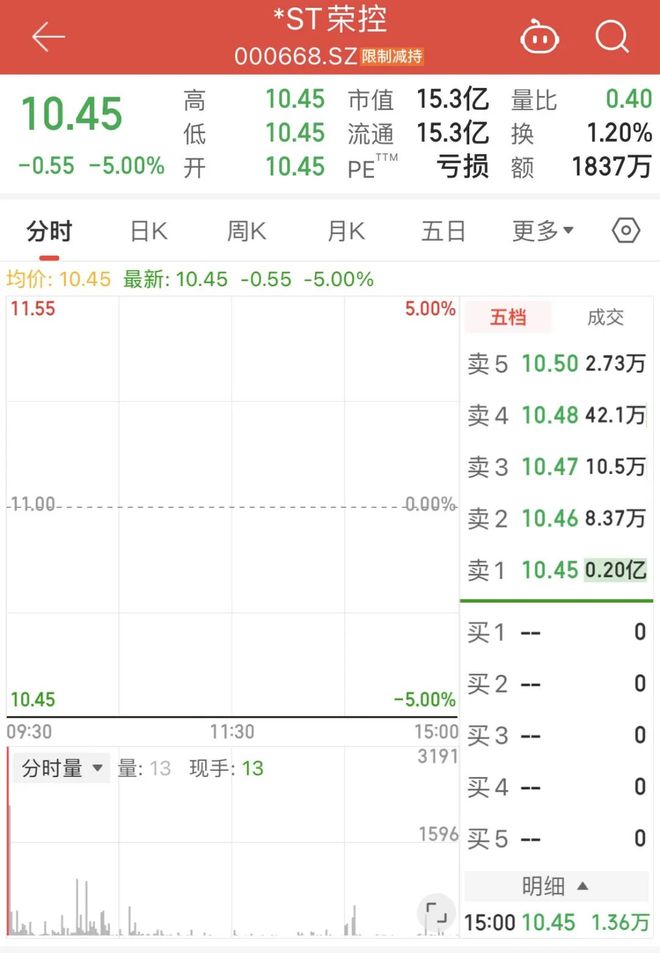
营收激增超300%,股价却一字跌停!*ST荣控回应独董失联
2 1 Shi Ji Jing Ji Bao Dao· 2025-10-27 10:06
Core Viewpoint - *ST Rong Control (000668.SZ) experienced a significant drop in stock price following the announcement of its Q3 financial results and the disappearance of its independent director, Liu Changkun, which has raised concerns among investors [2][3]. Financial Performance - In the first three quarters, *ST Rong Control reported a revenue increase of 377.55% year-on-year, reaching 185 million yuan, while the net loss narrowed by 20.18% [2][4]. - Despite the impressive revenue growth, the company still faces a substantial gap to meet the delisting risk threshold, as the net loss for the period was 27 million yuan, and the revenue remains 1.15 billion yuan short of the 300 million yuan requirement [4]. Corporate Governance - The company announced that it has been unable to contact independent director Liu Changkun since October 14, raising concerns about governance and oversight [2][3]. - Liu Changkun has been with the company for nearly five and a half years and has a strong background in management, having previously held significant positions in regulatory and corporate roles [3]. Business Strategy - The revenue growth in Q3 was primarily driven by increased sales of finished houses, although the company has also attempted to diversify its business by expanding into e-commerce and cross-border logistics, which contributed 51.05 million yuan, accounting for 38% of total revenue [5]. - However, the contribution from these new business segments has significantly declined, dropping to 6.67% in the first half of 2025 [5].
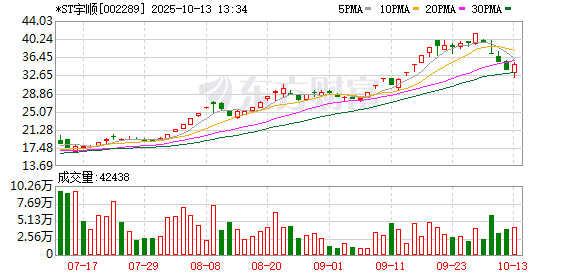
10倍大牛股披露重组进展,*ST宇顺盘中上演“地天板”
2 1 Shi Ji Jing Ji Bao Dao· 2025-10-13 05:33
Core Viewpoint - The stock price of *ST Yushun (002289.SZ) experienced significant volatility, influenced by the progress of its major asset restructuring, which is seen as a critical move for the company's survival [2][3]. Group 1: Stock Performance - *ST Yushun's stock price fluctuated dramatically, hitting a limit down early in the trading session but later rebounding to a limit up, closing at 34.7 CNY per share with a gain of 3.09% [2]. - The stock has seen an extraordinary increase of over 1000% within the year, with a current year-to-date gain of 845.51% despite recent adjustments [5]. Group 2: Asset Restructuring - On October 10, *ST Yushun completed the first phase of its major asset restructuring, paying 335 million CNY, which marks a significant advancement in the restructuring process [2]. - The restructuring involves acquiring 100% equity of three companies—Zhong'en Cloud Technology, Shenhui Biyuan, and Zhong'en Cloud Information—operating a data center project with approximately 8,000 cabinets [2][3]. - The total cash payment for the acquisition is set at 3.35 billion CNY, funded through loans from the controlling shareholder, the company's own funds, or self-raised funds [2]. Group 3: Financial Performance - *ST Yushun has reported continuous losses over five years, with a cumulative loss exceeding 120 million CNY, and faces delisting risk due to its financial performance [3]. - In contrast, the target companies are projected to generate revenues of 735 million CNY, 815 million CNY, and 218 million CNY for the years 2023, 2024, and the first quarter of 2025, respectively, with net profits significantly surpassing *ST Yushun's current performance [3]. - If the restructuring is successful, *ST Yushun's annual profit could potentially turn from a loss to a profit exceeding 150 million CNY, aiding in its financial recovery [3]. Group 4: Regulatory Attention - The unusual trading activity of *ST Yushun has attracted the attention of regulatory authorities, with the Shenzhen Stock Exchange monitoring the stock closely due to abnormal trading behaviors [5].

*ST星农涉嫌信披违法违规被证监会立案,此前调减2023年度营收超6000万元
Xin Lang Cai Jing· 2025-09-30 06:36
Core Viewpoint - *ST Xingnong has faced significant financial and regulatory challenges, including a recent investigation by the China Securities Regulatory Commission (CSRC) for alleged information disclosure violations, leading to a sharp decline in stock price and market capitalization [2][3]. Financial Performance - The company reported a reduction in 2023 revenue from 308 million yuan to 248 million yuan, a decrease of 60.73 million yuan [3] - The net loss attributable to shareholders increased from 55.79 million yuan to 61.08 million yuan, an increase of 5.29 million yuan [3] - *ST Xingnong has recorded losses for five consecutive years, with a net loss of 40.93 million yuan in the first half of this year [3] Regulatory Issues - The CSRC issued a notice of investigation due to suspected violations of information disclosure laws, which was announced shortly after the company disclosed accounting errors [2] - The company has been under a delisting risk warning since May 6, due to its audited net profit being negative and revenue falling below 300 million yuan [3] Business Strategy - *ST Xingnong plans to acquire 100% equity of Zhongcheng Automobile (Shandong) Co., Ltd. for 29.41 million yuan, with the aim of supporting its business operations [4] - The company has stated that it does not plan to abandon its agricultural machinery business despite ongoing losses, emphasizing a dual-main business strategy to revitalize the agricultural machinery sector [5] Operational Status - The company claims that all business activities are operating normally and it will cooperate with the CSRC during the investigation [5]

四家酒企“保壳”焦灼:若保不住,能被人借“壳”吗?
Nan Fang Du Shi Bao· 2025-09-25 09:58
Core Viewpoint - The "shell protection" situation for four wine stocks facing delisting risks is not optimistic, with varying performance in their financial results and uncertain paths ahead for maintaining their listings [1][3]. Group 1: Financial Performance of *ST Stocks - *ST ChunTian shows relatively clearer prospects for "shell protection," with a revenue of 1.24 billion, down 26.62% year-on-year, but a net profit of 1.316 million, indicating a turnaround despite a second-quarter loss [3]. - *ST YanShi reported a significant revenue drop of 85.22% to 28.25 million, with a net loss of 67.77 million, highlighting severe financial distress due to multiple pressures [4]. - *ST LanHuang's revenue fell by 15.82% to 96.84 million, with a net loss of 11.91 million, attributed to intensified market competition despite initial profit in the first quarter [4]. - *ST YeDao experienced a revenue decline of 26.62% to 89.21 million and a net loss of 16.41 million, struggling to recover despite restructuring efforts [5]. Group 2: Shell Selling and Borrowing Opportunities - There are discussions about the potential for "shell selling" among these four companies, as they may seek to maintain their listing status while meeting the needs of unlisted wine companies [6][7]. - *ST YanShi is considered to have a significant chance of being "borrowed," with its chairman indicating a search for strategic investors amid legal challenges [7]. - The process of "borrowing shells" is complicated by strict regulatory measures, making it as challenging as an IPO, with potential rejections from regulatory bodies [8]. Group 3: Future Prospects and Self-Rescue Efforts - Analysts suggest that while the current outlook for these four *ST wine stocks is bleak, some may have self-rescue potential, particularly *ST YeDao if its herbal liquor can achieve consolidation [9]. - The upcoming performance forecasts for the third quarter will be crucial in assessing the ongoing "shell protection" efforts of these companies [9].
多家A股公司开启保壳大战
Zheng Quan Shi Bao· 2025-09-24 13:02
Core Viewpoint - The A-share market is entering the fourth quarter, prompting several companies on the brink of delisting to engage in protective measures to maintain their listings, including asset divestiture, debt restructuring, and strategic investments [1] Group 1: Asset Divestiture - Many listed companies are opting to divest loss-making assets to quickly improve their financial statements and escape delisting risks. For instance, *ST Nan Zhi plans to transfer real estate-related assets and liabilities worth 13.357 billion yuan for 1 yuan to an affiliate, aiming to shift from a loss-making real estate business to a light-asset urban operation service [3][4] - After the transaction, *ST Nan Zhi's total assets and revenue will significantly decrease, but its equity and net profit will increase substantially, with a projected net profit of 225 million yuan for 2024, an increase of 2.463 billion yuan compared to before the transaction [3] - Similarly, *ST Bu Sen announced plans to sell a 35% stake in its subsidiary for cash to focus on its core apparel business, which is expected to improve liquidity and optimize asset structure [4][5] Group 2: Mergers and Acquisitions - Some companies are looking to reverse their fortunes through acquisitions. For example, *ST Fan Li intends to acquire a 60% stake in Guangzhou Feng Teng for up to 28.8 million yuan to enhance its position in the internet marketing sector [7] - The acquisition includes performance assessment clauses requiring the target company to achieve specific revenue and profit targets from 2025 to 2027, indicating a strategic move to mitigate delisting risks [7][8] Group 3: Seeking Strategic Investors - In the context of ongoing adjustments in the liquor industry, *ST Yan Shi is actively seeking strategic investors to optimize resources and support sustainable operations, as it faces delisting risks following a significant loss in revenue and profit [10] - The company has implemented measures to clear inventory and focus on B-end customers, indicating a shift in strategy to adapt to market conditions [10] Group 4: Long-term Trends - Analysts suggest that while asset divestiture, mergers, and strategic investments may provide short-term relief from delisting pressures, the long-term trend of declining shell resource scarcity will persist. Companies must focus on core business, technological innovation, and governance optimization to survive in a competitive environment [11]
多家A股公司开启保壳大战
证券时报· 2025-09-24 12:50
Core Viewpoint - The article discusses the ongoing "shell resource defense war" among listed companies in China's A-share market as they face delisting risks, highlighting various strategies such as asset divestiture, mergers, and seeking strategic investors to improve financial health and governance [1][2]. Group 1: Asset Divestiture - Many listed companies are opting to divest loss-making assets to quickly improve their financial statements and avoid delisting risks. For instance, *ST Nan Zhi plans to transfer real estate-related assets and liabilities worth 133.57 billion yuan for 1 yuan to Shanghai Longlin, aiming to shift towards light asset urban operation services [4][5]. - After the asset sale, *ST Nan Zhi's total assets and revenue will significantly decrease, but its equity and net profit are expected to rise substantially, with a projected net profit of 225 million yuan for 2024, an increase of 2.463 billion yuan compared to before the transaction [4]. - Similarly, *ST Bu Sen announced the sale of a 35% stake in Shaanxi Bu Sen to improve liquidity and focus on its core apparel business, with its stock facing delisting risk due to negative net profit for 2024 [5][6]. Group 2: Mergers and Acquisitions - Some companies are attempting to reverse their financial struggles through acquisitions. For example, *ST Fan Li plans to acquire 60% of Guangzhou Feng Teng for up to 28.8 million yuan to enhance its position in internet marketing [8]. - The acquisition includes performance targets for the acquired company, requiring revenues of at least 50 million yuan in 2025, 60 million yuan in 2026, and 70 million yuan in 2027, along with net profits of 5 million yuan, 6 million yuan, and 7 million yuan respectively [8][9]. - Despite the acquisition being a critical step for *ST Fan Li to mitigate delisting risks, uncertainties remain regarding the achievement of these performance commitments [9]. Group 3: Seeking Strategic Investors - In the context of the white liquor industry facing adjustments, *ST Yan Shi is actively seeking strategic investors to optimize resources and support sustainable operations, as it faces delisting risks with a reported revenue of 282.5 million yuan and a net loss of 67.8 million yuan for the first half of 2025 [11][12]. - The company is focusing on inventory clearance and cash flow improvement, launching discount sales for non-core brands to manage its financial situation [11]. - Analysts suggest that while companies may temporarily alleviate delisting pressures through asset divestiture, mergers, and strategic investments, the long-term trend of declining shell resource scarcity remains a challenge [12].