偿二代二期工程

Search documents
寿险公司的保单未来盈余
13个精算师· 2025-08-05 09:34
Core Viewpoint - The article discusses the implementation of the second phase of the solvency regulatory framework in China's insurance industry, focusing on the concept of future policy surplus as a key indicator of a company's future profitability [1][2]. Group 1: Future Policy Surplus - The future policy surplus is introduced under the second phase of solvency regulations and is crucial for assessing a company's future profitability [1]. - The future policy surplus is defined as the difference between accounting reserves and solvency reserves, adjusted for potential tax provisions and cash value guarantees [2]. - As of 2024, the future policy surplus for 66 insurance companies is projected to be 2.26 trillion, accounting for 8.8% of total assets, a decrease of approximately 150 billion from the end of 2022 [14]. Group 2: Impact of Accounting Standards - Starting in 2023, insurance companies began implementing the new accounting standard IFRS 17, which affects how insurance reserves are reported [3]. - The article highlights the importance of consistency in reporting deferred tax liabilities (DTL) and actual capital across different accounting standards [7][8]. - Companies that do not maintain consistency in their reporting may face challenges in validating their solvency reports [9]. Group 3: Analysis of Companies - The article provides a detailed analysis of various insurance companies, noting that the future policy surplus varies significantly among them, with some companies like AIA Life exceeding 15% of total assets [14]. - The article identifies that companies with a high proportion of participating insurance products tend to have lower future policy surplus compared to traditional insurance products [16]. - The future policy surplus for major players like China Life and Ping An has shown a noticeable decline, attributed to their historical focus on participating insurance products [15]. Group 4: Factors Influencing Future Policy Surplus - The decline in future policy surplus can be attributed to several factors, including a high proportion of participating insurance, adjustments in risk premiums, and changes in actuarial assumptions [19]. - Conversely, an increase in future policy surplus may result from a lower proportion of participating insurance and the successful generation of new business [19][22]. - The article emphasizes that the future policy surplus is a critical indicator but does not fully reflect a company's overall asset-liability management (ALM) status [16].







险企开启资本竞赛!年内“补血”已超530亿,释放啥信号?
Nan Fang Du Shi Bao· 2025-05-19 11:55
Core Viewpoint - Insurance companies have accelerated their capital replenishment efforts since 2025, with a total issuance of perpetual bonds and capital replenishment bonds reaching 49.6 billion yuan, alongside approved capital increase plans totaling 3.673 billion yuan, indicating a significant push to enhance solvency amid regulatory changes and market pressures [1][3][4]. Group 1: Capital Replenishment Trends - As of May 18, 2025, insurance companies have collectively achieved over 53 billion yuan in capital replenishment, with more than 10 billion yuan in additional capital increases in progress [1][2]. - The issuance of perpetual bonds has become a key method for insurance companies to supplement core tier 2 capital, with 11 companies issuing a total of 49.6 billion yuan in 2025, significantly surpassing the 14 billion yuan issued in the same period of 2024 [3][4]. - The average coupon rate for perpetual bonds in 2025 ranges from 2.18% to 2.75%, reflecting a decrease from previous years, making it an attractive option for insurers to optimize their capital structure [4][5]. Group 2: Regulatory Environment and Challenges - The implementation of the "Solvency II Phase II" project has led to stricter recognition of core capital, increasing the pressure on insurers to enhance their solvency ratios [1][12]. - Regulatory requirements stipulate that the balance of perpetual bonds must not exceed 30% of core capital, and capital replenishment bonds must not exceed 100% of net assets, limiting the issuance primarily to larger insurance firms [5][6]. - The overall solvency ratio for the insurance sector stood at 204.5% as of the end of Q1 2025, with property and life insurance companies showing varying levels of solvency [8][9]. Group 3: Company-Specific Developments - Companies like Guolian Life and Huagui Life have been particularly active in capital increases, with Guolian Life's solvency ratio dropping to 103.97% by Q1 2025, prompting a 3 billion yuan capital increase to bolster its solvency [9][10]. - Huagui Life, backed by the Moutai Group, has also reported declining solvency ratios, indicating a need for capital infusion to maintain operational stability [9][10]. - Conversely, companies like Dinghe Property Insurance, with solvency ratios exceeding 500%, are pursuing capital increases to support expansion into new business areas, despite their strong capital position [10][11].
瑞泰人寿连续两年业绩亏损 内控管理混乱 多项投资风控流程形同虚设
Sou Hu Cai Jing· 2025-04-24 02:47
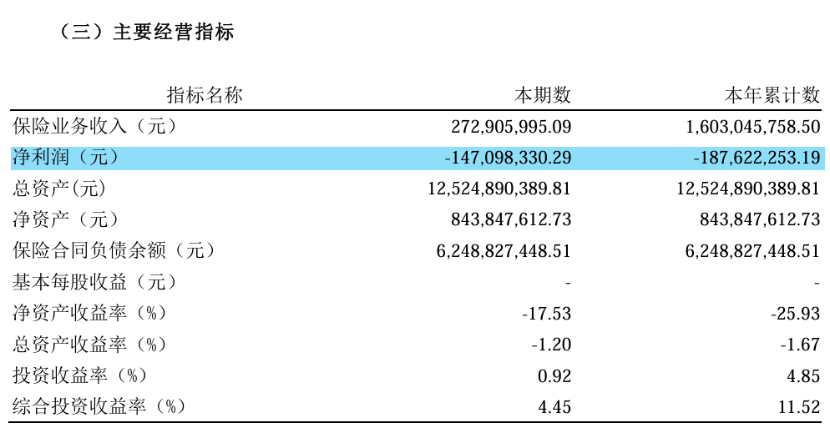
Core Viewpoint - 瑞泰人寿保险有限公司 is facing significant operational and financial challenges, with continuous losses and governance issues threatening its survival [1][15]. Financial Performance - In 2024, 瑞泰人寿 reported a loss of 188 million yuan, a year-on-year increase in losses of 17.35%, marking two consecutive years of net losses [1][3]. - Total assets grew to 12.525 billion yuan, but liabilities also increased to 11.681 billion yuan, resulting in weak equity of only 844 million yuan [1][3]. - The company’s total operating revenue was 1.675 billion yuan, with earned premiums of 1.215 billion yuan, a year-on-year increase of 17.22%, but total operating costs reached 1.84 billion yuan, leading to a cost-to-income ratio of 110% [3]. Premium Growth and Business Structure - 瑞泰人寿's premium growth has consistently lagged behind the industry average, with a scale premium income of 2.023 billion yuan in 2024, a mere 0.8% increase compared to the industry’s 13.27% growth [2]. - The core business's original insurance premium income was 1.603 billion yuan, with new policy premiums at 358 million yuan, showing a high growth of 35.67%, while renewal premiums decreased by 6.61%, indicating declining customer retention [2]. Governance Issues - The company has failed to effectively implement necessary governance reforms, with significant delays in updating its corporate charter and establishing independent directors and supervisory boards [4][5]. - Internal management practices are lacking, with no established guidelines for managerial work and inadequate accountability for investment decisions that led to significant losses [6][7]. Investment Risks - Major investment decisions lack transparency, as evidenced by the failure to timely address risks associated with holdings in 海航债券, leading to substantial financial losses [6][7]. - The company has not held management accountable for investment losses, which raises concerns about governance and risk management practices [7]. Human Resource Management - There have been multiple labor disputes involving former executives, resulting in financial and reputational damage to the company [13]. - The compensation management system is flawed, lacking clear standards for salary deductions and accountability measures [13]. Compliance and Regulatory Risks - 瑞泰人寿 has faced regulatory penalties for issues related to sales practices and compliance, indicating potential risks in its operational integrity [14]. - The company is urged to undergo significant reforms to address its governance, operational, and compliance challenges to avoid further deterioration [14][15].
头部险企打响新“军备竞赛”
和讯· 2025-03-11 09:19
Core Viewpoint - Perpetual bonds are becoming a new "capital ammunition depot" for leading insurance companies, with issuance reaching a historical peak of 23.7 billion yuan at the beginning of 2025 [1][3]. Group 1: Perpetual Bond Issuance - The issuance of perpetual bonds has surged, with insurance companies issuing a total of 35.77 billion yuan in 2023 and 35.9 billion yuan in 2024, while 23.7 billion yuan has already been issued in early 2025 [3]. - The issuance of perpetual bonds is primarily concentrated among AAA-rated leading insurance companies, as regulatory guidelines restrict the issuance to a maximum of 30% of core capital [4][5]. - The issuance of perpetual bonds serves as a low-cost financing method for insurance companies, allowing them to address capital pressures and optimize their capital structure [3][6]. Group 2: Driving Factors - The surge in perpetual bond issuance is driven by the need for effective capital supplementation amid tightening insurance regulations and the pressure on core solvency ratios [6]. - The transition period for the second phase of solvency regulations has been extended to the end of 2025, prompting insurance companies to adjust their capital structures within the year [6]. - The current market environment, characterized by declining interest rates, provides favorable conditions for insurance companies to issue perpetual bonds at lower costs [7]. Group 3: Implications for Insurance Capital - Issuing perpetual bonds not only strengthens core solvency but also enhances insurance companies' ability to invest in the capital market [8]. - There is a positive correlation between solvency ratios and the allocation of equity assets, with a 50 percentage point increase in solvency ratio allowing for a 2% to 3% increase in equity asset allocation [9]. - The long-term nature of perpetual bonds aligns well with the long-term investment needs of insurance capital, effectively mitigating maturity mismatch risks [10].