
光伏行业自律

Search documents
自律争议漩涡:弘元澄清与行业传言的拉锯战
3 6 Ke· 2025-10-13 03:17
Core Viewpoint - The recent rumors regarding Hongyuan Green Energy's non-participation in the photovoltaic industry's self-discipline have sparked significant attention, with the company issuing a statement supporting national policies against low-price competition and denying the rumors [2][3] Group 1: Company Response - Hongyuan Green Energy firmly supports the national "anti-involution" policies and will take actions to address low-price disorder in the market [2] - The company announced that some media outlets have deleted false reports, and it will pursue legal action against continued dissemination of such rumors [2] - The company's stock price fell by 3.2% on September 26, indicating a negative impact on investor confidence due to the rumors [3] Group 2: Industry Context - The photovoltaic industry has initiated strict management measures to curb low-price sales, with a cost line set at 0.69 yuan/W [4] - An anonymous source indicated that Hongyuan is no longer on the self-discipline execution list due to its low bid of 0.655 yuan/W in a project, which triggered disciplinary actions [2][4] - The industry has established a tight supervision network to monitor low-price sales, with severe penalties for violations [4] Group 3: Market Pricing Dynamics - Current market pricing for components is around 0.701 yuan/W, with expectations of price increases post-holiday leading to stockpiling by distributors [5] - Recent procurement bids have shown prices above the self-discipline standard, with no significant downward trends observed [5] - Some second and third-tier companies are still quoting low prices around 0.66 yuan/W, but they are not part of the self-discipline list, allowing them to operate outside the established norms [6] Group 4: Procurement and Investment Considerations - National enterprises prioritize stable procurement from traditional suppliers, reflecting a cautious approach amid fluctuating component prices [6] - The internal rate of return (IRR) for projects has become difficult to estimate due to declining grid prices, leading to a cautious stance from procurement parties [6] - The balance between price increases and maintaining contracts creates a complex dynamic for component manufacturers and buyers, necessitating ongoing adjustments in the self-discipline process [6]


高盛再抛核弹观点:硅料价格将下行20%??
Sou Hu Cai Jing· 2025-09-22 02:56
Group 1 - Goldman Sachs predicts a 20% decline in silicon material prices, forecasting a drop to 42,000 yuan/ton due to weak demand and cost reductions among major producers [3][4][5] - The report anticipates a 15% increase in capital expenditure plans for photovoltaic companies for 2025-2026, with year-on-year growth rates of -49% and 0% respectively [2][3] - The upstream supply chain remains weak, with a generally pessimistic outlook, while there is a more favorable view on auxiliary materials and high-efficiency component companies [2][3] Group 2 - Demand for silicon materials is expected to decrease by 40-45% in the second half of 2025 and the first half of 2026, according to Goldman Sachs [3][5] - Despite a decrease in cash costs for leading silicon producers, overall costs remain high, with major producers still facing significant losses [4][5] - The report suggests that the current market dynamics and policies may lead to a stabilization of demand, despite short-term declines [5][6] Group 3 - The profitability of auxiliary materials is closely tied to the overall profitability of components, which is currently under pressure due to supply-demand imbalances [10][11] - High-efficiency components are experiencing premium pricing, but this is limited to high-end markets due to funding constraints [10][11] - The overall health of the photovoltaic industry is contingent on the upstream supply chain's ability to manage production and pricing effectively [11][12] Group 4 - The report from Goldman Sachs is viewed skeptically by industry analysts, who believe it underestimates demand and the complexities of cost structures [12][14] - The ongoing industry reforms are expected to bring the sector back to a breakeven point, but long-term profitability remains uncertain due to competitive pressures and market dynamics [14]

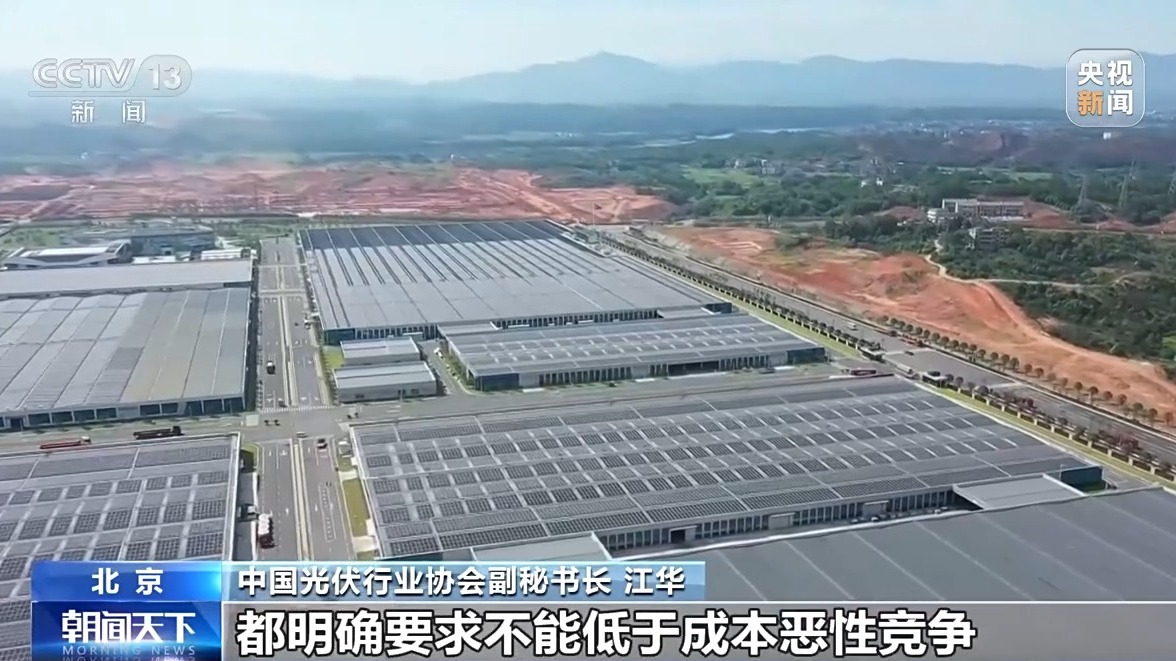
以创新拓展需求 光伏行业自律显现积极效果
Yang Shi Xin Wen· 2025-09-11 01:43
Core Viewpoint - The recent meeting held by the Ministry of Industry and Information Technology and five other departments aims to further regulate the competitive order of the photovoltaic industry, with a call for self-discipline within the industry to maintain fair competition and a healthy market environment [1]. Group 1: Industry Self-Regulation - The self-regulation initiative from the China Photovoltaic Industry Association focuses on three main aspects: enhancing industry chain regulation, promoting capacity clearance through market-oriented and legal methods, and eliminating sales below cost [2][4]. - The initiative emphasizes the prohibition of malicious competition, including dumping, and calls for companies to refrain from selling below cost [4]. - The third aspect of the initiative is to strengthen quality supervision and industry self-discipline, aiming to standardize market behavior and improve product quality for the healthy development of the industry [4]. Group 2: Positive Effects of Self-Regulation - Since last year, the push for self-regulation in the photovoltaic industry has shown positive effects, with many companies shifting from competing on scale and cost to focusing on innovation and exploring new application scenarios [5]. - The integration of photovoltaic power generation with various application scenarios is increasing, with innovative developments in areas such as photovoltaic + architecture, photovoltaic + fishery, and photovoltaic + desertification [7]. Group 3: Market Trends and Price Recovery - The future application of new information technologies, such as artificial intelligence, 5G, and industrial internet, is expected to lead to explosive growth in the photovoltaic sector [9]. - The market price for polysilicon has rebounded from 35-36 yuan per kilogram to 45-55 yuan, positively impacting confidence across various segments of the industry chain, including silicon wafers, battery cells, modules, and photovoltaic glass [9].
巨亏近百亿,TCL中环还得接着熬
Hu Xiu· 2025-04-26 15:00
Core Viewpoint - The photovoltaic industry is currently experiencing significant challenges, with TCL Zhonghuan reporting its worst financial results since its listing, including a substantial decline in revenue and profit margins [1][2]. Financial Performance - In 2024, TCL Zhonghuan achieved revenue of 28.419 billion yuan, a year-on-year decline of 51.95% [1]. - The company reported a net profit attributable to shareholders of -9.818 billion yuan, a staggering year-on-year drop of 387.42% [1]. - The gross margin plummeted from 20.2% in 2023 to -9.08% in 2024, marking a historical low [1]. Operational Strategy - TCL Zhonghuan maintained a high operating rate of 80%-90% in 2024, significantly exceeding the industry average of 50%-60% [4]. - Despite this aggressive strategy, the company's market share in silicon wafers decreased from 23.4% in 2023 to 18.9% in 2024 [7]. - The company faced increased inventory pressure due to the high operating rate, leading to further financial losses [8][10]. Market Dynamics - The price of silicon wafers has dropped significantly, with the average price for monocrystalline silicon wafers (210mm) falling from 3.2 yuan/kg to 1.4 yuan/kg, a decrease of 56.25% [3]. - Competitors like Longi Green Energy have adopted a strategy of reducing operating rates and using price competition, which has negatively impacted TCL Zhonghuan's market share [6]. Inventory and Losses - As of Q3 2024, TCL Zhonghuan's inventory reached a peak of 8.965 billion yuan, with a significant portion set aside for inventory impairment [11][12]. - The company's net profit margin deteriorated from -9.58% at the beginning of 2024 to -38.03% by the end of the year [8]. Component Business - The revenue from TCL Zhonghuan's photovoltaic battery and component segment was 5.811 billion yuan in 2024, a decrease of 37.57% year-on-year [17]. - The company shipped 8.3 GW of photovoltaic components in 2024, down from 8.9 GW in 2023 [18]. - The company is facing challenges in its component business due to a lack of competitive advantage and slower product transformation compared to market demand [19][20]. Future Outlook - The company plans to upgrade its component production capacity to Topcon and BC components by 2025, but faces significant challenges due to existing technological gaps and market competition [22][23]. - The photovoltaic industry is expected to see a turning point by the end of 2025, but TCL Zhonghuan will need to navigate through continued losses in the interim [25].

