
全空间无人体系

Search documents
【财闻联播】刚刚公告:终止重大资产重组!多家A股公司,被证监会立案
券商中国· 2025-11-07 15:20
Macro Dynamics - The State Council has issued opinions to promote the integration and application of new generation information technologies such as big data, IoT, brain-computer interfaces, and medical robots in healthcare scenarios [2] - The State Council aims to accelerate the development of an all-space unmanned system, encouraging applications in tourism, government services, logistics, and agriculture [3] - The Ministry of Finance plans to implement more proactive fiscal policies to boost consumption and support key sectors through financial subsidies [4] - As of the end of October, China's foreign exchange reserves reached $3.343 trillion, with gold reserves increasing for the 12th consecutive month [5] - The China Securities Regulatory Commission (CSRC) has introduced new regulations for the management of the securities settlement risk fund to enhance risk prevention and internal management [6] Company Dynamics - Ant Group has upgraded its organizational structure, establishing a new health business group to accelerate the development of its healthcare sector as a strategic pillar [14] - The company Deguot has announced plans to terminate the acquisition of 100% equity in Haowei Technology due to difficulties in meeting the demands of all parties involved [18] - Aifeng China reported a 23.91% year-on-year decline in consolidated revenue for the first ten months of 2025, totaling 587 million yuan [19] - Intercontinental Oil and Gas has been investigated by the CSRC for failing to halt trading when its shareholding reached 5% [20][21] - Meihua Biotechnology's controlling shareholder has been sentenced to three years in prison for manipulating the securities market, but this does not affect the company's operations [22] - Yingtang Intelligent Control plans to acquire 100% equity in Guanglong Integration and 80% equity in Aojian Microelectronics, with stock resuming trading on November 10, 2025 [23] - Fangzheng Technology intends to invest 1.364 billion yuan in expanding its production base for high-end PCBs to meet growing demand in AI and cloud computing [24] - ST Changyao has been investigated by the CSRC for suspected false reporting of financial data [25] - Nutag plans to invest 100 million yuan to establish a wholly-owned subsidiary focused on the industrialization of robotics and related components [26] - The actual controllers of Shanshui Technology have undergone a divorce and asset division, resulting in a change of control within the company [28] - Huadian Energy plans to invest 12.043 billion yuan in a wind power project to align with national industrial policies [29] - ST Huatuo has applied to revoke other risk warnings after receiving a penalty notice from the CSRC [30] - Ba Yi Steel has been investigated by the CSRC for suspected violations of information disclosure regulations [31]


经国务院同意,国办印发重要意见
中国能源报· 2025-11-07 10:12
Core Viewpoint - The article emphasizes the importance of cultivating and opening new application scenarios to promote the large-scale application of new technologies and products, thereby driving economic and social development through innovation and integration [1][2]. Group 1: Overall Requirements - The initiative is guided by Xi Jinping's thoughts and aims to leverage China's vast market and diverse application scenarios to support the construction of various integrated application scenarios across different sectors [2]. Group 2: Expanding Economic and Social Application Scenarios - The focus is on creating new application scenarios in emerging fields such as digital economy, artificial intelligence, and clean energy, promoting the integration of digital and physical economies [3][4]. - The initiative encourages the development of application scenarios in biotechnology, emphasizing the integration of biological technologies into various industries [4]. Group 3: New Business Application Scenarios for Industrial Transformation - In the manufacturing sector, the emphasis is on smart and green manufacturing, supporting the development of intelligent factories and zero-carbon parks [5]. - The transportation sector is encouraged to innovate in smart traffic management and logistics, enhancing efficiency and safety [5]. Group 4: Industry-Specific Application Scenarios - The emergency management sector is focusing on digitalization and smart technologies to improve disaster response capabilities [7]. - The mining safety sector aims to integrate advanced technologies for enhanced safety and operational efficiency [7]. Group 5: Social Governance and Service Application Scenarios - The government service sector is pushing for smart governance solutions, including intelligent appointment systems and digital social services [8]. - The rural construction sector is set to enhance information technology applications to improve governance and service standards [9]. Group 6: Enriching Livelihood Application Scenarios - The healthcare sector is promoting the integration of new technologies for improved medical services, including remote healthcare and intelligent diagnostics [10]. - The cultural and tourism sectors are encouraged to adopt digital technologies to enhance visitor experiences and service delivery [11]. Group 7: Promoting Scene Opening and Resource Allocation - The initiative calls for increased efforts in opening up various application scenarios and ensuring fair and efficient allocation of resources across different sectors [12]. - It emphasizes the importance of collaboration among different regions and sectors to maximize the benefits of new technologies [12]. Group 8: Enhancing Application Scenario Support Capabilities - The government is committed to strengthening policy support and management systems to facilitate the development of new application scenarios [14]. - There is a focus on ensuring safety and risk management in the implementation of these new scenarios [14]. Group 9: Strengthening Organizational Implementation - Local governments and relevant departments are urged to collaborate and effectively implement the initiative, with a focus on demonstrating leadership in the development of application scenarios [15].

飞行汽车加入车路云“朋友圈”,立体交通时代启幕!
3 6 Ke· 2025-07-03 07:59
Group 1: Industry Overview - The automotive industry is extending from land to air, accelerating the integration with the low-altitude economy, leading to the emergence of a three-dimensional transportation era [1] - Low-altitude flying activities are becoming central to various sectors, including urban air mobility, low-altitude logistics, tourism, emergency rescue, agricultural monitoring, and infrastructure inspection [1] - Flying cars and drones are identified as the main carriers of the future low-altitude economy, evolving into new members of the "car-road-cloud" ecosystem [1] Group 2: Technological Integration - The concept of flying cars has evolved to include both amphibious vehicles and eVTOLs, with the latter becoming the mainstream direction in the industry [2] - eVTOLs represent a cross-disciplinary fusion of aviation and automotive technologies, inheriting core capabilities from traditional aviation while adopting advancements in electrification and automation from the automotive sector [2] - The development of electric and intelligent technologies has been crucial in transitioning flying cars from concept to reality, with significant advancements in the three electric systems and smart driving technologies [2] Group 3: Company Initiatives - Several automotive companies, including XPeng, GAC, FAW, Chery, and Changan, are actively entering the flying car market, with XPeng's "land carrier" flying car set for mass production in 2026 [3] Group 4: Drone and Automotive Integration - Drones are rapidly integrating with automobiles, exemplified by the "Lingyuan" smart car-mounted drone system launched by BYD and DJI, which features dynamic takeoff and landing capabilities [4] - The integration allows for enhanced functionalities, such as real-time traffic monitoring, delivery services, and emergency reconnaissance, paving the way for a future where drones become standard automotive accessories [4] Group 5: Infrastructure Development - The 5G-A network is a critical information infrastructure for the "car-road-cloud" system, offering significantly improved speed, reduced latency, and enhanced connectivity compared to traditional 5G [5] - New information infrastructures, including the BeiDou navigation system and low-orbit satellite internet, are being utilized to support both ground and low-altitude transportation [5] Group 6: National Strategy and Collaboration - The integration of "car-road-cloud" construction and low-altitude economic development is included in national strategies, promoting resource efficiency and technological innovation [6] - Various local governments and enterprises are exploring collaborative development between intelligent connected vehicles and the low-altitude economy [6] Group 7: Future Transportation Vision - A vision for a smart transportation system is emerging, where ground and air transportation will form an integrated system characterized by technological fusion and resource sharing [8] - The evolution towards a "car-road-air-cloud" system aims to address modern transportation challenges, enhancing safety and efficiency [9] - The introduction of flying cars is expected to significantly reduce travel times, redefining commuting distances and urban space value [9][11]

深圳低空经济进入“下半场”:中兴通讯组局,生态化博弈提速
Nan Fang Du Shi Bao· 2025-05-28 07:17
Group 1 - The core viewpoint of the article highlights the emergence of a new "ecosystem builder" in the trillion-level low-altitude economy, with ZTE Corporation launching a "Low Altitude Industry Ecosystem Platform" in Shenzhen, aiming to integrate resources across the industry chain [1][2] - The platform has attracted 32 member companies from various sectors, including upstream manufacturers of aircraft and components, midstream infrastructure service providers, and downstream logistics and emergency services [2][3] - ZTE's initiative is seen as a response to the increasing complexity of low-altitude operations, where effective collaboration among players is essential to address challenges in communication, navigation, and monitoring [2][3] Group 2 - The concept of "full space" is emerging as a new focus in the low-altitude economy, expanding the vision from low-altitude to a comprehensive network that includes land, sea, air, and cyberspace [4] - Shenzhen has already initiated actions towards "full space" exploration, including the launch of a procurement platform for unmanned systems that aims to connect various unmanned vehicles and provide integrated services [4][5] - The low-altitude economy is recognized as a critical entry point for urban competition, with cities like Guangzhou and Hefei prioritizing the development of "full space unmanned systems" [5][6] Group 3 - Shenzhen, known as the "drone capital of the world," boasts over 2,000 companies in the industry and a quarterly growth rate of 48% in the drone sector [7] - The city is actively enhancing its policies to support the low-altitude economy, including the establishment of a 2 billion yuan aerospace industry fund and the planning of over 1,200 low-altitude takeoff and landing points [7][8] - The collaboration among government, research institutions, leading enterprises, and innovative small and medium-sized enterprises is crucial for driving the low-altitude economy in Shenzhen and across China [7]

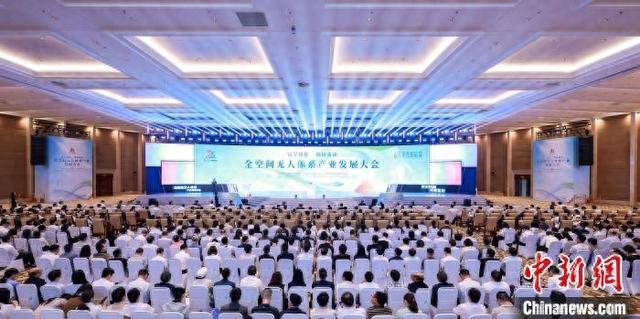
全空间无人体系产业发展大会在福州举办 发布多项重要成果
Zhong Guo Xin Wen Wang· 2025-05-01 02:28
Group 1 - The "All-Space Unmanned System Industry Development Conference" was held in Fuzhou, Fujian Province, focusing on the safe and controllable development of unmanned technology [1][3] - The conference was co-hosted by the China Macroeconomic Society, China Aviation Industry Corporation, and Fujian Big Data Group, with multiple organizations involved in its execution [3] - The "All-Space Unmanned System Construction Engineering General Department" released the "2025 Work Points" document, outlining a work plan with phased goals and timelines based on principles such as standard leadership and industry aggregation [3][4] Group 2 - Fujian Big Data Group presented digital research results, proposing a standardized framework for unmanned systems covering "air, land, sea" to provide unified technical references for the industry [3][4] - China Aviation Industry Corporation introduced the "Tiandun" intelligent security system to address issues related to unauthorized drone flights, emphasizing comprehensive perception and efficient collaboration [4] - The conference featured expert speeches on the establishment and development opportunities of the all-space unmanned system, highlighting its potential to invigorate China's digital economy and industrial upgrade [4] Group 3 - A signing ceremony for industry cooperation took place, with multiple projects signed to promote innovation in Fujian, including a partnership between Pingtan Comprehensive Experimental Zone Management Committee and Fujian Big Data Group [5][6] - The Fujian Meteorological Bureau signed an agreement with Fujian Big Data Group to explore the integration of meteorological data into the all-space unmanned system and low-altitude economic development [6]

国家发展改革委、商务部、市场监管总局重磅发布!解读来了
21世纪经济报道· 2025-04-24 13:19
Core Viewpoint - The 2025 version of the Market Access Negative List aims to further relax market access restrictions, reducing the number of items from 117 in 2022 to 106, thereby optimizing market access management and enhancing market vitality [3][5][8]. Summary by Sections Market Access Negative List Overview - The Market Access Negative List system compiles industries and sectors that are either prohibited or require government permission for investment and operation. Outside this list, all entities can enter the market equally [2]. Changes in the 2025 Version - The 2025 version of the Market Access Negative List has reduced the number of items to 106, with a focus on a "national unified" management model, meaning no local or departmental negative lists can be created [3][5]. - The list includes 6 prohibited items, such as activities that do not meet functional area construction requirements and unauthorized financial activities [5][6]. Licensing and Permits - There are 100 items under the licensing category, covering various industries including agriculture, manufacturing, and finance. Specific licensing requirements are outlined for sectors like manufacturing and finance [6][7]. - The list aims to lower entry barriers and stimulate market activity by removing or simplifying several national and local measures [7][8]. New Business Models and Fields - The 2025 version also standardizes management measures for new business models and fields, such as unmanned aerial vehicles and e-cigarettes, ensuring compliance with existing laws and regulations [10][11]. - The government emphasizes the importance of optimizing the market access environment for emerging sectors, which is part of a broader strategy to enhance innovation and competitiveness [11][12]. Future Directions - The National Development and Reform Commission plans to continue reforming and innovating market access policies, focusing on key industries and strategic emerging sectors to promote a positive cycle of technological breakthroughs and industrial applications [15].

四度瘦身!2025年市场准入负面清单减至106项,特别举措加码新兴产业发展
2 1 Shi Ji Jing Ji Bao Dao· 2025-04-24 11:47
Core Points - The 2025 version of the Market Access Negative List has reduced the number of restricted items from 117 to 106, further relaxing market access restrictions and optimizing management [1][2][5] - The core requirements of the negative list system are "national unification" and "non-prohibition means entry," allowing equal access for all types of enterprises outside the negative list [1][2] - The negative list includes 6 prohibited items and 100 licensed items, with specific regulations for various industries such as manufacturing, finance, and agriculture [2][3] Group 1 - The 2025 version of the negative list is part of the high-level socialist market economy system, aiming to lower entry barriers and stimulate market vitality [2][4] - Prohibited items include activities that do not meet functional area construction requirements and unauthorized financial and internet-related activities [2][3] - Licensed items cover a wide range of industries, including agriculture, manufacturing, and finance, with specific licensing requirements for each sector [3][4] Group 2 - The 2025 version has removed several national and local measures, simplifying the approval process for various sectors, including the film industry and medical services [4][5] - The negative list has undergone four revisions since 2019, consistently reducing the number of items and lowering transaction costs for market entry [5][6] - New management measures have been established for emerging industries such as unmanned aerial vehicles and e-cigarettes, aligning with existing laws and regulations [6][7] Group 3 - The government is focusing on optimizing the market access environment for new industries, including deep-sea, aerospace, and artificial intelligence sectors [6][8] - Local initiatives in regions like Guangzhou and Hefei are exploring the application of unmanned systems and developing industry standards to facilitate market entry [7][9] - The development of deep-sea technology and robotics is being supported by favorable policies and infrastructure, enhancing commercial applications in these fields [9][10]
四大科技打开全空间无人交通
Guang Zhou Ri Bao· 2025-03-25 19:02
Core Insights - The article discusses the development of an all-space unmanned transportation system in Guangzhou, particularly in the Nansha area, which includes land, sea, and air transportation technologies [1][12] - The initiative is part of the Guangdong Province's action plan to enhance modern industrial systems by improving infrastructure for electric vehicle charging and vehicle-network collaboration [1][12] Group 1: Vehicle-Network Collaboration - In Nansha, the use of unmanned smart connected taxis has become a common mode of transportation for residents [2] - A real-time monitoring platform for smart connected vehicles has been established to objectively collect and analyze testing data [2] - The proportion of vehicles in autonomous driving mode has reached over 90%, indicating significant advancements in autonomous driving technology [3] Group 2: Information Complementation - Autonomous vehicles equipped with cameras can collect data on 14 types of urban events, enhancing the information available to smart roadside devices [4] - This data collection does not increase costs for car manufacturers and reduces the need for additional camera installations [4] Group 3: Advanced Networking - The deployment of 5G-A networks is crucial for the success of the vehicle-network collaboration and all-space unmanned systems [6] - 5G-A offers significant improvements in latency and device connectivity, supporting millions of devices per square kilometer [6] - Smart lamp posts equipped with weather monitoring devices can provide necessary forecasts and warnings for low-altitude vehicles [6] Group 4: Smart Roadside Systems - Smart roadside systems, primarily composed of intelligent lamp posts, play a vital role in the vehicle-network collaboration [7] - These systems can monitor road conditions and send real-time alerts to connected vehicles using C-V2X communication protocols [7][9] - Edge computing capabilities allow for low-latency responses to road conditions, enhancing the safety and efficiency of autonomous vehicles [8] Group 5: Satellite Network Development - The "Five Rams Constellation" satellite network is being designed to provide comprehensive monitoring and information services for low-latitude regions [10][11] - This network aims to improve the efficiency of government services and expand applications in various sectors, including economic development and emergency management [11] Group 6: Industry Development - The all-space unmanned system in Guangzhou has a solid industrial foundation and application scenarios, with ongoing advancements in technology [12] - The city is actively promoting its capabilities in the IoT sector, attracting interest from other cities and supporting various vehicle-network projects across the country [12]