双边贸易协议

Search documents
莫迪与特朗普通电话讨论贸易能源等问题
Zhong Guo Xin Wen Wang· 2025-12-12 04:09
Group 1 - Indian Prime Minister Modi and US President Trump discussed expanding cooperation in trade, key technologies, and energy during a phone call on December 11 [1] - The two countries are negotiating a bilateral trade agreement aimed at alleviating the pressure of tariffs on Indian goods, which have reached as high as 50% under the Trump administration [1] - The US tariffs have negatively impacted various Indian export products, including textiles, leather, jewelry, and shrimp, prompting ongoing dialogues between negotiators from both sides to find solutions [1] Group 2 - Indian Minister of Commerce and Industry Goyal stated that negotiations are progressing well, but no final deadline has been set for the trade agreement [2] - Goyal responded to US Trade Representative Lighthizer's claim that the US received "the best offer ever" from India, suggesting that the Trump administration should sign the agreement immediately [2]
突然暴涨!关税,降至15%!
Zhong Guo Ji Jin Bao· 2025-12-02 06:20
Group 1 - The U.S. will reduce tariffs on South Korean automobiles to 15%, effective retroactively from November 1 [2][7] - Following the announcement, shares of Hyundai and Kia rose nearly 5% and 4% respectively, contributing to a nearly 2% increase in the South Korean Composite Stock Price Index [3][6] - The U.S. Department of Commerce stated that South Korea's commitment to invest in the U.S. strengthens the economic partnership between the two countries and supports domestic employment and industry development [8] Group 2 - The reduction in tariffs is part of a bilateral trade agreement that sets a 15% cap on potential future tariffs on semiconductors and pharmaceuticals, aligning South Korea with Japan in this regard [7] - Prior to this change, the U.S. imposed a 25% tariff on imported goods from South Korea, including automobiles, citing national security concerns [7] - The South Korean government is pushing legislation to fulfill a previous agreement to invest $350 billion in strategic industries in the U.S., including shipbuilding [7]

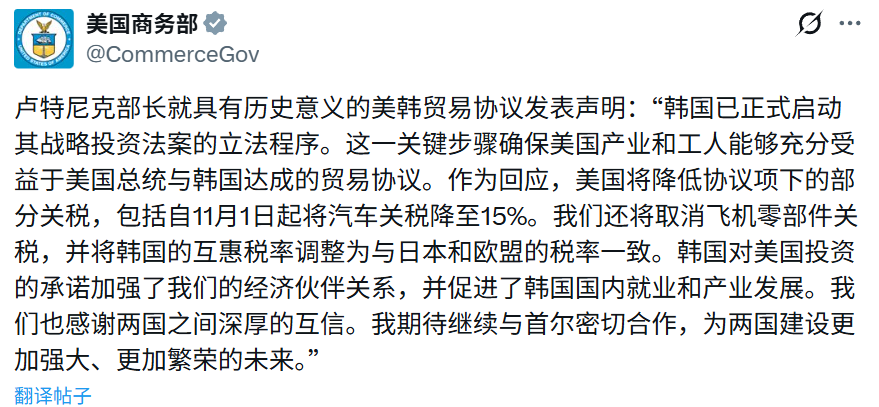
印媒:美贸易谈判代表团取消访印,双方重启谈判具体时间未知
Huan Qiu Wang· 2025-08-17 02:43
Core Points - The scheduled trade negotiation delegation from the U.S. to New Delhi from August 25 to 29 has been canceled, potentially delaying the next round of bilateral trade agreement talks [1] - Despite ongoing communication between the two countries, a specific timeline for resuming negotiations has not been established [1] - The cancellation casts doubt on the previously agreed timeline to finalize the first part of the trade agreement by September to October [1] Group 1 - The U.S. trade negotiation delegation was expected to meet around August 27, indicating the importance of this round of talks [1] - Indian government officials have stated that they are advancing the bilateral trade agreement negotiations through multiple channels, emphasizing the significance of the U.S. as a trade partner [1] - In late July, President Trump announced a 25% tariff on goods imported from India, citing high tariffs, trade barriers, and cooperation with Russia as reasons [1] Group 2 - Trump also signed an order imposing an additional 25% tariff on Indian imports due to India's purchase of oil from Russia, with sanctions set to take effect on August 27 [1]
X @外汇交易员
外汇交易员· 2025-08-04 03:21
US-India Relations - The US administration's attitude towards India has shifted from praising it as a key strategic partner to expressing indifference towards its economic stability [1] - Initial enthusiasm for a bilateral trade agreement waned due to a lack of progress in negotiations [1] - The US President is reportedly frustrated with the slow pace of trade talks with New Delhi [1] Trade Negotiations - Efforts to quickly reach a bilateral trade agreement between the US and India have failed [1]
刚刚!特朗普宣布:25%关税!直线跳水
Zhong Guo Ji Jin Bao· 2025-07-30 13:38
Core Points - Trump announced a 25% tariff on India starting August 1, citing high tariffs and non-tariff trade barriers as reasons for the decision [1][2] - The announcement comes as a setback for India, which had hoped for preferential treatment following negotiations with the U.S. earlier this year [1] - Despite the tariff threat, Indian officials plan to continue negotiations for a bilateral trade agreement with the U.S. before autumn [2] Group 1 - Trump criticized India's tariffs as among the highest globally and mentioned India's significant military purchases from Russia [1] - The tariff announcement coincides with Trump's broader strategy to impose tariffs on countries purchasing Russian exports, including oil [2] - The Indian currency experienced a sharp decline following the news of the tariff announcement [2] Group 2 - The U.S. is India's largest trading partner, with bilateral trade expected to reach $127.9 billion in 2024 [2] - Earlier this year, India attempted to negotiate a limited trade agreement with the U.S. during Trump's first term but was unsuccessful [2] - The initial framework for trade negotiations was established in April, following a meeting between U.S. Vice President and Indian Prime Minister [2]
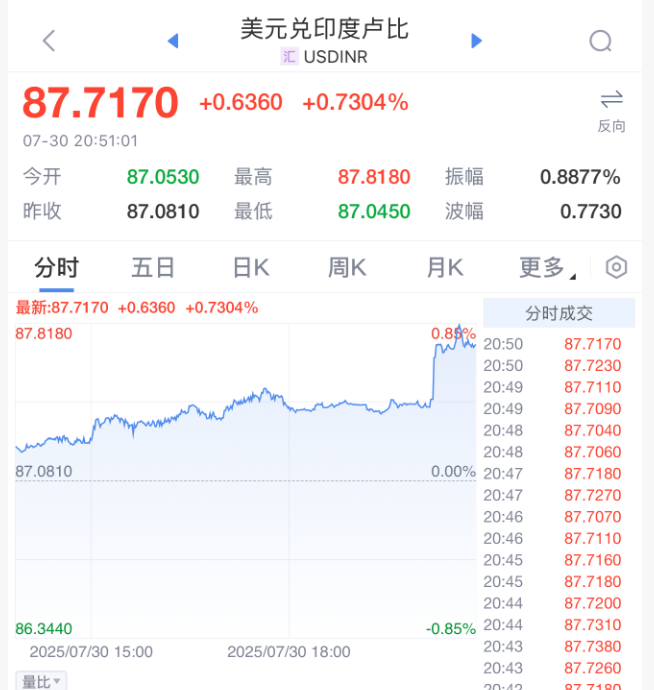
印度据悉仍致力于秋季之前与美国达成双边贸易协议
news flash· 2025-07-30 09:41
Core Viewpoint - India is reportedly committed to negotiating a bilateral trade agreement with the United States before autumn, despite potential tariffs proposed by President Donald Trump [1] Group 1: Trade Agreement Negotiations - Indian officials plan to continue discussions with the U.S. on a bilateral trade agreement this fall [1] - The negotiations are ongoing despite the threat of tariffs exceeding 25% on Indian exports [1] Group 2: Impact of Tariffs - Internal estimates indicate that if tariffs over 25% are imposed, approximately 10% of India's exports could be affected during the July to September period [1] - Sectors such as electronics, gems, and jewelry are expected to be significantly impacted by these potential tariffs [1]
印度旨在秋季前与美国达成贸易协议
news flash· 2025-07-30 08:56
Core Viewpoint - India aims to reach a trade agreement with the United States before the fall, despite recent tariff increases announced by President Trump [1] Group 1: Trade Negotiations - Indian officials plan to continue negotiations with the U.S. regarding a bilateral trade agreement, targeting completion by this fall [1] - There is a sense of pessimism regarding the possibility of reaching a temporary agreement before the higher U.S. tariffs take effect on August 1 [1] Group 2: Impact of Tariffs - If India faces higher import tariffs this week, it will view any temporary agreement as a transitional measure until a broader bilateral agreement is finalized in the fall [1]
美国前驻APEC大使:尽管特朗普对关税“情有独钟”,但他知道其他人并不喜欢
Sou Hu Cai Jing· 2025-07-02 15:04
Group 1 - The podcast "Pacific Polarity" features Kurt Tong discussing the evolution of U.S. foreign policy in Asia, particularly regarding tariffs and trade agreements [1][2] - Kurt Tong predicts that the U.S. will engage in multiple bilateral trade agreements this year, as the desire to maintain high tariffs has diminished due to public discontent and inflation concerns [2][5] - The U.S. remains a major source of foreign direct investment and technology, but there is a political contradiction regarding overseas investments by American companies [4][5] Group 2 - There is a growing political focus on the need for more domestic manufacturing in the U.S., especially in traditional industries, as voters in key regions are affected by the decline of manufacturing jobs [5][6] - The perception that companies are "exporting jobs" overseas creates a political dilemma, as there is a desire to keep manufacturing in the U.S. despite potential cost implications [5][6] - The current political environment is pushing for a reevaluation of trade and investment policies, influenced by protectionist sentiments and the desire to bring jobs back to America [5][6]
印度贸易部官员:印度与美国的双边贸易协议谈判正在取得进展,双方坚持在2025年秋季之前签署协议的时间表。
news flash· 2025-06-16 09:18
Group 1 - The core viewpoint is that negotiations for a bilateral trade agreement between India and the United States are making progress, with both parties aiming to sign the agreement by the fall of 2025 [1]
降关税谈判可仿英国模式 加美两周内盼达协议
Sou Hu Cai Jing· 2025-06-03 05:52
Group 1 - The Ontario trade representative David Paterson indicated that there is a possibility of progress in negotiations to lower high tariffs with the U.S. during the upcoming G7 summit in two weeks [2] - Paterson expressed hope for a meeting between President Trump and Prime Minister Mark Carney at the G7 summit to achieve further results on tariff reductions [2] - Despite a temporary court ruling blocking the Trump administration's emergency order to normalize tariffs, trade negotiations are ongoing [2] Group 2 - The recent court ruling does not affect tariffs on steel, aluminum, and automotive industries, which are crucial to Ontario's economy [3] - Paterson emphasized the need for Canada to solidify its position as a key trade partner with the U.S. in the short term, as other countries are also competing for bilateral trade agreements [4] - Countries like Japan, South Korea, the UK, the EU, and Vietnam are actively seeking bilateral agreements with the U.S. [6] Group 3 - The UK has reached a framework trade agreement with the U.S., serving as a model and motivation for Canada to secure its own advantageous agreements [6] - Paterson highlighted that tariffs on British-made cars entering the U.S. are lower than those on Chevrolet produced in Ontario, indicating a need for Canada to achieve more progress [6] - As a signatory of the CUSMA agreement, Canada should receive preferential treatment in the U.S. market [6] Group 4 - Paterson's role includes conveying to the Trump administration the importance of Canada as a major trade partner, as trade volumes between U.S. states and Canada exceed those with any other country [6] - A recent visit by a U.S. Senate delegation to Ottawa, led by North Dakota Republican Senator Kevin Cramer, exemplifies the recognition of Canada's significance by U.S. officials [6] - It is acknowledged that the U.S. should prioritize reducing tariffs on Canada to inject certainty into the economy [7]