多边央行数字货币桥

Search documents
深圳开立数字人民币钱包近3000万个 多个运用场景创新落地
Bei Ke Cai Jing· 2025-10-24 12:16
Core Insights - The People's Bank of China Shenzhen Branch reported significant growth in digital RMB adoption, with nearly 30 million digital wallets opened and over 2 million merchants accepting digital RMB as of September 2025 [1] - The total transaction amount for digital RMB in Shenzhen reached nearly 180 billion yuan, an increase of 40 billion yuan since the beginning of the year [1] Group 1: Digital RMB Wallets and Transactions - As of September 2025, Shenzhen has opened nearly 30 million digital RMB wallets, an increase of approximately 1.5 million since the start of the year [1] - The cumulative transaction amount for digital RMB reached nearly 180 billion yuan, with an increase of 40 billion yuan from the beginning of the year [1] Group 2: Innovative Applications and Use Cases - Shenzhen has implemented innovative applications for digital RMB, including the first digital RMB car insurance payment and direct salary payments to workers' digital wallets [1] - The Industrial and Commercial Bank of China Shenzhen Branch has created a closed loop for loans using digital RMB, providing tailored financing solutions for businesses [1] Group 3: Prepaid Business Management and Cross-Border Applications - Shenzhen has pioneered a prepaid business management service model, signing contracts with nearly 5,000 merchants and managing funds of nearly 4.7 billion yuan [2] - The region is exploring the applicability of a multilateral central bank digital currency bridge in cross-border transactions, with total business amounts exceeding 10 billion yuan [2]

从“美元潮汐”到“人民币暖流”:中国金融强国建设的“五把钥匙”
Guo Ji Jin Rong Bao· 2025-09-29 10:45
Core Viewpoint - The article highlights the shift in global financial governance from dominance by sovereign currencies to the provision of safer, lower-cost, and inclusive cross-border payment solutions, exemplified by the contrasting experiences of digital RMB and traditional currency exchanges [1]. Group 1: Trade Scenarios - The strategy focuses on creating a "RMB circle" by facilitating direct currency exchanges with countries related to the Belt and Road Initiative, aiming for 100% mutual currency settlement accounts with ASEAN countries by the end of 2025 [2]. - The implementation of simplified tools for small and medium enterprises (SMEs) has significantly reduced transaction times from 3 days to 2 minutes, enhancing efficiency and reducing costs [2]. Group 2: Fiscal Incentives - A fiscal incentive program offering a 0.3% reward on RMB settlements for SMEs is projected to cost 12 billion yuan annually but could stimulate 2 trillion yuan in trade, effectively lowering costs for businesses [3]. Group 3: Bond Market Development - The expansion of foreign market makers in the bond market from 46 to 100 by the end of 2025 aims to enhance liquidity and reduce transaction costs, with the first foreign market maker already demonstrating improved pricing [4]. - The introduction of long-term interest rate hedging products, such as 10-year government bond options and green CDS, is expected to attract foreign investment and mitigate credit risk [5]. Group 4: Offshore Financial Regulation - The establishment of integrated offshore accounts in Shanghai aims to streamline cross-border transactions while maintaining regulatory oversight, with significant reductions in transaction fees [6]. - The collaboration between Shanghai and Hong Kong to create a unified bond yield curve is set to enhance the pricing benchmark for RMB bonds in Asia [7]. Group 5: Capital Flow Management - The implementation of a macro-prudential adjustment fee for excessive capital inflows and outflows is designed to stabilize the market and reduce volatility [8]. - The use of AI for early warning systems in capital flows has proven effective in preventing potential financial risks [9]. Group 6: Rule-Making and International Cooperation - The establishment of a CBDC international alliance aims to facilitate cross-border digital currency transactions, with significant cost reductions compared to traditional methods [10]. - The proposal for IMF reform to increase the SDR weight of the RMB is gaining support among emerging economies, indicating a shift towards a more multipolar financial system [11]. Group 7: Overall Financial Strategy - The article concludes that the future of global finance will not be dominated by the RMB replacing the USD, but rather a coexistence of multiple currencies, with the RMB emerging as a regional leader in Asia and Africa [12][13].
金融机构积极探索数字人民币跨境支付
Zheng Quan Ri Bao· 2025-09-15 16:08
Core Viewpoint - The National Internet Information Office has released a draft regulation to promote and standardize the application of electronic documents, encouraging financial institutions to explore the use of digital RMB for cross-border payments under legal and risk-controlled conditions [1] Group 1: Digital RMB Cross-Border Payment Developments - Financial institutions are actively exploring the application of digital RMB in cross-border scenarios, with notable transactions occurring in Chongqing and Shenzhen [1] - In September, the first bilateral cross-border settlement using digital RMB between China and Singapore was successfully executed [1] - In March, a cross-border capital pool transaction involving 637 million RMB was completed in Shenzhen [1] Group 2: Advantages of Digital RMB - Digital RMB cross-border settlement offers efficiency, security, and low costs, enhancing corporate cross-border settlement efficiency and reducing payment costs [2] - The use of digital RMB is expected to broaden cross-border fund clearing channels and promote the internationalization of the RMB [2] Group 3: Supportive Policies and Strategic Opportunities - Numerous supportive policies have been introduced this year to facilitate the development of digital RMB in cross-border areas [3] - Financial institutions are encouraged to explore new payment methods and participate in the construction of a multilateral central bank digital currency bridge, presenting strategic opportunities to enhance international competitiveness [3][4] - The future digital RMB cross-border ecosystem is expected to transition from pilot programs to normalization, providing a Chinese standard for global trade digitization [4]
数字人民币创新应用亮点频现
Jing Ji Wang· 2025-09-04 02:31
Core Viewpoint - The digital renminbi is rapidly integrating into various sectors of the Chinese economy, enhancing payment systems and transaction efficiency, thereby injecting new momentum into the real economy [1]. Group 1: Progress and Achievements - In the first half of 2025, significant progress was made in the digital renminbi pilot program across various provinces, with notable increases in transaction volume, wallet openings, and application scenarios [3][5]. - Suzhou has emerged as a leading city in the digital renminbi pilot, with 31.04 million personal wallets and 1.041 million corporate wallets opened, and a transaction amount of 2.15 trillion yuan, marking a 67.07% increase year-on-year [3]. - By the end of June 2025, Guangdong province had opened 44.9 million personal wallets, with a total transaction volume of 157.6 billion yuan, leading the nation in transaction counts [5]. Group 2: Application Innovations - The digital renminbi is witnessing continuous innovation in application scenarios, particularly in cross-border payments, with various banks actively participating in the "central bank digital currency bridge" projects [6][7]. - Notable transactions include a 68 million yuan cross-border trade payment in Shenzhen, showcasing the efficiency of real-time settlement compared to traditional systems [7]. - As of June 2025, Chongqing has issued over 100 million yuan in digital renminbi consumption red packets, covering over 20 sectors, indicating the growing acceptance and application of digital currency [7]. Group 3: Future Directions - The focus for the second half of 2025 will be on deepening pilot programs and enriching application scenarios, with a consensus among various central bank branches to enhance infrastructure and promote digital renminbi applications [8]. - The People's Bank of China emphasizes the need for a strategic shift from expanding scenarios to deepening applications in key areas such as cross-border payments and smart contracts [2][8].

苏、粤领跑!数字人民币试点迈入新阶段
券商中国· 2025-09-04 01:57
Core Viewpoint - The digital RMB is rapidly integrating into various sectors of the Chinese economy, enhancing payment systems and transaction efficiency, while becoming a focal point for future applications and pilot programs [1] Group 1: Digital RMB Pilot Progress - By mid-2025, significant progress has been made in the digital RMB pilot across various provinces, with Jiangsu and Guangdong leading in transaction volume and wallet openings [2][3] - Suzhou has opened 3,104.63 million personal wallets and 104.11 million corporate wallets, with a transaction amount of 2.15 trillion yuan in the first half of the year, marking a 67.07% increase year-on-year [2] - As of July, Suzhou's digital RMB balance reached 77.3 billion yuan, accounting for 30% of the national total [2] Group 2: Application Innovations - The digital RMB is seeing innovative applications, particularly in cross-border payments, with banks like Bank of Communications and Industrial and Commercial Bank of China actively participating [4][5] - In Shenzhen, a significant cross-border trade payment of 68 million yuan was completed using the digital RMB, showcasing real-time settlement capabilities [5] - Chongqing has issued over 100 million yuan in digital RMB consumption red envelopes, covering various sectors [5] Group 3: Future Directions and Consensus - Industry analysts emphasize the need to combine the authority of legal currency with the flexibility of application scenarios to maximize the value of digital RMB [6] - The People's Bank of China is focusing on deepening pilot programs and expanding application scenarios, with various local branches outlining plans for infrastructure and cross-border applications [6][7] - Recent government initiatives in Shanghai and Shandong aim to enhance cross-border financial services and promote the use of digital RMB in consumer subsidies [7]

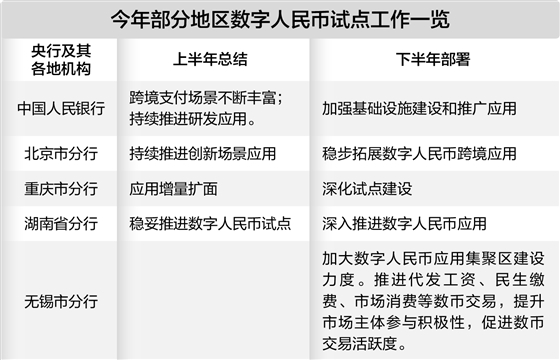
从“场景拓宽”迈向“场景深耕” 数字人民币创新应用亮点频现
Sou Hu Cai Jing· 2025-09-03 21:26
Core Insights - The digital RMB is rapidly integrating into various sectors of the Chinese economy, enhancing payment systems and transaction efficiency, thereby injecting new momentum into the real economy [1] Group 1: Central Bank and Regional Initiatives - The People's Bank of China (PBOC) and its branches are focusing on expanding the pilot programs for digital RMB in the second half of 2025, emphasizing infrastructure development and application promotion [2][7] - Various regional branches, such as those in Beijing, Chongqing, and Wuxi, are committed to deepening pilot construction and expanding application scenarios for digital RMB [1][7] Group 2: Performance Metrics and Adoption - By mid-2025, significant growth in digital RMB usage has been reported, with Suzhou leading in wallet openings and transaction volumes, totaling 2.15 trillion yuan, a 67.07% increase year-on-year [3] - In Nanjing, 575.6 million personal wallets and 31.8 million corporate wallets have been opened, with nearly 180,000 merchants supporting digital RMB payments [4] - Guangdong province has opened 44.9 million personal wallets, with 1.576 billion yuan transacted across 620,000 merchants, ranking first in transaction volume [4] Group 3: Innovation in Application Scenarios - The digital RMB is seeing innovative applications in cross-border payments, with banks like Bank of Communications and Agricultural Bank of China facilitating transactions through the mBridge platform [5][6] - Notable transactions include a 68 million yuan cross-border trade settlement in Shenzhen, showcasing the efficiency of real-time transactions compared to traditional systems [6] Group 4: Future Directions and Challenges - Analysts suggest that the focus will shift from expanding scenarios to deepening applications in key areas such as cross-border payments and smart contracts [2][7] - Despite challenges like user habit formation and cross-border interoperability, the integration of digital RMB with flexible application scenarios is seen as crucial for maximizing its value [7]
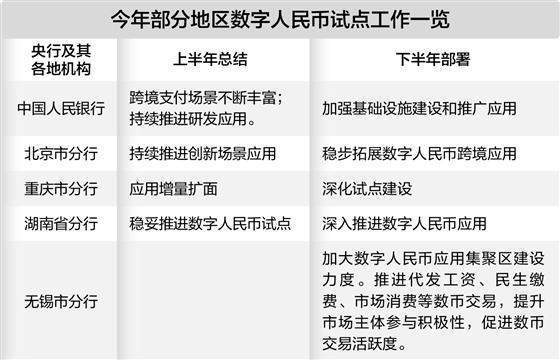
从“场景拓宽”迈向“场景深耕”数字人民币创新应用亮点频现
Zheng Quan Shi Bao· 2025-09-03 18:24
Core Insights - Digital RMB is rapidly integrating into various sectors of the Chinese economy, enhancing payment systems and transaction efficiency [1] - The People's Bank of China (PBOC) is prioritizing the expansion of digital RMB trials and applications in its 2025 work plan [1] - The shift from infrastructure development to deep application and ecosystem building marks a new phase for digital RMB [1] Group 1: Pilot Progress and Statistics - By mid-2025, significant progress has been made in the digital RMB pilot across various provinces, with Jiangsu and Guangdong leading in transaction volume and wallet openings [2][3] - Suzhou has opened 31.05 million personal wallets and 1.041 million corporate wallets, with a transaction amount of 2.15 trillion yuan in the first half of 2025, a 67.07% increase year-on-year [2] - As of late July, Suzhou's digital RMB balance reached 7.73 billion yuan, accounting for 30% of the national total [2] Group 2: Application Innovations - The digital RMB's application in cross-border payments is gaining traction, with banks like Bank of Communications and Hangzhou Bank actively participating [4][5] - The Bank of Communications in Shanghai has completed cross-border remittance services using digital RMB, with a cumulative transaction amount of 4.962 billion yuan by August 2025 [4] - In Shenzhen, a significant cross-border trade payment of 68 million yuan was settled using the digital RMB, showcasing real-time transaction capabilities [5] Group 3: Future Directions and Challenges - Industry analysts emphasize the need to combine the authority of legal currency with the flexibility of application scenarios to maximize the value of digital RMB [6] - The consensus among central bank branches is to deepen pilot projects and enrich application scenarios for digital RMB [6] - Recent government initiatives in Shanghai and Shandong highlight the push for expanding digital RMB applications in various sectors, including consumer subsidies [7]
疆内首笔港币多边央行数字货币桥业务落地
Sou Hu Cai Jing· 2025-08-18 08:48
Group 1 - The core viewpoint of the news is that the Industrial and Commercial Bank of China (ICBC) Xinjiang Branch successfully executed the first cross-border payment of dividends in Hong Kong dollars using the multi-central bank digital currency bridge platform, enhancing the application scenarios of digital currency in Xinjiang [1] - The multi-central bank digital currency bridge platform was jointly established by several financial institutions, including the Bank for International Settlements (Hong Kong), the Central Bank of Thailand, the Central Bank of the UAE, the Digital Currency Research Institute of the People's Bank of China, and the Hong Kong Monetary Authority, facilitating cross-border payments in multiple currencies with advantages such as fast settlement, low costs, and enhanced security [1] - To meet the growing demand for diversified and efficient cross-border payment services from enterprises in Xinjiang, ICBC Xinjiang Branch formed a dedicated digital currency bridge service team in April last year, which tailored service plans for clients and established a comprehensive service system covering the entire business process [1] Group 2 - The continuous promotion of the multi-central bank digital currency bridge business is an important measure for ICBC Xinjiang Branch to serve the real economy and support the development of Xinjiang's outward-oriented economy [2] - ICBC Xinjiang Branch plans to increase resource investment in the cross-border financial sector, explore the application potential of the digital currency bridge business, and expand more diverse business scenarios to provide more efficient and comprehensive cross-border financial services for "going out" enterprises [2]

管涛:稳定币在货币体系中将扮演何种角色仍待观察
Sou Hu Cai Jing· 2025-07-24 12:57
Core Viewpoint - The U.S. has officially regulated stablecoins through the "Genius Act," while China continues to promote its central bank digital currency (CBDC) initiative, highlighting differing approaches to digital currency regulation and innovation [1][2]. Group 1: Stablecoins and Regulation - The "Genius Act" signed by President Trump incorporates stablecoins into regulatory frameworks, reflecting a growing focus on stablecoins in the market [1]. - Stablecoins are defined as cryptocurrencies pegged to fiat currencies or assets, which aim to enhance cross-border payment efficiency and user experience [1]. - According to the Bank for International Settlements, stablecoins have not met the key requirements for a robust international monetary system, suggesting their future role may be limited to a supportive function [1]. Group 2: China's Digital Currency Initiatives - As of July 2024, the digital yuan has been implemented in 26 pilot areas across 17 provinces, with 180 million personal wallets opened and a total transaction volume of 7.3 trillion yuan [2]. - China is a founding member of the "Multi-Central Bank Digital Currency Bridge" project, which aims to enhance cross-border payment scenarios using blockchain technology [2]. - The project has transitioned from sandbox testing to formal operations, involving multiple central banks and commercial banks across various jurisdictions [2]. Group 3: Cross-Border Payment Innovations - Third-party payment institutions in China have made significant advancements in cross-border payments since the pilot program began in September 2013, enabling 24/7 rapid transactions [2]. - The "Cross-Border Payment Link" launched in June 2023 connects mainland China's online payment systems with Hong Kong's rapid payment system, improving transaction efficiency and reducing costs [4]. - There is an openness to exploring stablecoin payment tools, with a focus on leveraging their advantages while ensuring compliance and fostering competition in the cross-border payment sector [4].
14.16万亿元!深圳重磅发布!
中国基金报· 2025-07-22 07:56
Core Insights - As of June 2025, the total balance of various deposits in Shenzhen reached 14.16 trillion yuan, an increase of nearly 600 billion yuan since the beginning of the year [1] - The balance of various loans in Shenzhen reached 9.85 trillion yuan, with an increase of over 350 billion yuan since the beginning of the year [1] - The balance of loans to the private economy in Shenzhen reached 4.26 trillion yuan, with a new addition of 849.75 billion yuan [1] Financial Innovations - The scale of technology innovation bonds (referred to as "科创债") reached 20.75 billion yuan, with 14 bonds issued by 9 enterprises including major tech firms [3] - The People's Bank of China Shenzhen Branch has facilitated the issuance of technology innovation bonds, providing a model for financial support in the tech sector [3] - In the first half of 2025, 102 enterprises signed agreements for "腾飞贷" totaling 3.6 billion yuan, while "科技初创通" helped 3,761 enterprises secure loans amounting to 4.84 billion yuan [3] Cross-Border Transactions - In the first half of 2025, the number of foreign card transactions via WeChat Pay increased by 1.6 times, with nearly 2 million foreign users binding their cards [5] - Foreign personnel in Shenzhen conducted 85.8754 million non-cash payment transactions totaling 11.81 billion yuan, marking increases of 29% and 35% respectively [5] - The cross-border RMB payment amount reached 27.6328 trillion yuan, a year-on-year increase of 24.3%, with goods trade accounting for 5.5128 trillion yuan of this total [6] Digital Finance Development - The Shenzhen local credit platform launched over 50 credit products, enabling enterprises to secure financing of 574.4 billion yuan [8] - The digital RMB pilot program has seen nearly 30 million digital wallets opened, with pre-paid funds management reaching nearly 3.1 billion yuan [8] - Shenzhen is advancing the application of a multi-central bank digital currency bridge in cross-border transactions, successfully executing the first transaction involving "bulk commodity trading + multi-central bank digital currency bridge" [8]