
宏观经济回暖

Search documents
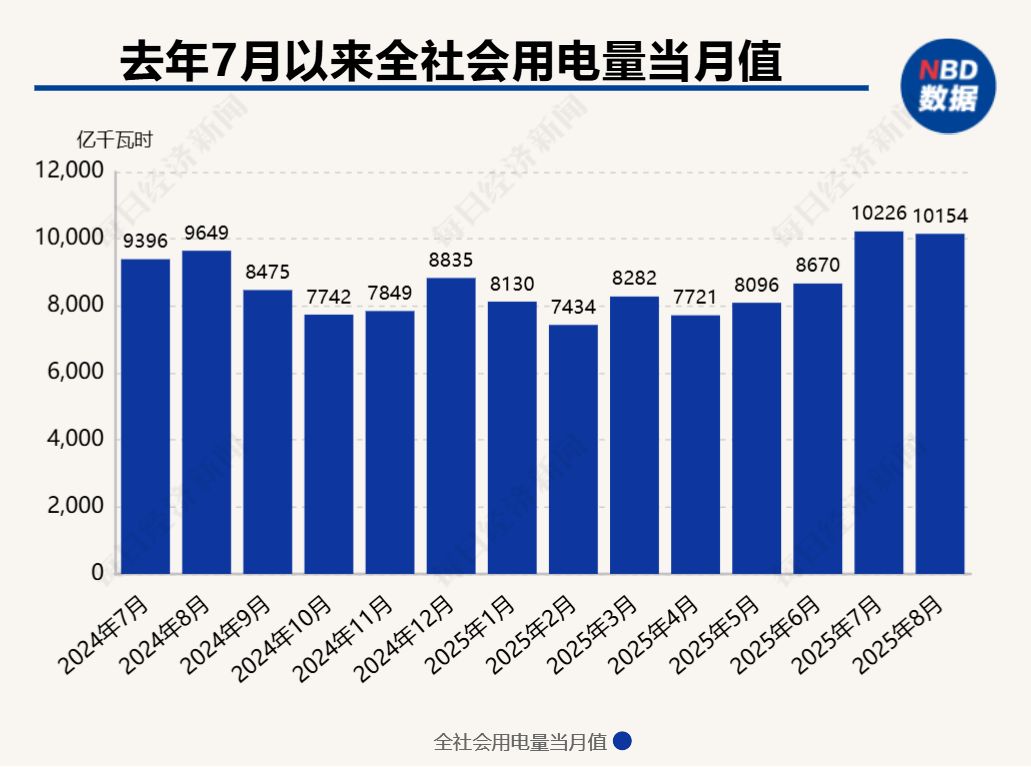
10154亿千瓦时!8月全社会用电量连续第二个月破万亿 制造业用电量同比增速创年内新高
Mei Ri Jing Ji Xin Wen· 2025-09-23 16:16
Core Insights - In August, China's total electricity consumption reached 10,154 billion kilowatt-hours, marking a year-on-year increase of 5.0% [1][3] - The total electricity consumption exceeded 10 trillion kilowatt-hours for two consecutive months (July and August), setting a global record [1][3] - The growth in electricity consumption is attributed to high summer temperatures and supportive government policies aimed at stabilizing industrial growth [1][3] Electricity Consumption Data - In August, the electricity consumption in the manufacturing sector grew by 5.5%, the highest monthly growth rate of the year [1][3] - The total electricity consumption from January to August reached 68,788 billion kilowatt-hours, with a year-on-year increase of 4.6% [5] - The first industry saw a significant increase in electricity consumption, with a total of 1,012 billion kilowatt-hours, reflecting a growth rate of 10.6% [5][7] Sector Performance - The second industry had a total electricity consumption of 43,386 billion kilowatt-hours, but only a 3.1% year-on-year growth [5][8] - High-tech and equipment manufacturing sectors demonstrated strong resilience, with a combined electricity consumption growth of 9.1%, surpassing the average manufacturing growth rate by approximately 4.6 percentage points [4] - The new energy vehicle manufacturing and photovoltaic industry also showed rapid growth, contributing to the overall increase in electricity consumption [4] Third Industry Growth - The third industry continued its rapid growth, with electricity consumption reaching 13,297 billion kilowatt-hours, reflecting a year-on-year increase of 7.7% [5][10] - The electricity consumption in the third industry has been a significant contributor to the overall growth in electricity demand [10]

口子窖(603589):控货稳价业绩承压,静待需求复苏
Orient Securities· 2025-08-22 15:16
Investment Rating - The report maintains a "Buy" rating for the company with a target price of 37.91 CNY based on a 17x P/E ratio for 2025 [3][6][10]. Core Views - The company's performance is under pressure due to controlled inventory and pricing strategies, with a wait for demand recovery amid a weak macroeconomic environment [2][9]. - Revenue and gross margin forecasts for 2025-2026 have been revised downwards, with expected earnings per share of 2.23 CNY and 2.16 CNY for 2025 and 2026 respectively [3][10]. - The company is experiencing a significant decline in revenue and net profit in Q2 2025, attributed to economic weakness and inventory control measures [9][10]. Financial Summary - Revenue for 2025 is projected at 4,929 million CNY, a decrease of 18.0% year-on-year, with a slight recovery expected in 2027 [5]. - Gross margin is expected to decline to 73.4% in 2025, reflecting pressures from product mix and pricing [5][10]. - The net profit attributable to the parent company is forecasted to be 1,337 million CNY in 2025, down 19.2% from the previous year [5][10]. Performance Metrics - The company reported a net profit margin of 27.1% for 2025, down from 28.9% in 2023 [5]. - The return on equity (ROE) is expected to decrease to 12.3% in 2025, indicating a decline in profitability [5]. - The company's market capitalization is approximately 21,173 million CNY, with a total share count of 59,812 million shares [6].

宝城期货贵金属有色早报-20250728
Bao Cheng Qi Huo· 2025-07-28 01:37
Report Summary 1) Report Industry Investment Ratings - There is no specific industry - wide investment rating provided in the report 2) Core Views - For gold, the short - term view is bearish, the medium - term view is sideways, and the intraday view is sideways - bearish. The core logic is that the US has reached tariff agreements with other countries, leading to a rise in market risk appetite and pressure on gold prices [1][3] - For copper, the short - term view is bullish, the medium - term view is bullish, and the intraday view is sideways - bullish. After the market digested the impact of US tariffs, the recovery of the global macro - economy pushed up copper prices [1][4] 3) Summary by Related Catalogs Gold - **Price Movement**: Last week, the gold price showed an inverted V - shaped trend. The New York gold price hit the $3450 mark in the first half of the week and then fell below $3350 in the second half [3] - **Core Logic**: Market concerns about the US tariff deadline on August 1st and the Fed's interest - rate meeting at the end of July led to the early - week price increase. However, positive trade signals at the end of July reduced trade policy uncertainty, increased market risk appetite, and pressured gold prices. Currently, gold is at a low level since the second quarter, and the $3300 mark's long - short battle can be watched [3] Copper - **Price Movement**: Last week, the copper price also rose first and then fell. After the market digested the impact of US tariffs, the copper price rebounded with the global macro - economic recovery. The Shanghai copper price hit the 80,000 yuan mark, and the London copper price approached $10,000. In the second half of the week, due to increased long - short divergence in the domestic market and strong willingness of copper bulls to close positions, the copper price decreased significantly [4] - **Core Logic**: The inventory of electrolytic copper is low in China and high abroad, and the pattern of stronger domestic and weaker overseas copper prices may continue. The domestic downstream is in the off - season, inventory depletion has slowed down, and with the continuous improvement of macro - expectations, the futures price may maintain a pattern of near - term weakness and long - term strength. Short - term attention can be paid to the long - short battle at the 79,000 yuan mark of Shanghai copper [4]